
Back in 2020 I penned an article about George Auger, the ‘tallest man on earth’ who had been born in Temperance Town, in the centre of Cardiff.
Temperance Town is no longer there. It was demolished in the 1930s and few people now will have first-hand memories of it. The land was then used for Cardiff Bus Station which wasn’t built until after WWII and in more recent years has been replaced by Central Square and the BBC building.

The five streets of terraced housing stood directly in front of Cardiff station, where the BBC building now stands. It was constructed in 1860.

The area used to be known as the Bulwarks (see 1859 newspaper cutting).

The land is reclaimed land resulting from the River Taff being straightened. But where do the street names originate from? I’ve been doing some research and these are my thoughts:
Wood Street: The land on which Temperance Town was built was owned by Colonel Edward Wood and hence Wood Street was probably named after him. A lot of modern references, including Wikipedia, state that Temperance Town was so named because Wood was a teatotaller and supporter of the Temperance Movement. I’ve found no historic reference linking Colonel Edward Wood to the temperance movement. I think people have probably been getting him mixed up with Jacob Scott Matthews, the land developer, who was the teatotaller (see below)

Scott Street: The developer of the area was Jacob Scott Matthews who leased land from Colonel Wood and completed the project by about 1864. Around 1860 Mathews authorised the tipping of huge quantities of rubbish onto this land, streets were laid out, and very soon a new suburb had been created. He was also a staunch advocate of temperance (not drinking alcohol) and would not allow any public house to be built in Temperance Town (see newspaper cutting). On the outskirts of Temperance Town was a large Music Hall for which J S Matthews held the licence.


Jacob Scott Matthews was born in Cardiff in 1817. He married Elizabeth Brown in Bristol in 1847. Jacob Scott Matthews took over his father Samuel Matthews successful nursery in 1847 developing it into the premier nursery in Cardiff. It was to Jacob that JH Insole turned for the trees, for the initial planting of Ely Court (Insole Court). Jacob and Elizabeth lived at Station Terrace near the Taff Vale railway station.
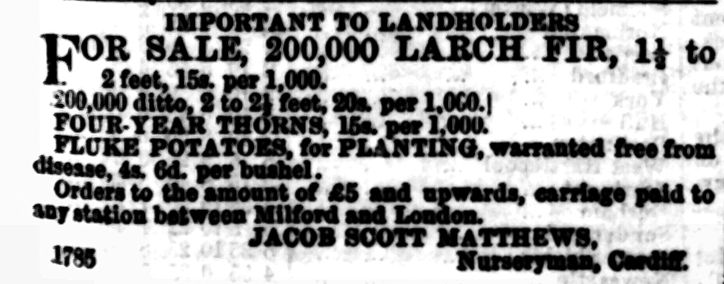
It appears he was a multifaceted individual. As wall as being a nurseryman and property developer he also filed patents. After Temperance Town was developed Scott and Elizabeth Matthews moved to Penarth. Jacob Scott Matthews died in 1880 is buried at Cathays Cemetery (plot M372) in what appears to be an unmarked grave or one where the headstone has been removed.
Gough Street: Thought to be named after John Bartholomew Gough, a famous temperance movement speaker of the time who came to Cardiff and delivered a powerful speech. Gough was born in Kent but sent to America at the age of 12 to learn a trade which he never did. Instead he ended up a heavy drinker in New York. He became a convert of the Temperance Movement and toured the world lecturing. His story is told in The Cambrian newspaper in 1879.


On some old maps part of Gough Street sometimes appears labelled as Raven Street. I haven’t yet found out the origin of that name.
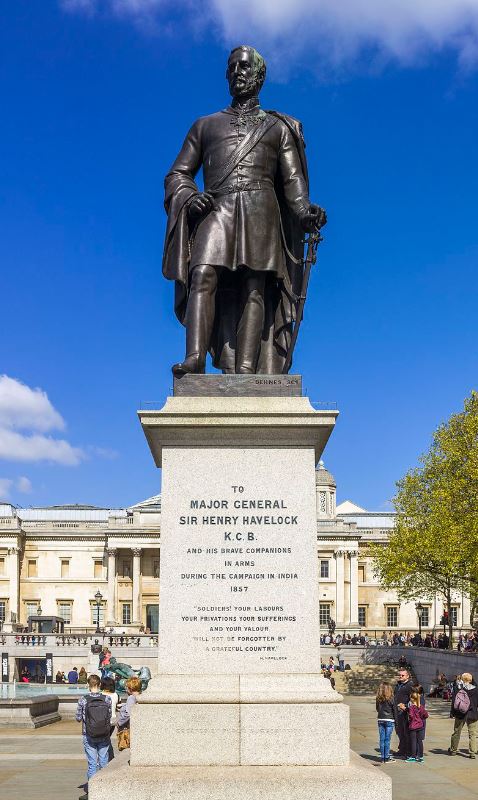
Havelock Street: Probably named after the army temperance advocate Sir Henry Havelock. He was a strong advocate of the temperance movement. Following his death in 1859 (just as Temperance Town was being built) the ‘Havelock Cross’ medal was founded which was awarded to soldiers for seven years’ temperance. There is also reference to a temperance club formed in the army called the Havelock’s Saints.
From ‘Watch and Be Sober’: The story of Army temperance:-
One of the earliest Army temperance societies was established in Burma by Lieutenant (later General Sir) Henry Havelock of the 13th Regiment in 1823. Its members were dubbed ‘Havelock’s Saints’. Indeed, his wife’s family were missionaries and this religious zeal no doubt inspired him to begin bible classes for his soldiers. On becoming adjutant of the 13th in India in 1839, he formed the first regimental temperance society.
Havelock later died of disease during the Indian Mutiny (1857-59), but was commemorated by the Army Temperance Society with the ‘Havelock Cross’, awarded for seven years’ temperance. Many regimental temperance societies were subsequently formed in India, numbering over 50 by 1850.
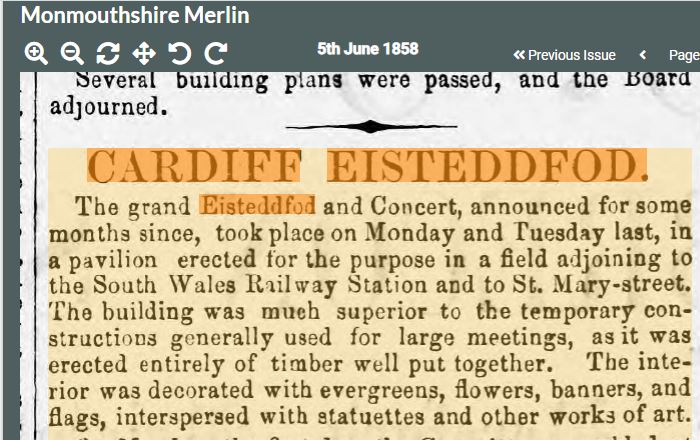
Eisteddfod Street: Named after the Cardiff Eisteddfod that was held there in 1858 – see newspaper cutting. (Note that the National Eisteddfod of Wales didn’t start until 1961).
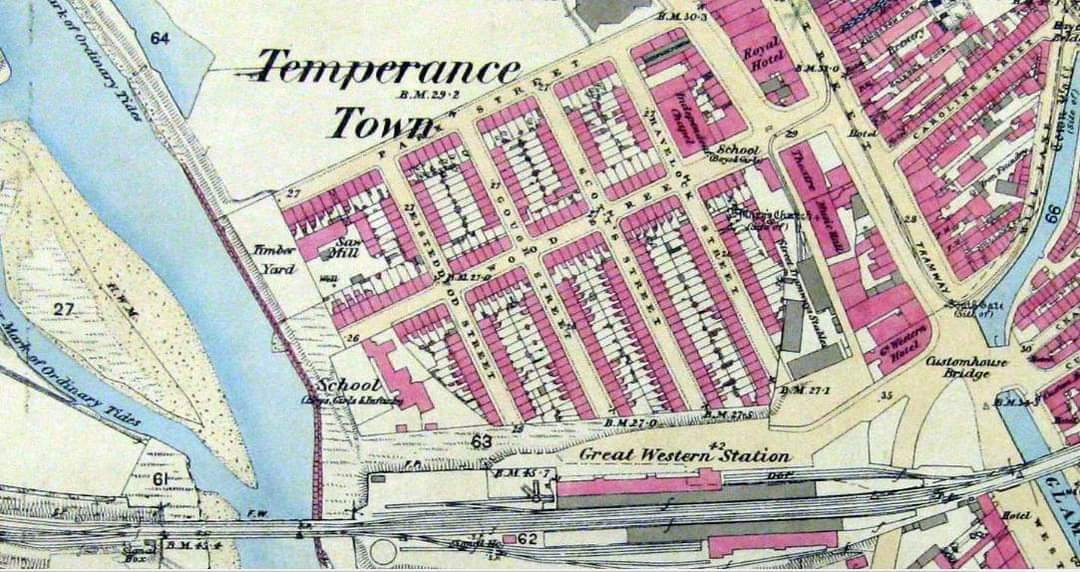
A good history of Temperance Town can be found on the Abandoned Communities website.
 Roath Local History Society
Very interesting article, recalling some historic names associated with Cardiff. It is sad there is now no reference to, or legacy of, this important 19th century social movement in the redeveloped Central Square. The name itself is so bland and utilitarian. Why not Havelock Square?
I wonder too whether the planners in any Continental city would have dumped huge architectually arid, undistinguished blocks, especially the monolithic BBC building, in front of the main entrance for visitors to the city through the station. It just looks a complete jumble from whatever angle you approach. This fine art deco building – now completely overshadowed – rightly appears in Simon Jenkins’ list of outstanding British railway stations. Elsewhere in Europe planners would surely have regarded the space in front of the station as the ideal location for a relaxing green parkland space and would have restricted the height of surrounding buildings. Cardiff Bay was supposed to be the new business district but that is now leisure orientated instead and all the new office blocks have been crowded into a small area around the station. Where is the masterplan?