
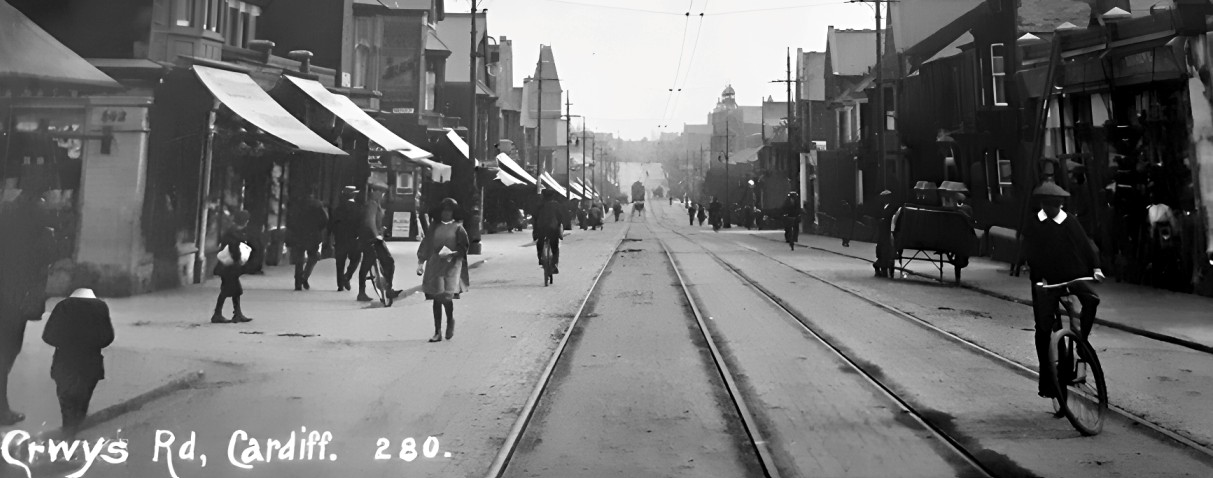
The boundary of the old parish of Roath ran down the middle the whole length of Crwys Road.
The first house plans were approved for Crwys Road in 1868 with five property plans being approved.
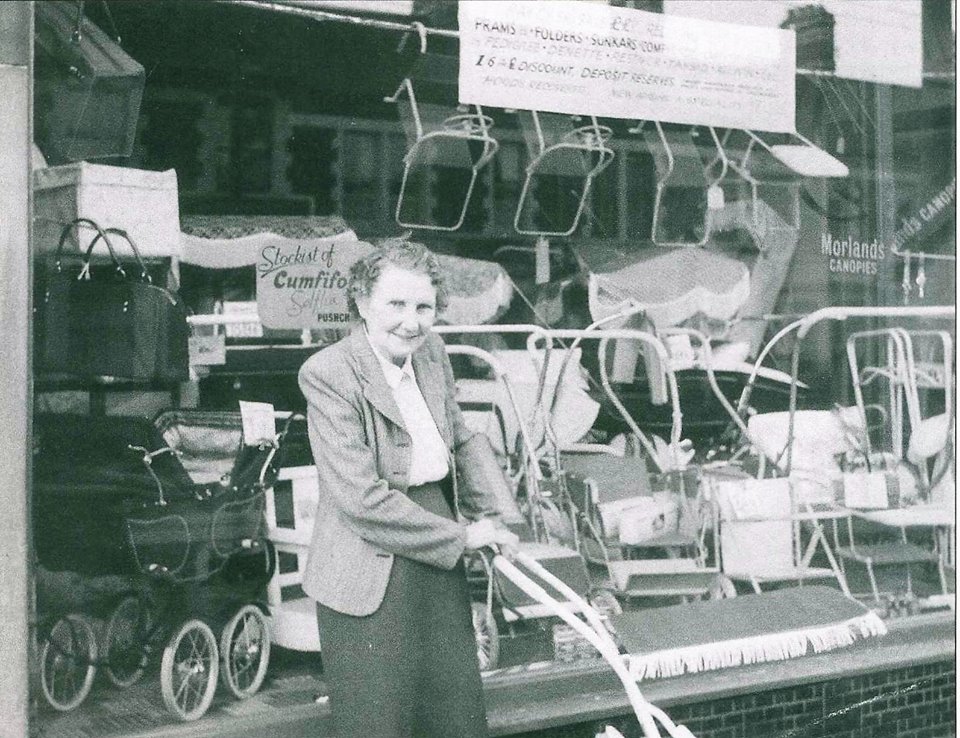
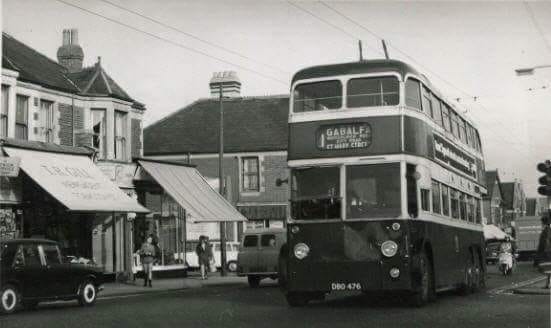
By 1914 a considerable amount of development had taken place and amongst the commercial properties on Crwys Road were seven butchers, four grocers, four fruiters, three bookmakers, three bakers and confectioners along with a number of various combinations of confectioners, tobacconists, stationers, newsagents and hairdressers.

Death Junction
For hundreds of years, at the start of Crwys Road, between the boundaries of Cardiff and Roath was an area used for executions. This is part of the reason why the busy road junction is known as Death Junction. It isn’t known whether gallows were a permanent structure on the site, but in relation to other areas there were not that many executions over the years, so it is likely that a temporary structure was used each time, possibly using the cart that the prisoner was conveyed in. The condemned would be tethered to a wooden frame and dragged behind a cart from the gaol in St Mary Street or the Castle through what is now Queen Street, to Newport Road, then left into City Road and up to what is now the junction of City Road, Albany Road, Richmond Road and Mackintosh Place. Depending on the sentence, the unfortunate would be hanged until dead, or hanged drawn and quartered whilst still alive. The remains would either be left there to rot or taken away by relatives for secret burial. Public executions ended in 1868, and from then, the condemned were executed within the prison walls.
It is here that two priests, Phillip Evans and John Lloyd were executed in 1679 for the crimes of practising their faith, at a time where this was considered a crime.

Both priests were accused of treason. Local Justices of Peace had even put up large sums of reward money to lead to their apprehension, but both priests refused to hide and so were later arrested and imprisoned together in Cardiff Castle.
It is alleged that several men were beaten and whipped for refusing to give evidence against the two priests but eventually an old lady and her daughter were brought forward to give evidence to say that they had seen the men say Mass.
Fr Phillip Evans was first to undergo the torture of being hung drawn and quartered. Fr John Lloyd then had the additional horror of watching this before being subjected to the same fate.
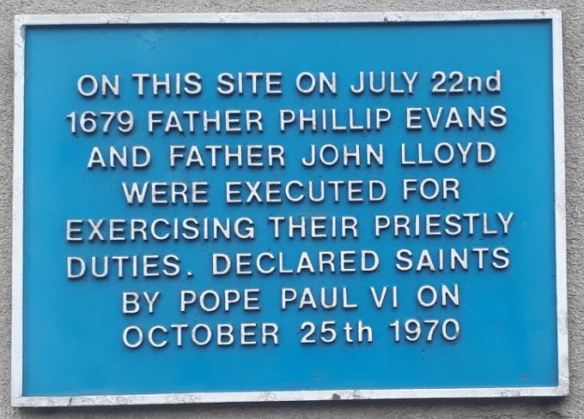
Plaque on the side of the Nat West bank on Crwys Road marking the site of the gallows.

Crwys Hotel
The Crwys Hotel is one of the oldest pubs in the area dating back to 1870 at least. The pub’s Welsh name Crwys means cross in English. In 1872 Dr Lougher was riding past on his horse on his way to an urgent case in Whitchurch when his horse bolted, frightened by a nearby scavenging cart. He was thrown to the ground and ‘dreadfully injured’. He was taken into the Crwys Hotel where he was able to give instructions on how to stem the bleeding. Unfortunately the horse didn’t survive. In 1876 the papers report a gas explosion that shattered the windows and blew out the exterior door frame. The Crwys Hotel had four bars till the early 2000s. A number of refurbishments have taken place since, the latest adding a roof-top outdoor seating area.

Cathays Police Station
From the Weekly Mail, 8th January 1887. A New Police-station at Cardiff: The Police-station for the Cathays district, built on the vacant space of ground adjoining the bridge over the Rhymney Railway at Crwys Road, was inspected on Tuesday by the Mayor, Alderman Yorath, and Councilors Rees, Hurley, D. Jones, Price, and other members of the Watch Committee, prior to its being occupied by the police. The building has a rather handsome front, facing the Crwys-road. It is built of Dumfries stone, with Newbridge stone for the walling. The upper floor consists of four good bedrooms; the ground floor comprises parlour, kitchen, office, and day-room. In the basement are five cells, charge-room, lamp- room, two w.c.’s, and storage for coals. The charge-room is placed in the basement, as prisoners will be brought in through the gateway at the back, which is on a lower level than the front. There is also provision here for warming the cells by hot water pipes. The arrangements of the building are good, the living-rooms for the police-sergeants lofty end well- ventilated, and all necessary conveniences have been provided. The building was erected by Messrs. Turner and Sons, Penarth Road, builders, from designs prepared by the borough engineer, Mr. Harpur. The contract for the erection of the station, walls to enclose the ground, and fittings was £ 2,538. The mayor and members of the corporation in inspecting the new premises were accompanied by the town-clerk, the borough engineer and by Superintendent Price. The mayor and those with him were much pleased with the excellent way in which the builders had carried out their contract. The new station will supply a want, long felt in the Cathays district, which has now become one of the most populous suburbs in Cardiff, and although included in the Roath district, under the charge of Inspector Cox, it is distant from the Roath Police-station more than a mile, and much annoyance has been experienced by the inhabitants in their inability to find a police- constable when his services were required.

Woodville Road Baptist Church
Woodville Road Baptist Church, on the corner of Woodville Road and Crwys Road, began as an offshoot of Bethany and Tabernacle Baptist churches in the 1870s. It started as a group meeting in an upper room at the town end of Cathays Terrace. The school room was then constructed on the site of the present church, the first mention of which in the newspapers appears to be 1876. By 1881 it had 280 scholars attending. Membership continued to increase and the main church was constructed and opened in 1887 with galleries added in 1892. A pipe organ and a young men’s institute followed, and organisations for all ages made for a lively church. In 1904, the year of Revival, over 100 baptisms took place. In the 1920s the church was often filled, and the Sunday school peaked at 611 with 45 teachers. Over the years however the building deteriorated and in 1990 a gale removed part of the roof. The church was demolished in 1993 and the new church Woodville Baptist Church – ‘Woodville Christian Centre’ constructed and opened in 2002 on part the same site whilst the corner part of the original site is now an Italian desert parlour.

Woodville Road Baptist Church – top – the schoolroom and original church. Bottom- looking along Woodville Road from Crwys Road with the church on the right.
Crwys Road School
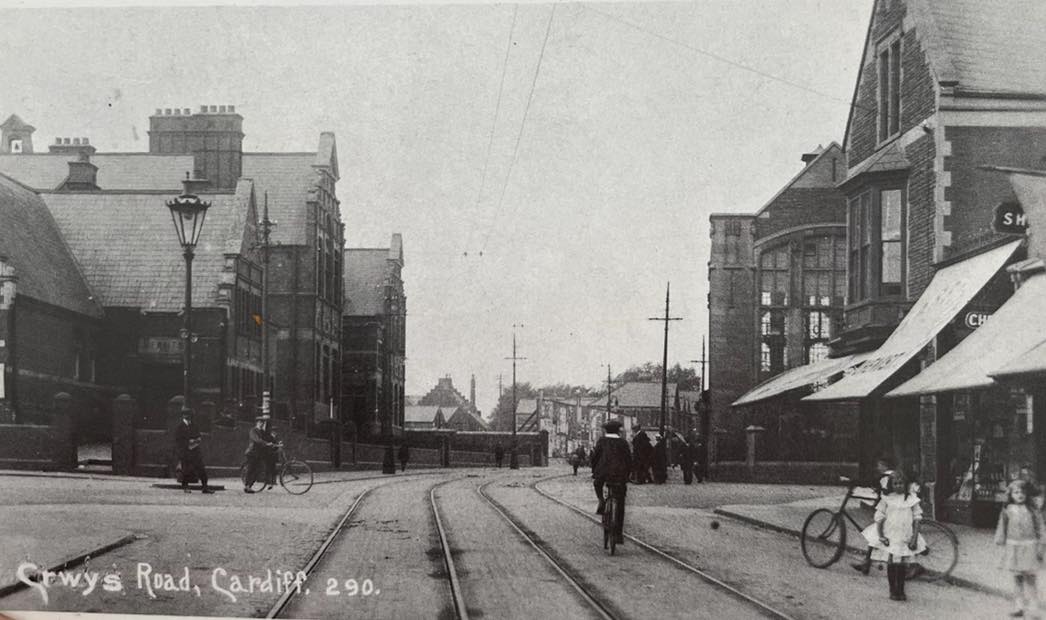
Crwys Road Board School, near the junction with Fanny Street, had a chequered history. It opened in January 1883 and enlarged in 1890. In 1901 it had accommodation for 1255 pupils. It closed in 1939 as an elementary school when it was handed over to the council for war purposes. After the war the building was then refurbished and took on a new identity as the College of Food Technology, which acquired a national reputation even before its move in the late 1960s to new buildings on Colchester Avenue. The school building reverted briefly to a school c.1972, accommodating an overflow from Gladstone Girls’ Secondary Modern, but was demolished in 1973. A Co-op foodstore with offices above and British Heart Foundation charity chop now occupies the site. Its most famous pupil was First World War hero Fred Barter of Daniel Street who won the Victoria Cross for conspicuous bravery at the WWI Battle of Festubert on 17 May 1915. On the 8 July 1915 a reception was held at Crwys Road School for the return of Sergeant Major Barter V.C. from the war. A plaque remembering the former pupils who had fallen in WWI was unveiled by Fred Barter in the 1930s. Tensions appear to have been running high in 1921 when headmistress Miss Wakley protested about her class sizes being 86. She was told her protest was unreasonable and given three months notice. The newspaper archives feature a number of references to former staff including Mrs Tate who is said to have opened the school and Bill Charles who taught there for 42 years.


 Roath Local History Society