

PHILIP VINCENT COOPER
Private, 11th Battalion, Welsh Regiment (Service Number: 14303)
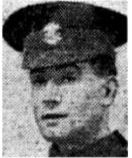 Philip Vincent Cooper was born on 20 Jul 1891 in Cardiff to John Cooper, a master mariner, originally from County Durham and Jane Hannah Henderson Cooper née Cooper originally from Seaham Harbour, Durham. He was baptised on Aug 20 1891 when the family were living at 78 De Burgh Street, Riverside and he was still living there at the time of the 1911 census. He attended Severn Road school before going on to Howard Gardens. After leaving school he became a clerk at a coal exporter office in Cardiff Docks. He served with the 11th Battalion Welsh Regiment and died of wounds received on 14 Sep 1916 aged 26 in Salonika. He is buried at the Karasouli Military Cemetery (grave D.726). Commonwealth War Graves Commission record. His brother Joseph Herbert Cooper was also lost in WWI when serving in the Merchant Navy. They are both remembered on their parent’s grave at Cathays Cemetery.
CLIFFORD MARTYN DUNN
Captain, 17th Battalion, Welsh Regiment
Clifford Martyn Dunn was born in 1892 in Cardiff, when the Dunn family were living at 108 Newport Road. He was born to John Tregerthen Short Dunn, a Stock and Sharebroker in shipping, originally from St Ives, Cornwall and Anna Maria Cecilia Dunn née Stallybrass, originally from Cardiff. By 1901 the Dunn family had moved to Radyr and in 1911 they were living at 74 Cardiff Road, Llandaff. By this time 18 year old Clifford was working as a clerk in the shipping industry. In WWI he became a Captain in the 17th Battalion Welsh Regiment and was twice mentioned in dispatches. He died on 24 Nov 1917 aged 23 on the Western Front in France. He is buried at the Anneux British Cemetery (grave I.E.31.). He is remembered on the Coal Exchange War Memorial plaque where he probably worked and a plaque at Llandaff Cathedral. Commonwealth War Graves Commission record.

EDGAR VIVIAN EDWARDS
Private, 1st Field Ambulance, Royal Army Medical Corps (Service Number: 48282)
Edgar Vivian Edwards was born in Cardiff on 10 Apr 1894 to Edgar Edwards, a shipowner, originally from Llandaff and Mary Elizabeth Edwards nee Williams, originally from Llanelli. In 1901 the family lived at 7 Theobald Road, Canton. In 1911 they lived at Risoer House, Cowbridge Road, Cardiff. He was employed as a clerk. He enlisted on 5 Jan 1915 and is posted to Porthcawl. On 24 Mar 1915 he is discharged after just 76 days and deemed unlikely to become an effective soldier. We know he joined the Penarth Lodge of the Freemasons on Jun 1916. He died on 24 Feb 1919. The fact he does not have a Commonwealth War Graves Commission record points to his death not being related to his short war service.
JOSEPH FAIRWEATHER
Major, 4th Battalion, South Wales Borderers
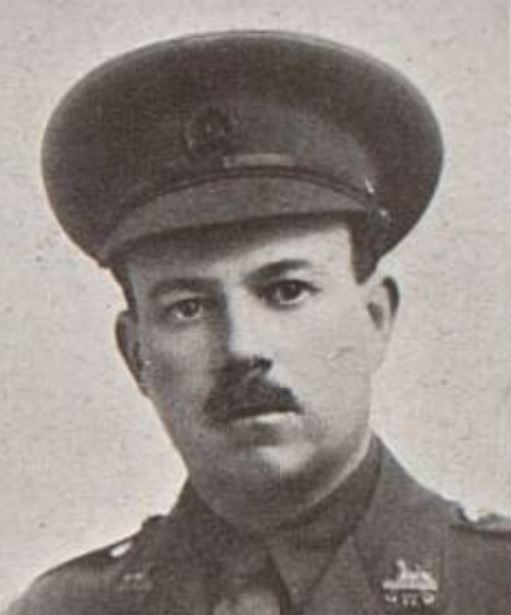 Joseph Fairweather was born in Dundee, Scotland on 25 May 1878 to Joseph Fairweather, a monumental sculptor and Jane (Jessie) Fairweather née Macintyre. He and his brother Paul, a noted multi-linguist, had moved to Cardiff from Scotland and Joseph was a partner in his brother’s coal export firm in Bute Street. In 1911 Joseph was living in Colum Road before later moving to 91 Pentrebane Street (Grange Gardens) Grangetown. He had previous military service in South Africa and after joining up and being commissioned in 1915, had been wounded at Gallipoli and also suffered from fever before returning to action. He was killed at the siege of Kut al Amara, Iraq, aged 38, where he was second in command of his battalion. He and four other men were killed whilst digging trenches. He is buried at Amara cemetery and remembered on the Cardiff Coal Exchange war memorial plaque. Commonwealth War Graves Commission record. His brother Lt Col James Macyntyre Fairweather DSO, was killed in action just over a month later when serving in serving in South Africa .
JOHN ANGEL GIBBS
Major, 9th Battalion, Welsh Regiment
John Angel Gibbs was born in 1880 at 12 St Andrew’s Crescent, Cardiff to John Angel Gibbs, a ship broker, originally from Waterford, Ireland, and Elizabeth Gibbs née Scriven, originally from Portland, Dorset. His father died when he was just 4. In 1891, at the age of 10, he was attending Queen’s College, Taunton. By 1901 he was working as an accountant and living at Marine Parade, Penarth, with his siblings. He played rugby for Penarth RFC in a team that beat the Barbarians. In 1910 he married his cousin Susan Gladys Morel, daughter of Sir Thomas Morel, Mayor of Cardiff. They had a son together, John Morel Gibbs, born in Aug 1912. In the 1911 census John Angel Gibbs is living in Penarth with his wife and lists his profession as ship owner. He enlisted with the 13th Battalion Welch Regiment. He goes to France in 1916 by which time he has transferred to the 9th battalion. By the end of 1916 he has been promoted to Major and awarded a DSO. In early 1917 he was taken ill with appendicitis and came home for surgery. He returned to the Western Font and was killed on 20 Sep 1917, aged 37, at the Battle of the Menin Road. He is buried at the Kemmel Chateau Military Cemetery, Belgium (plot H25). In his Will he left money for an orphanage in Penarth for children whose fathers didn’t return from the war which was called the J.A.Gibbs Memorial Home. The school changed name and purpose over the years and is now run by the charity Action for Children and called Headlands School. He is remembered on the Coal Exchange memorial plaque and the war memorial plaque at Queen’s College, Taunton. Commonwealth War Graves Commission record. His grandson Simon Gibbs is currently writing a book about Major J.A.Gibbs.

ATHOL THOMAS GIBSON
Captain, 2nd Battalion, South Lancashire Regiment
 Athol Thomas Gibson was born on 11 Mar 1878 at 6 Wordsworth Street, Roath, to Thomas Gibson, a ship’s store merchant, and Mary Gibson née Pye, both originally from originally from North Shields, Northumberland. In 1881 the family were living at 5 Marlborough Terrace, Newport Road, Cardiff (now 108 Newport Road). In 1891, at the age of 13, Thomas was away at school in Warminster. His mother died in 1893 and his father remarried his aunt, Alice Pye, in Jersey. The London Gazette of Dec 1899 records that Athol Thomas Gibson served as 2nd Lieutenant with the 2nd Glamorganshire Regiment (whether he ever served in South Africa is not clear). By 1901 the Gibson family had moved to Penarth and Athol was working as a clearing clerk in the firm S.D.Jenkins & Co. He married Elizabeth Pyman, daughter of another Cardiff shipping merchant, on 1 Jun 1907. In the 1911 census they have moved to Porthcawl with the Pyman family. Athol was a keen golfer and played in the Welsh team against Ireland in July 1914 at Royal Porthcawl Golf Club. He was gazetted as 2nd Lieutenant to the 3rd South Lancashire Regiment at the outbreak of war in Aug 1914 and was promoted the following month to Lieutenant. He served with the Expeditionary force in France. He was posted to France joining the ranks of the 2nd South Lancs at Neuve Chapelle in the rank of Captain and was killed in action on 21 Oct 1914 aged 41. His burial place is unknown but he is remembered on the Le Touret Memorial in France. He is also remembered on the Coal Exchange War Memorial plaque in Cardiff Bay and the Penarth War Memorial in Alexandra Park, St Augustine’s war memorial plaque, Penarth, and the Glamorganshire Golf Club memorial plaque plus the Royal Porthcawl Golf Club memorial plaque and a plaque to gold club members in All Saints church, Porthcawl. Commonwealth War Graves Commission record.
WALTER FRANCIS GRAVES
Lieutenant, 3rd Battalion, Bedfordshire Regiment
Walter Francis Graves was born on 19 Dec 1884 in Hornsey, Middlesex to Walter Graves, an architect, originally from St Pancras, London, and Fanny Graves née Francis, originally from Holborn, London.
The following is from the Bedfordshire Regiment website: Spending his younger years in Islington, education at Worthing College, then Haileybury College followed. Walter spent a 3 year apprenticeship at “a large London Engineering firm”, joining the Bedfordshire Regiment’s 3rd (Volunteer) Battalion. He was attached to the 1st Duke of Cornwall’s Light Infantry until the death of his father in June 1907, at which time he had to retire following family pressures.
In Jul 1908 he moved to Cardiff where he established himself as a partner in the coal and pit wood exporter Messrs Williams, Ambrose and Graves, based from at Cardiff Docks. He had a deep interest in social, educational and municipal matters and was asked to run for the Roath Conservative Ward which he won in November 1912. Walter was active in many committees including every mental health group he could help with. By this time, Walter had developed a reputation as a “Young man of great promise”.
When war broke out he relinquished his seat, announcing that he had to “rejoin the regiment” but did not wish to draw an income and leave his constituency without full time support. Walter was reinstated as a Second Lieutenant in the 3rd Battalion in August 1914, his promotion to Lieutenant following on 3 September 1914.
Lieutenant Graves was in a large draft which landed in France 15 September, finally arriving with the 1st Battalion on the front lines on 14 October, during the Battle of La Bassee. They were involved in the heavy fighting around Givenchy until the end of the month, being pulled from the line and rushed north to Ypres, to help hold the line against the latest German attacks. After going into the front line in the woods around Herentage Chateau, east of Ypres, on 6 Nov, Lieutenant Graves was killed during the heavy fighting as the British line held back the massed German assault of 7 Nov 1914.
Although his official date of death is recorded as the 9th Nov in some documents, eye witness sources refer to his death being on the 7th when the battalion were heavily engaged rather than the 9th when the fighting had died down considerably. Walter’s grave was initially unknown but a year after his death, a wounded 1st Bedfordshires’ Sergeant in hospital reported that it was “buried 600 yards south-east of the portion of ornamental water in the Herontage (sic) Chateau grounds”.
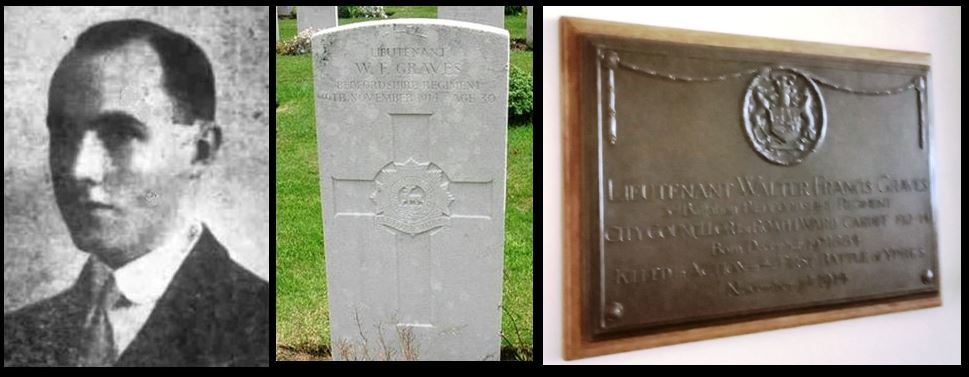
As the family had nowhere to focus their mourning, the memorial plaque below was erected by his widowed mother (Mrs. Fanny Graves) in the church in Sandy, Bedfordshire. In June 1925, during the battlefield clearances, a mass grave containing mostly unidentifiable remains was uncovered near the remains of Herentage Chateau. Among them was an officer, later identified as Walter Graves from the numerals on his person, being his Long Service Number. The soldiers – mainly Bedfordshires who had fallen during the 7th Nov 1914 fighting – were interred together in the same section of Bedford House cemetery. What remains of his service record is held at the National Archives under reference WO339/19994.
Additional information to above: In the 1911 Census Walter Graves was living at 11 Hickman Road, Penarth and his profession stated as a Coal Exporter. It is not known whether he lived in Roath when he became a Roath councillor or continued to live in Penarth. He quickly gained responsibility on Cardiff Council and in 1914 was appointed Chair of the Coal Committee. He was 30 years old when killed. As well as the memorial at Sandy, he is remembered on a plaque in the City Hall, Cardiff (see picture). Commonwealth War Graves Commission Record.
RAOUL GABRIEL VAILLANT De GUELIS
Brigadier, 11th Artillery Regiment, French Army
Raoul Gabriel Vaillant de Guelis as born on 26 Dec 1872 in Herry, Cher, France to Théodule Vaillant De Guélis, a farmer, and Marie Louise De Guelis née Josserand from Sauvigny-les-Bois, France. He came to Cardiff around 1900 and worked as a coal export agent, ending up as a business partner with Sam Powell coal exporter. In the 1901 census he lived at 28 Ruthin Gardens, Cathays. He was a member of the Cardiff Anglo-French Society where he delivered lectures periodically. In Aug 1904 he married Marie Stephanie Barbier, daughter of Paul Barbier, French professor at the university. They went on to have two children together, Jaques (b.1908) and Jacqueline Marie (b.1911). At the time of the 1911 census they lived at 3 Richmond Terrace (now called Museum Place). He joined the French army upon the call to arms in Aug 1914 and served as a Brigadier with the 11th Artillery Regiment. He died of pneumonia on 19 Apr 1916 aged 44 whilst serving in Argonne, France. He is remembered on the Cardiff Coal Exchange war memorial. His son Jacques Vaillant de Guélis became a Special Operations Executive (SOE) agent, an undercover spy, for the British army who carried out missions in France during the Second World War and was killed in France. His daughter Jacqueline Marie was killed in a road accident in Pen-y-lan in 1934 aged 23.

WILLIAM HENRY HOLLYMAN
Private, 1st/28th Battalion, London Regiment (Artists’ Rifles) (Service Number: 764067)
William Henry Hollyman was born on 8 Jan 1885 in Cardiff to Robert James Hollyman, a baker and confectioner, originally from Abbots Leigh, Somerset and Mary Elizabeth Hollyman née Mewton, a confectioner, originally from Liskeard, Cornwall. At the time of the 1891 and 1901 census the Hollyman family were living at 32 Crwys Road (on the corner of Woodville Road) where they ran a bakery and cake shop. William attended Crwys Road Board School before going on to Howard Gardens School. After leaving school he became a commercial clerk in a coal export company in Cardiff Docks. He attended Cathays Methodist Church on Crwys Road and was a member of the Loyal Commercial No. 2720 Masonic Lodge. At the time of the 1911 census he was living at 41 Wellfield Road with his mother. In Jul 1916 he married Della Irene Veale, originally from Plymouth, in Liskeard, Cornwall. He signed up in Dec 1915 in Cardiff, aged 30, joining the 28th Battalion, London Regiment and went to France in Mar 1917. He was killed in action on 30 Dec 1917 in France aged 32. He has no known burial place. The painting ‘Over the Top’ by John Nash depicts his regiment in action on 30 Dec 1917. The 1st Artists Rifles counter-attacked at Welsh Ridge, south-west of Cambrai. Nash called the action ‘pure murder’ as most of the company were killed. John Nash, a sergeant, counted himself lucky to escape the carnage. William is remembered on the Thiepval Memorial, France, the Cathays Methodist Church memorial, Cardiff Coal Exchange War Memorial plaque, and the war memorial plaque at the Cardiff Masonic Hall . Commonwealth War Graves Commission record. Two of his brothers emigrated to Canada and became bakers. Another brother went to Argentina. His wife Della died in Cornwall in 1961.

EDGAR VERNON JENKINS
Corporal, 1st Battalion, Honourable Artillery Company (Service Number: 2854)
Edgar Vernon Jenkins was born on 18 Apr 1883 at 10 Stacey Road, Roath to Edgar Jenkins, a shipowner and Captain in the merchant navy, and Eliza Jenkins née Shugg, both originally from Hayle, Cornwall. In 1891 the family were living at 42 Richmond Road. Edgar attended Stacey Road School. By 1901 the family had moved to 71 Cardiff Road, Llandaff. Edgar was employed as a chartering clerk in his father’s firm E. Jenkins and Co in Cardiff Docks. He was a keen sportsman and Captain of Cardiff Rowing Club in 1911 and secretary of the annual regatta. He was a member of East Cardiff Hockey Club and played rugby for Old Monktonians and captained the club in their first season under their new name, Glamorgan Wanderers in 1913-14. He also played for the Coal Exchange rugby team. Before the war he served in the 3rd Volunteer Battalion, Welsh Regiment and later the Glamorgan Yeomanry. Edgar enlisted 4 Jan 1915 in the (Territorial) HAC at the Armoury House, City Road, London, which was the HQ of the Honourable Artillery Company. He went out to the 1/1st Honourable Artillery Companyon the Western Front on 21 Jul 1916, a few days after the battalion had been transferred to the 190th Infantry Brigade, 63rd (Royal Naval) Division. He was killed in action at Oppy during the Battle of Arras 19 Apr 1917, aged 34. He has no known burial place. He is remembered on the Aras Memorial. He is also remembered on the Llandaff War Memorial on Llandaff green, the WWI plaque in Llandaff Cathedral, Cardiff Rowing Club War Memorial, Cardiff Coal Exchange War Memorial Plaque, Hayle War Memorial in Cornwall and St Felicitas Church War Memorial plaque, Hayle, Cornwall. Commonwealth War Graves Commission record. His father served in the merchant navy in WWI and died in 1939 in Hayle, Cornwall, aged 94. (Compiled with the grateful assistance of Gwyn Prescott).

JAMES FRANCIS JOHNSON
Private, 11th Battalion, Welsh Regiment (Service Number: 203387)
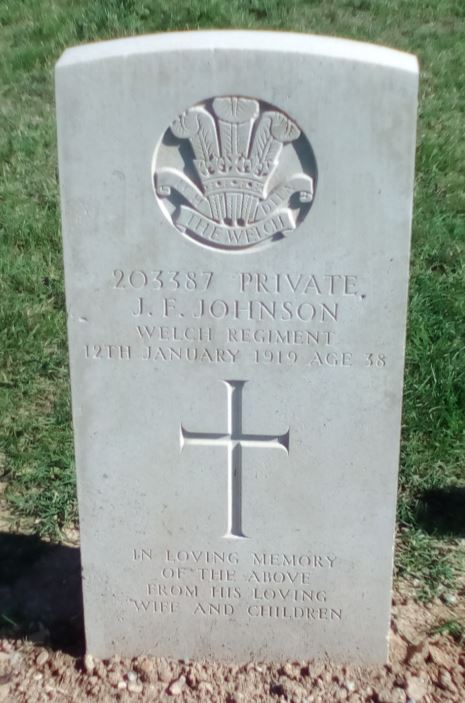
James Francis ‘Frank’ Johnson was born on 22 May 1880 in Cardiff to Martin Johnson, a mariner and water clerk, originally from Norway, and Jane Johnson née Elsworth, originally from Tallow, County Waterford, Ireland. He was baptised in St John the Baptist church on 4 Jul 1880. In 1881 and 1891 the Johnson family lived at South London Place in the Docks. By 1901 the Johnson family had moved to 14 Pen-y-Peel Road, Canton and Frank was working as a shipowner’s clerk. In 1909 he married Angelina Charlotte Castelli, originally from Cork, Ireland. They lived at 11 Waterloo Road, Pen-y-lan and went on to have three daughters; Ester, Maud and Angela (baptised at St Margaret’s church). In WWI Frank Johnson served with the 11th Battalion, Welsh Regiment. He died of influenza following wounds on 12 Jan 1919, aged 38, in Salonika, Greece. He is buried at Kirechkoi-Hortakoi Military Cemetery (plot 625). He is remembered on the St Margaret War Memorial Tower and the St Edward War memorial plaque. He is also remembered on the Cardiff Coal Exchange war memorial plaque. Commonwealth War Graves Commission record.
FREDERICK JUKES
Second Lieutenant, 9th Battalion, Welsh Regiment
Frederick ‘Fred’ Jukes was born on 1 Sep 1891 at 12 Lewis Street, Canton to George Jukes, a boilermaker journeyman and commission agent (turf), originally from Newport and Elizabeth Ann Jukes née Lewis, originally from Cardiff. In 1901 the family were living at 12 Lewis Street but by 1911 had moved to 126 Cathedral Road. Fred attended Cardiff High for Boys, leaving in Jul 1905, before moving onto Taunton School. After leaving school he worked as a clerk and was on the staff of Messrs Mitchelson & Co, Stockbrokers. His obit says he was well known in Cardiff as a good swimmer, football player and all round athlete. Fred joined the Public Schools Corps in the first week of the war and served at the front for 3 years unscathed. He transferred briefly to the Royal Flying Corps in 1917 but later transferred back to the Welsh Regiment. He was killed in action on 20 Sep 1917, aged 26, while leading his men in a bombing raid at Passchendaele. He has no known burial place. He is remembered on the Tyne Cot Memorial in Belgium. He is also remembered on the Taunton School war memorial and the Cardiff Coal Exchange War Memorial plaque as well as a plaque in his memory at Cathays Cemetery (plot VL7). His parents paid for a pair of stained glass windows in his memory which are at St Catherine’s Church, Canton. His father also gave 1,000 guineas endowment for a two-bed ward at King Edward VII hospital (Cardiff Royal Infirmary). Commonwealth War Graves Commission record.

WILLIAM PETER KELLY
Captain, 26th (Tyneside Irish) Battalion, Northumberland Fusiliers
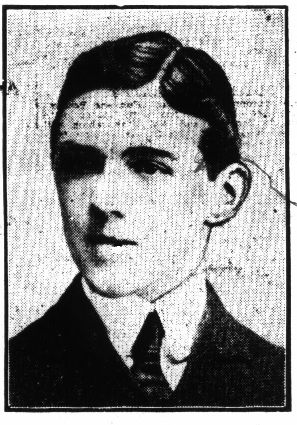 William Peter Kelley was born at 127 Price Street, Birkenhead on 27 Jun 1885 to William Kelley, a clothier, originally from Birkenhead and Margaret Kelley née Brierton, originally from Belfast. His father died shortly after he was born and his mother remarried Henry Canning, a marine engineer, originally from Manchester. By 1891 the family had moved to Roath and were living at 27 Glenroy Street. William attended St Bede’s Roman Catholic College, Manchester and St Peter’s Church in Tredegarville, Cardiff. In 1901 they lived at 89 Arabella Street and in 1911 at 66 Amesbury Road when William, then aged 25, was working as a shipping agent. Prior to the war he was a member of the Cardiff Exchange, being a partner in Vyvyan, Kelly & Co Coal Exporters. His obit in 1916 states ‘Captain Kelly on the outbreak of war enlisted in the Dragoons, subsequently obtaining a commission, and being an efficient officer his promotion was rapid. He had been in France for about 12 months. The gallant Captain first joined a cavalry regiment as a trooper, but when the Tyneside Irish Brigade was formed he applied to be posted to it. It was characteristic of him that he declined a staff appointment, which would have kept him hundreds of miles from the trenches’. He was wounded on Nov 10th 1916 on the Western Front whilst in temporary command of the 26th battalion, Northumberland Fusiliers and died of wounds on 12 Nov in hospital at No 2 Casualty Clearing Station, Bailleul, aged 31. He is buried at Bailleul Communal Cemetery Extension (plot III. A. 209). In his will he left £4,791, a quarter to go to St Bede’s College and a quarter to St Peter’s Church. He is remembered on St Bede’s College memorial, Cardiff Coal Exchange Memorial and St Peter’s Roll of Honour. Commonwealth War Graves Commission record. (It seems William kept in touch with the Kelly family in Birkenhead after coming to South Wales. His obit mentions Bridget Kelly who seems to have been the matriarch of the family, being a car proprietoress in Birkenhead for many decades).
EDWARD JOHN LORD
Private, 8th Battalion, Welsh Regiment (Service Number: 47445)
Edward John Lord was born on 23 Feb 1889 at 5 Darran Street, Cathays, to Edward John Lord, a labourer at a patent fuel factory, originally from Springfield, Essex and Mary Agnes Lord née Cox, originally from Downside, Somerset. At the time of the 1891 census the family had moved to Bedminster, Somerset but they had returned to live in Cardiff, at 101 Bedford Street, by 1901. In 1911 they were living at 59 Bedford Street when Edward worked as a chartering clerk. He served with the 8th Battalion, Welsh Regiment (possibly the 15th Battalion before that). Edward died on 9 Oct 1918 in India of pneumonia, aged 29, and is buried at Kirkee New Cemetery, Pune, India (Plot B. Row 4. Grave 8). A CWGC headstone was erected above his resting place in 2016 when his burial place had been identified. He is remembered on the Cardiff Coal Exchange Memorial and the St Peter’s Roll of Honour. Commonwealth War Graves Commission record. Four of his brothers also served in WWI but survived. His younger sister Sarah Catherine Lord was headmistress at St Peter’s RC School for forty years (1921-1961) and passed away in 1999 aged 99.

JOHN MATHEWS
Private, 15th Battalion, Welsh Regiment (Service Number: 35126)
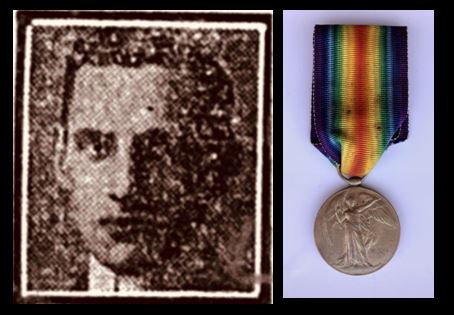
John Matthews was born on 15 Aug 1889 in Cardiff to Thomas Matthews, a vaccination officer, originally from Cardiff and Margaret Matthews née Jenkins originally from Llanbleddian, Cowbridge. In the 1891 census the Matthews family were living at 19 Llantwit Street, Cathays. John’s mother dies when he is only six leaving Thomas Mathews to bring up the seven children. In 1895 John enrolled as a pupil at Albany Road school and he later went on to attend Howard Gardens High School. By 1911 the family were living at 5 Alma Road in Pen-y-lan and John was working as a clerk in a ship owners. His father passes away in 1912 aged 67. On enlistment he joined the 15th (Carmarthenshire) Battalion of the Welsh Regiment. John was killed on the 11 July 1916 aged 26, during the closing stages of the battle for Mametz Wood. He was one of seventy men of the 15th battalion who were killed during the battle. The majority of the dead were buried within the wood where they fell, at Mametz Wood Cemetery. Many of these were lost during subsequent fighting in the area, and John is commemorated on the Thiepval Memorial to the missing of the Somme. He is also remembered on the Howardian High School War Memorial and the Cardiff Coal Exchange war memorial plaque. Commonwealth War Graves Commission record.
JOHN EDMUND MATHIAS
Second Lieutenant, 5th Battalion, Welsh Regiment.
John Edmund Mathias was born on 24 Dec 1878 in Porth, Glamorgan, to William Henry Mathias, Director of the Aber-Rhondda Coal Company, originally from Gelligaer, Glamorgan, and Rachel Mathias née Thomas, daughter of a colliery owner, originally from Mynyddislwyn, Monmouthshire. Prior to the war John was employed by H C Vivian & Co (coal exporters), Cardiff Docks and previously to that was connected with Messrs Perch & Co. In WWI he served initially with the 3rd Battalion, Welsh Regiment before transferring to the 5th Battalion. He joined the Welsh Regiment in Sep 1915 and was promoted to Second Lieutenant in Oct 1915. He died as a result of an accident at Kinmel Camp, Rhyl, on 11 Oct 1916 aged 37. A newspaper report of his inquest reports: …….. He was very popular among the soldiers. The last time he was seen was on Monday, last week, when he was left in his room by himself. It was an exceptionally dark night, and the wind blew bitterly. The pond where his body was found was a few yards from the road that leads from the stable. The officers to his own tent said there was no fence around it. Sergeant Chaplin said he had seen the body in seven or eight feet of water. His staff was in his right hand and his coat on his left arm. Hardly anyone could get out of the water after going there once, because there were so many weeds growing there. It was an ‘Accident’. He is buried in the family grave at St Mabon, Llanfabon, Glamorgan. He is remembered on the Cardiff Coal Exchange Memorial. His father also sponsored a memorial bed in memory of his son in the Shand Ward at Cardiff Royal Infirmary. Commonwealth War Graves Commission record.

JAMES HILL PATON
Second Lieutenant, Machine Gun Corps (Infantry) (Service Number: 6539 761388)
 James Hill Paton was born in Crosshill, Glasgow in 1888 to Peter Duff Paton, a mercantile clerk, originally from Scone, Perthshire, and Jessie Paton née Duff, originally from Rutherglen, Lanarkshire. At the time of the 1891 and 1901 census the Paton family were living in Glasgow. James was educated at Albion Academy and Allan Glen’s School and afterwards went to Spain to learn the language. By 1911 James Hill Paton and his brother Walter were boarding at 29 Wordsworth Avenue, Roath with James now a coal exporter, aged just 22. He was part of the firm Denstad and Paton, Coal Exporters, who had an office in the Imperial Building, 27 Mount Stuart Square in Cardiff Docks. In Dec 1915 he enlisted as a Private with the Artist’s Rifles, London Regiment before being gazetted to the Machine Gun Corps a year later. He served in France and was taken prisoner of war for eight months before the armistice was signed. He died at the Prince of Wales Military Hospital, London on 19 Mar 1919, aged 30. James is buried at Cathcart Cemetery, Glasgow (plot Q.203). He is remembered on the Cardiff Coal Exchange memorial. Commonwealth War Graves Commission record.
EDWIN VIVIAN ROWE
Second Lieutenant, 13th Battalion, Welsh Regiment (Service Number 61566)
 Edwin Vivian Rowe was born in Woodlands Terrace, Swansea in Mar 1881 to Edwin Rowe, a steamship owner and broker, originally from Fowey, Cornwall and Mary Brayley Rowe née Stevens, originally from Swansea. Sometime in the next ten years they moved to Newport Road, Cardiff. His father died in 1905 and Edwin himself became a steamship owner and broker. In 1907 he married Elsie Baker Fox, at Roath Road Wesleyan Church. They lived at 65 Richmond Road and went on to have two children, Charles Edwin Vivian b.1909 and Dorothy Mary Vivian b.1915. It appears Edwin was a volunteer in the Glamorgan Imperial Yeomanry and qualified in musketry in 1902 and then took part in miniature rifle shooting competitions representing Cardiff Exchange in 1906. In WWI he served with the 13th Battalion, Welsh Regiment. He was killed in action on 1 Sep 1918 on the Western Front aged 37. He has no known burial place. He is remembered on the Vis-en-Artois Memorial in France. He is also remembered on the Broadway Methodist war memorial plaque, Cardiff Coal Exchange war memorial and the Cardiff Masonic Hall war memorial plaque. Commonwealth War Graves Commission record. His brother Arthur Leslie Rowe was also killed in WWI. His son Charles Rowe studied law and went on to become the Town Clerk of Northampton.
WILLIAM HENRY SEAGER
Second Lieutenant, 10th Battalion, South Wales Borderers
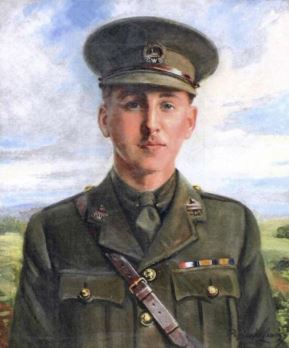
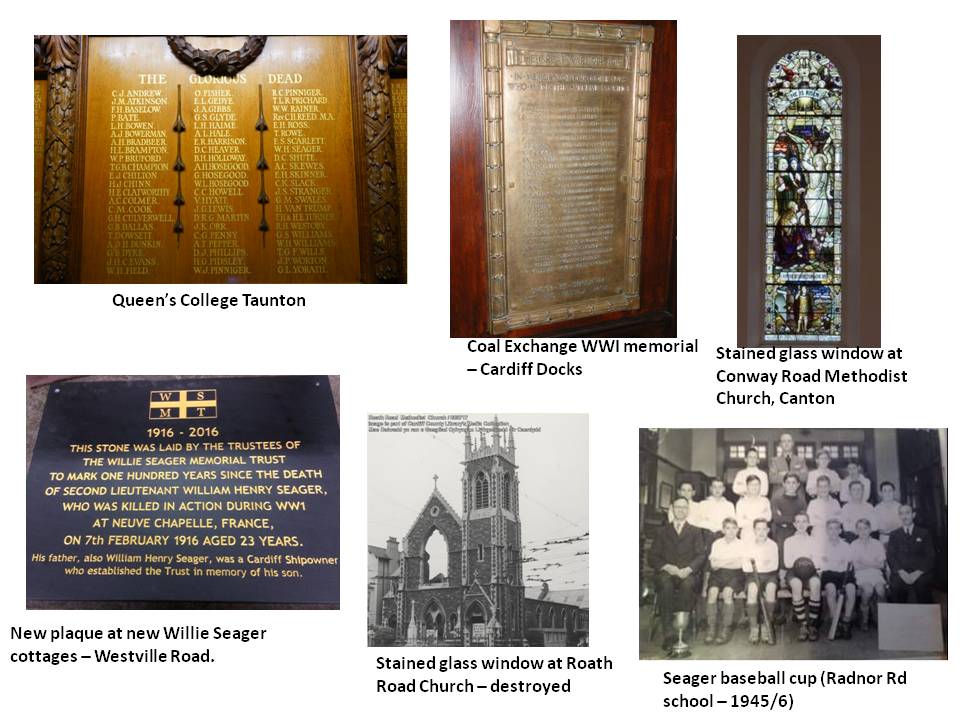
William ‘Willie’ Henry Seager was born in Cardiff on 28 Jan 1893 to William Henry Seager, originally from Cardiff and Margaret Annie Seager née Elliot originally from South Shields, County Durham. His father was a prominent ship-owner and ship’s chandler who was knighted in 1918 who was also the Liberal MP for Cardiff East between 1918 and 1928. In 1901 the Seager family lived at Pitman Street, Riverside but moved to 203 Newport Road shortly afterwards. Willie spent three years at Cardiff High School from 15 Jan 1903 until 1906. He then completed his education at Queen’s College, Taunton. He was an active member of the Roath Road Wesleyan Chapel and was closely involved with the Sunday School there. He was first employed with the Cardiff ship-owners and coal exporters Lambert Brothers Ltd. After gaining experience in the shipping trade with them, when he was 21, he joined his father’s firm W.H. Seager and Co on 14 Feb 1914 and was later made a director while in the Army. At the outbreak of war, he attempted to enlist but was rejected twice as medically unfit. However, he persisted and was finally accepted at the third attempt. His address then was given as 60 Newport Rd. By Dec 1914.he was serving as a private in No. 2 Company 21st Battalion Royal Fusiliers (4th Public Schools) which was then in training at Ashstead, Surrey. That month, however, he applied for a commission in the Welsh Army Corps and he was eventually commissioned second lieutenant on 4 May 1915, joining the 10th Battalion (1st Gwent) South Wales Borderers who were at Colwyn Bay. After further training near Winchester at Hursley Park and Hazely Down, the 10th South Wales Borderers went out to France with the rest of the 38th (Welsh) Division in Dec 1915, landing at Le Havre on the 4th. The Welsh Division spent the next few weeks training and by mid-January they were deemed ready to take over part of the front line themselves near Neuve Chapelle. At this time, it was a fairly quiet area, apart from snipers and shellfire. Very shortly afterwards, however, while Willie was supervising the repair of a trench which had been damaged by shellfire, he was hit in the chest by sniper-fire. After only a few weeks in the front line, Second Lieutenant William Seager was killed in action at Neuve Chapelle on 7 Feb 1916. He was 23. His company commander wrote: “By his unbounded generosity, joviality and capability he has endeared himself to every officer and man of the company. The men have lost a brilliant leader, and I – well, I have lost a brother who was my right-hand man.” He was buried by his comrades nearby at what is now St. Vaast Post Military Cemetery, Richebourg L’Avoué, six miles north-east of Béthune (grave II. O. 11). Commonwealth War Graves Commission record. He is commemorated on the Cardiff High School memorial plaque, Queen’s College Taunton memorial, Roath Road Wesleyan Church war memorial and Cardiff Coal Exchange war memorial. Within months of his death, his parents donated funds in his name for a new operating theatre at the Cardiff Royal Infirmary and a special memorial plaque was placed there. A similar plaque existed in Whitchurch Hospital. They also endowed a bed in his memory at the Royal Hamadryad Seamen’s Hospital in the Docks. In addition, his parents dedicated two stained glass windows to his memory: one at Conway Road Methodist Church in Canton; and the other at Roath Road Wesleyan Chapel, which was located at the junction of City Road and Newport Road but destroyed by bombing during the Blitz. In 1939, the Willie Seager Memorial Trust was established to build and manage ten homes in Newport Road for retired seamen and their wives. In 1995, the Trustees replaced these with ten new homes in Westville Place, Penylan. Exactly a hundred years to the day after his death, in a special centenary service, the Willie Seager Trust dedicated a memorial stone at St. Edward’s Church in Roath to his memory, now outside the houses in Westville Place. Cardiff schoolchildren also used to compete annually for the Seager Baseball Cup. Finally, he is remembered on the Seager family grave at Cathays cemetery.

FREDERICK OTTO TRECHMANN
Second Lieutenant, 94th Brigade, Royal Field Artillery
Frederick Otto Trechmann was born in 1893 in Seaton Carew, County Durham to Albert Frederick Trechmann, a ship owner, originally from Hartlepool, County Durham and Marian Anna Trechmann née Jachmann, originally from Germany. In 1901 the Trechmann family were living at 1 Station Street, Stockton-on-Tees, probably on a temporary basis after fire had destroyed their home, Nordby, in Hartlepool. Frederick travelled to Canada in 1911. He worked for the family ship broking business, Trechmann, Carrick and Gladstone & Co, which was at 38 Mount Stuart Square in 1914, and probably what brought him to Cardiff (his brother Richard worked in Cardiff in 1911 as a chartering clerk, boarding at St Teilo St, Pontcanna). In WWI Frederick served as Second Lieutenant with the 94th Brigade, Royal Field Artillery.He was injured by shell fire on 16 Sep 1916 at Gueudecourt, in the battle of the Somme. He died of his wounds in Manchester Hospital on 14 Oct 1916 aged 23. He is buried at St Mary’s churchyard, Norton, Stockton-on-Tees. He is remembered on the Cardiff Coal Exchange war memorial plaque. Commonwealth War Graves Commission record.

ERNEST WILLIAM TREGARTHEN
Lieutenant, Royal Flying Corps
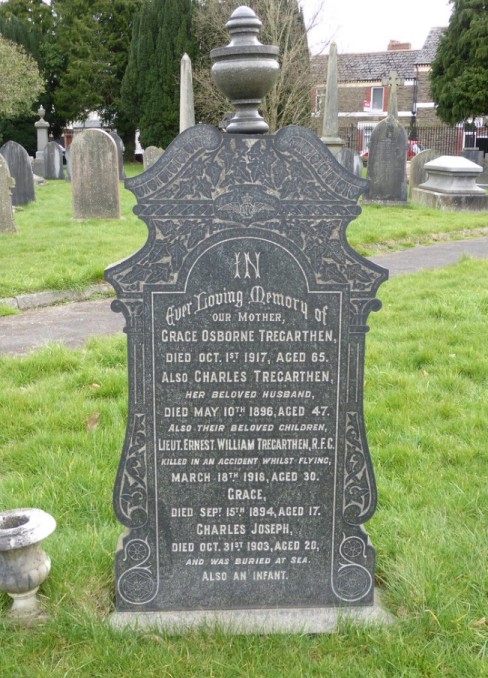
Cathays Cemetery (pic credit: Des Sanford on Flickr)
Ernest William Tregarthen was born in Cardiff on 27 Jan 1888 to Charles Tregarthen, a publican, originally from the Scilly Isles and Grace Osborne Tregarthen née Boase, originally from St Ives, Cornwall. At the time of the 1891 census the family were living at the Macworth Hotel, Neath, where Charles was the licensed victualler. By 1894 the family had returned to Cardiff and were living at 121 Richards Street and Ernest and his brother Thomas were admitted to Albany Road School. His father died in 1896 and in 1901 the family were living at 73 Alfred Street. Ernest went on to attend Howard Gardens School. In 1911 Ernest was living at 5 Westville Road with his mother and sister and working as a shipping clerk. In WWI he trained with the Inns of Court Officer Training Corps and then served with the 5th Battalion, Royal Welsh Fusiliers from Jul 1916 and then the Royal Flying Corps from Nov 1917. He died on 18 Mar 1918 aged 30 as a result of a flying accident at Thetford, Norfolk in which his aircraft spun off a turn at low altitude. He is buried in a family plot at Cathays Cemetery (plot U.65). He is remembered on the Roath Park Wesleyan Church War Memorial, Howard Gardens High School War Memorial and the Cardiff Coal Exchange War Memorial plaque. Commonwealth War Graves Commission record.
GERARD ILLTYD TURNBULL
Lieutenant, 18th Battalion, Welsh Regiment
Gerard Illtyd Turnbull was born in Cardiff on 11 Jul 1886 to Philip Turnbull, a ship owner, originally from Whitby, Yorkshire and Everilda Turnbull née Smith, originally from Egton, Yorkshire. At the time of the 1891, 1901 and 1911 census the Turnbull family were living at 130 Newport Road. His mother sadly passed away in 1893 and in 1894 Illtyd started attending Downside School in Somerset where he was an excellent all-round sportsman and boxing champion for the whole school on a number of occasions. After leaving school he played hockey for Cardiff and became Captain of the Glamorganshire Golf Club second team. He worked as a chartering clerk for Messrs Mann, George & Co in Cardiff Docks. His school record records: In Aug 1914, on the outbreak of war, he offered himself to the Honourable Artillery Company, but was medically rejected. Eventually, he joined the Inns of Court O.T.C. In 1915, obtained a commission in the Welch Regiment, and went to France in Oct 1916. On 21 Mar 1918, he was wounded, but remained on duty. On 9 Apr he was again wounded, this time severely (shrapnel in upper right arm), and was taken prisoner. He died in a German field hospital on 20 Apr 1918, aged 31. It has been ascertained that, whilst fully conscious, he received the last Sacraments, and that he was buried with the rites of the Catholic Church and full military honours in the cemetery at Ronchin, a village near Lille. A number of German officers and men and many of the French inhabitants of the village attended the funeral which took place on 22 Apr. Over his grave has been placed a cross bearing his name. The colonel of his battalion wrote to say that Illtyd Turnbull had been recommended for the Military Cross for fine services rendered during the fighting on 21 Mar and subsequent dates. The following is the official statement which appeared a little later: ‘When acting as battalion scout officer, he carried out a series of daring reconnaissances into enemy lines for six days and nights without rest, bringing back information of the greatest value’. He is remembered on the Downside School War Memorial, Cardiff Coal Exchange War Memorial plaque, one of the Stations of the Cross at St Peter’s Church, and on the grave of his parents grave at Cathays Cemetery. In 1930 his brother paid for a memorial statue of St Illtyd which stood in an alcove on an exterior wall of St Illtyd’s School in Splott. The school and statue suffered bomb damage in WWII and for some time afterwards the remaining head of the statue stood on top of the WWII War school memorial. It is now thought to have been reconstructed and in St Illtyd’s School in Rumney. Commonwealth War Graves Commission record.

ALEXANDER FAUVEL WHITLEY
Lieutenant, 49th Siege Battery, Royal Garrison Artillery
Alexander ‘Alex’ Fauvel Whitley was born in Penarth on 12 Apr 1892 to Edwin John Whitley, a ship broker and storage agent, originally from Jersey and Jessie Mackintosh Whitley née Miller, originally from Galway, Ireland. He was baptised at St Augustine’s church on 19 May 1892. In 1901 and 1911 the Whitley family lived at 14 Albert Crescent, Penarth. Alex attended Cardiff High School, leaving in 1909. By 1911 Alex was working as a coal merchant’s clerk. In Mar 1914 he played rugby for Cardiff Exchange versus Baltic Exchange, London, in a game played at Cardiff Arms Park. He also played for Penarth RFC. In WWI he served with the 49th Siege Battery of the Royal Garrison Artillery. In Apr 1915 he took part in a military boxing tournament at Barry for regiments stationed there. Whitley fought in the heavyweight class. He was promoted to Second Lieutenant with effect from Mar 1915. He was killed in action at the Somme on 23 Jul 1916 in France aged 26 and is buried at the Peronne Road Cemetery, Maricourt (grave I.A.31). He is remembered on the Cardiff Coal Exchange memorial, Cardiff Rowing Club war memorial, Penarth War Memorial, St Augustine’s Church memorial (Penarth), Penarth RFC Roll of Honour and a stained glass window memorial in Gouvey Church, Jersey. He is not listed on the Cardiff High School memorial. Commonwealth War Graves Commission record. His brother Harry Perchard Whitley served with the Royal Field Artillery in WWI as 2nd Lieutenant and in WWII was awarded an OBE for his services as manager of the Mountstuart Drydocks Ltd. His brother-in-law John Stewart Minshull Nicholls died in the WWII serving with the Merchant Navy and is on the Penarth Memorial. (Summary compiled with input from rugby historian Gwyn Prescott).

JOHN LEWIS WILLIAMS
Captain, C Company. 16th ‘Cardiff City’ Battalion, Welsh Regiment
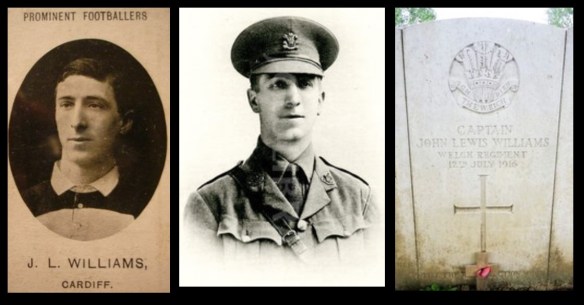
John ‘Johnny’ Lewis Williams was born on 3 Jan 1882 in Whitchurch, Cardiff to Edward Williams, a farmer/licensed victualler /rate collector, originally from Radyr and Mary Williams née Lewis, originally from Whitchurch. At the time of the 1891 census the Williams family were living at the Hollybush Inn where Edward was the licensed victualler. In 1892 Johnny started attending Cowbridge Grammar School. By 1901 the family were living at 2 Rhiwbina Rd and Johnny, aged 19, was working as a clerk. By 1911 the family were living at ‘Llwyncelyn’, Pantmawr Road, Whitchurch and Johnny a partner in a coal-exporting firm Greenslade & Williams at the Cardiff Coal Exchange. He was a brilliant rugby wing three-quarter and was one of the most distinguished of all the 135 international rugby players who lost their lives in the War. He played initially for Whitchurch and Newport but spent most of his career with Cardiff, whom he captained in 1909-10. He won 17 international caps between 1906 and 1911, during one of the most successful periods ever for Welsh rugby. He played in three Grand Slam teams and was also a member of the British (Anglo-Welsh) Team in Australia and New Zealand in 1908. He enlisted in the Royal Fusiliers early in the War and was commissioned in the Cardiff City Battalion in Nov 1914. This battalion had a strong contingent of officers and men who were members of Cardiff Rugby Football Club and Johnny was one of four Welsh rugby internationals who joined at that time. Shortly afterwards, in early 1915, he married Mabel Anne Morgan of ‘Caercady’, Archer Road, Penarth. He went overseas with the 38th (Welsh) Division in the following Dec. During the Battles of the Somme, he was very badly wounded in the Cardiff City Battalion’s attack on the ‘Hammerhead’ in the Battle of Mametz Wood. He succumbed to his wounds several days later on 12 Jul 1916 at a casualty clearing station, aged 34. He is buried in Corbie Communal Cemetery Extension, France (plot 1. row C. grave 31). He is remembered on the following memorials: Whitchurch War Memorial, St.Mary’s Church, Whitchurch, Welsh Rugby Union War Memorial, Cardiff, Cardiff Coal Exchange War Memorial, Cowbridge Grammar School Memorial, Cardiff Masonic Lodge War Memorial, Newport Athletic (Rugby) Club War Memorial, Penarth War Memorial, All Saints Church, Penarth. Commonwealth War Graves Commission record. (Summary compiled with input from rugby historian Gwyn Prescott).
RICE WATKIN WILLIAMS
Private, 23rd Battalion, Royal Fusiliers (Service Number: PS/1075)

Rice ‘Ricey’ Watkin Williams was born in Treorchy on 16 Sep 1889 to Henry Williams, a grocer and hotel keeper, originally from Brynmenyn, Glamorgan, and Sarah Ann Williams née Davies, originally from Bassaleg, Monmouthshire. At the time of his baptism in May 1890 the family were living at 19 Bute Street, Treorchy. In the 1891 census they were at the Tyler’s Hotel in Tylorstown. By the time of the 1901 census his mother had passed away and the family were living at 18 Ninian Road, Roath. He attended Cardiff High School for one term in the autumn of 1904 and then left to continue his education from 1905 to 1909 at Llandovery College, where he was a member of the rugby First XV and also played cricket. After school, Rice worked in the shipping business at Cardiff docks as a chartering clerk and was living at home at 18 Ninian Road in the 1911 census. He was a keen sportsman, and played rugby at half back and three-quarter for Cardiff Roxburgh RFC. He also spent some time in Bordeaux where, in 1911-12, he played at three-quarter for Stade Bordelais who, a year earlier in 1910-11, had won the French Championship for the seventh time. After losing his place there, Rice joined the Burdigala (Bordeaux) rugby club. He enlisted in Cardiff early in the war in one of the four Public Schools battalions of the Royal Fusiliers but later transferred to the 23rd Battalion (1st Sportsman’s) Royal Fusiliers. This battalion arrived in France on 17 Nov 1915, though it is not known whether Rice had joined them then. He was, however, subsequently wounded twice, so he must have served in France some time before his death. Private Rice Williams was killed in action on the Somme, aged 26, by machine-gun fire during the 2nd Division’s attack on Redan Ridge during the Battle of the Ancre, on 13 Nov 1916. His captain wrote to his sister: ‘Your loss is my loss: he was a good and very keen soldier and undoubtedly the most popular man in the platoon’. He has no known grave and is commemorated on the Thiepval Memorial. Rice Watkin Williams is commemorated on the Thiepval Memorial to the Missing of the Somme, France. He is also commemorated on the war memorials at Cardiff High School, Llandovery College, St. Edward’s Church, Roath, and St. Martin’s Church, Albany Road, Cardiff. He is also probably the ‘W Williams, Royal Fusiliers’ on the Cardiff Coal Exchange War Memorial plaque. Commonwealth War Graves Commission record. Rice’s sister Ann, had two daughters: Annie who married the boxing champion Jack Peterson and Barbara Williams who served in the WAAF in WWII but was killed in a car accident, aged 17. Annie and Jack Peterson’s son David was a successful sculptor and designed the dragon sculpture memorial at Mametz Wood, France commemorating the WWI battle there. (Summary compiled with input from rugby historian Gwyn Prescott).
 Roath Local History Society