

A LL JONES – I have not been able to iidentify any likely possibilities.
I have found a couple of possibilities for John Roberts (and of couse there may be others too). (a) John Roberts, born in Conway is one possibility. The family were bilingual. There i a verse in Welsh on the mother’s headtone in Cathays Cemetery but I have found no connection as yet between the maily and Pembroke Terrace Chapel. (b) John Roberts from Groeswen. A sad story of a man who was not suited to the army. Although Groeswen is someway from Pembroke Terrace the chaels may have been on the same circuit.
JOHN ROBERTS
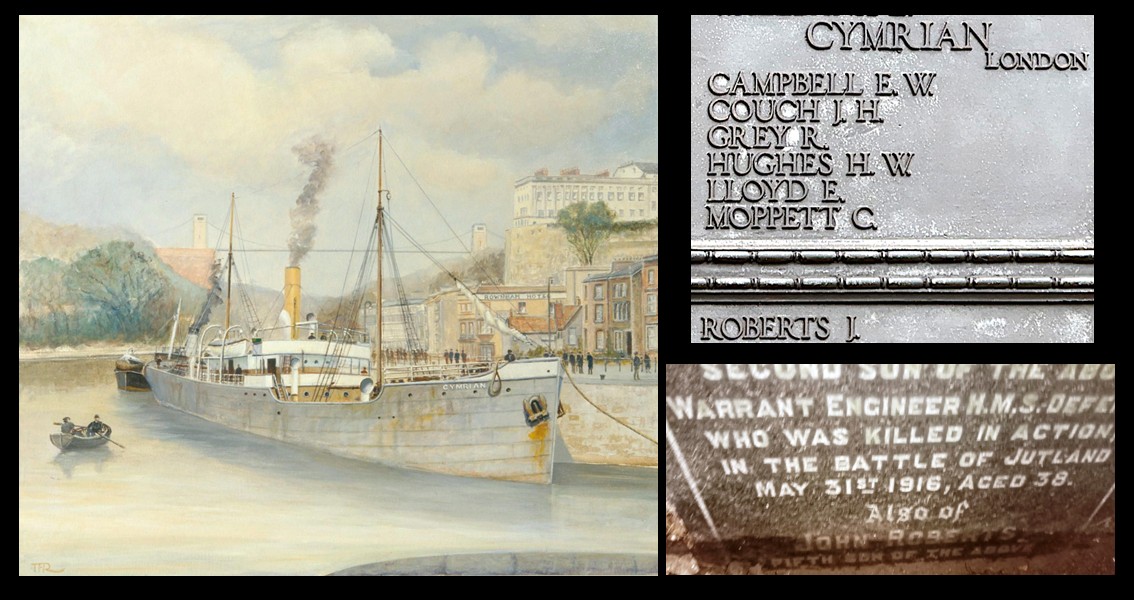
First Engineer, S.S. Cymrian, Merchant Navy
John ‘Jack’ Roberts was born in 1888 in Conway, Caernarfonshire to Thomas Roberts a master mariner and Catherine Roberts née Owens, both originally from Conway. By 1891 the Roberts family had moved to Cardiff and were living at 12 Loudoun Square, Butetown and by 1901 had moved to 184 Corporation Road, Grangetown. The census records them as speaking both Welsh and English. His mother, Catherine, died in 1913 and is buried at Cathays Cemetery. Jack married Isabella Laverick, a superintendant typist at St Stephen Church, Butetown on 2 Jan 1915. At the time Jack was working as a marine engineer. They lived with her parents at 37 Pomeroy Street and had one daughter together, Olwen Isabella Roberts, born in Jan 1917. During WWI Jack served in the Merchant Navy. He was killed, believed drowned, when the S.S. Cymrian, a coal shop heading between Newport and Dublin, was torpedoed by a U-boat and sunk in the St. Georges Channel on 25 Aug 1917 with the loss of ten crew. He was 28 years old. Both Jack and his brother Thomas Henry Roberts, who had been killed at sea the previous year, are remembered on his mother’s headstone. Their father, Captain Thomas Roberts, died later in 1917 at home in Corporation Road. Jack is remembered on the Tower Hill Memorial to Merchant Seamen. There is a possibility he is also the John Roberts remembered on the Pembroke Terrace Welsh Calvinistic chapel memorial. Commonwealth War Grave Commission record.
JOHN ROBERTS
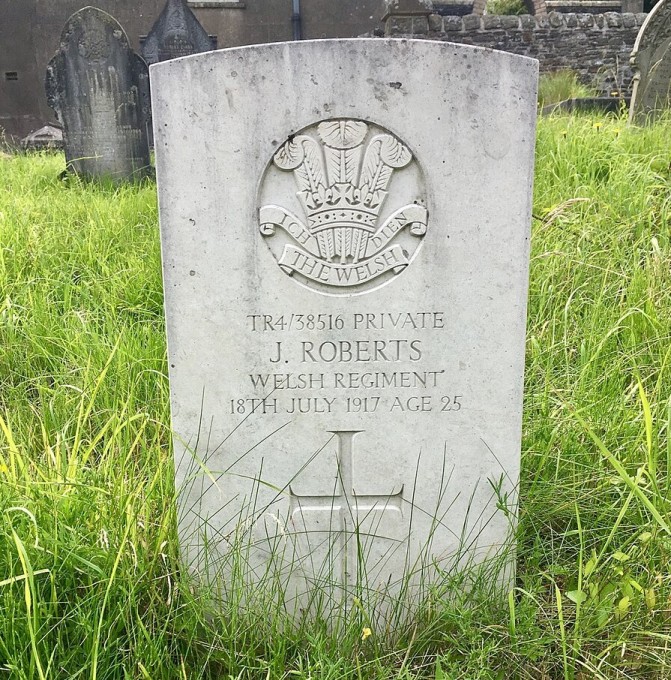
Private, 22nd Battalion, Welsh Regiment (Service Number: TR/4/38516)
John Roberts was born in 1893 in Groeswen, Glamorgan to Thomas Roberts, a road labourer and grave digger and Sarah Roberts née Williams, both originally from Groeswen, Glamorgan. In 1911, at the age of 18, John was living in the family home and working as a coal miner. He signed up on 26 Jun 1917 in Caerphilly. His army records show he was 5ft ½in with a 30in chest and gave his occupation as a farm labourer. When he joined up he assigned to the 66th Training Reserve Battalion. He took his own life on 18 Jul 1917 after being in the army for less than a month. He was aged 25. His body was found on a railway near Oswestry near to his army camp. Witness statements at his inquest make sad reading. He has reportedly said to colleagues he had been kicked by a horse prior to joining up and had pains in his head. Prior to his disappearance he had stated he was tired of army life and looked weary. He had been recommended for medical discharge on the basis of being medically unfit to serve, as early as 30 Jun. He is buried at Groeswen Welsh Congregational Chapel. Commonwealth War Graves Commission record. There is a possibility he is the John Roberts named on the war memorial in Pembroke Terrace Welsh Calvinistic Methodist chapel, the thinking being that the chapel in Groeswen may have been on the same circuit.
ARTHUR ROGERS
Second Lieutenant, 1st/7th Battalion, Royal Welsh Fusiliers
Arthur Rogers was born in Llanwnda, Caernarvonshire in 1897, the only child of Rev John Rogers, a Calvinistic Methodist Minister and one time examiner in Greek and history at Bala Theological College, originally from Bersham, Denbighshire and Annie Ellen Rogers née Roberts originally from Bala, Merionethshire. In 1901 the Rogers family were living at Minawel, Llanwnda. His father passed away in 1903. In 1911 Arthur was living at Bronwylfa, Bala with his widowed mother and attending Bala Grammar School where he captained the football team and held the school record for the 100 yds sprint. He and his mother moved to 34 Colum Road, Cardiff and Arthur worked at the Atlas Assurance Company Ltd. He enlisted with the 6th Battalion, Royal Welsh Fusiliers in Nov 1915 and was posted to Egypt on 14 Dec 1916. His mention on WWI Wales Bala War Memorial page describes how he was attached to 158 Brigade, 53rd (Welsh) Division who helped guard the Suez Canal before taking part in operations to drive the Turks out of the Sinai. The EEF then turned its attention onto driving the Turks out of Palestine, and on 26 Mar1917 launched its first offensive against the coastal city of Gaza, which guarded the road to Jerusalem. Initial gains during the day were lost when the assaulting divisions lost touch with each other and communication broke down when a thick fog cloaked the battlefield. Arthur was killed in action during the fighting that day. He was aged 20 and is buried at Gaza War Cemetery (plot II.C.11.) He is remembered on the Pembroke Terrace Welsh Calvinistic Methodist Chapel WWI War Memorial in Cardiff as well as the Bala War Memorial. Commonwealth War Graves Commission record.
ARTHUR THOMAS
Gunner, 50th (Northumbrian) Division, Royal Field Artillery (Service Number: 198641)
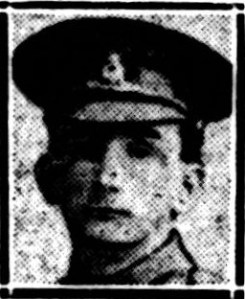
Driver Arthur Thomas Royal Field Artillery
Arthur Thomas was born in Cardiff on 19 Feb 1891, to Thomas Thomas, a solicitor’s clerk and Mary Thomas nèe Millward, both originally from Eglwysilan, Glamorgan. In 1891 and 1901 the family lived at 7 Adamsdown Square. Arthur was admitted to Cardiff High School on 25 Apr 1904 and he left the school in 1907. He then became an accountant in his father’s office at 34 Queen Street. By 1911 the Thomas family were living at 45 Kimberley Road. Arthur enlisted in Cardiff in Jan 1917. He had been serving on the Western Front for over a year when he was taken prisoner on 27 May 1918, during a major attack by the Germans on the opening day of the Battle of the Aisne. After receiving a letter from him dated 10 Aug, his mother heard no more. Arthur Thomas died at Trelon, aged 27, when a prisoner of war on 18 Aug 1918. He is buried nearby in Glageon Communal Cemetery, Nord, France. He is remembered both on the Cardiff High School War Memorial and the Pembroke Terrace Welsh Calvinistic Methodist Chapel WWI War Memorial. He was also remembered on his parent’s headstone in Welsh in Cathays Cemetery which has since been removed (plot W1095). Commonwealth War Graves Commission record.
ROBERT PENDRILL THOMAS
Third Engineer, S.S.Bayronto, Merchant Navy
Robert Pendrill Thomas was born in 1888 in Morrison, Glamorgan to Robert Thomas, a rollerman at a steelworks, originally from Aberavon, and Hannah Thomas née Davies originally from Morriston, Glamorgan. In 1891 the Thomas family were living at Plas-y-Coed, Morriston. By 1901 they had moved to Railway Terrace, Pontardawe. In 1911 Robert Pendrill Thomas had moved to Cardiff, was working as a fitter and was living with his sister and her family at ‘Plas-y-coed’, 7 Cefn Coed Road, Cardiff. His brother-in-law was Dr David Evans, professor of music in Cardiff University and composer/arranger of many works including the popular hymn Be Thou My Vision. In WWI Robert served as a third engineer in the merchant nave on board S.S.Bayronto. On 30 Jul 1918 the S.S.Bayronto was torpedoed and damaged by a German U-boat. The S.S.Bayronto survived but two men including Robert, aged 30, were killed. His body was brought home to Wales on 12 Aug 1918 and buried at St Samlet church, Llansamlet. A CWGC headstone has recently been added in the churchyard which includes the words ’buried elsewhere in this churchyard. He is remembered on the Pembroke Terrace Welsh Calvinistic Methodist Chapel memorial in Cardiff (mis-spelt R Pendal Thomas) where his brother-in-law Dr David Evans was a deacon. He is also remembered on the Tower Hill Memorial to Merchant Seamen in London and on the Pontardawe War Memorial and St Peter’s Church Memorial, Pontardawe. Commonwealth War Graves Commission record.

 Roath Local History Society