
For casualties whose surnames begin with other letters of the alphabet please visit the main Roath Virtual War Memorial page.
WILLIAM PAUL CALEY
Private (Signaler), 10th Battalion, Yorkshire Regiment (Service Number: 203670)
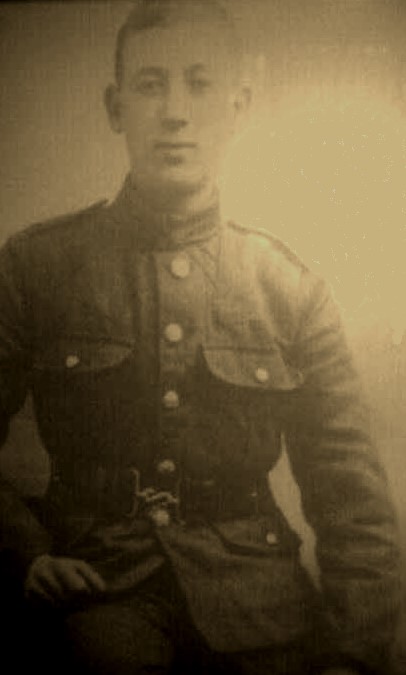
William Paul Caley was born on 19 Dec 1897 in Cardiff to William Singleton Caley, a waterworks inspector, originally from Port Talbot, and Harriet Laura Caley née Hill, originally from Birmingham. He was baptised in St Mary the Virgin church on 5 Mar 1898 when the family were living at 49 Hereford Street, Riverside. By 1901 the Caley family had moved to 65 Robert Street, Cathays and were still there at the time of the 1911 census. William attended Crwys Road School from 1905 to 1911 before going onto work at Masters & Co Counting House. In WWI he served as a Signaller in the 10th Battalion, Yorkshire Regiment. He was killed in action on 5 Nov 1917, aged 20, on the Western Front in France. His burial place in unknown. He is remembered on the Tyne Cot Memorial, Belgium (Panel 52 to 54). Commonwealth War Graves Commission record.
PERCIVAL AUSTIN CALLARD
Private, 16th Battalion, Welsh Regiment (Service Number: 23649)
Percival Austin Callard was born in Neath in 1896 to James Callard, a railway guard, originally from Neath, and Emily Callard nee Hanford originally from Skewen. By the time Austin was four years old the family had moved to Roath and were living at 79 Clifton Street and they were still living there in 1911. Austin enlisted in Cardiff and served as a Private with the 16th (Cardiff City) Battalion Welsh Regiment on the Western Front. He was killed in action on 1 Aug 1917 aged 20. He has no known grave. He is remembered on the Menin Gate Memorial (panel 37) at Ypres, Belgium. He was remembered on a war memorial plaque (now believed lost) and a Roll of Honour of unknown origin. Commonwealth War Graves Commission record.
GEORGE SPENCER CAMPBELL
Lance Corporal, 6th Company, Machine Gun Corps (Infantry) (Service Number: 64977)
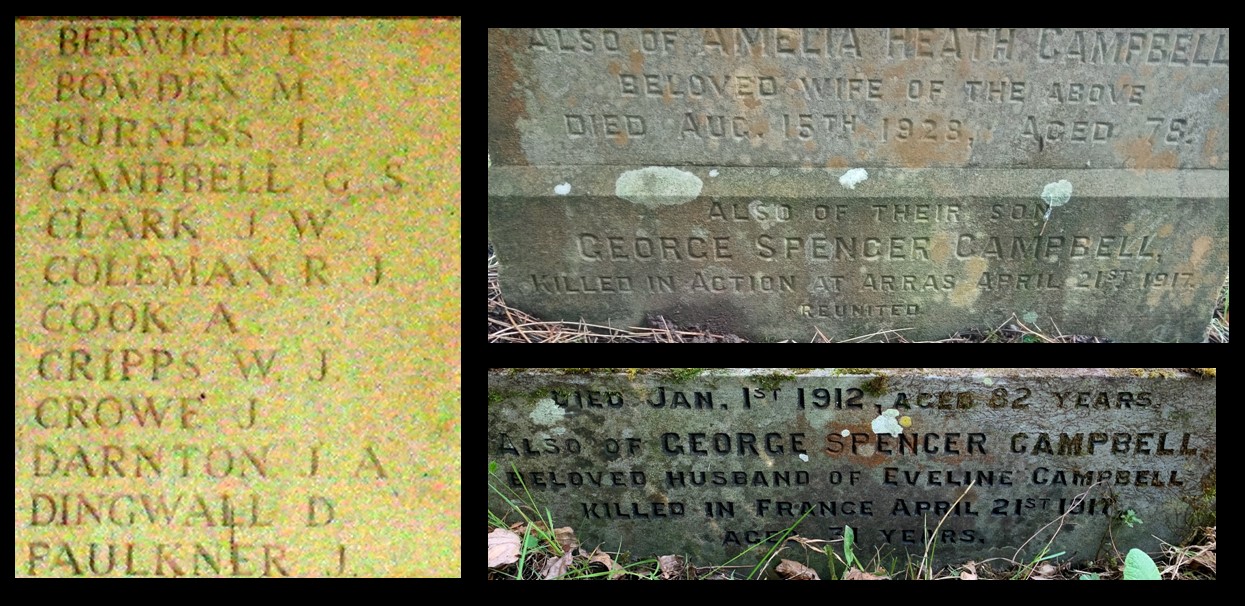
George Spencer Campbell was born in Cardiff in 1885 to George Campbell, a master mariner, originally from Aberdeen and Amelia Heath Campbell née Lee, a lodging house keeper, originally from Bideford, Devon. His father sadly died when George was aged just one. The Campbell family grew up at 28 Metal Street, Adamsdown. At 15 George was a clerk in a colliery office. In 1911 he is lodging in Aberavon and working as a manager of a bottled beer store. On 15 Apr 1914 he married Evelyn Amelia Paddison at St Matthews church, Duffryn, near Neath. They had one son together George Charles Lee Campbell, born May 1915 in Neath. He enlisted in Cardiff in Aug 1916 initially with the Gordon Highlanders before transferring to the Machine Gun Corps where he served as a Lance Corporal. He was killed in action at the Battle of Arras on 21 Apr 1917 in France aged 31. He has no known burial place but is remembered on the Arras Memorial (Bay 12). He is also remembered on his parent’s headstone at Cathays Cemetery (grave O1024a) as well as his in-laws headstone at St Matthews, Neath. Commonwealth War Graves Commission record. His son George Charles Lee Campbell went on to graduate as an engineer and worked in Coventry and then Bradford.
JAMES SUMMONS CESHION
Private, 16th Battalion, Royal Welsh Fusiliers (Service Number: 36642)
James Summons Ceshion was born in Cardiff in 1879 to John Ceshion, a general labourer, originally from Yorkshire and Isabella Ceshion née Phillips, originally from Scotland. In 1881 the family were living in Bromfield Street, Grangetown. James’s father died when he was just four. In 1891 the Ceshion family had moved to 19 Howard Street, Splott. By 1901 James, then aged 21, was working as a draper’s assistant in Portsmouth. In 1911 James had returned to Cardiff, still working as a draper’s assistant, and living in the family home in Howard Street. He enlisted in Nov 1915 in Cardiff joining the Royal Welsh Fusiliers. He was posted to France in Mar 1916 and killed in action on the Western Front on 11 Jul 1916 aged 36. He has no known grave. He is remembered on the Thiepval Memorial (Pier and Face 4 A). He is also remembered on the City United Reformed Church war memorial. Commonwealth War Graves Commission record.
RICHARD CHAMBERS
Sapper, Inland Waterways and Docks, Royal Engineers (Service Number: WR/552616)
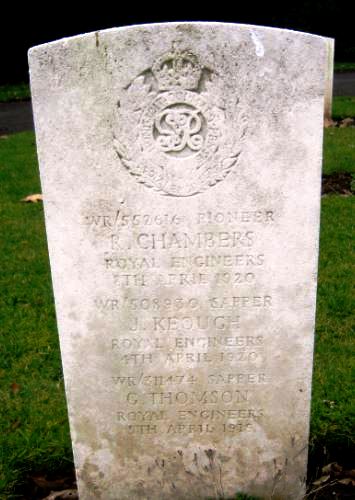
Richard Chambers was born in 1876 though we know nothing of his family background other than he was single. He enlisted in the Royal Engineers on 11 Sep 1916 and was discharged on 16 Sep 1918. He served as a Sapper in the Inland Waterways and Docks division. His records showed he served abroad which may have been in any number of locations including France, Mesopotamia, Salonika etc. The work of the Inland Waterways and Docks division is explained here. His records show he suffered from VDH (heart disease) and bronchitis. Richard died on 4 Apr 1920 aged 40 at Clyne House Red Cross hospital on Newport Road, Cardiff (his death registration states he was 40 but his pension records state he was born in 1876 making him a bit older). His military pension record shows his address as 36 Maria Street, Docks, Cardiff which in the 1922 Cardiff Directory was a boarding house. He is buried at Cathays Cemetery, Cardiff (Plot EB. 77) alongside two other members of the Royal Engineers. Commonwealth War Graves Commission record. (The burial record indicates he died at Clyne House Hospital but 24 Shakespeare Street crossed out next to it. This may have been a genuine error or may indicate an address he had connections with e.g. friend, relative or as a boarder. The address was occupied by Patrick Donovan in the 1911 census and 1922 Cardiff directory).
GEORGE CHURCH
Private, 1st/5th Battalion, Welsh Regiment (Service Number: 8377)
George Church was born in Canton, Cardiff in 1883 to Thomas Church, a labourer, and Joanna Church nèe Gould, both originally from Cardiff. In 1891 he was an inmate at Ely Industrial School, his father having died he previous year. His son Windsor Church was born in 1909 to Gwen Church nèe Roderick. In they were living at 75 Ethel Street, Canton. At the time of the outbreak of war Private George Church had already served three years in India and immediately rejoined the Welsh Regiment, going to the front with the first Expeditionary Force. He performed a number of brave deeds on the Western Front and was awarded the Distinguished Conduct Medal (DCM) for bravery at Givenchy, Jan 1915, which he received in a ceremony at Cardiff Arms Park in Oct 1915. He was wounded twice and sent home. After recovering the second time he was offered a post at home but was keen to return to the front. He drowned, aged 34, off the coast of Italy. He was aboard a troop ship R.M.S. Transylvania when it was torpedoed and sunk on 4 May 1917. He is buried at Savona Town Cemetery, Italy (Grave E9). Commonwealth War Graves Commission record. He was remembered on the Oddfellows WWI plaque. His son Windsor served at the Infantry Training Centre with the Welsh Regiment in WWII.
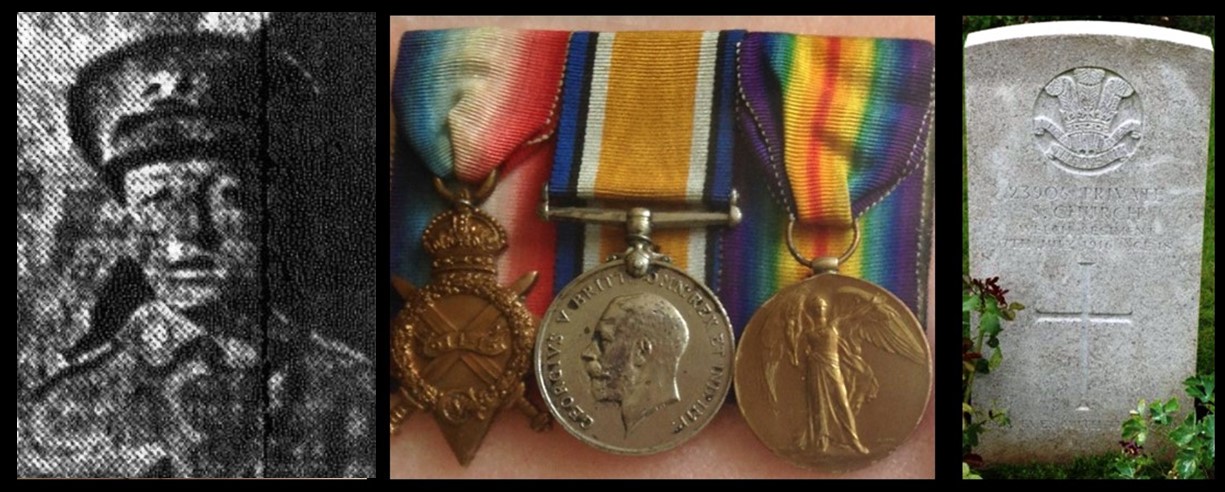
STANLEY TEIFI MIRUS CHURCH
Private, 16th Battalion, Welsh Regiment (Service Number: 23905)
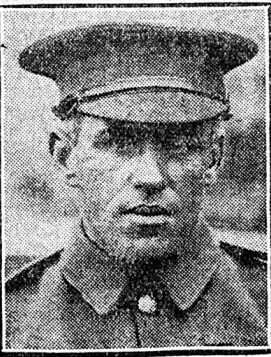
Stanley Teifi Mirus Church was born on 12 Dec 1897 at Cambrian House, Llandyssil, Cardiganshire to Edward Church, a former Sergeant Major in the Royal Field Artillery, and then licensed victualler at the Red Lion, and Martha Church née Lewis, both originally from Radyr, Glamorgan. By the time Stanley was baptized on Feb 18th 1898, Edward and Martha had moved to become hotel proprietors at the Cliwyn Arms, Llandyssil. Stanley’s middle name may derive from the fact that the River Teifi flows next to the Cilgwn Arms. By the time of the 1901 census the Church family had moved back to the Cardiff area were living at 18 Old Radyr Road, Whitchurch with Edward working as a soldier- recruiting sergeant for the agent reserve. In 1911 they had moved again to the Masonic Lodge, 8 Guilford Street, Cardiff where Edward was caretaker assisted by Martha. By this time they had 13 children, all living with them at the Masonic Lodge. Stanley was still at school in 1911 but after leaving school he worked for the Cardiff Railway Company. He enlisted with the 16th ‘Cardiff City’ Battalion, Welsh Regiment in Cardiff in Jan 1915. He was killed in action on 7 Jul 1916, aged 18, at Mametz Wood where his regiment took heavy losses in the face of German machine gun fire. He is buried at Flatiron Copse Cemetery, France (grave VI.J.6). He is remembered on the Charles Street Wesleyan Methodist Church war memorial plaque (in storage at Cathays Cemetery) and the Cardiff Railway roll of honour at the Pierhead Building, Cardiff Bay. Commonwealth War Graves Commission record.
ARTHUR JAMES CLACKETT
Private, 1st Battalion Honourable Artillery Company
‘Archie’ Clackett was born in 1895 to Cephas Clackett, a commercial traveller for a paint and varnish company, and Leonora Clackett (née Leist). In 1911 the family lived in Boverton Street, Roath. Arthur joined the Honourable Artillery Company and died on 8th Feb 1917 aged 21 in Northern France. He is buried at Queens cemetery, Bucquoy, Pas de Calais, France. At the time of his death the Clackett family were living at Oakdene, Penylan Hill. Looking at a Trade Directory of the time Oakdene was down from Green Lawn, approximately where 21 Cyncoed Road is today. Commonwealth War Graves Commission record.
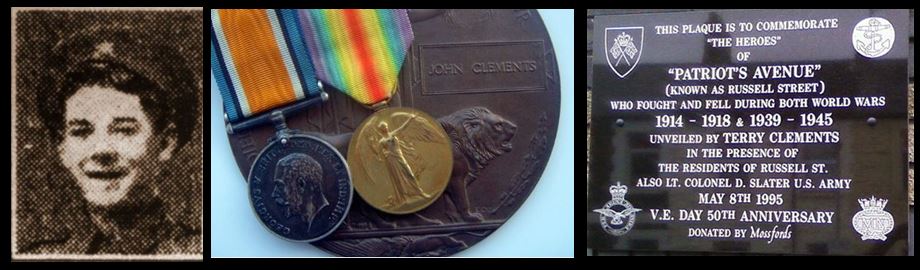
JOHN CLEMENTS
Private, 2nd/4th Battalion, Oxford and Bucks Light Infantry (Service Number 6710)
John Clements was born in Cardiff on 30 Jan 1896. His father, Walter Clements, was a Corporation labourer and originally from Ledbury, Herefordshire and his mother Elizabeth Clements nee Brown was originally from Overbury, Worcestershire. In the 1901 Census the Clements family are living in the ‘cottage behind the laundry’ near Sandringham Road, opposite Marlborough Road School, the school which John first attended. He later went to Tredegaville School when the family moved to 34 Russell Street. After leaving school he was a general labourer before joining the 7th (Cyclist) battalion of the Welsh Regiment. He was then drafted into the 2/4th Oxford and Buckinghamshire Light Infantry – and he was one of thirteen men from the city who lost their lives whilst serving with that battalion. On the 21st December 1916 John was with his battalion in reserve when he was killed in action, aged 20, probably by German shellfire. The battalion war diary simply states ‘The Berks and Gloucesters again took first innings in the trenches, whilst the Bucks and ourselves stayed in support. Battalion Headquarters with A and B Companies were in Wellington Huts near Ovillers; C and D went two miles further forward to some scattered dugouts between Thiepval and Mouquet Farm.’ His death did not warrant a further mention at the time. He was buried in Ovillers Military Cemetery, Somme, France (grave I. D. 17). His father Walter and brother Charles also served in the Welch Regiment in WWI. He brother Walter served 20 years in the Royal Navy. There is a memorial plaque on the Clements house in Russell Street. The plaque was originally unveiled in 1995 and on the New Park Liberal Club in City Road before it was redeveloped into flats. The plaque pays tribute to patriots of Russell Street who fought in both World Wars and makes reference to the street’s unofficial name – Patriot’s Avenue. The plaque was unveiled by Terry Clements, a relative of John Clements. Commonwealth War Graves Commission record.
ALBERT JAMES CLIFFORD
Corporal, 9th Battalion, Devonshire Regiment (Service Number: 11700)
Albert James Clifford was born in 1897 in Cardiff to Arthur Clifford, originally form Marshfield, Gloucestershire and a ticket collector on Great Western Railways, and Julia Clifford nee Potter, originally from Imber, Wiltshire. In 1901 the Clifford family were living at 77 Sanquahar Street, Splott, but by 1911 they had moved to 86 Clifton Street, Roath. In 1911 Albert is 14 and working as an errand boy at University College. He enlisted in Cardiff and served with the 9th Battalion of the Devonshire Regiment in France and was promoted to Corporal. He was killed in action on 30 Sep 1915 aged 18 at the Battle of Loos. He has no known grave. He is remembered on the Loos memorial (panel 31-35). He was also remembered on a Roll of Honour at a place not yet identified. Commonwealth War Graves Commission record.
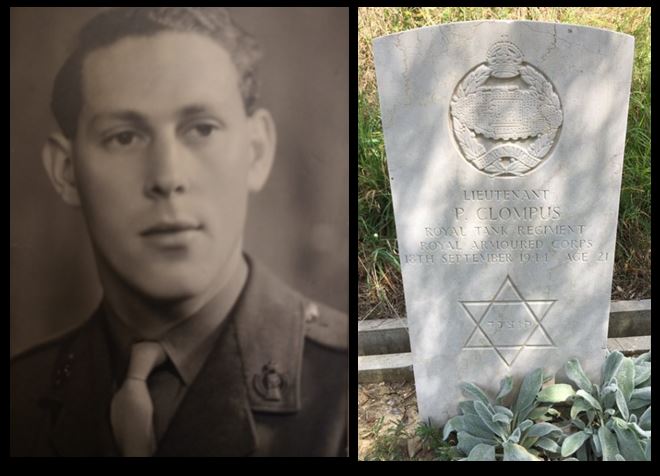
PAUL CLOMPUS
Lieutenant, C Squadron 12th, Royal Tank Regiment, RAC (Service Number 264511).
Paul Clompus was born in Cardiff in 1922 to Harry Clompus, a pawnbroker, originally from Palanga in Lithuania and Esta Clompus née Zeitlin from Manchester. He attended Cardiff High School and the family lived at 4 Constellation Street, Adamsdown and then at 65 Marlborough Road, Penylan. He was studying to become an accountant when he was called up. He trained at Sandhurst and served in North Africa and then in Italy where he died on 18 Sep 1944 aged 22. He was a tank commander in the Battle of Rimini and his tank suffered a direct hit, killing him instantly. He is buried in Gradara War Cemetery in Italy (Grave number I C 31). He is remembered on a plaque at Cardiff United Synagogue. Commonwealth War Graves Commission record.
AARON SIMEON COHEN
Lieutenant, Royal Army Medical Corps
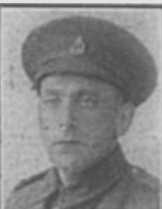 Aaron Simeon ‘Zak’ Cohen was born on 2 Apr 1891 in Ferndale, Glamorgan to Eli Cohen, a pawnbroker, originally from Kaunas, Lithuania and Yetta Cohen née Melcher, originally from Poland. By 1901 the Cohen family had moved to 94 Woodville Road, Cathays. Aaron attended Crwys Road school and Howard Gardens Secondary school and then went on to South Wales (Cardiff) University. He qualified as a medical doctor and won numerous scholarships along the way. He trained at both Westminster and St Mary’s hospitals in London before starting medical practice at Foulby, Yorkshire and then going onto Chelsea Infirmary. He joined the Royal Army Medical Corps in May 1915, served as a Lieutenant, and was attached to the 8th battalion Somerset Light Infantry. He was killed in action at the Battle of Loos on 25 Nov 1915 aged 24. He has no known burial place. He was remembered on the Loos Memorial in France (panel 136) as well as the war memorial plaques at Howard Gardens, Cardiff University, and the plaques for Windsor Place and Cathedral Road synagogues, Cardiff. Commonwealth War Graves Commission record.
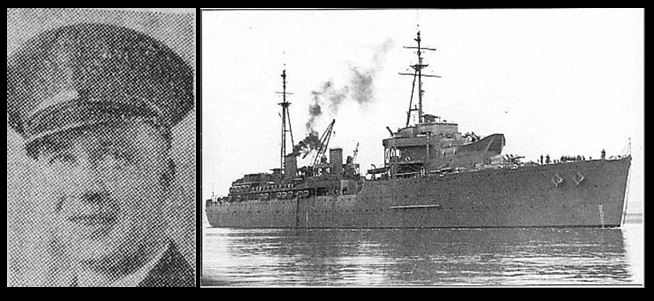
WILLIAM KENNETH LLEWELLYN COLLARD
Leading Supply Assistant, H.M.S. Hecla, Royal Navy (Service Number: D/MX 80195)
William Kenneth Llewellyn Collard was born on 15 Oct 1910 in Newport to William Samuel Collard, a company secretary to a Provisions company, originally from Bassaleg and Annie Collard nee Evans originally from Llanfrecha, Monmouthshire. He was educated at Croesyceiliog Council School and later at West Monmouth Grammar School. He worked in the grocery trade, initially in Newport and then as a representative in West Wales basing himself in Swansea and attending Argyle Street Baptist church. On 7 Aug 1939 he married Violet Doreen Waters, a post office clerk, at Woodville Road Baptist church. After living for a time at Pienwood Road, Uplands, Swansea they then relocated to Cardiff and lived at 66 Monthermer Road, Cathays. He joined the Royal Navy in Nov 1940. He served on board HMS Hecla as a leading supply assistant. On 15 May 1942, the destroyer HMS Hecla (F 20) struck a mine laid by a German minelayer off Capetown, South Africa. The explosion hit amidships, put the steering gear out of action and caused a big leak. The ship was towed to Simonstown, where she was repaired. 24 crew members were lost including Kenneth Collard aged 31. He is remembered on the Plymouth Naval Memorial (Panel 71, Column 3). He is also remembered on the Woodville Road Baptist church WWII memorial plaque. Commonwealth War Graves Commission record.
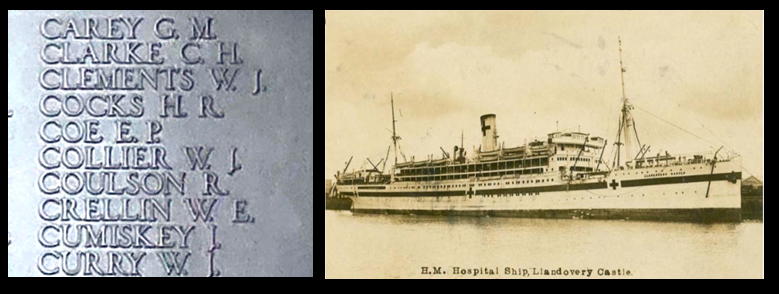
WILLIAM JOHN COLLIER
Ordinary Seaman, Merchant Navy, H.M.H.S. Llandovery Castle
William John Collier was born in Cardiff in 1902, one of seven children born to Thomas Newton Collier, a foreman dry dock rigger originally from Beer, Devon and Dorcas Alwyn Collier née Truscott originally from Cornwall. In 1911 the Collier family lived at 39 Fitzhamon Embankment before later moving to 89 Broadway, Roath. William Collier joined the merchant navy and was killed on 27 Jun 1918 when the Canadian hospital ship Llandovery Castle was torpedoed off the coast of County Cork, Ireland. He was 17 years old, one of the youngest killed. 234 doctors, nurses, members of the Canadian Army Medical Corps, soldiers as well as seamen died in the sinking and subsequent machine-gunning of lifeboats. Firing at a hospital ship was against international law and standing orders of the Imperial German Navy. The captain of U-boat sought to destroy the evidence of torpedoing the ship. When the crew, including nurses, took to the lifeboats, the U-boat surfaced, ran down all but one of the lifeboats and machine-gunned many of the survivors. William John Collier is remembered on the Tower Hill Memorial for Merchant Seamen and on the Broadway Methodist church plaque now at Trinity Centre. Commonwealth War Graves Commission record.
JOHN BRYANT COLLINS
Private, C Company, 15th Battalion, Welsh Regiment, (Service Number: 35213)
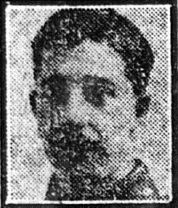
John Bryant Collins was born in Cardiff in 1895 to Samuel Henry Collins, a bus and van driver originally from High Ham, Somerset and Helen Collins née Young originally from Sutton Mallet, Somerset. He attended Albany Road school. Before the war Bryant worked as a milkman. His father died in 1905 and his mother remarried to Simeon J Wheadon. In 1911 the family were living at 143 Arabella Street, Roath. He enlisted in Oct 1915 and went to the front in Mar 1916. He was killed in action on 11 Jul 1916, aged 21, at the Somme, France. He is buried at Serre Road Cemetery No.2 in Somme (grave XXVI. H. 14). Commonwealth War Graves Commission record. His brother Robert E Collins was also killed in WWI.
ROBERT EDWARD COLLINS
Private, 49th Siege Battery, Royal Garrison Artillery (Service Number 737)
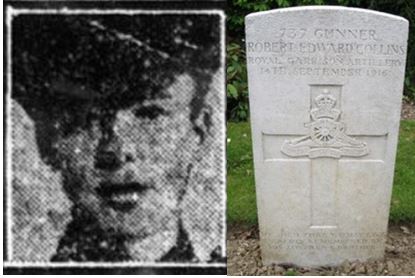
Robert ‘Rob’ Edward Collins was born in Cardiff on 22 Jun 1898 to Samuel Henry Collins, a bus and van driver originally from High Ham, Somerset and Helen Collins née Young originally from Sutton Mallet, Somerset. He attended Albany Road school. His father died in 1905 and his mother remarried to Simeon J Wheadon. In 1911 the family were living at 143 Arabella Street, Roath. He enlisted in Jul 1915 in the Royal Garrison Artillery and went to the front in Mar 1916. He died at the Somme, France on 14 Sep 1916 aged 18. He died at the base hospital from shell shock and injuries to the spine when a dug out fell in on him. He is buried at the Abbeville Communal Cemetery, Somme, France (grave: III. A. 3.). Commonwealth War Graves Commission record. His brother John Bryant Collins was also killed in WWI.
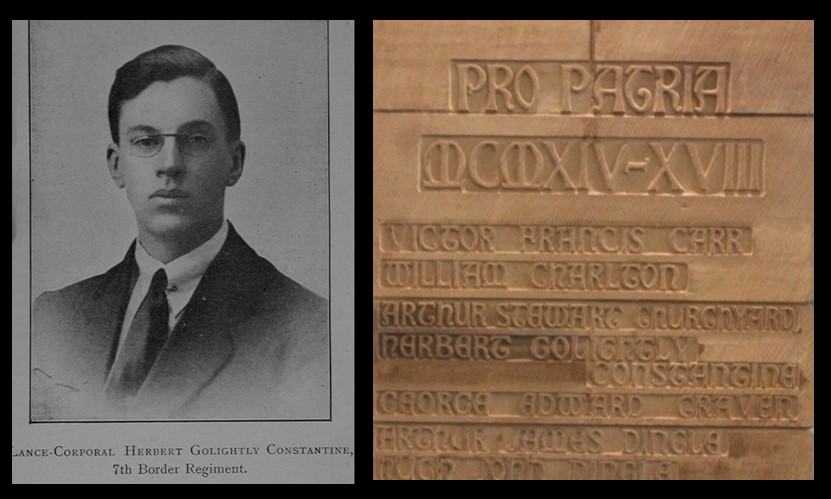
HERBERT GOLIGHTLY CONSTANTINE
Lance Corporal, “C” Company, 7th Battalion, Border Regiment (Service Number: 36234)
Herbert Golightly Constantine was born in Cardiff in 1899 to Robert Constantine, manager of a marine engineering works, originally from Bentham, Yorkshire and Mary Hannah Constantine née Golightly, originally from Durham. The Constantine family lived at 11 Longcross Street and Herbert attended Broadway Methodist church. He was educated at Durham School. In WWI he served as a Lance Corporal with “C” Company, 7th Battalion, Border Regiment having previously served with the South Lancashire Regiment. He was killed in action on the Western Front on 2 Jun 1918 aged 18. He is buried at the Acheux British Cemetery in France (Plot 1. Row D. Grave 23). He is remembered on the Broadway Methodist WWI plaque now at Trinity church, a plaque at Durham School chapel and a plaque at St Margaret’s of Antioch church, Durham. Commonwealth War Graves Commission record. His elder brother Robert served in the Royal Navy in WWI, leaving the navy in 1925. His parents moved to “Kenilworth,” Cefn Coed Road.
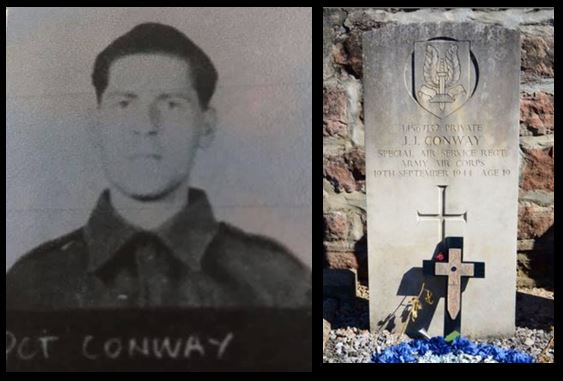
JOHN JOSEPH CONWAY
Private, Special Air Service Regiment (Service Number: 14567132)
John ‘Johnny’ Joseph Conway was born on 4 Feb 1925 in Cardiff to Edward Conway, a dock labourer, and Catherine Conway nee Warnock, both originally from Cardiff. The Conway family lived at North William Street, Newtown, Cardiff. His father died when Johnny was just ten and in 1939 we find Johnny working as a hotel porter in the Esplanade Hotel, Penarth aged 14. He enlisted in the General Service Corps in Mar 1943 before transferring to the Royal Artillery and later the Oxfordshire and Buckinghamshire Light Infantry. In Mar 1944 he volunteered for the SAS and went on parachute training where his instructor noted him to be ‘a good performer, cheerful, keen and confident’. Soon after he took part in Operation Loyton where the SAS parachuted into a remote region in Occupied France, close to the German border on 12 Aug 1944. It proved a costly mission. Nearly half of those who parachuted into France never came home – a horrific attrition rate. It was only ever meant to be a quick in-and-out mission, a fortnight at the most. In the end it went on for two months. The idea had been to drop behind enemy lines and create havoc ahead of the advancing allies. There were two miscalculations. The first was that the Allied forces were advancing much more slowly than anticipated, thereby prolonging the operation indefinitely. The second was that the area was not sparsely defended, as had been thought. On the night of 6-7 Sep 1944 Jonny Conway parachuted into a drop zone near Pexonne in the Vosges department of eastern France to reinforce Operation Loyton. He and two others from 2 SAS, Corporal Michael Fitzpatrick and Lance Corporal John Herbert Elliott (who had broken his thigh on landing), were separated from the rest of the stick. They took shelter in a farm building but were captured on 16 Sep, then executed on 19 Sep 1944. Johnny Conway was just 19 at the time and the second youngest of the SAS victims to die in Operation Loyton. He is buried at Moussey churchyard in France. He is also named on a memorial at the National Memorial Arboretum, Staffordshire, dedicated to the hundred plus French resistance fighters who were also killed as a result of Operation Loyton. Commonwealth War Graves Commission record. (Daily Mail article on Operation Loyton mentioning Johnny Conway).
EDITH COOK
Civilian Casualty
Edith Cook died at 12 Agincourt Road, Roath, in a bombing raid on 3 Mar 1941. Her daughter Margaret was also killed, as were five other civilians in the same road. On the other side of the road was Marlborough Road school which was severely damaged that night and later demolished. Edith Cook née Francis was born on 20 Jan 1888 in Cardiff to Daniel Francis, a carpenter, originally from Llanthew, Pembrokeshire and Martha Francis née Morgan originally from Llawhaden, Pembrokeshire. In May 1918 Edith, then aged 27 and living in Shirley Road with her parents, married Leslie George Cook from Ontario at St Andrew’s parish church, Cardiff. Sergeant Leslie Cook was a quartermaster in the 1st Canadian Contingent of the Canadian Expeditionary Force. It is not clear how they met but maybe Sergeant Cook was being treated in one of the war hospitals in Cardiff. It appears they then went to live in Ontario where their daughter Margaret Gwendoline Cook was born in 1919 and where they were living in 1921 in Paris, Ontario with Leslie working as a bricklayer. Their second daughter Joyce Mary Cook is born back in Cardiff in 1922. In 1939 Edith, now widowed, is living at 12 Agincourt Road, with their daughter Margaret, a typist for a sales organisation, an ARP and nursing auxiliary. They were both killed that night in the air raid and are both buried at Cathays cemetery (grave EH 2124). Commonwealth War Graves Commission record.
MARGARET GWENDOLINE COOK
Civilian Casualty
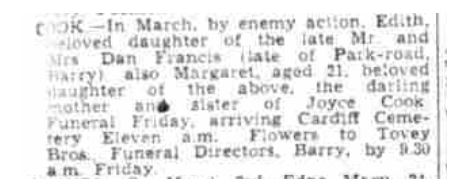
Margaret Gwendoline Cook was born in Ontario, Canada in 1919 to Leslie George Cook, a former Canadian solider and later bricklayer and Edith Cook née Francis from Cardiff. Her sister Joyce Mary Cook was born back in Cardiff in 1922. In 1939 Margaret is living at 12 Agincourt Road, with her widowed mother Edith and working as a typist for a sales organisation, an ARP and nursing auxiliary. Both Margaret (21) and her mother Edith (48) were killed on 3 Mar 1941 in their house during an air raid. They are both buried at Cathays cemetery (grave EH 2124). Commonwealth War Graves Commission record.
REGINALD CHARLES COOKE
Second Lieutenant, 9th Battalion, Welsh Regiment
Reginald Charles Cooke was born on 17 Jun 1886 at 21 Northcote Street, Roath to Charles Peter Cooke, a wholesale grocer and ship broker, originally from Gloucester and Annie Eliza Cooke née Rimron originally from Cardiff. The family lived at 49 Wellfield Road when Reginald was attending school and also Station Road, Llanishen. Reginald went to Roath Park Primary school and Howard Gardens School before entering Cardiff High School in the first ever intake with roll number 5 in Sep 1898 and remained there until Jul 1901. Reginald then attended Bristol Grammar School until 1903. After school, he served his articles with Bolton and Davidson, solicitors, in Bristol and, after qualifying in Mar 1911, practised as a solicitor in Weston-Super-Mare and then in 1913 took up a partnership in the law firm of W.B. Francis and Cooke, 31 Queen Street, Cardiff. Reginald was a very fine hockey player for Weston-Super-Mare, Llanishen and Somerset and he won four Welsh international hockey caps as a forward in 1912-13 (v Scotland at Wrexham lost 1-3) and 1913-14 (v Ireland at Whitchurch lost 1-2; v Scotland at Aberdeen won 3-1; and v England at Weston-Super-Mare lost 2-6). The victory over Scotland was Wales’ first against them in nine years. Reginald enlisted in Aug 1914 in Cardiff as a private in the Cardiff Pals; was gazetted to the 9th Battalion Welsh Regiment on 10 Apr 1915; and went to the Western Front in Oct 1915. He was twice Mentioned in Despatches and was awarded the Military Cross in Jun 1916 for repeatedly cutting the enemy’s wire under heavy fire. Second Lieutenant Reginald Cooke was killed in action, aged 30, in the 19th Division’s assault on trenches at Bailiff Wood near Contalmaison during the Battles of the Somme on 7 Jul 1916. Many of the attacking troops here were caught by their own creeping artillery barrage. He is commemorated on the Thiepval Memorial to the Missing, France. He is also remembered on the Cardiff High School Memorial, Bristol Grammar School Memorial and a plaque dedicated to him at Holy Trinity, Weston-Super-Mare. Commonwealth War Graves Commission record.

WILLIAM ARROWSMITH COOK
Lance Corporal, 1st Battalion, Gloucestershire Regiment (Service Number: 8026)
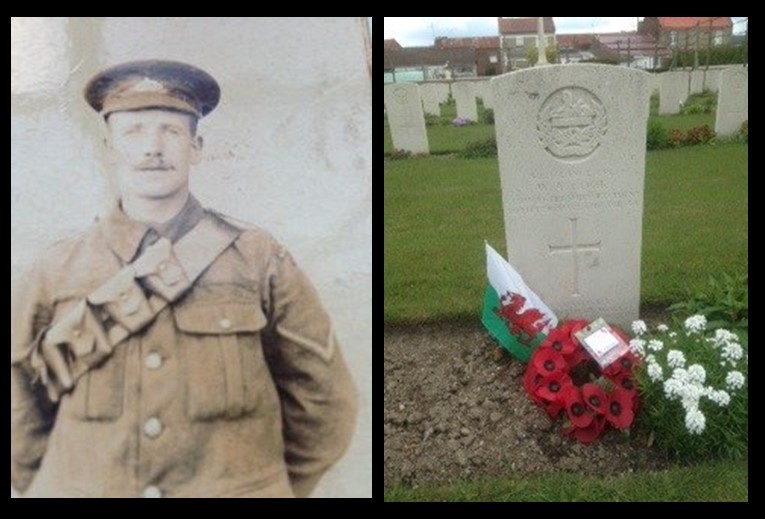
William Arrowsmith Cook was born on 6 Jan 1876 in Merthyr Tydfil to Geoarge Cook, a schoolmaster, originally from Studley, Warwickshire and Annie Cook née Williams, originally from Merthyr Tydfil. He was baptized on 27 Feb 1876 in Merthyr. By 1891 the family had moved to Cardiff and were living at 26 Llanbleddian Gardens, Cathays. His father was headmaster at Crwys Road Board School where William attended school. William later attended Howard Gardens secondary school. In 1901 the family lived at 117 Richmond Road and William was working as a coal shipper’s clerk. The family later moved to 35 Kimberley Road. It is thought William possibly joined the army and served in India. When WWI started he re-enlisted in Bristol with the Gloucestershire Regiment and served as a Lance Corporal. He was killed in action on 20 Feb 1916 aged 40 (though his CWG record records him as being just 34). He is buried at the Maroc British Cemetery, France (grave I.D.34.). He is remembered on the Howard Gardens memorial plaque. Commonwealth War Graves Commission record.
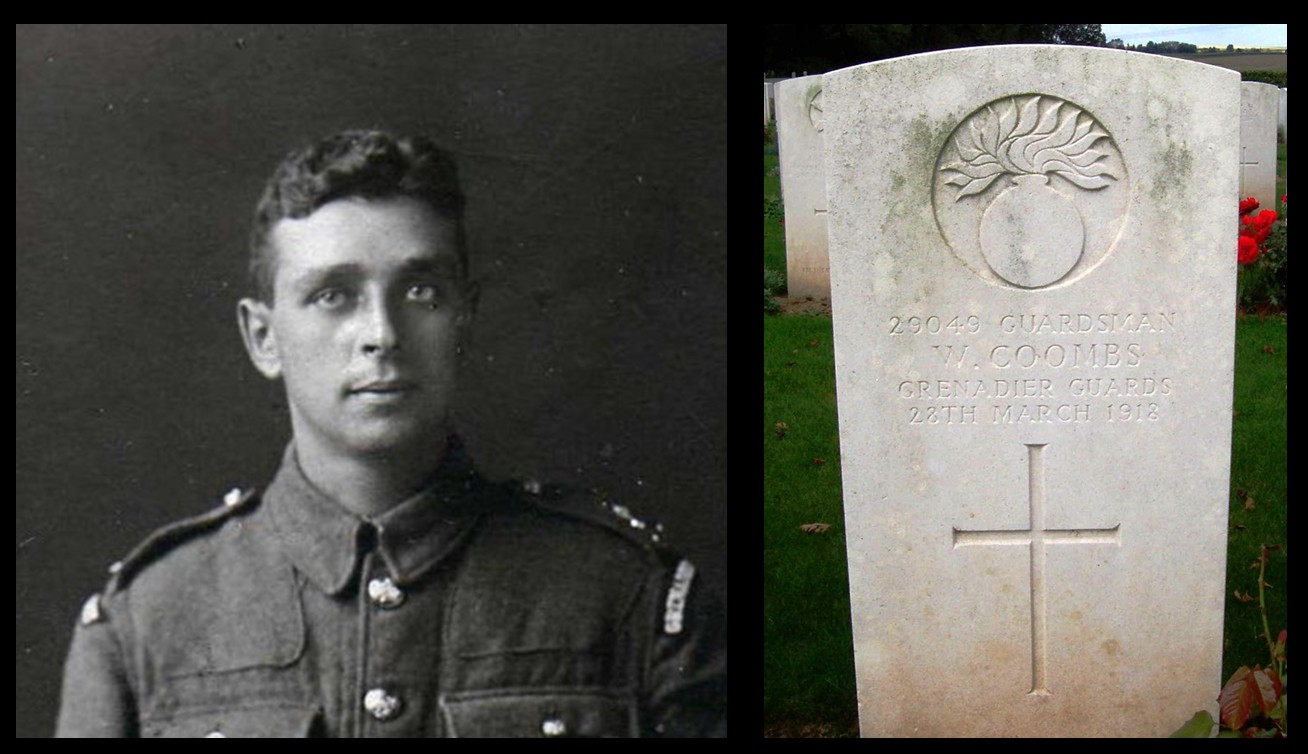
WILLIAM COOMBS
Private, 2nd Battalion, Grenadier Guards (Service Number: 29049)
William Coombs was born in Cardiff on 28 Jul 1893 to William Coombs, a coal trimmer, originally from Newport, Monmouthshire and Emma Coombs née Fearn, originally from Sheffield, Yorkshire. William was baptised at Canton Parish Anglican church on 23 Aug 1893 when the family were living at 93 Eldon Road. At the time of the 1901 census the Coombs family were living at 103 Eldon Road. William’s father died in 1910 of injuries sustained as a result of a work-related accident. In 1911 the Coombs family were living at 115 Clare Road, Grangetown. William worked as a chargeman at Messrs Spillers and Bakers. He married Mary Catherine Affleyat St Peter’s church, Roath, in 1915 and their daughter, Eileen Coombs, was born in 1916. They lived at 1 Lead Street, Adamsdown. He joined up in Jan 1917 and had been in France for eight month when he was killed in action on 24 Mar 1918, aged 24, whilst serving with the 2nd Battalion, Grenadier Guards. He is buried at the Bucquoy Road Cemetery south of Arras, France (grave VI.A.26). Commonwealth War Graves Commission record. William’s widow Mary Catherine Coombs née Affley also lost a brother, Jeremiah Affley, in the war who is also on the Roath Virtual War Memorial.
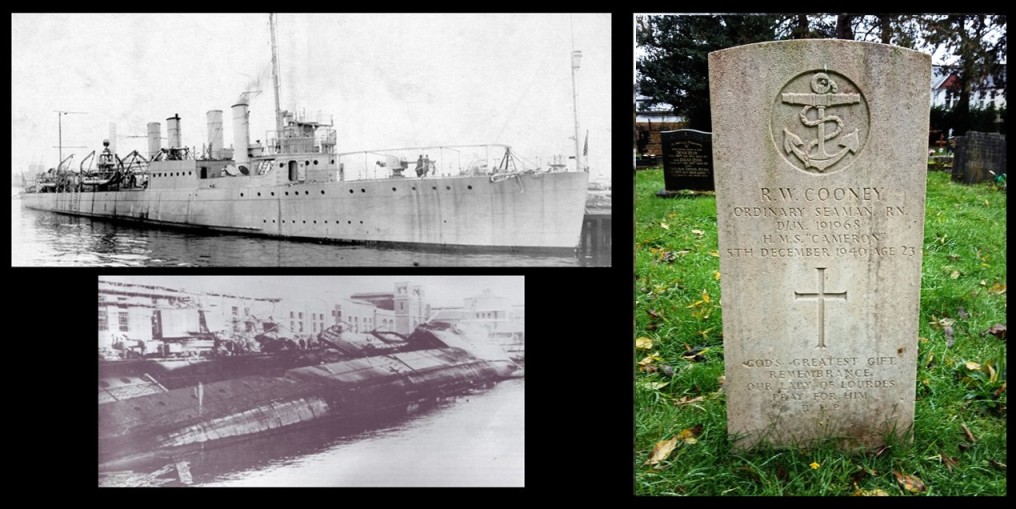
RICHARD WILLIAM COONEY
Ordinary Seaman, H.M.S.Cameron, Royal Navy (Service Number: D/JX191968)
Richard William Cooney was born in Cardiff on 4 Apr 1917 to Richard Cooney, a dock labourer, originally from Cardiff, and Emily Ellen Cooney née Fennerty, originally from Exeter, Devon. At the time of the 1921 census the family were living at 79 Carlisle Street, Splott. By 1939 they were living at 69 Pontypridd Street and Richard was working as a blast furnace labourer. In WWII Richard joined the Royal Navy and served as an ordinary seaman. He was killed along with 13 fellow sailors when H.M.S. Cameron was bombed in Portsmouth dry dock harbor when undergoing refurbishment on 5 Dec 1940. A high explosive bomb severely damaged the ship, capsizing her. H.M.S. Cameron was built in USA and originally called U.S.S. Welles. She was first commissioned in the USA in 1919 and served with the US Navy for 20 years as a ‘Town’ class destroyer. In 1940 she was transferred to The Royal Navy and renamed H.M.S. Cameron. On 9th Sept 1940 she sailed from Halifax, Nova Scotia, for England. She put into Plymouth on 13 Nov to repair a slight mechanical fault and then sailed for Portsmouth three days later, arriving on the 16 Nov where she was scheduled to have a refit in the next available dry-dock. Those killed were mostly stokers working on the re-fit in the engine room. Richard William Cooney was killed, aged 23. He is buried at Cathays Cemetery (grave EM339). Commonwealth War Graves Commission record.
CHARLES WILLIAM COOPER
Secord Corporal, 38th Division, Signal Company, Royal Engineers (Service Number: 62982)
Charles William Cooper was born on 27 May 1887 in Cardiff to Charles William Cooper, a berthing master and lock keeper at Cardiff docks, originally from Plymouth, Devon and Elizabeth Agnes Cooper née Quinton originally from Docks, Cardiff. The Cooper family lived at 9 West Bute Street, Cardiff Docks. Charles attended Eleanor Street board school before moving to Howard Gardens Higher Grade school in 1899. He started work as a postal sorting clerk in 1906. In WWI he served as a Secord Corporal with the 38th Division, Signal Company, Royal Engineers. He was killed in action on 19 Apr 1918 aged 30 on the Western Front. He is buried at Warloy-Baillon Communal Cemetery Extension in France (grave IV.F.1). He is remembered on his parent’s headstone at Cathays Cemetery (plot 1574), the Howard Gardens War Memorial board and the Cardiff Post Office workers Roll of Honour. Commonwealth War Graves Commission record.
JOSEPH HERBERT COOPER
First Engineer, Merchant Navy, S.S. Rosario (Service Number 5602)
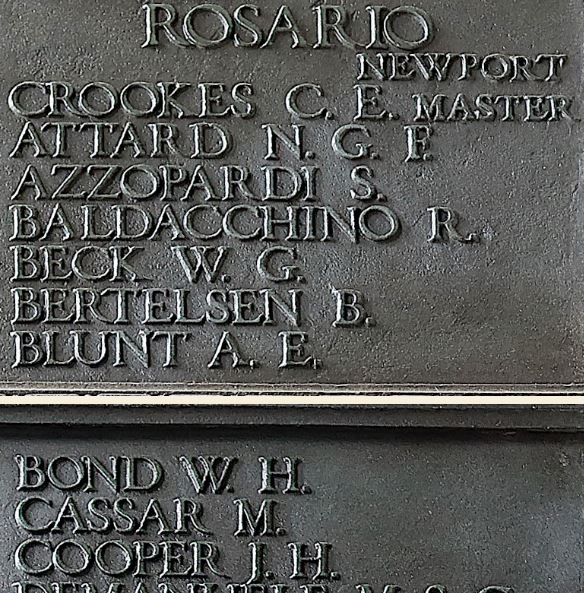
John Herbert ‘Bert’ Cooper was born in 1885 in Seaham Harbour, Durham to John Cooper, a master mariner, originally from County Durham and Jane Hannah Henderson Cooper née Cooper originally from Seaham Harbour, Durham. By 1891 the family had moved to Cardiff and were living at 78 De Burgh Street, Riverside. In 1901 Joseph, then aged 15, was an engineer’s apprentice. In 1912 in Cardiff he married Jane Mason Humphreys, originally from Pen Llwyn, Cardiganshire. They go on to live at 68 Angus Street, Roath and have one son together, John Cooper, born 1913. Joseph served as a First Engineer in the Merchant Navy. He lost his life, presumed drowned, on 18 Aug 1917, aged 32, when the S.S.Rosario was torpedoed and sunk in the Atlantic south west of Ireland. The S.S.Rosario was a British Merchant Steamer of 1,821 tons built in 1900 and in Aug 1917 when on route from Huelva in Spain for Troon, Scotland with a cargo of pig iron. He is remembered on the Tower Hill Memorial for Merchant Seamen. Commonwealth War Graves Commission record. His brother Philip Vincent Cooper was also killed in WWI when serving with the Welsh Regiment. They are both remembered on the their parent’s grave at Cathays Cemetery.
PHILIP VINCENT COOPER
Private, 11th Battalion, Welsh Regiment (Service Number: 14303)
Philip Vincent Cooper was born on 20 Jul 1891 in Cardiff to John Cooper, a master mariner, originally from County Durham and Jane Hannah Henderson Cooper née Cooper originally from Seaham Harbour, Durham. He was baptised on Aug 20 1891 when the family were living at 78 De Burgh Street, Riverside and he was still living there at the time of the 1911 census. He attended Severn Road school before going on to Howard Gardens. After leaving school he became a clerk at a coal exporter office in Cardiff Docks. He served with the 11th Battalion Welsh Regiment and died of wounds received on 14 Sep 1916 aged 26 in Salonika. He is buried at the Karasouli Military Cemetery (grave D.726). He is remembered on the Coal Exchange War Memorial Plaque . Commonwealth War Graves Commission record. His brother Joseph Herbert Cooper was also lost in WWI when serving in the Merchant Navy. They are both remembered on their parent’s grave at Cathays Cemetery.
FREDERICK OWEN COTTRELL
Private, 10th Battalion, Welsh Regiment (Service Number: 54530)
Frederick Owen Cottrell was born in Cardiff in 1884 to Frederick Charles Cottrell, a carpenter and joiner, originally from Cardiff and Catherine Jane Cottrell née Owen, originally from Llansadwrn, Carmarthenshire. In 1901 and 1911 the Cottrell family were living at 151 Inverness Place, Roath. He attended Howard Gardens school after which he went to university in Cardiff and obtained a BA. Frederick worked as an assistant schoolmaster at Ninian Park School. He married Florence Pattie Gillies, at St Margaret’s church on 31 Oct 1914 when he was living at 62 Kimberley Road and they moved to live together at 51 Stallcourt Avenue. He enlisted in Dec 1915 and was mobilized in Aug 1916 having formerly served as Private 2899 in the Glamorgan Yeomanry. Frederick served with the 10th battalion Welsh Regiment and died of wounds on the Western Front on 21 Feb 1917 aged 33. He is buried at the Wimereux Communal Cemetery, France (grave II.E.1A). He is remembered on the following war memorials: Howard Gardens, St Edward’s church, Cardiff Council employees at City Hall and Cardiff University WWI memorial. Commonwealth War Graves Commission record. After the war his widow Florence moved to London.

Frederick Owen Cottrell (headstone photo credit BillionGraves.com)
JOHN JAMES COURT
Private, 2nd Battalion, Scots Guards (Service Number 9152)
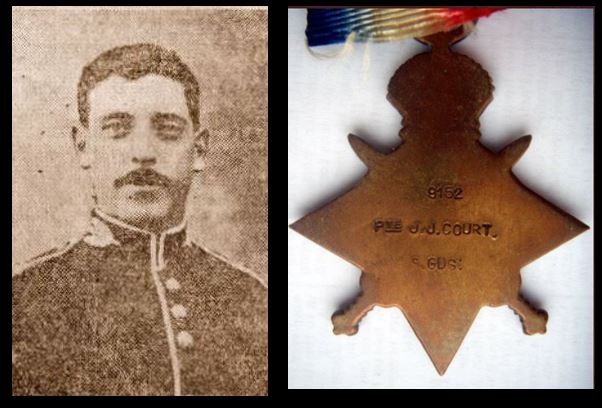
John James Court was born in Roath in 1893 to William Henry Court, a traveller’s porter, originally from Beadle, Yorkshire and Mary Maude Court née Barrow originally from Axbridge, Somerset. Sometime around 1881 the Court family move from Bradford to Cardiff living at 7 Lily Street, Roath. (From a geneaology point of view the family is a bit tricky to follow as they use the surname Robinson for a while). John was the youngest of seven brothers, many of whom worked as stonemasons, but John followed a different career path and went to London and became a pasty cook. In 1911 he was living in Battersea. He enlisted with the Scots Guards in Aug 1914 in London but then almost immediately was admitted to hospital for an operation on swollen veins. He departed for France in Feb 1915 but was killed on 18 May 1915 in the battle of Festubert, aged 22. During the fighting the 2nd Scots Guards suffered heavy casualties. His body was not recovered. He is remembered on Le Touret Memorial in France. Commonwealth War Graves Commission record.
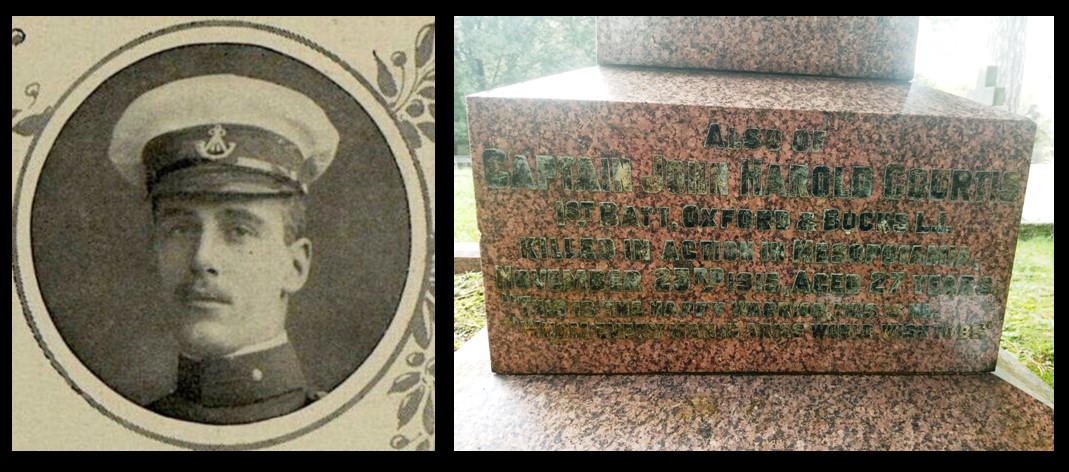
JOHN HAROLD COURTIS
Captain, 1st Battalion, Oxford and Bucks Light Infantry
John Harold Courtis was born on 25 Jul 1888 in Llanishen, Cardiff to John Wesley Courtis, a stockbroker and brick works owner, originally from Australia, and Marian Courtis née Riches, originally from Aberdare. He was baptised on 1 Sep 1888 at Llanishen Parish Church when the family were living at Llwyndrew, Llanishen. They then moved briefly to 69 Richmond Road before moving to Hillside, Pen-y-lan (at the bottom end of Ty-Gwyn Rd, near the junction with Pen-y-lan Rd) in 1891. John attended Llandaff Cathedral School, Cardiff High School for a year in 1901 before going onto Repton Preparatory School from 1902 to 1907 and then the Royal Military College Sandhurst in 1908. He was gazetted as Second Lieutenant to the 1st Battalion Oxfordshire and Buckinghamshire Light Infantry in Feb 1909 and was promoted Lieutenant in Nov 1912. John served in Burma and India from 1909. In Nov 1914, his battalion was part of the Indian Expeditionary Force which went to the Persian Gulf where he became brigade machine-gun officer. After his promotion to Captain in Jun 1915, he was appointed to the 17th Brigade staff. He was twice Mentioned in Dispatches for gallant and distinguished service in the field. Captain John Courtis was killed in action, aged 27, by sniper-fire, whilst carrying a message from the headquarters staff to his colonel, in the Battle of Ctesiphon during the advance on Baghdad on 22 Nov 1915. He is commemorated on the Basra Memorial to the Missing, Iraq. He is also remembered on the Llandaff war memorial (Cathedral School panel); on the war memorial in Llandaff Cathedral; the Cardiff High School War Memorial, on the Repton School war memorial and on a family grave at Cathays Cemetery. Commonwealth War Graves Commission record. His father was a stockbroker and was Lord Mayor of Cardiff in 1911-12 when he was knighted. His brothers Captain Walter Stuart Courtis (Royal Engineers) and Surgeon Lieutenant Alan Osborne Courtis (Royal Navy) served in the war. They both also attended Cardiff High School. His sister Elsie Agnes Courtis was an ambulance driver with the First Aid Nursing Yeomanry on the Western Front and she was awarded the Military Medal for rescuing the wounded during an air raid on the night of 18/19th May 1918. Another sister worked at a YMCA canteen in France.
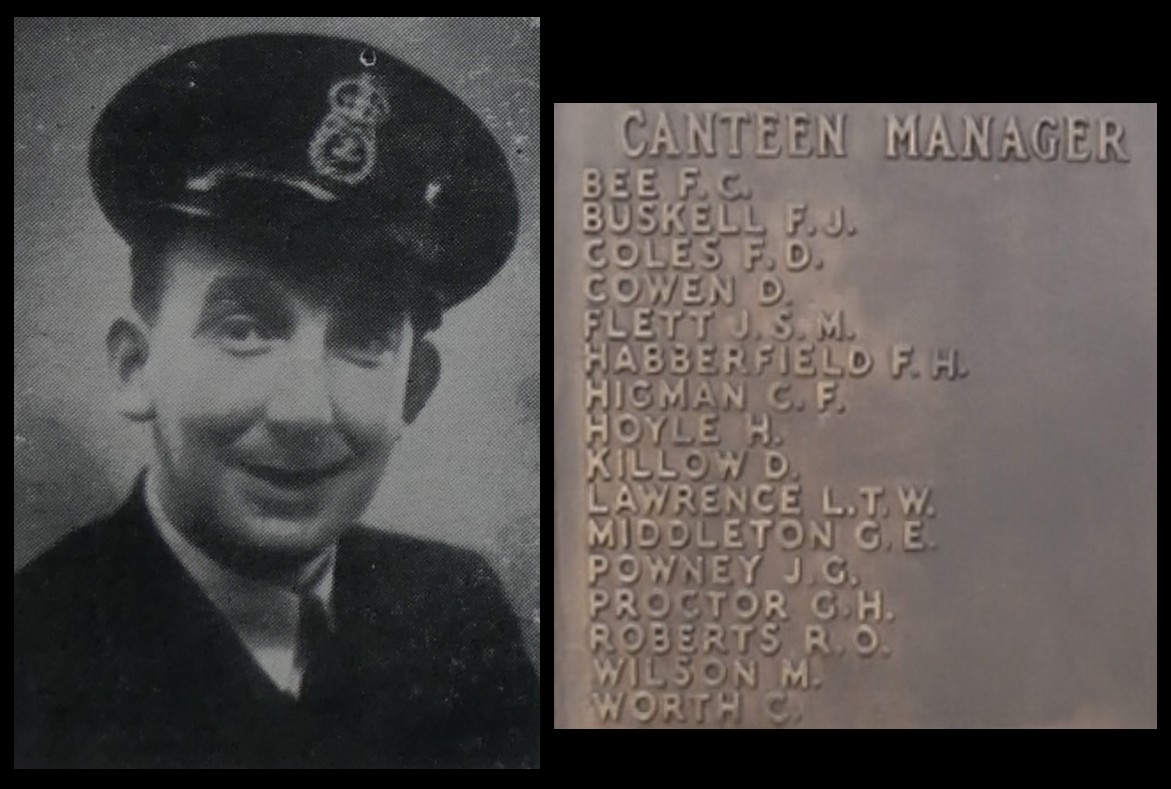
DAVID COWEN
Canteen Manager, H.M.S. Dasher, Royal Navy (Service Number: C/NX 2245)
David Cowen was born in Cardiff on 4 Oct 1911 to Solomon Cowen, a dealer in jewelry and drapery, originally from Russia and Sarah Cowen née Isaacs also originally from Russia. In 1921 the Cowen family lived at 6 Plantagenet Street, Riverside. At the time of the 1939 Register David Cowen was boarding at 4 King’s Gardens, Plymouth and training to be a naval canteen manager. He enlisted Aug 1937 and served in the Pacific, on the Russian convoy route, North Atlantic, and took part in naval actions off Norway and the North African campaign. He was killed in explosion on board HMS Dasher in Firth of Clyde on 27 Mar 1943, aged 31. David Cowen is remembered on the WWII memorial at Cardiff United Synagogue. He is also remembered on the Chatham Naval Memorial, Kent. Commonwealth War Graves Commission record. HMS Dasher was a converted American vessel that entered into British navel service in Jul 1942. A total of 379 out of 528 crewmen died as a result of the explosion, drowned or died of hypothermia, making it one of the largest tragedies in UK in WWII. The cause is thought to be accidental.
CLIFFORD EVAN COX
Chief Engineer Officer, S.S. King Gruffydd, Merchant Navy
Clifford Evan Cox was born on 6 Dec 1901 in Cardiff to Thomas Cox, an interstocking fitter on the railways, originally from Cardiff, and Cecilia Annie Cox nee Salisbury, originally from Paddington, London. He was baptised at St John the Baptist church in Feb 1902. The Cox family lived at 57 Cathays Terrace and Clifford attended Gladstone Elementary School before going on to Howard Gardens Municipal Secondary School. After leaving school he worked in an office. He married Olive Edwina Roberts in at Woodville Road Baptist church on 17 Jan 1931 by which time he was already serving as an engineer in the merchant navy. They lived at 23 Heathwood Grove and it appears they had at least one child together. Clifford served as chief engineer officer aboard steamship King Gruffydd. The King Gruffydd was part of a trans-Atlantic convey which was attacked by a U-boat on 17 Mar 1943 and sunk mid-Atlantic. Of the 49 crew, 24 were killed and 25 rescued. Clifford Evan Cox was drowned aged 42. He is remembered on the Tower Hill Memorial, London. He is also remembered on the Howardian School memorial board and the Woodville Road Baptist church memorial plaque. Commonwealth War Graves Commission record. His wife Olive died in 1991 having been a member of Woodville Road Baptist church for 71 years.

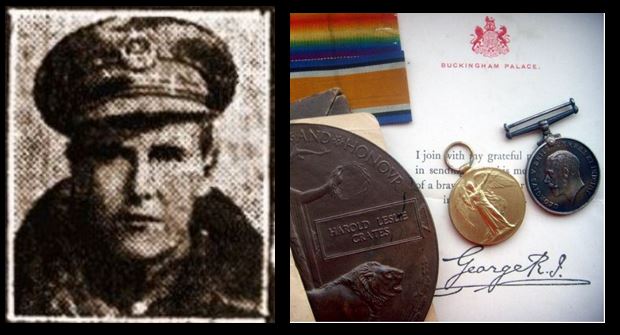
HAROLD LESLIE CRATES
Private, 1st/6th Battalion, Cheshire Regiment (Service Number 66011)
Harold Leslie Crates was born in Cardiff in early 1899 to William Henry Crates, a grocer, originally from Beaufort, Breconshire and Mary Jane Crates nee Morgan originally from Cardiff. The Crates family lived at 14 Marlborough Road, Roath. Before war broke out Harold worked in his father’s grocery shop in Clifton Street. He joined the training battalion at Kinmel Park, North Wales in Feb 1917 by which time his brother has already served in France and Salonika with the 11th Welsh Regiment. He was transferred to the South Wales Borderers and served in Ireland for some months before proceeding to France with the Cheshire Regiment in Jan 1918. He was killed on 3 Mar 1918 aged 19 at Gouzeau, the only casualty his battalion suffered that day. He is buried at the Fins New British Cemetery at Sorel Le Grand, France (grave IV. C. 16). He is remembered on the war memorial plaque which was at Roath Park Wesleyan Methodist Church. Commonwealth War Graves Commission record.
JOHN LOUIS CRICHTON
Captain, 3rd Battalion, Parachute Regiment A.A.C. (Service Number: 164891)
John Louis Crichton was born on 23 Apr 1917 in Sainte Adresse, France to William Hay Crichton, a commercial salesman, originally from Workington, Cumbria and Louisa Minnie Sarah Edith Crichton nèe Primavesi. He was educated at Clifton College and then Glasgow University and excelled at sport including the putt and javelin. He played rugby for Rosslyn Park, Harlequins (with forty five appearances for the first XV), and Sussex as well as captaining the first Parachutes team. After graduating he trained to be a solicitor or articled clerk in London in 1936. He joined the Gordon Highlanders where he boxed for his regiment. He was promoted to Captain but so keen was he to join the Paratroopers that he dropped down a rank to Second Lieutenant in order to join. He died in Gibraltar as a result of an accident on 11 Nov 1942, aged 26, on the eve of the 3rd Battalion, Parachute Regiment taking part in Operation Torch i.e. capturing and defending airfields in North Africa at the beginning of the allied landings. He is buried in the Gibraltar (North Front) Cemetery (Plot 2, Row E, grave 10). He is remembered on the Primavesi family grave at Cathays Cemetery in Cardiff as well as the WWII Law Society Memorial in Chancery Lane, London. Commonwealth War Graves Commission record. The Primavesi were originally from Italy and moved to Cardiff in the 1800s and became china importers. Zaverio Fedele Primavesi and his wife Sarah (sister of Alfred Thomas MP, Lord Pontypridd) lived in Pen-y-lan House and moved to Le Harve, France in ~1890 but maintained ownership of Pen-y-lan House. Their son, Fedele Daniele Primavesi (d.1868, Cardiff) a coal exporter, also moved to France where in 1895 his daughter Louisa Minnie Sarah Edith Primavesi was born. William Hay Crichton had seemingly emigrated to France and become a commercial salesman. William Hay Crichton played rugby for Harve and won two caps playing rugby for France in 1906, one against the New Zealand and one against England. William Hay Crichton died in 1922.

HECTOR CREWS
Private, A Company, 20th Battalion, Royal Fusiliers (London Regiment) (Service Number: PS/8702)
 Hector ‘Tony’ Crews was born on 16 Apr 1897 in Kings Norton, Worcestershire to Harry Orlando Crews, a tailor’s salesman, originally from Cheltenham, and Annie Crews nèe Holder, originally from Petersfield, Hampshire. By 1901 the Crews family had moved to 133 Donald Street, Roath. Hector attended Roath Park School before moving on to Howard Gardens School. After leaving school he worked as a clerk in a good department at Great Western Railways. In WWI he served as a Private with ‘A-Company’, 20th Battalion, Royal Fusiliers (London Regiment). He was killed in action on 20 Jul 1916 on the Western Front in France, aged 19. He has no known grave. He is remembered on the Thiepval Memorial. He is remembered on the Howardian High School War Memorial plaque, the Tredegarville Baptist Church war memorial and the GWR WWI Memorial plaque. Commonwealth War Graves Commission record.
CORNELIUS PATRICK FINBARR CRONIN
Pilot Officer, 157 Squadron, Royal Air Force Volunteer Reserve (Service Number 60358)
Cornelius Patrick Finbarr Cronin was born on 9 Jun 1912 in Killarney, Co Kerry, Ireland to Daniel Cronin, a police sergeant in the Royal Irish Constabulary, and Teresa Cronin nee O’Shea. He attended St Illtyd’s College between 1924 and 1928. His sister Eleanor was head girl at Heathfield House high school. Cornelius went on to get a B.A. at London University and then became assistant master at St Illtyd’s College and part-time lecturer at Cardiff Technical College. He played rugby for Old Illtydians and Cardiff Rugby Clubs. The Cronin family lived at 32 Lake Road North. His father died in Jul 1940 and the funeral held at St Peter’s church. Cornelius joined the RAF in 1940 and became a pilot officer, 157 Squadron, Royal Air Force Volunteer Reserve. He lost his life aged 30 on 20 Jan 1943 when navigating a Mosquito II aircraft which crashed into the North Sea 30 miles east of Clacton-on-Sea, after it is believed an attack by enemy aircraft. The plane had taken off from RAF Hunsdon, Essex. Australian Keith Walter Paul was piloting the plane and also died. Cornelius Cronin is remembered on the Runnymede Memorial in Surry. He is also remembered on the St Illtyd’s College memorial in St Alban on the Moors church. Commonwealth War Graves Commission record.
JAMES ARTHUR CURNOW
Company Quartermaster Serjeant, Labour Corps (Service Number: 355863)
James Arthur Curnow was born in Bedminster, Bristol, Somerset in 1865 to James Curnow, a tailor, originally from Bath, Somerset and Mary Ann Curnow née Bradbear originally from Bedminster, Bristol. James was baptised in Bedminster on 9 Feb 1865. In the 1881 census, he was working as a clerk. He had a long army career enlisting on 6 Jan 1883, serving in the Welsh Regiment in South Africa (1883-86), Egypt (1886-89), Malta (1889-93) where he married Martha Gill, originally from County Roscommon, Ireland. The family lived at 113 Clive Road, Canton. He was discharged for the first time in 1903 having completed 20 years service and attaining the rank of serjeant. In the 1911 census he describes himself as an army pensioner, house painter and GPO porter. When WWI began he enlisted again in Sep 1914 with the 11th Battalion Welsh Regiment and served in France as a quartermaster. He suffered from hemorrhoids and sent back to England in 1917. He served a short time with the Labour Corps before being finally discharged in Sep 1917 aged 52. He died on 14 Dec 1919, aged 54, in Cardiff. He qualified for a war grave as his cause of death was deemed attributable, at least in part, to his war service. He is buried in Cathays Cemetery (plot EI 1188). The grave has a pedestal marker often called a Gallipoli Marker. Commonwealth War Graves Commission record. He is also named on the Cardiff Post Office Roll of Honour.

DENIS CUMMINS
Private, 2nd Battalion, Royal Munster Fusiliers (Service Number 922)

Denis Cummins was born in Cardiff in 1895 to John Cummins, a docks labourer and Catherine Cummins née Barry. In the 1911 census Denis Cummins aged 16 is an errand boy. The Cummins family lived at 23, Oxford St, Roath. Denis enlists in Cardiff and serves as a Private in the 2nd Battalion, Royal Munster Fusiliers. He was killed in action 18 October 1918 aged 23. Denis is buried Highland Cemetery, Le Cateau, France. (plot s19.11.18). He is remembered on the St. Peter’s RC Church, CYMS Roll of Honour. Commonwealth War Graves Commission record.
JOHN HENRY CULVERWELL
Sergeant, 87th Squadron, Royal Air Force (Service Number: 529270)
 John Henry Culverwell was born on 30 Sep 1914 in Fulham, London to Thomas Henry Culverwell, a clerk, originally from Pimlico and Florence Culverwell nee Collins, originally from Knightsbridge. He joined the RAF on 18 Feb 1936 and trained initially as a metal rigger before volunteering for pilot training in 1939. He was promoted to Sergeant in Jan 1940. He spent some time at St Athan before going to France with 87 Squadron in Mar 1940. They returned to England later to re-equip, having lost 6 pilots and 16 aircraft in France. On 22 Jun 1940 he married Beryl Joan Williams, a millinery saleswoman, at Star Street Congregational church in Cardiff and went to live with her parents at 160 Marlborough Road. Sergeant Culverwell was killed in a night-flying accident a month later on 25 Jul 1940 aged 25. He took off from Hullavington, Wiltshire, appeared to climb too steeply, stalled and crashed back into the ground in Hurricane P3596. He is buried at Cathays Cemetery (grave EJ 114). Commonwealth War Graves Commission record.
EVAN CHARLES CUTTER
Gunner, 82nd Battery, Royal Field Artillery (Service Number: 91146)
Evan Charles Cutter was born in 1890 in Cardiff to John Henry Cutter, a bricklayer, originally from Usk, Monmouthshire and Mary Ann Cutter née Julian, originally from Wadebridge, Cornwall. The family home at 44 Cairns Street, Cathays (now called Rhymney Street). He attended Crwys Road School from 1897 to 1904 and he also attended Roath Road Wesleyan Methodist Chapel. Evan enlisted in Newport in 1911 with the Royal Garrison Artillery and served seven years in the army. During the war he served in Mesopotamia and was taken prisoner by the Turkish army at the Fall of Kut. He died of chronic enteritis at Afion Kara Hissar, Turkey, 1 Jan 1917, aged 26. He is buried at the Baghdad (North Gate) War Cemetery, Iraq (grave XXI.K.12). He was remembered on the Roath Road Wesleyan Church war memorial (now lost). Commonwealth War Graves Commission record.
 Roath Local History Society
