
The following memorials used to be at St James the Great Church, Newport Road, Cardiff but are now at St John’s church in central Cardiff. :-
Great War memorial


In addition to the WWI plaques pictured above there also used to be an individual plaque dedicated to Sergeant Henry Davies Jones. It used to be on the left hand wall of the nave of St James. It is not certain if this plaque was transferred to St John’s with the others or remains at St James the Great.
This Tablet is erected

As a token of the affectionate esteem in which the late
Sergeant Henry Davies Jones
Was held by the Officers Non-Commissioned Officers
And Men of the Mechanical Transport
RASC and Members of the QMAAC
Bulford Camp
Salisbury Plain
Died Oct 31st 1918
At Fargo Military Hospital
“To die for one’s Country is Sweet and Seemly”
“Give God the Glory”
Names on the memorials:
THOMAS WALTER MANNING BILLINGHAM
Driver, 98th Sanitary Section, Royal Army Medical Corps (Service Number: T2/9733)

Thomas Walter Manning Billingham was born in Machen, Monmouthshire in Summer 1890 to Edward Thomas Halton Manning Billingham, an engineer, originally from Flore, Northamptonshire and Eleanor Billingham nee Thomas, originally from Pontaddulais, Swansea. In 1901 the Thomas family lived in Hartshill, Warwickshire. In 1911 with his father having passed away in 1904, Thomas was living with his elder brother Christopher and his family in Newport and working as an ironmongers mechanic. They move to Cardiff sometime later and Thomas works as a fitter for Cardiff Railway. We don’t know where Thomas lived in Cardiff, possibly with his brother at 13 Heath Park Avenue. He joined up in Cardiff and served as a driver with the 98th Sanitary Section of the Royal Army Medical Corps. He died on 20 Nov 1917 aged 27 in Salonika, Greece and is buried at the Lembet Road Military Cemetery in Salonika (grave 1282). He is remembered on the Cardiff Railway war memorial and on the St James the Great war memorial (now at St John’s). Commonwealth War Graves Commission record.
HUBERT SAMUEL EMERY BOND
Second Lieutenant, 42nd Training Squadron, Royal Flying Corps.
Hubert Samuel Emery Bond was born on 28 Sep 1893 in Cardiff to Samuel Bond, a ship repair engineer originally from Howdon, Northumberland, and Cecilia Elizabeth Bond née Edwards, originally from Cardiff. He was baptised at St John the Baptist Church on 29 Oct 1893 when the family were living at 224 Castle Road. In 1901 the family were living ay 1 The Parade and in 1911 at 9 The Walk, Tredegarville. He attended Cardiff High School from 1905. From school he went to University College Cardiff, in 1911 and, after university, he was articled to Sydney Jenkins and Howells, solicitors, Cardiff. He joined the Law Society as a probationer in May 1915. He was commissioned Second Lieutenant to the 7th (Cyclist) Battalion Welsh Regiment, Territorial Force on 19 Aug 1915 and transferred to the Royal Flying Corps in Oct 1916. Hubert Bond died, aged 23, at the Royal Flying Corps Hospital, 37 Bryanston Sq, London on 17 Jun 1917. He died of injuries received in a flying accident at Hounslow three days earlier, 14 Jun, when his RE8 broke up while diving at an abnormal speed and nosedived into the ground. He was buried with full military honours in Cathays Cemetery, Cardiff (plot J.CE.1385). He is commemorated on the Cardiff High School war memorial, the war memorial in Cardiff University and also on the St. James Church, Newport Road, war memorial (now located in St. John’s Church, Trinity Street). Commonwealth War Graves Commission record.

REGINALD JOHN EARLAND
Second Lieutenant, 2nd Battalion, South Wales Borderers
Reginald John Earland was born on 28 Jul 1891 in Paddington, London, to Frederick Earland, an accountant, originally from Greenwich, Kent, and Lucy Louisa Earland née Nott originally from Chulmleigh, Devon. He was baptised in Llandaff on 18 Sep 1891. In the 1901 census the Earland family were living at 14 Pontcanna Road, Llandaff. In 1909 he was already secretary of the Splott Wednesday Football Club. By 1911 they had moved to 28 Mackintosh Place and Reginald was working as a gent’s tailor. Soon after they moved to 51 Roath Court Road. Reginald served with the 2nd battalion South Wales Borders from 2015 and rose to the rank of Second Lieutenant. In 1916 he married Ellen Wallis/Gullick in West Derby, Lancashire. He died as a result of a gunshot wound to the head on 30 Jan 1917, aged 25, on the Western Front. He is buried at Grove Town Cemetery, Meaulte, France (grave I. A. 11.). He is remembered on his sister’s headstone at Cathays Cemetery and the St James the Great war memorial plaque, now at St John’s church. Commonwealth War Graves Commission record.
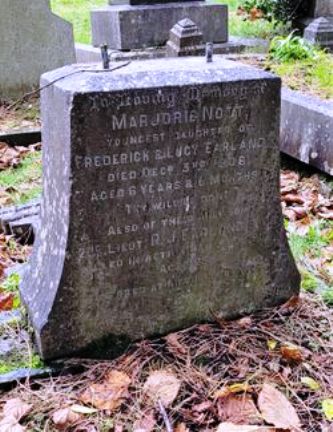
Find a Grave, database and images (https://www.findagrave.com/memorial/245728602/marjorie-nott-earland: accessed 22 October 2023), memorial page for Marjorie Nott Earland (1902–3 Dec 1908), Find a Grave Memorial ID 245728602, citing Cathays Cemetery, Cathays, Cardiff, Wales; Maintained by Gardley (contributor 51324475).
JAMES EDWARD ELSTON
Sergeant, 2nd/7th Battalion, Lancashire Fusiliers (Service Number: 36875)
James Edward ‘Eddie’ Elston was born in Cardiff on 31 Dec 1881 to George Elston, a mason and clerk of works, originally from Torquay, Devon and Alice Elston née Ashton, originally from Hartland, Devon. He was baptized at St James the Great church on 14 May 1882 when the family were living at 79 Bedford Street. In 1891 they were living at 30 Arabella Street. At the time of the 1901 and 1911 Census the Elston family were living at 100 Strathnairn Street and Eddie was working as a plumber and gas fitter. In WWI he served as a Sergeant with the 2nd/7th Battalion, Lancashire Fusiliers. He was reported injured on 13 Aug 1917. He was later killed in action on 14 Aug 1917 on the Western Front on Belgium aged 35. He has no know burial place but is remembered on the Tyne Cot memorial, Belgium. He is also remembered on the St James the Great war memorial plaque (now at St John’s church) and on St Martin’s war memorial plaque. Commonwealth War Graves Commission record.
HENRY DAVIES JONES
Sergeant, M.T. Mob. and Embarkation Area, Army Service Corps (Service Number: DM2/155516)
Henry ‘Harry’ Davies Jones was born in Ealing, London on 2 Oct 1892 to Thomas Davies Jones, a draper, originally from Llanidlois, Montgomeryshire and Helena Susanna Jones nee Cole originally from Chawleigh, Devon. The family moved to Roath when Harry was young, living at 4 Morlais Street, Roath Park. Harry attended Marlborough Road School before going on to Howard Gardens school. After leaving school he worked in a solicitor’s office and the Jones family lived at 222 Mackintosh Place. He was a Sergeant in the Army Service Corps. Harry died of pneumonia on 31 Oct 1918, aged 26, at Fargo Military Hospital, Salisbury Plain. He is buried in the family grave at Cathays Cemetery (plot L 2222). He is remembered on the Howard Gardens school memorial plaque and the WWI memorial plaque that used to be at St James the Great church, now at St John’s church. He was also remembered at a personalised plaque at St James the Great church which read that it was ‘given as a token of the affectionate esteem in which the late Sergeant Henry Davies Jones was held by the Officers Non-Commissioned Officers And Men of the Mechanical Transport Royal Army Service Corps and Members of the Queen Mary’s Army Auxiliary Corps, Bulford Camp, Salisbury Plain’. Commonwealth War Graves Commission record.

THOMAS STANLEY SILBY
Lieutenant, 10th Battalion, South Wales Borderers
Thomas Stanley Silby was born in Cardiff on 11 Jan 1895 to John William Silby, a coal trimmer originally from Trowbridge, Wiltshire and Elizabeth Ann Silby nee Jenkins originally from St Mellons, Monmouthshire. In 1901 the Silby family were living at 8 Hinton Street, Splott. He attended Moorland Road Elementary School before going on to Howard Gardens School in 1905. He left in 1908 and began work as a clerk in the City Treasurer’s Department. In 1911 Thomas and the Silby family had moved to 19 Cressy Road. In WWI he initially enlisted in the Welsh Regiment in Sep 1915 as Private and was then Corporal in the Cheshire Regiment before becoming a Lieutenant with the Welsh Borderers. He was awarded the Military Cross in 1917 for his actions on 19 Sep 1917 at L’Epinette: ‘For conspicuous gallantry and devotion to duty during a hostile raid on an advanced post. Hearing that the commander of his post had been killed, he went forward from the support line under a heavy barrage and took command. He rallied the men at a critical moment and drove off the enemy. He showed great courage, coolness and initiative.’ He married Ethelinda ‘Linda’ Harriet Hudson, who lived at 138 Richmond Road, in St James the Great church, Cardiff on 14 Aug 1918. He then returned to the Western Front and was sadly killed in action less than a month later on 12 Sep 1918 aged 23. He is buried at the Gouzeaucourt New British Cemetery in France (grave II. B. 13). He was remembered on the memorial plaque believed to have been at Clifton Street Welsh Methodist church. He was also remembered on the plaque at St James the Great Church (now in St John’s church) and the memorial plaque at Howard Gardens school (now at Howardian Primary). Commonwealth War Graves Commission record.

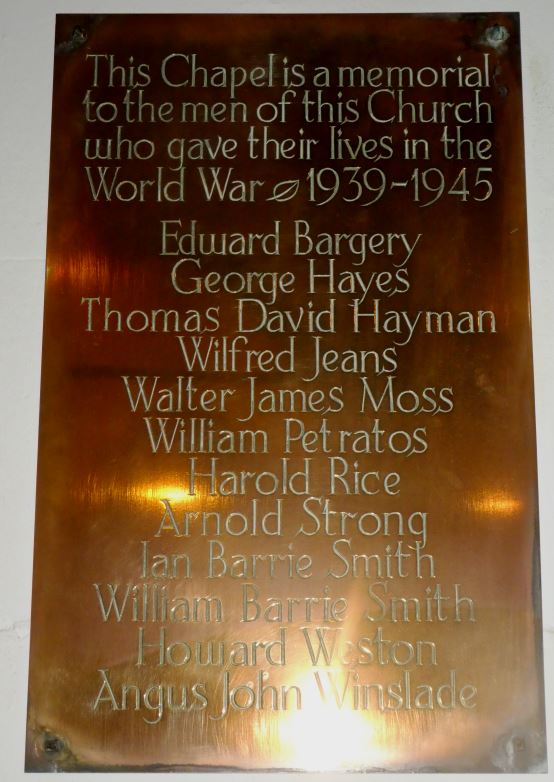
ROLL OF HONOUR
1939 – 1945
This Chapel is a Memorial
to the Men of this Church
who gave their lives in the
World War 1939 – 1945
EDWARD BARGERY
GEORGE HAYES
THOMAS DAVID HAYMAN
WILFRED JEANS
WALTER JAMES MOSS
WILLIAM PETRATOS
HAROLD RICE
ARNOLD STRONG
IAN BARRIE SMITH
HOWARD WESTON
ANGUS JOHN WINSLADE
The memorial was consecrated by the Bishop of Llandaff on St Marks day 25th April 1966
The memorial chapel was created by George Pace who was considered by many to be the most influential post War Ecclesiastical architect in the country.
In between the chancel and the nave is a carved wooden perpendicular screen made from selected wainscot oak carved on both sides. It commemorates the worshippers of St James who made the supreme sacrifice whilst on active service during the Great War and also as a thanksgiving for those whose lives had been spared. The dedication the original screen and a bronze tablet which bears the names of the fallen took place during a special service held on Sunday 8th October 1922.

 Roath Local History Society