
The Trinity Centre was previously the Trinity Methodist Church.
The centre still houses a collection of memorial plaques, some collected from other churches when they closed down.
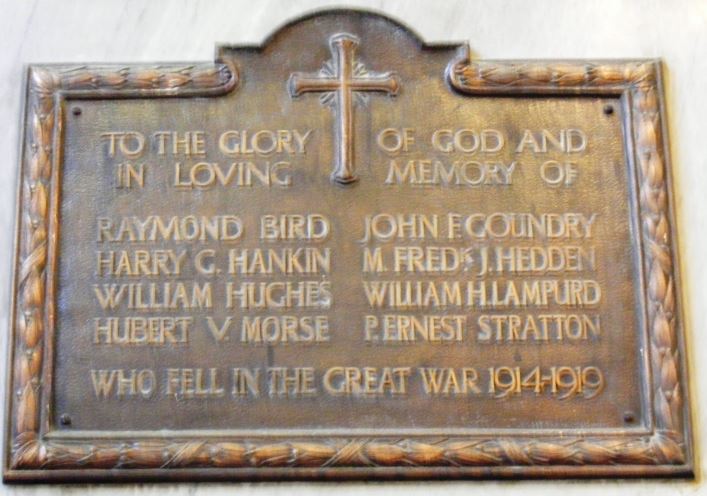
The names on the Trinity Methodist plaque: Raymond Bird, John F Goundrey, Harry G Hankin, M Frederick J Hedden, William Hughes, William H Lampurd, Hubert V Morse, P Ernest Stratton.
RAYMOND BIRD
Second Lieutenant 1/4th (City of Bristol) Battalion, Gloucestershire Regiment
Raymond Bird was born on 27 Aug 1890 in Cardiff, the only son of Frederick Graham Bird, a chemical manufacturer business owner, originally from Gloucester, and Mary Bird née Dill originally from Bath, Somerset. The family lived at 106 Newport Road, Roath and later Cranmore, Radyr. He entered Cardiff High School in 1901, when his family were living at St. Elmo, Radyr. He also went to school in Taunton. Raymond was later employed as a clerk in the family chemical manufacturing business, Bird and Sons in Cardiff. On 20 Nov 1915, he married teacher Alice Smith of Fairoak Road and later Ambleside, Lake Road West, Roath Park. He joined the Inns of Court Officer Training Corps at Berkhamsted, Hertfordshire as an Officer Cadet on 12 Apr 1915. Raymond was then commissioned in the Gloucestershire Regiment on 2 Aug 1915 and posted to the 3/4th Battalion stationed at Weston-Super-Mare. He went out to France on 29 May 1916 and joined the 1/4th Battalion Gloucestershire Regiment, Territorial Force. Raymond Bird was killed in action, aged 25, by shell-fire during an entirely unsuccessful attack at the Leipzig Redoubt, near Ovilliers, during the Battle of the Somme on 16 Aug 1916. He was at first reported missing but a wounded soldier recuperating in hospital told Raymond’s wife that he had been with him when he was hit by a shell and that he had remained with him for four hours until he died. He is buried in Pozieres British Cemetery, France (grave IV.A.52). He is commemorated on war memorials in Trinity Methodist Church, Four Elms Road, Roath, St. John’s Church, Canton, Christ Church, Radyr and on the Cardiff High School War Memorial as well as the Radyr War Memorial. Commonwealth War Graves Commission record.

HENRY GEORGE HANKINS
Private, 10th Battalion, Royal Welsh Fusiliers (Service Number: 56690)
Henry ‘Harry’ George Hankins was born in Cardiff in 1898 to George Albert Hankins, a labourer at an oil and tar distillery, originally from Bristol, and Rose Hankins née Cole, also originally from Bristol. In 1901 the Hankins family lived at 67 Janet Street. In 1911 they were at 1 Caerphilly Street, East Moors but by 1914 they were living at 70 Railway Street, Splott. Harry served with the 10th Battalion, Royal Welsh Fusiliers. He was killed on 26 Sep 1917 aged 19 in France. He is buried at the Tyne Cot Cemetery (plot XV. E. 19.). He is remembered on the Splott War Memorial and the Trinity Methodist church war memorial plaque. Commonwealth War Graves Commission record.

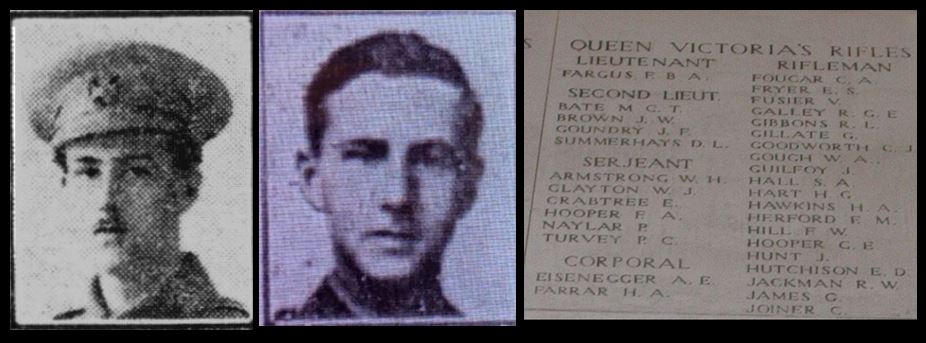
JOHN FIRTH GOUNDRY
Second Lieutenant 1/9th (County of London) Battalion London Regiment (Queen Victoria’s Rifles)
John Firth Goundry was born 27 Mar 1893 in Cardiff, the younger son of Edward Whitfield Goundry, a master mariner, originally from Lambeth, Surrey, and Jane Goundry née Ellerington originally from St John Lee, Northumberland. In 1901 the family lived at 100 Claude Road and in the 1911 census they were at 23 Marlborough Road. John entered Cardiff High School in September 1905, when his family were living at 27 Ryder Street, Pontcanna. At the outbreak of war, he was employed as a pharmaceutical chemist and was studying at the School of Pharmacy, Bloomsbury Square, London. He enlisted as a private in the Queen Victoria’s Rifles in Nov 1914 and went out to the Western Front 6 Jun 1915. John was wounded in the attack on the Gommecourt Salient during the Battle of the Somme on 1 Jul 1916. He was commissioned to the 9th Battalion, London Regiment 28 Apr 1917 and returned to the Western Front for about six weeks. He was very badly wounded in the neck when leading his company in an attack near Polygon Wood during the Battle of Langemarck. A strong German counter-attack made it impossible to recover the wounded. Second Lieutenant John Firth Goundry was killed in action 16 Aug 1917. He was 24. He is commemorated on the Ypres (Menin Gate) Memorial to the Missing, Belgium. He is also commemorated on the war memorial in Trinity Methodist Church, Four Elms Road, Roath and the Cardiff High School memorial plaque. Commonwealth War Graves Commission record. (John’s elder brother was also a pharmacist and owned a shop in City Road).
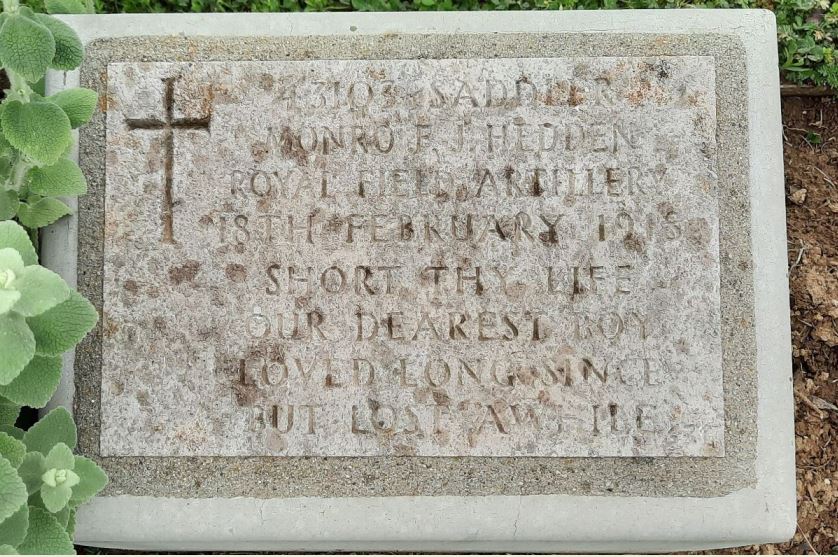
MONRO FREDERICK JAMES HEDDEN
Saddler, “D” Battery. 57th Brigade, Royal Field Artillery (Service Number: 43103)
Monro Frederick James Hedden was born in Cardiff on 13 Feb 1894 to Alfred Hedden, a foreman at a corn merchants, originally from Welcombe, Devon and Annie Marie Hedden née Cornish also from Welcombe. The Hedden family lived at 24 Mackintosh Place, Roath. Monro attended Albany Road Elementary School before moving on to Howard Gardens secondary school in 1907 for two years. By 1911, aged 17, he was working as a junior clerk at a provision merchant. In WWI he served as a Sadler in the Royal Field Artillery. He died of blackwater fever on 18 Feb 1918 aged 24 in Salonika, Greece. He is buried at the Sarigol Military Cemetery, Greece (grave D. 631.) which mainly holds those who died at the 31st Casualty Clearing Station hospital. He is remembered on the Howard Gardens High School War Memorial plaque and the Trinity Methodist church war memorial plaque. Commonwealth War Graves Commission record.
WILLIAM HUGHES
Sergeant, 2nd Battalion, Welsh Regiment (Service Number: 2380)
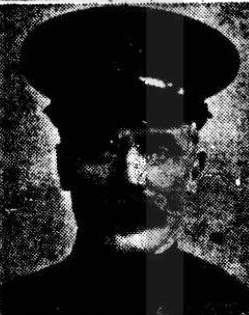
William Hughes was born in Swansea in 1873 to William Hughes, a carpenter, originally from Sketty, Swansea, and Martha Hughes née Wellington, originally from Luxulyan, Cornwall. In 1881 the Hughes family were living at James Place, Swansea. They later moved to Cardiff and in 1897 William married Alice Pyke at St German’s church. At the time he was 24 and worked as a labourer and was living at 53 Diamond Street. Alice and William continued to live in Diamond Street, William working as a docks labourer and they went on to have three children, Alice May (b. 1899), William Ernest (b.1901) and Ronald Howard (b.1911). He served as a Sergeant with the 2nd Battalion Welsh Regiment. He died of wounds at the clearing hospital in Bethune, France on 4 Jan 1915 aged 43. He is buried at Bethune Town Cemetery (plot III. B. 25). The newspaper announcement of his death describes him as well known in Cardiff and a member of the Blue Ribbon Choir. He is remembered on the Trinity Methodist war memorial plaque. His Commonwealth War Graves Commission record describes him as having received the Volunteer Long Service Medal indicating he had some military service prior to WWI.
WILLIAM HENRY LAMPERD
Private, 1st/14th Battalion, London Regiment (London Scottish) (Service Number: 515864)
William Henry Lamperd was born in 1890 in Penarth, the only child of John Lamperd, a baker, originally from Southampton, and Katherine Lamperd née Coles, originally from Burnham, Somerset. In the 1911 census the family were living in Harriet Street, Cogan and William was employed helping in the bakehouse. He married Alice Gwendoline Cook in 1915. Their daughter Olga Katherine Lamperd was born in Jan 1917. William served as a Private in the 1st/14th Battalion, London Regiment (London Scottish). He died on 24 Nov 1917 aged 27. He has no known grave. He is remembered on the Cambrai Memorial in France which remembers those fought in the Battle of Cambrai on the Western Front. He is also remembered on the Penarth War Memorial in Alexandra Park, St Augustine’s church war memorial plaque, Penarth and his parent’s grave at St Dochdwy’s Church, Llandough. His widow Alice remarried in 1921 and on her wedding certificate gave her address as 21 Clifton Street. This would explain William’s name (mis-spelt Lampurd) being included on the nearby Trinity Methodist memorial plaque. Maybe Clifton Street was where William and Alice set up home after getting married. Commonwealth War Grave Commission record.
HUBERT VICTOR MORSE
Private, 1st Battalion, Leicestershire Regiment (Service Number: 37848)
Hubert Victor Morse was born in 5 Apr 1891 in Penarth to Edwin Morse, a general haulier, originally from Gloucestershire and Ellen Morse, née Ashelford, originally from Somerset. He attended Victoria Board School, Penarth before moving to Marlborough Road School in 1903 when the family were living at 127 Dalcross Street, Roath. Hubert worked as a clerk in a rents and estates business before joining the Leicestershire Regiment as a Private. The family had lived at 105 City Road in 1911 but Hubert’s war record show them by then living at 40 Bedford Street, Roath. He died of his wounds on 25th Apr 1917 aged 26. He is buried at the Philosophe British Cemetery (plot II.P.1.) in northern France. He is remembered on the Albany Road Baptist Church war memorial plaque and the Trinity Methodist WWI plaque. Commonwealth War Graves Commission record.
PHILIP ERNEST STRATTON
Private, 2nd Battalion, Duke of Cornwall’s Light Infantry (Service Number: 27954)
Philip Ernest Stratton was born in Cardiff in 1884 to Henry James Stratton, an ironware dealer, originally from Southampton, and Mary Jane Stratton née Thomas, originally from St Austell, Cornwall. In 1891 the Stratton family lived in Arran Street, Roath. By 1901 they had moved to 149 MacKintosh Place. After leaving school Ernest worked as a law clerk. In 1912 he married Edith Emma White in Cardiff. They went on to have two sons together. Ernest Stratton served in the 2nd Battalion, Duke of Cornwall’s Light Infantry. He died on 25 Nov 1918 in Bulgaria of bronchial pneumonia and influenza aged 34. He is buried at the Sofia War Cemetery (plot I.C.5). He is remembered on the Trinity Church War Memorial plaque. Commonwealth War Graves Commission record.

Broadway Methodist WWI Plaque

The names on the Broadway Methodist Church memorial plaque are:
ALFRED HENRY ALLARD
Lance Corporal, 8th (Service) Battalion, Devonshire Regiment (Service Number 10669)

Alfred Henry ‘Harry’ Allard was born at Frome, Somerset on 25 Sep 1894 to John Thomas Allard, an iron works erector, and Sarah Ann ‘Annie’ Allard nee Singer, both originally from Somerset. Harry attended Stacey Road school. In the 1911 census the Allard family were living at 1 Vere Street, Roath and Harry was working as a plumber’s assistant. He enlisted in Bristol. He served as a Lance Corporal in the 8th Battalion of the Devonshire Regiment. He was killed in action on the Western Front on 25 Sep 1915, on his 21st birthday. He is remembered on the Loos memorial in France. He is also remembered on the Broadway Methodist church war memorial plaque now at the Trinity Centre. Commonwealth War Graves Commission record.
ARTHUR SYDNEY BANBURY
Corporal, 38th Division, Signal Company, Royal Engineers (Service Number: 62902)
Arthur Sydney Banbury, was born on 29 May 1883 in Cardiff to John Banbury, a coal merchant, originally from Boscastle, Cornwall and Mary Ann Banbury née Symons, also from Boscastle, Cornwall. He grew up in the Splott area attending Metal Street Infants School and then Splotlands Board School before moving on to Howard Gardens School for two years. In the 1891 census the Banbury family lived at 8 Coveny Street. They also lived at 73 Broadway and 96 Splott Road before moving to 52 Partridge Road, Roath where they were at the time of both the 1901 and 1911 census. When Sydney left school in 1898 he worked initially at the Western Mail newspaper then as a telegraphist at Cardiff GPO. He was a Methodist as indicated by his name appearing on two local church memorial plaques. In 1912 he married Florence Mary Jennings, a telephonist, originally from St Ives, Cornwall. They lived at 10 Grenville Road and went on to have a son, Philip Sydney Banbury, born in Feb 1916. Sydney enlisted in Porthcawl and served as a telephone linesman on the Western Front from Dec 1915. He was killed in action in the Battle of Pilckem Ridge on 31 Jul 1917 aged 34. He is buried at Dragoon Camp Cemetery, Boesinghe, Belgium (plot A5). He is remembered on the Broadway Methodist Church War Memorial Plaque and the Cyfarthfa Street Mission memorial plaque, both now housed at the Trinity Centre, and on the Cardiff Post Office’s Roll of Honour. He is also remembered on his parent’s headstone in Boscastle. Commonwealth War Graves Commission record. His brother Alfred was a Corporal with the Honourable Artillery Company who enlisted in 1915 and was discharged on 10 Sep 1917 due to gunshot wounds to his right arm and eye. Sydney’s son joined the military and rose to be Major Philip Sydney Banbury with the Royal Signals during WWII. He was awarded the Bronze Star Medal for his work in defending the important port of Antwerp from Nov 1944 to Mar 1945. He helped deploy and run an efficient communication system covering large parts of Holland and Belgium that acted as an early warning system of V1 and V2 flying bombs heading towards Antwerp.

HERBERT BARNEY BINGHAM
Private, ‘C’ Company, 11th Battalion, Welsh Regiment (Service Number: 14915)
Herbert Barney Bingham was born on 26 Jun 1894 in Norwich to Herbert John Bingham, a commercial traveller for a chocolate manufacturer, originally from Bruston, Norfolk and Catherine Charlotte Bingham née Browne, originally from Norwich. The Bingham family moved to Cardiff around 1904 and in 1911 were living at 119 Claude Road and Hubert, aged 16, was working as an insurance clerk. They later moved to 6 Penylan Road. In WWI he served as a Private in the 11th Battalion, Welsh Regiment. He died of the effects of gas shells in Salonika, Greece on 18 March 1917 aged 22. He is buried in Karasouli Military Cemetery in Greece (plot D. 787). Herbert is remembered on the Broadway Methodist church memorial plaque at Trinity church and the Plasnewydd Presbyterian Church WWI memorial. He is also remembered on his parents headstone in Cathays Cemetery. Commonwealth War Graves Commission record. His father died in June the same year.

WILLIAM BLACK
Engineer Lieutenant, HMS Natal, Royal Navy.
William Black was born on 6 Jan1885 in Cardiff, the only son of William Black originally from Kinghoorn, Fife, Scotland and Alice Black née Gray originally from Hartlepool. The family originally lived at of 80 Richards Terrace, Roath but by 1891 the family had moved to 235 Newport Road, Roath. His father was a superintendent marine engineer. William attended Cardiff Municipal Secondary School, Howard Gardens from 1895 to 1898 and then Cardiff High School from September 1898, when he was in the school’s first ever intake . He left in Dec 1900 to follow his father’s profession and started work as an apprenticed engineer. He took an extra first class engineers certificate at South Shields in 1911 and later qualified as a naval architect. He was employed as a consulting engineer at Cardiff docks and, on the death of his father in 1912, he succeeded him in the business. In Sep 1915, he was appointed Engineer Lieutenant RN. William Black was killed, aged 30, when HMS Natal accidentally exploded with great loss of life in Cromarty Firth on 31 Dec 1915. Over four hundred died. Though it was at first assumed she had been torpedoed it was later concluded that the cause was an internal ammunition explosion, possibly the result of faulty cordite. Engineer Lieutenant William Black is commemorated on the Chatham Naval Memorial to the Missing and also on family gravestones in Cathays Cemetery and in Kinghorn, Fife, where his family originated. He is also commemorated on the Cardiff High School war memorial, the Howard Gardens war memorial and the war memorial that was in the Wesleyan Methodist Church, Broadway, Roath now in the Trinity Centre. Commonwealth War Graves Commission record.

WILLIAM JOHN COLLIER
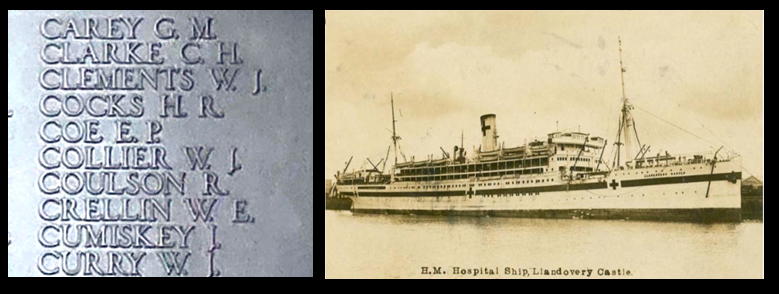
Ordinary Seaman, Merchant Navy, H.M.H.S. Llandovery Castle
William John Collier was born in Cardiff in 1902, one of seven children born to Thomas Newton Collier, a foreman dry dock rigger originally from Beer, Devon and Dorcas Alwyn Collier née Truscott originally from Cornwall. In 1911 the Collier family lived at 39 Fitzhamon Embankment before later moving to 89 Broadway, Roath. William Collier joined the merchant navy and was killed on 27 Jun 1918 when the Canadian hospital ship Llandovery Castle was torpedoed off the coast of County Cork, Ireland. He was 17 years old, one of the youngest killed. 234 doctors, nurses, members of the Canadian Army Medical Corps, soldiers as well as seamen died in the sinking and subsequent machine-gunning of lifeboats. Firing at a hospital ship was against international law and standing orders of the Imperial German Navy. The captain of U-boat sought to destroy the evidence of torpedoing the ship. When the crew, including nurses, took to the lifeboats, the U-boat surfaced, ran down all but one of the lifeboats and machine-gunned many of the survivors. William John Collier is remembered on the Tower Hill Memorial for Merchant Seamen and on the Broadway Methodist church plaque now at Trinity Centre. Commonwealth War Graves Commission record.
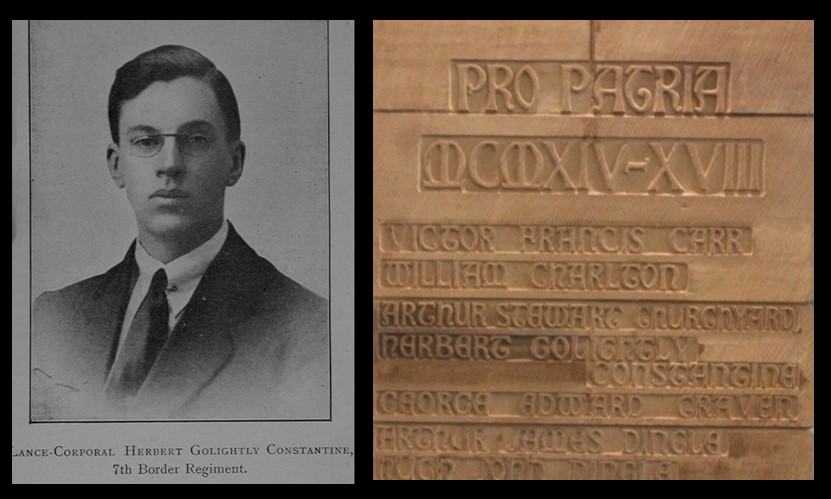
HERBERT GOLIGHTLY CONSTANTINE
Lance Corporal, “C” Company, 7th Battalion, Border Regiment (Service Number: 36234)
Herbert Golightly Constantine was born in Cardiff in 1899 to Robert Constantine, manager of a marine engineering works, originally from Bentham, Yorkshire and Mary Hannah Constantine née Golightly, originally from Durham. The Constantine family lived at 11 Longcross Street and Herbert attended Broadway Methodist church. He was educated at Durham School. In WWI he served as a Lance Corporal with “C” Company, 7th Battalion, Border Regiment having previously served with the South Lancashire Regiment. He was killed in action on the Western Front on 2 Jun 1918 aged 18. He is buried at the Acheux British Cemetery in France (Plot 1. Row D. Grave 23). He is remembered on the Broadway Methodist WWI plaque now at Trinity church, a plaque at Durham School chapel and a plaque at St Margaret’s of Antioch church, Durham. Commonwealth War Graves Commission record. His elder brother Robert served in the Royal Navy in WWI, leaving the navy in 1925. His parents moved to “Kenilworth,” Cefn Coed Road.
,
WILFRED HAROLD DYMOKE
Lance Corporal, 13th Battalion, Welsh Regiment (Service Number: 56647)

Wilfred Harold Dymoke was born in Roath on 1 Jun 1890 to William Dymoke, a carpenter at a motor garage, originally from Cranmore, Somerset, and Sarah Dymoke née Dowling originally from South Brewham, Somerset. The Dymoke family family lived at 169 Broadway and Wilfred attended Stacey Road School and later worked as a bookkeeper in Park Place, Cardiff. He enlisted in Cardiff with the Cyclists Battalion of the Welsh Regiment in 1914 and was posted to France in Jul 1916 with the 10th Battalion Welsh Regiment as a Lance Corporal and later transferred to the 13th Battalion. Wilfred died of wounds on 19 Apr 1918 at the 129 Field Ambulance in France aged 28. He is buried at the Warloy-Baillon Communal Cemetery Extension in NE France (grave IV.F.4). He is remembered on the Broadway Methodist WWI Plaque now housed at the Trinity Centre. Commonwealth War Graves Commission record. In later years (~1930s) a W H Dymoke is mentioned in newspapers as an employee of the South Wales Electric Power Company who had laid down his life in defense of this country (maybe he worked at Roath Power Station for a time?).
ALGIE VICTOR FARLEY
Deck Boy, Mercantile Marine, H.M.H.S. Llandovery Castle.
Algie Victor Farley was born in Roath on 11 Feb 1901 to Henry Farley, a house painter, originally from Warminster, Wiltshire and Ethel Clara Farley née Dunn originally from Uffculme, Devon. In 1901 the Farley family were living at 293 Portmanmoor Road. In 1906, on his Stacey Road School admission form, the family were living at 163 Broadway. In the 1911 census Algie was a patient at the sanatorium hospital for infectious diseases in Canton. In WWI he joined the merchant navy and was killed on 27 Jun 1918 when the Canadian hospital ship Llandovery Castle was torpedoed off the coast of County Cork, Ireland. He was 17 years old, one of the youngest killed. 234 doctors, nurses, members of the Canadian Army Medical Corps, soldiers as well as seamen died in the sinking and subsequent machine-gunning of lifeboats. Firing at a hospital ship was against international law and standing orders of the Imperial German Navy. The captain of U-boat sought to destroy the evidence of torpedoing the ship. When the crew, including nurses, took to the lifeboats, the U-boat surfaced, ran down all but one of the lifeboats and machine-gunned many of the survivors. Algie Victor Farley is remembered on the Tower Hill Memorial for Merchant Seamen and on the Broadway Methodist church plaque now at Trinity Centre. Commonwealth War Graves Commission record. William John Collier, also on the Broadway Methodist plaque and also aged 17, died in the same tragedy.

THOMAS HAROLD PEACOCK
Second Lieutenant, 1st Battalion, attached to 14th Battalion, Worcestershire Regiment

Thomas Harold Peacock was born in Grimsby, Lincolnshire in 1895 the eldest child of Thomas Peacock, a basket weaver, originally from Kimbolton, Huntingdonshire and Ellen Peacock née Bond originally from Southwell, Nottinghamshire. The Peacock family moved to Cardiff in 1906 and lived at 21 Sapphire Street, Adamsdown. In the 1911 census Harold is described as a Commercial Student. He went on to work for some time with H.T.James, Barrister, in Windsor Terrace before moving to the offices of the Vacuum Oil Distillery in Cardiff Docks. The family moved to Whitchurch in 1912, and later to The Grove, Rumney, Cardiff. Harold joined the Devon Regiment in Aug 1914 and received rapid promotion. He fought at Loos in 1915, where he was shot through the left lung. He returned to Britain for treatment. After recovering he served with his regiment and returned to France in May 1918. Harold was killed by a bursting shell on the night of 27 Jun 1918 aged 22. He is buried at the Acheux British Cemetery in France (Plot 1. Row E. Grave 17). Harold is remembered on the Broadway Methodist church war memorial plaque, now at Trinity Centre. Commonwealth War Graves Commission record. (Harold’s father Thomas worked as a basket weaver and mat maker at the Blind Institute in 1911. A newspaper report from the time of his death in 1949, aged 79, following a bicycle collision, also described him as a well-known local Methodist preacher. Harold’s younger brother Charles, moved to Canada and also became a minister in the church. Harold’s youngest sister, Ethel May Peacock, became a nurse and was awarded an MBE for bravery for her actions during WWII in the London Blitz).
ARTHUR LESLIE ROWE
Chief Engineer, S.S.Bagdale

Tower Hill Memorial – SS Bagdale (pic credit http://www.benjidog.co.uk)
Authur Leslie Rowe was born in Cardiff on 2 Jul 1888 to Edwin Rowe, a steamship owner and broker, originally from Fowey, Cornwall and Mary Brayley Rowe née Stevens, originally from Swansea. He was a grandson of Peter Rowe, who founded the Cardiff ship-owning firm of Peter Rowe and Sons. In 1891 the Rowe family were living at 160 Newport Road and in 1901 at 195 Newport Road. Arthur attended Cardiff High School for Boys from 20 Jan 1899 until the spring of 1905. He served in the Mercantile Marine for about six years. Arthur Rowe drowned, aged 28, when his armed merchant transport was sunk in the English Channel by a submarine thirteen miles from Creac’h Point, Brittany on 1 May 1917. SS Bagdale was on a voyage from the Clyde to Nantes with coal. Twenty-three lives were lost. Arthur is commemorated on the Tower Hill Memorial to the Missing, London. He is also commemorated on the Cardiff High School war memorial, Cardiff Masonic Lodge war memorial and on the Broadway Wesleyan Methodist Church war memorial (relocated to Trinity Methodist Church, Four Elms Road). Commonwealth War Graves Commission record.
EDWIN VIVIAN ROWE
Second Lieutenant, 13th Battalion, Welsh Regiment (Service Number 61566)

Edwin Vivian Rowe was born in Woodlands Terrace, Swansea in Mar 1881 to Edwin Rowe, a steamship owner and broker, originally from Fowey, Cornwall and Mary Brayley Rowe née Stevens, originally from Swansea. Sometime in the next ten years they moved to Newport Road, Cardiff. His father died in 1905 and Edwin himself became a steamship owner and broker. In 1907 he married Elsie Baker Fox, at Roath Road Wesleyan Church. They lived at 65 Richmond Road and went on to have two children, Charles Edwin Vivian b.1909 and Dorothy Mary Vivian b.1915. It appears Edwin was a volunteer in the Glamorgan Imperial Yeomanry and qualified in musketry in 1902 and then took part in miniature rifle shooting competitions representing Cardiff Exchange in 1906. In WWI he served with the 13th Battalion, Welsh Regiment. He was killed in action on 1 Sep 1918 on the Western Front aged 37. He has no known burial place. He is remembered on the Vis-en-Artois Memorial in France. He is also remembered on the Broadway Methodist war memorial plaque, Cardiff Coal Exchange war memorial and the Cardiff Masonic Hall war memorial plaque. Commonwealth War Graves Commission record. His brother Arthur Leslie Rowe was also killed in WWI. His son Charles Rowe studied law and went on to become the Town Clerk of Northampton.
Frank Stacey,
BERNARD WALTER WAY
Private, 2nd Battalion, Devonshire Regiment (Service Number: 11946)
Bernard Walter Way was born in 1892 in Crediton, Devon to Arthur Way, a carpenter and joiner, originally from Exeter, and Emma Elizabeth Way née Sutherby, originally from Lambeth, London. Bernard’s father Arthur passed away before he was born. In 1911 Bernard was working as a sugar grinder in a medical lozenge factory and living in Crediton, Devon. Bernard moved to Cardiff and worked as a porter for Great Western Railways, starting in Jan 1914 and leaving in Dec 1915. It is not clear where he was living at the time but the fact that his name appears on the Broadway Methodist Church War Memorial seems to indicate it was in the Roath area (there was a Way family from Devon living in nearby Topaz Street in 1911 who may have been relatives). Bernard signed up in Cardiff with the 2nd Battalion, Devonshire Regiment. He died of wounds on 31 Dec 1916 aged 24. He is buried at the Grove Town Cemetery, Meaulte, France. (plot II. J. 23.). He is remembered on the Broadway Methodist Church war memorial plaque, now at Trinity Centre. He is also remembered on the Crediton War Memorial and on the memorial in Church of the Holy Cross, Crediton. Commonwealth War Graves Commission record. Bernard’s brother Arthur William Way served 12 years in the navy from 1909 to 1921.

Bert Yarwood


Cyfartha Street Mission plaque

Names on the memorial: Sydney Banbury, Frank Stacey
ARTHUR SYDNEY BANBURY
Corporal, 38th Division, Signal Company, Royal Engineers (Service Number: 62902)
Arthur Sydney Banbury, was born on 29 May 1883 in Cardiff to John Banbury, a coal merchant, originally from Boscastle, Cornwall and Mary Ann Banbury née Symons, also from Boscastle, Cornwall. He grew up in the Splott area attending Metal Street Infants School and then Splotlands Board School before moving on to Howard Gardens School for two years. In the 1891 census the Banbury family lived at 8 Coveny Street. They also lived at 73 Broadway and 96 Splott Road before moving to 52 Partridge Road, Roath where they were at the time of both the 1901 and 1911 census. When Sydney left school in 1898 he worked initially at the Western Mail newspaper then as a telegraphist at Cardiff GPO. He was a Methodist as indicated by his name appearing on two local church memorial plaques. In 1912 he married Florence Mary Jennings, a telephonist, originally from St Ives, Cornwall. They lived at 10 Grenville Road and went on to have a son, Philip Sydney Banbury, born in Feb 1916. Sydney enlisted in Porthcawl and served as a telephone linesman on the Western Front from Dec 1915. He was killed in action in the Battle of Pilckem Ridge on 31 Jul 1917 aged 34. He is buried at Dragoon Camp Cemetery, Boesinghe, Belgium (plot A5). He is remembered on the Broadway Methodist Church War Memorial Plaque and the Cyfarthfa Street Mission memorial plaque, both now housed at the Trinity Centre, and on the Cardiff Post Office’s Roll of Honour. He is also remembered on his parent’s headstone in Boscastle. Commonwealth War Graves Commission record. His brother Alfred was a Corporal with the Honourable Artillery Company who enlisted in 1915 and was discharged on 10 Sep 1917 due to gunshot wounds to his right arm and eye. Sydney’s son joined the military and rose to be Major Philip Sydney Banbury with the Royal Signals during WWII. He was awarded the Bronze Star Medal for his work in defending the important port of Antwerp from Nov 1944 to Mar 1945. He helped deploy and run an efficient communication system covering large parts of Holland and Belgium that acted as an early warning system of V1 and V2 flying bombs heading towards Antwerp.
Trinity Methodist Church WWII Roll of Honour
This Roll of Honour is in the form of a book believed in pocession of one of the church members. It was recorded as containing the following names:
George James Davey
Colin Malcolm Dunn
John Charles Gilbert
Vernon Hughes
Cyril James Holway
Frank Parry James
Thomas Charles Laing
Alan George Morgan
Douglas Henry Wain Morgan
Howard James Phillips
WILLIAM ROYSTON RYMAN
Flight Sergeant, 274 Squadron, Royal Air Force Volunteer Reserve (Service Number: 1314783)
William Royston Ryman was born in Cardiff on 28 Jul 1923 to William Thomas Henry Ryman, a lorry driver and RAF motor cyclist, and Katura Mabel Ryman née Scadding, both originally from Cardiff. At the time of the 1939 Register, the Ryman family were living at 147 Richmond Road. In 1943 he married Lilian Ivy Brown, originally from Newport, in Cardiff and they lived in Roath Park. He enlisted in Oxford and served as a Flight Sergeant in 274 Squadron, Royal Air Force Volunteer Reserve. He was killed on 13 Aug 1944 when the Tempest V aircraft he was flying flew into a hill northwest of Elham near Canterbury, Kent in poor visibility during a diver patrol. He was 21 years old. He is buried at Cathays Cemetery (grave EJ 142). He is remembered in the Trinity Methodist Church WWII Roll of Honour. He is also remembered on the Newport Cenotaph. Commonwealth War Graves Commission record. His young brother Leighton Ryman was also killed in WWII.

John Thomas Shellman
Sidney John Slee
John Creese Smith
Richard James Stevens
Reginald George Tett
Arthur Vodden
Cyril Arthur White
Cyril Williams
David Eric Williams
Laurence Dutt
Hilda Margaret Dutt
Leslie Roy Dutt
Charles Gough Howell
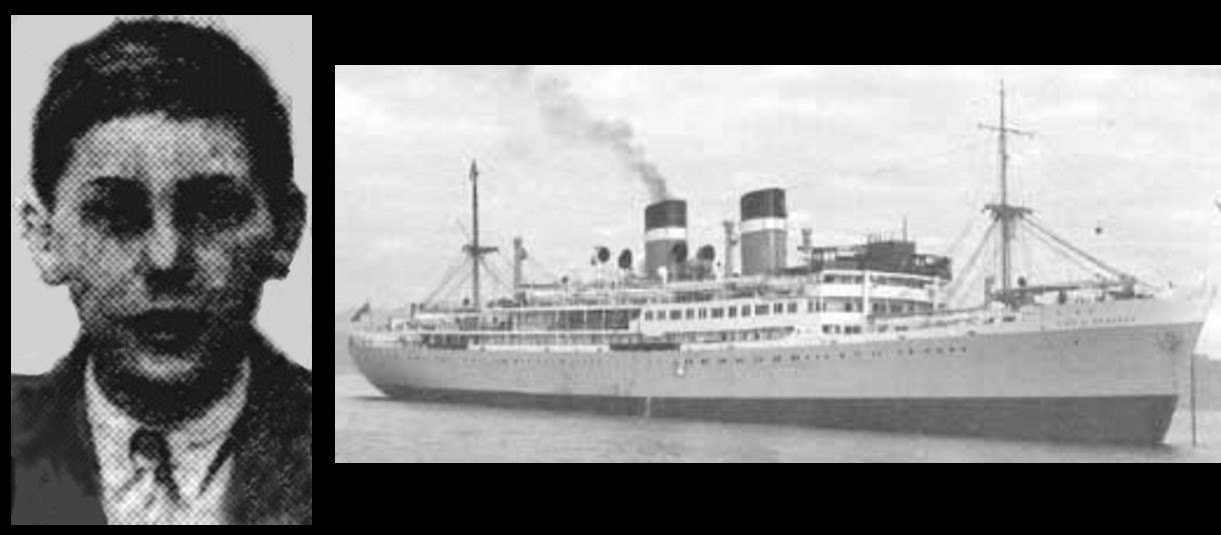
LEIGHTON GEORGE RYMAN
Civilian Casualty
Leighton George Ryman was born in Cardiff on 26 Aug 1930 to William Thomas Henry Ryman, a lorry driver and RAF motor cyclist, and Katura Mabel Ryman née Scadding, both originally from Cardiff. At the time of the 1939 Register, the Ryman family was living at 147 Richmond Road. Layton was one of the 90 British children aboard the SS City of Benares, part of a Children’s Overseas Reception Board plan to evacuate British civilian children to Canada. The City of Benares also transported civilian passengers; on the night of September 17, 1940, she was carrying 407 souls. 250 miles from Rockall, the City of Benares was spotted by a German U-48 submarine. It fired three torpedoes at her; the first two missed their mark, while the third struck her in the stern. In the frantic minutes which followed, passengers scrambled to escape, while the CORP escorts tried desperately to save their child charges. Lifeboats overturned and were engulfed in the water. It took just 30 minutes for the SS City of Benares to vanish beneath the waves. Many passengers who did not go down with her died later of exposure in the lifeboats, during the long wait for the lifeboats to be rescued. 260 people were lost in the sinking of the Benares; of the 90 child evacuees, only 13 survived the sinking. Layton was nine years old. He either drowned in the sinking of the ship, or died of exposure in the lifeboats afterwards. The newspaper reports that Mrs Ryman had only just come out of hospital a short time ago, just in time to see Leighton off. Both his father and brother William Royston Ryman served in the RAF during WWII which together with the fact that his mother was in hospital probably explains why he was being evacuated to Canada. Commonwealth War Graves Commission record (where his first name is spelt Layton). Leighton is remembered on the Trinity Methodist Church WWII Roll of Honour. His brother William Royston Ryman was killed in 1944 in the RAF.
 Roath Local History Society