
The great Cardiff Gold Robbery of 1889, just like the Great Train Robbery of the 1960s, certainly caught the public’s imagination. The newspapers described it as a ‘Daring Gold Robbery with some remarkable features’.

Crowds flocked to Cardiff railway station in the hope of catching a glimpse of the arrested suspects Philip Osborne and Harry Dugmore. When the engine steamed into Cardiff the excitement intensified and there was a general crush to catch a glimpse of the youthful delinquents.
Disappointment followed when it was ascertained that the prisoners had not made their appearance. Someone announced that the prisoners had alighted at Newport and were being driven to Cardiff. This led to the crowd retreating to Newport Road. Others went to the Taff Vale station after hearing another rumour. Most left disappointed when the prisoners were smuggled out of the back of the General station having arrived on the late mail train.
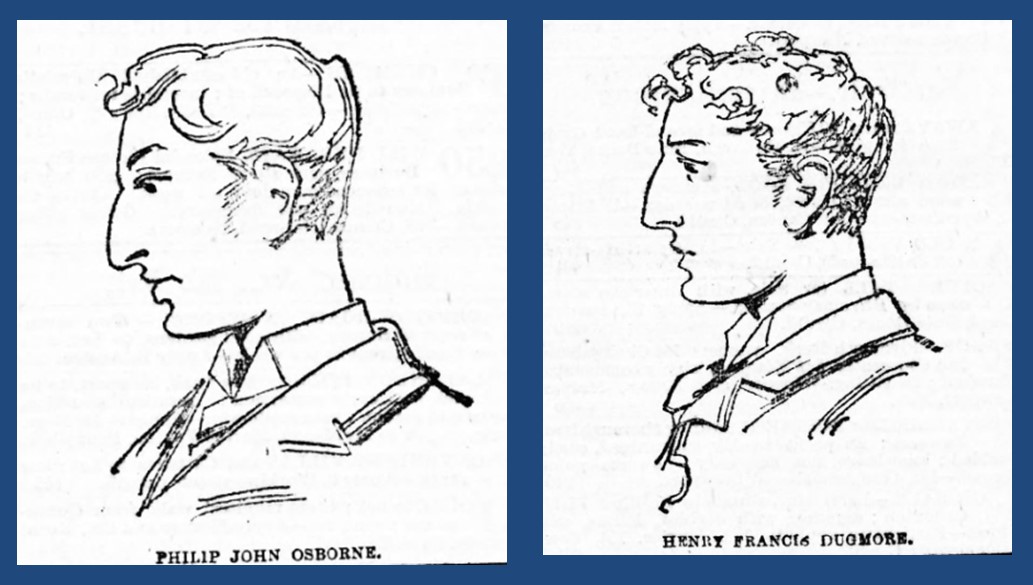
It looks a fascinating story and one I’d like some help with, especially if you are a keen genealogist or amateur sleuth. The question I’m trying to answer is whether Philip Osborne the gold thief was also a journalist? But before we get to asking that question there’s a bit of a preamble.
Like many stories I discover, I stumbled across this one quite by accident. I spend considerable time researching those that fell in WWI and WWII for including on the Roath Virtual War Memorial. I have different methods for choosing who to research next. Sometimes I get request in to include someone specific on the memorial or sometimes I work though the list of over 4000 from Cardiff who died in the two wars. Last week I started looking at Francis Morris Grey who lost his life as a Merchant Seaman in WWI. Although it turned ut not to have any Roath connections it led to an interesting story.
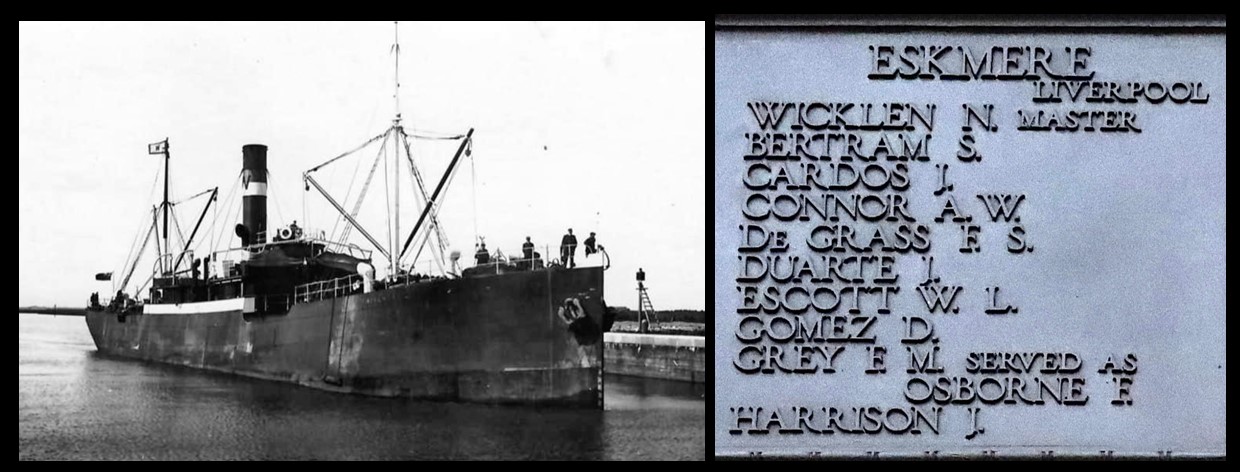
The first thing that struck me about Francis Morris Grey was his age. He was just 15 when he died, working in the Merchant Navy as an assistant steward on board the S.S. Eskmere when it was torpedoed and sunk south of Anglesey on 13 Oct 1917. Twenty crewmen were drowned, including Francis and only a few survived. At 15 years old he is the youngest person of the over 400, I have so far added to the Roath Virtual War Memorial.
The other thing that struck me about Francis Morris Grey was that the record stated he didn’t serve under his own name but under that of ‘F Osborne’. At this stage I didn’t know a lot more, other than his mother was called Elizabeth. In fact his Commonwealth War Graves Commission record read unusually strange:
(Served as OSBORNE). Son of Elizabeth Philp (formerly Grey), of 36, Fryatt St., Barry Dock, Glam. Born at Cardiff.
I couldn’t find him in the 1911 census and I was at a loss to where to turn to next to find out whether he came from the Roath area or not.
It was then that I remembered that it is now possible to purchase certain birth certificates for just £2.50. Previously, family historians have had to pay out much more than. At £2.50 (or two for the price of pint!), it makes them much more accessible. There was only one person called Francis Morris Grey born in Cardiff, or indeed anywhere in the country, in or around 1902, so it seemed pretty obvious it was going to be him. I took the plunge and ordered his birth certificate.
Not only have birth certificates become relatively affordable but they are also available virtually instantaneously online. I visited the GRO website, filled in the details, made my payment and could view the certificate there and then. Gone are the days of waiting 10 days for the certificates to arrive, peeping out of the window to see is the postman is coming down the street clutching your A4 brown envelope. I miss those days in a way but then again l do like getting to see the results straight away.
Ping went my e-mail inbox and a few clicks later I saw the birth certificate for Francis Morris Grey. He was born on 21 Mar 1902 to Elizabeth Grey, a domestic servant, but no mention of a father. Francis was born at 23 Gloucester Street, Riverside. I think this is very much the area covered by the splendid Grangetown Local History Society. They have done for very comprehensive work on the names that appear on the Grangetown War Memorial and also researched others from the area whose names are not on the memorial and included them on their website. I checked out their website but Francis Morris Grey was not included, but it looks like Gloucester Street is just outside their area of interest.

I could have left it there and just messaged my friends at Grangetown Local History Society with the information but as it was still a few hours till bedtime and as I had a few important unanswered questions remaining, I carried on. Why did he sail under the name of F Osborne? I thought for a while that he may just have made up the name as he was so young and desperate to serve or be a sailor.
It took a while but eventually I tracked him down in the 1911 Census and called Frank Grey, aged 9. He had a sister Violet Grey, aged 10 and his mother, now called Elizabeth Osborne, it seems had married Philip John Osborne, in 1908. So that would explain why he served in the Merchant Navy under the name ‘F Osborne’. They were living at 64 Neville Street, Riverside in 1911.
A couple of other things were apparent on the census record. Philip John Osborne was a journalist, born around 1866 in Pontypool. Elizabeth Osborne was born around 1882 in Ebbw Vale.
So with that one important question, why did he sail under the name F Osborne, seemingly answered, I just had one other left. Why did his war record state: mother – Elizabeth Philp (formerly Grey).
I searched for Philip John Osborne, journalist, and discovered he had died in 1915, seemingly of a heart attack, at home in Denton Road, aged 44. Elizabeth then went on to marry Charles L Philp in Cardiff in late 1917.
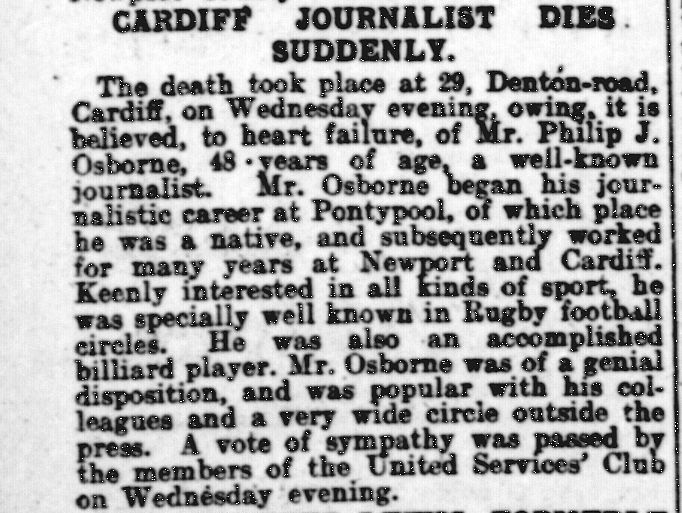
What caught my eye however was that when searching under the name ‘Philip John Osborne’ and ‘Cardiff’, a imprisonment record in 1889 appeared. The prisoner, aged 22, had been found guilty of stealing £650 from his employers, the Great Western Colliery Company, and sentenced to of 9 months imprisonment in 1889. A quick check on an inflation calculator showed that £650 in 1889 is worth over £100,000 in today’s money. Wow! And he was only sentenced to 9 months. And in those days people seemed to be sentenced for longer for stealing a bicycle.
I thought it unlikely at this stage that the prisoner was the same Philip John Osborne, step-father to our Frank who drowned off Anglesey, even though the age and name matched. It looked an intriguing story however so more research was needed, this time mainly using the online newspaper archives. Here’s the essence of the seemingly well-planned robbery which took place on 13 Apr 1889.
Philip John Osborne was a clerk working for the Great Western Colliery Company and had responsibility for gong to the Bristol and West Bank to collect the money for the wages to be paid to the miners on Saturday.
Ah, remember those days, when you got paid on a Friday in a little brown envelope? No getting it paid directly into your bank account. £9.67 a week was how much I used to get in the 1970s. Hard to believe these days.
The Bristol and West bank was in St Mary Street, on the corner of Wharton Street. The building has gone now. It was knocked down and replaced by the expansion to the James Howell’s building in the 1930s. .
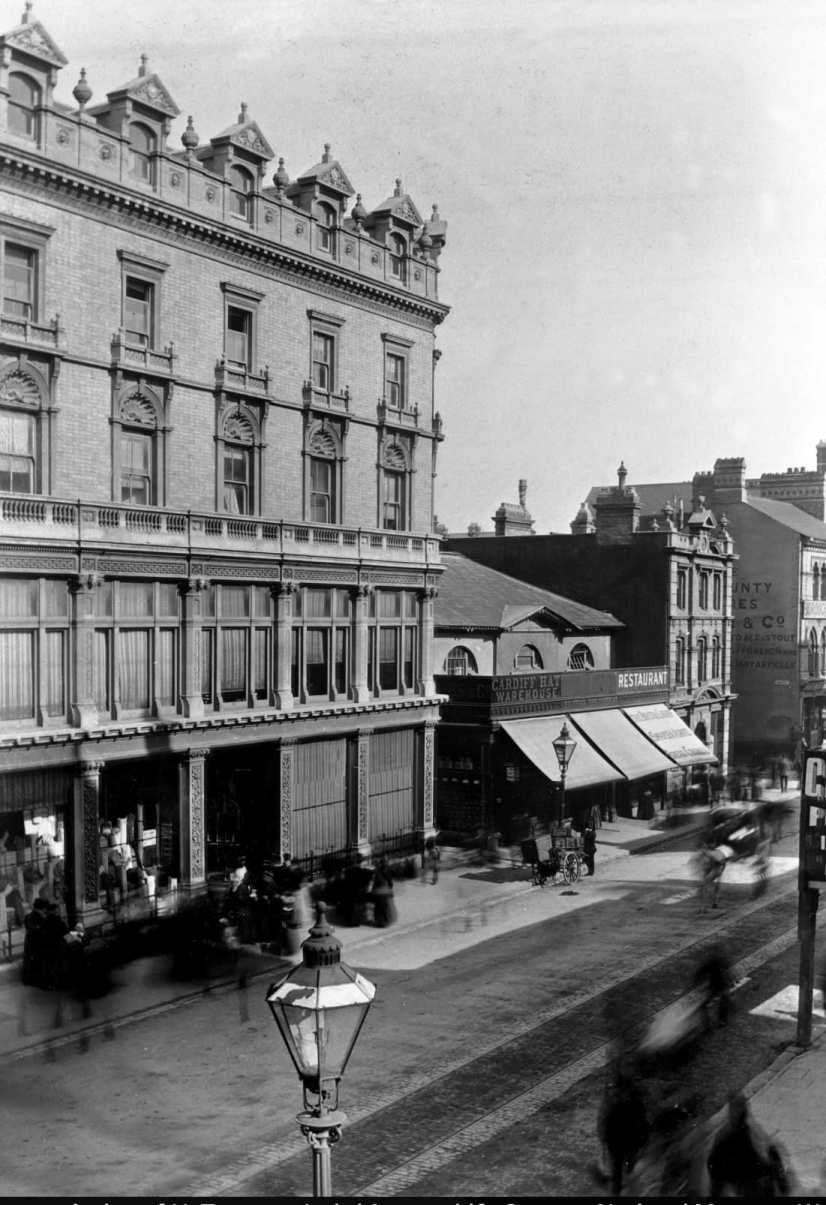
After going to the bank he went back to the office and deposited the bag in the safe. On Saturday however he failed to show up for work and on examination the bag in the safe was found to be empty.
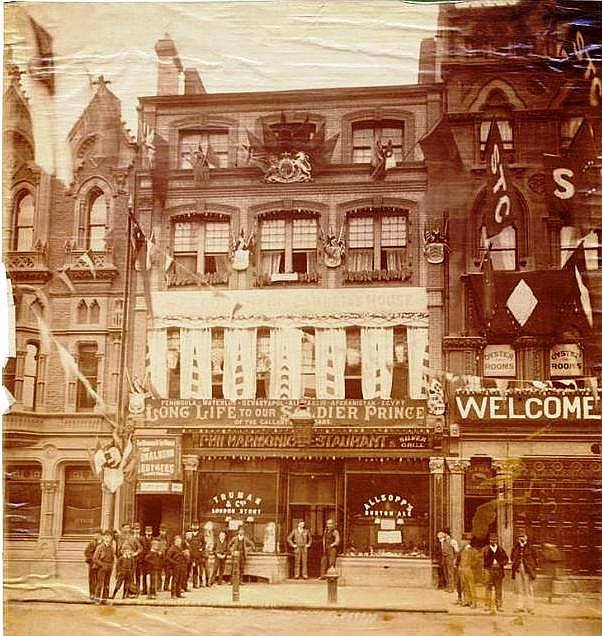
The police soon discovered that Osborne had left Cardiff for London the previous night in the company of his fellow lodger Henry Francis Dugmore (23), who the papers described as ‘though lame is a good-looking young man’. Scotland Yard were informed and the hunt began for Osborne and Dugmore. Police circulated a picture of Osborne, a copy of which the newspapers obtained from a girl at the Philharmonic Restaurant. The newspaper also reported that Osborne had been in the employment of the Great Western Colliery Company for about seven years and although trusted with a position of great responsibility was only paid about 30s per week.
It is thought that the clue which led the police to their arrest was a telegram from Duggan to his father asking that his box be sent to him in London.
Osborne and Duggan had been spotted by people who recognized Duggan, at the station in Newport. Osborne was reported as being in procession of a new yellow portmanteau (I admit I had to look that up. It’s a large travelling bag, typically made of stiff leather and opening into two equal parts.)
They were on their way to their hideout in deepest Suffolk but they stopped in London where they enjoyed life by visiting the Alhambra and other places of amusement.
They were later tracked down and arrested at Yaxley, Suffolk where they had been passing themselves off as the brothers Benson.
It had been a well-planned robbery. The proprietor of a guesthouse in Yaxley that received summer visitors had earlier received a letter from H.F.Dugmore, Cardiff saying that he thought the fashionable accommodation offered would exactly suit two young fellows of his acquaintance who resided in London and whose physician had ordered them quiet rest in the country. The accommodation was booked and the Saturday following Good Friday the landlady received a telegram saying that the bothers Benson would arrive that day. A carriage was sent to the station to meet them but only one arrived, the second one arriving the next day.
It is reported that their behavior at the guesthouse in Yaxley during their two to three week stay was most exemplary and their habits regular. They were ‘respectably dressed and heavily ringed’. Their gentile behavior and apparent affluence made them great favorites with the best people. They took part in balls, lawn tennis, card parties and other amusements as well as taking short tours of nearby towns and villages including Eye where they played billiards at the White Lion Hotel.
One Wednesday however they were arrested whilst playing tennis with several ladies. The landlord of the guesthouse interrupted their tennis game and they were asked to come inside but suspected nothing. They were greeted by the manager of the Colliery Company who immediately recognized Osborne as an employee and Dugmore as a clerk at another local office. When the colliery manager demanded the money a bag was fetched from their bedroom and emptied onto the table and found to be 611 sovereigns. They admitted their guilt and had another £24 in their pockets.
At some stage Osborne telegraphed his brother saying ‘Am in custody. Deficiency very small. See Jones.” Jones it seems was the manager of the colliery company and the hope was that making up the shortfall would be enough to get any charges dropped.
So how did the police find the perpetrators? Once the detectives had discovered the hotel Osborne and Duggan used in London they had a lucky break. The porter remembered ordering them a cab and was able to give the police the number. The cabby was able to tell them that it was Liverpool Street station he had taken them and that they were heading for Mellis station in Suffolk near Yaxley. It sounds like Osborne and Duggan weren’t very good at covering their tracks.
When the police turned up to arrest Osborne and Dugmore with the colliery manager they immediately admitted their guilt. There is no mention of them demanding a lawyer or answering ‘no comment’ to questions. Out of the £650 stolen, £624 was recovered and prior to the trial friends of the prisoners made up the deficiency. It seems an attempt was made to get the case dismissed under the First Offenders Act but their employers thought it too serious a nature to be dealt with as such. Bail was accepted and public interest in the case continued unabated.
When the case convened a large crowds flocked to the court to see the prisoners and hear the evidence but police were determined that the court would not be crowded and a very limited number were allowed to enter. Those who did make it in were said to be ‘of a different class of persons from those who usually occupy it’ and ‘were probably acquainted with one or both of the prisoners through commercial intercourse’. Bail was set at £100, again quite a considerable amount in today’s money.

Harry Dugmore had been charged with receiving the money knowing it to be stolen.
At the trial the details of how the robbery was carried out were revealed. Osborne and a colleague named Ambrose had gone to the bank to collect the wages. Whilst the money was being counted Osborne induced his colleague to pop out for a few minutes to the Philharmonic Restaurant to make a reservation and during his absence placed the money in his own pocket rather than the leather bag which was provided for the purpose. That’s why the leather bag later found in the safe was empty and not full of gold sovereigns.
Perhaps their capture could have been something to do with that the papers called ‘a scandalous piece of imposition’. A person who represented himself as an employee of the Great Western Colliery Company visited Philip Osborne’s parents in Pontypool and asked them if they had heard from their missing son. He went onto say that if information was not forthcoming to his whereabouts, his brother, a booking clerk with Great Western Railways, would probably suffer the consequences as he would certainly be dismissed. The threat was evidently used by the man with a view of extorting any possible information that the parents may have privately received.
In the trial, both Osborne and Dugmore pleaded guilty. (I noted the irony that a Mr Benson, the name the prisoners used whilst n the run, was the council for the Osborne). The lawyers pleaded that their youth was an extenuating circumstance together with the fact at all stolen money had been paid back and of course were of excellent character. In the end they were both sentenced to 9 months imprisonment.
It looks like after serving his sentence Harry Dugmore went on to be an accountant in his hometown of Mynyddyslwyn, Monmouthshire.
So I’m left asking whether Philip John Osborne the gold robber was the same Philip John Osborne who married Elizabeth Grey and lived in Riverside.
Philip John Osborne, the journalist, was born in Pontypool in on 5 Oct 1866, youngest son of Edwin Osborne, a baker, and Mary Ann Osborne née Parsons. Looking at the 1881 census record we see that at the age of 14 he is at home and a newspaper clerk. In the 1891 census he is also living with his parents in Pontypool and a newspaper reporter. That still left him time in theory to have moved to Cardiff in the 1880s, worked as a clerk, stolen the gold, served his 9 months prison sentence and be back in Pontypool for the 1891 census. In 1901 he is lodging in Newport and working as a journalist and author. In 1911, as we know, he was living in Riverside, Cardiff and had married Elizabeth Grey.
There are some mentions in the newspaper reports of the gold robbery that strongly suggest the two Philip John Osborne are indeed the same person. There is the mention that the parents lived in Pontypool. Also, that Philip was the youngest son, which he was. And also that he had an elder brother who worked for Great Western Railways as a clerk. A look at the family tree of Philip John Osborne the journalist does indeed show he had an elder brother, William Henry Osborne, who in the 1891 census was living in Penllyn Road, Canton and whose job was Chief Booking Clerk on the Railway. Maybe that’s enough to prove it .……… or maybe not?
I did find another Philip John Osborne would you believe in Cardiff. He was 25 when he got married in 1896, so the age is a bit out. He was a platelayer and lived in Llantwit Street, Cathays. I may be wrong but it doesn’t seem a good match to a heavily ringed gentleman playing lawn tennis in Suffolk.
So what started as an investigation into the sad death of 15 year old Francis Morris Grey (F Osborne) led to the ‘Cardiff Gold Robbery’. You never quite know where this local history research is going to lead you. Here’s just one more puzzle to leave you with.
Remember that the information on Assistant Steward Francis Morris Grey’s record stated:
(Served as OSBORNE). Son of Elizabeth Philp (formerly Grey), of 36, Fryatt St., Barry Dock, Glam. Born at Cardiff.
Well, I happened to glance at the information for the Chief Steward lost on the S.S.Eskmere. He was William Maxwell, aged 59. It said:
Son of the late William Maxwell; husband of Eliza Ann Maxwell (nee Rich), of 36, Fryatt St., Barry Dock, Glam. Born at Glasgow.
Note it is the same address on both records. The story of William Maxwell is interesting in that his body as the only one recovered from the sea where the Eskmere went down. His body was brought back to Barry and is buried in an unmarked grave. Dr Jonathan Hicks, a Barry historian and author, is leading a campaign for the grave to have a Commonwealth War Graves headstone installed.
I did some more research, thinking that possibly Elizabeth Philp and Eliza Maxwell were the same person but I don’t think there are.
I did however find a strong connection. Remember the birth certificate I purchased atated that Francis Morris Grey was born at 23 Gloucester Street, Riverside in March 1902. Well, I researched Eliza Ann Maxwell née Rich and found her in the 1901 census living as Eliza Ann Rich at the same house – 23 Gloucester Street, Riverside.

I haven’t been able to figure out the connection as yet but I think there must be between the two families and therefore between the Chief Steward and the Assistant Steward of the S.S.Eskdale. I’ll leave that one for you amateur sleuths to salve. Thanks for your patience.
 Roath Local History Society
Great research. Local History and Family History leads us down many strange but interesting paths!
I’ve had a little look into this as I found the story very interesting. In the South Wales Daily Telegram, one of the people to give him a good character reference was a Mr H. Hughes, newspaper proprietor, Pontypool.
Well found. That looks like an extra bit of evidence to say he was indeed the journalist. Thanks.
As a Cardiffian, extremely proud of my background, these studies provide a great sense of connection now that l live so far adrift.
Please keep on keeping on
I have always been interested in this story. My Surname being Dugmore, my family berng from Abercarn, my Grandfather was called Henry and my Father Francis. There is bound too be a family connection, too much of a coincidence otherwise. Trying too work out where Henry Francis Dugmore falls in my family tree.