
The following words and pictures have kindly been provided by Cardiff author Chris Butler along with premission to reproduce them.
The National Pageant of Wales took place in Sophia Gardens, Cardiff between 26th July and 7th August 1909. With 5,000 performers it was an expensive and swanky event reflecting the growth of Cardiff, its new city status (as of 1905), its new City Centre (as of 1906), its aspirations and the fact that it referred to itself as “The Modern Athens”. All this was built on the thriving export trade of coal and iron from its docks.

Coal had come down from the South Wales Valleys and made the Marquess of Bute, who owned Cardiff Castle and the docks, the richest man in the world. It had created a proud, rich city, too. In 1907 it was the largest coal port in the world and our Royal Navy depended solely on Welsh coal.

The official photographer of the National Pageant of Wales was a Mr Corn, trading as C. Corn from the Metropole Studios, 3 The Hayes in central Cardiff.

His trades directory entry shows him as being a portrait painter as well as a photographer. He is clearly a photographer of talent, demonstrable from the suite of 36 real photographic postcards which he produced for the pageant. They are so well composed that these postcards leave a collector of Cardiff wanting more. Participants in the pageant ranged from workers recruited en masse from Cardiff docks to the cream of Welsh society, including even the Marchioness of Bute, appearing as Dame Wales. Although described as “the charming chatelaine” of Cardiff Castle, she looks sternly regal in her postcard, and it is known that her understudy took most of the strain of the actual performances.
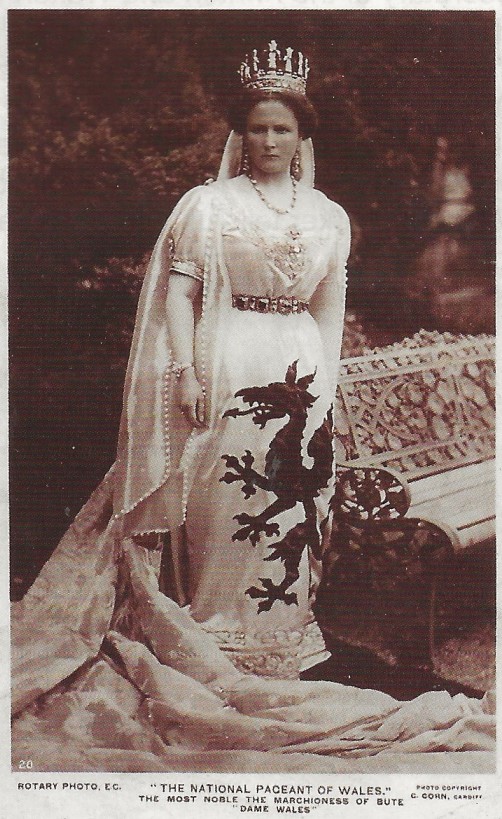
It was quite common for prominent local figures to participate in pageants though. Lady Ninian Crichton Stuart for example who was a supporter of Mr Corn, featured as Glamorgan, and both Lewis Morgan, the Conservative Lord Mayor of Cardiff and his wife, Lady Morgan, both had prominent roles.

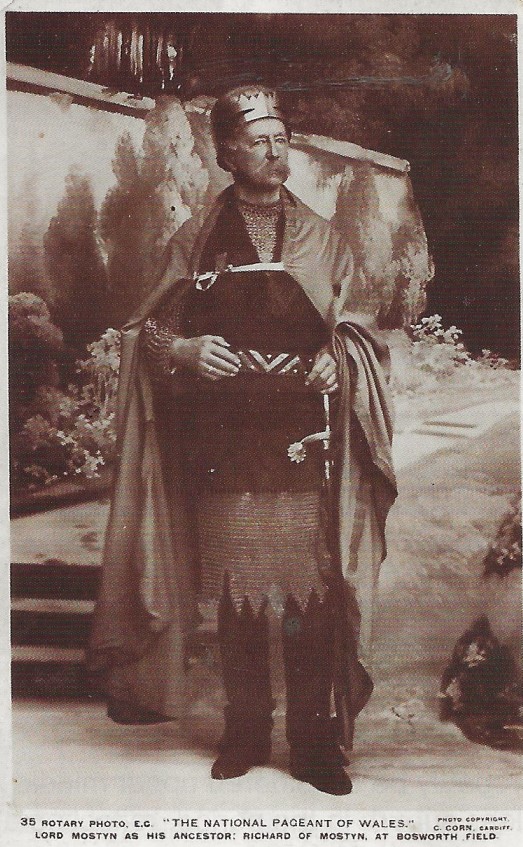
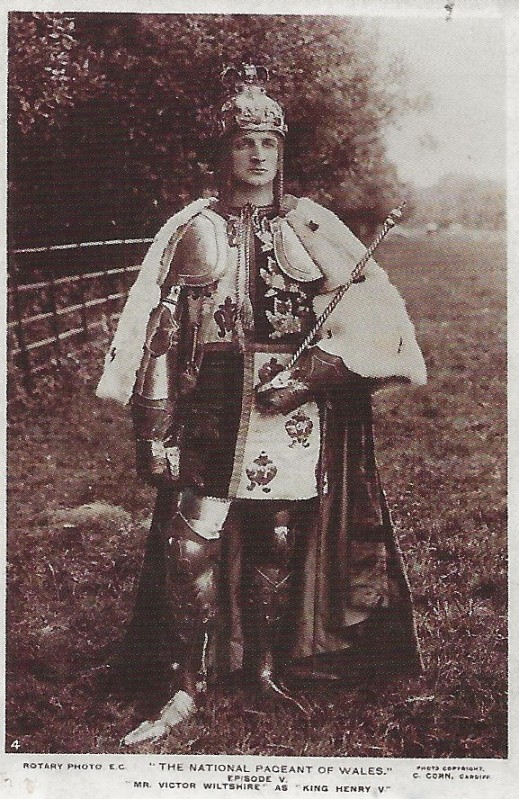
Some of the performers of this pageant were even playing roles of their actual ancestors many generations before. Lord Mostyn, for instance played Richard ap Howel of Mostyn from the Battle of Bosworth. And even when a rare outsider was brought in, to play Henry V for instance, no expense was spared and an important and influential West End actor in the shape of Victor Wiltshire was hired.

Henry Corn’s Metropole Studios were in an up-and-coming part of Cardiff, the heart of its retail shopping and the scene of a titanic commercial battle between the two competitive drapers, James Howell and David Morgan. Morgan’s investment in shops and arcades had raised the social status of the Hayes buildings but James Howell was a prominent backer of the pageant. And, as we have already witnessed, Corn had made acquaintance with the cream of contemporary Welsh society, and must have spent quite some time with them in his studio. Indeed, his advert in the Pageant’s “Book of the Words” lays emphasis on how much he was patronized by the nobility as well as local political grandees. The list of patrons, as you can see from his advertisement, included The Duke of Argyll, the Marquis and Marchioness of Bute, Viscount Tredegar, Lord and Lady Crichton Stewart, the Lord Mayor and Mayoress of Cardiff, several Aldermen, JP’s and so on.


Mildly surprising though was the fact that, apart from his advertising of the studio Corn does not seem to appear in the local press. He keeps a low profile. The 1911 Census shows a Henry Corn living with his wife, Annie, and servant in 6 Ty-Draw Place in a 7 roomed property in Roath. This part of Roath would probably be considered upper middle-class suburb in the period, reflecting a comfortable lifestyle.

More mysteriously. his hitherto regular entry in trade directories suddenly disappears after 1914. Till this date he regularly advertised his studio. Did he die? There are no relevant UK death records or probate records. As his profession is listed as photographer in the Census this must be him.

A key to all this though, turns out that he was born in Altona, Hamburg on 8th November 1875, information provided on his subsequent entry to America. This corresponds with a German birth certificate for Henry Cohn, son of Isaas Cohn, most probably Jewish.
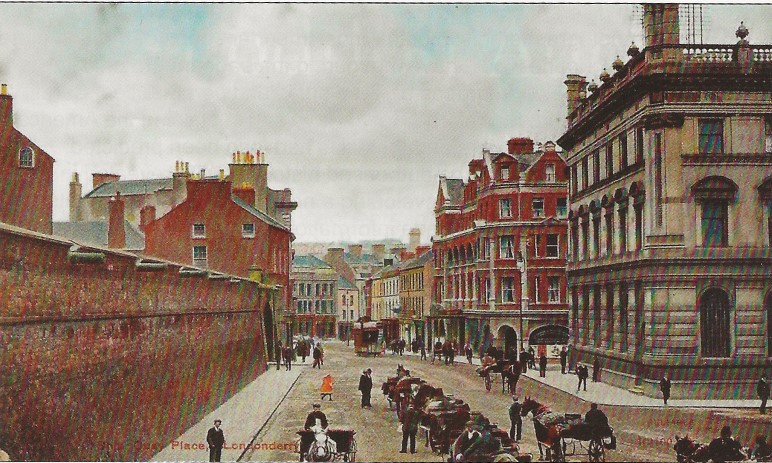
The 1901 Census then shows him trading as a portrait painter and commercial traveller aged 27 living in digs in Linenhall Street, Londonderry in Northern Ireland and not far from the River Foyle which carried a very busy shipping trade. His religion by that time is recorded as Unitarian.

Thereafter he must have come over to Cardiff,established a respectableand profitable business and found his bride from Bargoed, Glamorgan…But the question remains, what took a young German from Hamburg to Londonderry in the first place?
When the Great War broke out in 1914 resentment against German nationals resident in Britain rose steadily and Henry seems to have found his way out in a narrow squeak before internment scooped him up in its net. Indeed he shows up on a passenger list from Liverpool to New York on a ship with a neutral flag on January 12th 1915.
This was just 4 months before the sinking of the Lusitania on the 7th May 1915, when Internment became much more universal, and his flit is reminiscent of the escape of Burgess and Maclean before they were rounded up as spies. Burgess and Maclean, of course, had been tipped off.

Corn’s “enemy” nationality is listed on the manifest as German. His wife, Annie, does not appear to be with him, unless she is travelling under an assumed name. There is an “Annie” travelling on board and listed as “enemy” but she bears a different surname. His occupation is not recorded like other passengers. Maybe he wanted to conceal it. There is no record of Corn’s wedding or divorce that I can trace, though an Annie “Corn” gets married in Cardiff for the first or second time in 1919 and resides in up-market Lake Road West for the rest of her life.

Then we can trace his naturalization record in the USA on 6th April 1916 – a year before the USA enters the Great War. He is 5’ 5” tall, 140lbs weight, dark brown hair, with a (fencing?) scar on his nose, his last foreign residence being Cardiff in South Wales, and he renounces all allegiance to the German Emperor. He states flatly: “I am not married”. Perhaps he never was – and the Census entry had been another deception. He lists an alternative surname as “Cohn”. He is now a fine art dealer…Corn ultimately died in the Jewish Hospital Brooklyn in 1933 and is buried in the Mount Olivet cemetery in Washington. His obituary records him as having been a manager of several manufacturing firms in Manhattan, latterly Automatic Linker. He left a wife, Rose, behind him.
There are two possibilities. One is that our talented Photographer, the man who captured the cream of Welsh society in the famous 1909 National Pageant of Wales, was a victim of circumstance, and lost his wife, home and business before escaping to a new life in the USA. However, conspiracy theorists may have a different concept. Here is a mobile, linguistically able, artistic young German who finds himself as a gifted photographer in two of the most important ports of Britain before the Great War. He mixes with local dignitaries whom he would have met during the pageant. Potentially, he might have been able to make observations and take photographs of Allied ships and port facilities. Cardiff would have been of critical importance to the war effort, fuelling the Royal Navy and sustaining the American Expeditionary Force (AEF). A war between the Central Powers and the Allies had long been predicted.

Is this a plausible theory? Well, “Defence of The Realm” the authorised history of MI5, revealed in 2009 that the German Admiralty’s intelligence service had set about developing a network of German agents in Britain for some years before 1914, to monitor shipping and provide information. Some of these agents were identified and tried before the war. MI5 records show that 65 German agents were arrested during World War I. This general approach was also captured by popular spy novels of the time such as “The Riddle of the Sands” and “The Invasion of 1910”, the latter predicting a German invasion assisted by a complex spy network, and as early as July 1908 the “Western Mail” posed the questions: “Are we prepared for war? What would happen in a fight with Germany?”
It would have been sensible of course for the Germans to have installed a sleeper agent with photographic skills, an ability to mix with the rich and powerful, and with easy access to the Docks in Londonderry or Cardiff, from his city centre studio.

And then, escaping in the nick of time and concealing his talent as a photographer, he might well have gained entry to New York – a vital port of the USA which was destined to join the war against Germany in 1917. New York was the Port of Embarkation for the American Expeditionary Force and having an observant and experienced agent in place would have been a real coup for the Germans.
So, unless there are some MI5 records available on the mysterious Mr Corn, we may never know whether he was a spy or not… But he certainly was in the right place at the right time, mixing with the right people – and a clear master in his craft, as his postcards bequeathed to us clearly demonstrate.
 Roath Local History Society
My Gran was in this Pageant, aged 15 & was captured by the Chief Brigand (Police Constable of Glamorgan) & thrown over the saddle of his horse & carried away screaming. She was Lillian Cosslett then but for some strange reason her name doesn’t show up in the list of participants. There was a photo however and she was mentioned in a newspaper article (‘blood curdling screams’) and when the horse grew old & died she was given one of the hooves as a doorstop with a little plaque on it, as promised by her captor.
Her mother washed her hair with beaten egg every day of the performance, she suffered from backache for the rest of her life (she was thrown backwards over the saddle), was NOT allowed by her father to become an actress, & lived to the ripe old age of 103!