
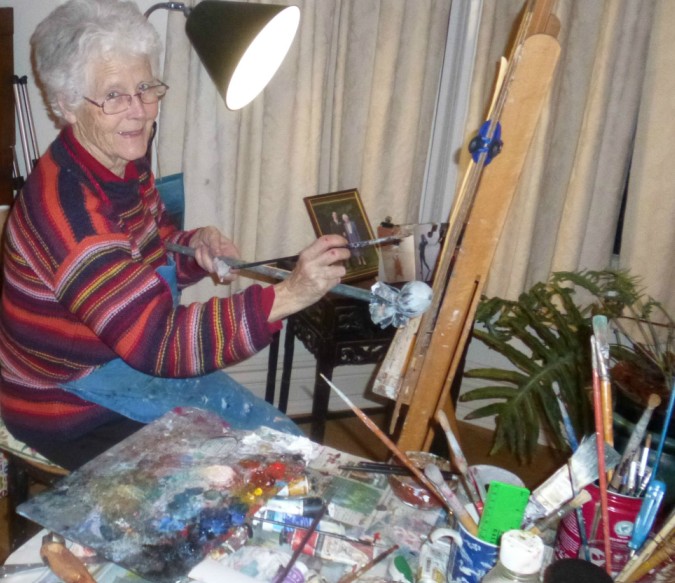
It is with sadness that we learnt recently of the death of Mary Traynor, at the age of 91. Besides being a Society member and a long-time resident of Penylan, Mary was an accomplished artist, who depicted many of Cardiff’s notable buildings in her book Creating Cardiff.
Copies of her book will be available for sale at the AGM and talk on 10 September 2025.
Here is a profile of Mary, first published in the RLHS Newsletter in August 2020.

Some of my most treasured possessions are my sketchbooks. For me they are a record of things I have done, seen and visited over the years on family holidays in places like North Wales, Cornwall, Brittany and painting trips to Palma, Symi and Barcelona; not forgetting Australia and Vietnam where two of my children lived for a while. Being an artist is one thing that has kept me going and has given me pleasure throughout a long life. I have been a widow for many years. There is still a layer of sadness in me, but Brian was so supportive that l was compelled to continue painting, partly in his memory and have done so ever since, exhibiting and selling my work

A four- year course in Theatre Design at Birmingham College of Art & Crafts introduced me to architectural history and the challenges of drawing buildings, especially large historical ones. Perspective has always been difficult and I faintly ‘set square in’ a few vertical and horizontal lines as a guide. The Grade 1 listed art college was the ideal base from which to sketch the huge 19c buildings of the city centre. I then lived in Hammersmith, London for a while, spending my free time in sketching the Thames at Battersea Bridge, going to galleries and museums until I met Brian, a Cardiff man.
It was exciting to have the early sight-seeing trips of Cardiff: the gleaming white City Hall and Law Courts, the National Museum, Cardiff Castle, Castell Coch, the parks and in contrast the Docks and The Valleys which paid for all this building. We settled in Roath (this includes Penylan for convenience) and I have lived here ever since, in three different houses in one road! I raised a family and continued doing art through this time as most women artists blessed with children do. I usually love sketching children.

I have spent many happy years living in Roath – and here are some of my favourite places: firstly busy Albany Road and the network of streets surrounding it; the Mackintosh Institute or ‘The Mac’ an early 19c mansion in Plasnewydd Square, a thriving community centre and Farmers’ Market, not forgetting the arts centre opposite in the former Presbyterian Church where I much enjoyed dance performances by the young people of the Rubicon. There is a gruesome side to this as the Albany and Richmond Road crossroads is where Cardiff’s hanging field was! It is very sad that Grade 2 listed Globe Cinema was replaced and The Gaiety in City Road is making way for yet more student flats – how unnecessary is that?

A reconstruction based on sketches and photographs of how the cinema might have looked in the 1920’s. It opened in 1913 and was a listed Grade II building that was demolished to build The Pear Tree Cafe.
Top of my list of favourite Roath buildings is the Edwardian Roath Church House with its central panel elegantly carved with the name and 1914 which says it all. Opposite is Grade 1 listed St Margaret’s Church with the polychromatic interior that makes it so special. I felt that I should have painted the interior but the drawing does show patterned brickwork and different stones. I must go down after Covid-19 is over and subtly paint the shadowy interior. I enjoyed doing the front and back in their leafy settings. Nearby I like Willie Seager Cottages, a modern version of the original ones on Newport Road. Charming as they were, it must have been very noisy for the retired mariners living there.
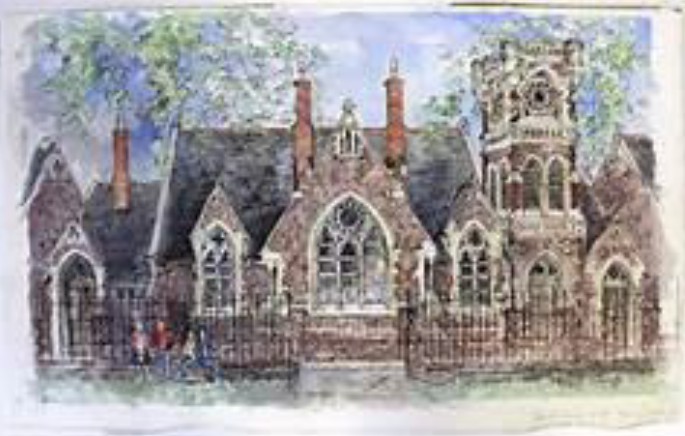
The East Cardiff Conservation Area which takes in the area encircling the parks starts at St Margaret’s and ends at the top of Roath Park Lake. As a representative of The Victorian Society I was on the advisory group. We helped keep the character of the area by vetting detrimental planning applications to both large and smaller houses, sometimes for extensions, more often for new inappropriate windows in the front or as dormers on the front roofs. One application was for another of my favourite buildings – listed Roath Park Primary School- to have replacement windows. We opposed this and the school remains as it was. I did a painting of it as a retirement gift from the school to its Headmistress enjoying putting in the proper windows and children in the playground. Roath Park, said by experts to be one of the country’s finest urban parks is of course of on my list. Scott’s Memorial Lighthouse was done in the raging blizzard of my imagination, instead of from outside! Finally, St Andrew’s United Reformed Church, its elegant spire marking Wellfield Road, the parks and playing field; is for me a reminder of Constable’s paintings of Salisbury Cathedral.
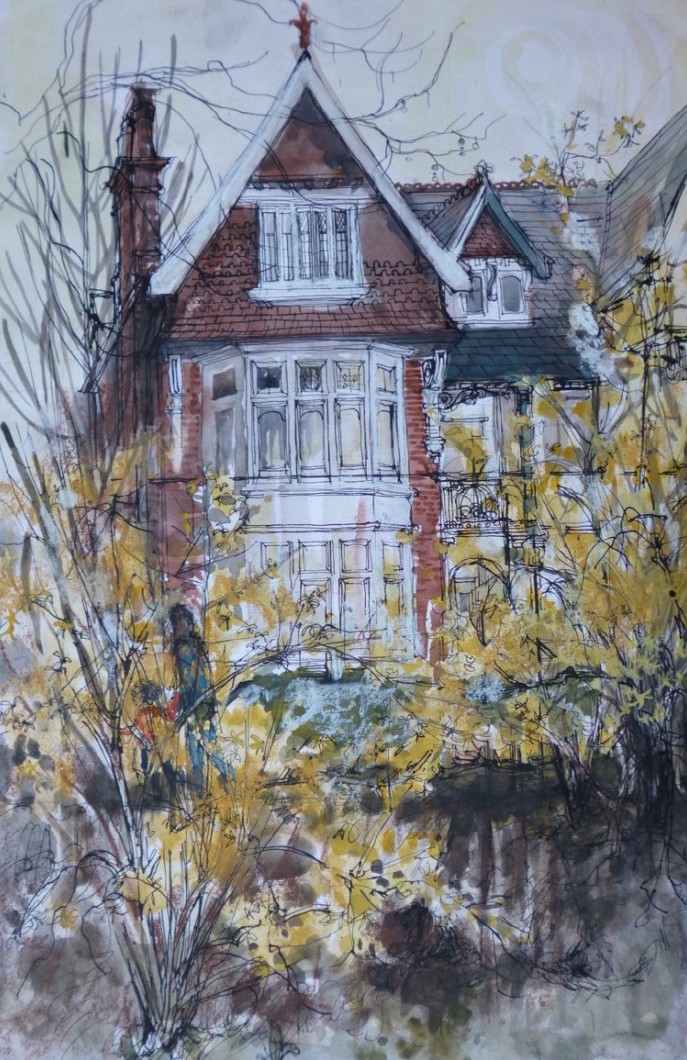
Pen and Watercolour
Facing the Roath Recreation Ground, the houses in Ninian Road date from 1891 and completed 1910
Artists don’t retire if they can help it and I keep painting and drawing from my sketch books and photos during Covid -19. I am proud to be one of a group of at least five artists living quite near. For a few years an enterprising group of artists organised ‘Made in Roath’, taking place in October when artists, including me opened their studios to anyone who wanted to see them.
When I first started in the late ’60s and ’70s there were a lot of changes going on in Cardiff, such as the building of Boulevard de Nantes, the demolition of the houses at Dumfries Place and the splitting of the civic centre from the city centre. There was even talk of driving a road through Cathays Cemetery. Painting is what I do, so I would go and sketch buildings I knew were going to disappear – but I didn’t think I would still be doing it 50 years later. In January 2003 the Central Hotel was lost, when a huge fire swept through the derelict building. It was demolished in 2006 to make way for a new high-rise hotel. I have mixed feelings about the redevelopment of Cardiff over the years, some things I love – like the walkway around Cardiff Bay and the Millennium Stadium, which I think is fantastic – but other things I’m not so sure about. There does seem to be a bit more sensitivity now though in the way historic buildings are treated.
The climax of my work to date has been the writing of ‘Creating Cardiff’ done alongside my painting and drawing. The illustrations are taken from work done over many years and especially for the book. Now it is published I shall return to my latest project which is a very challenging commissioned painting of Roath Brook Gardens and then continue recording the different styles of the houses of Roath and Penylan.
In June 2014 Glamorgan Archives received a very interesting and unique deposit, when Mary gifted her collection of sketchbooks and loose works. They form an invaluable record and resource, both for researchers and as the basis for many exhibitions.
Creating Cardiff

- ISBN: 9781845242961
- Mary Traynor
- Publication June 2020
- Format: Paperback,
150×155 mm, 168 pages - Price : £8.95
Cardiff became a city in 1905 and the capital of Wales in 1955. It has a castle, civic buildings and extensive parklands, docks, two cathedrals, three universities,concert halls and theatres and museums. A new rugby stadium and arts centre marked the millennium.
Author Biography: Mary Traynor is an artist with a vivid interest in architectural and historical subjects. She has spent a lifetime recording Cardiff buildings, many of which have been threatened and has campaigned to save them. All the images in this book have been sketched on site. Sadly, some have been demolished over the years. This book brings the memory of them back to life in the company of her present-day images of the capital.
To me, this beautiful book, honed over many decades, represents a love letter from Mary to Cardiff, for all to cherish. Elizabeth Morgan.
 Roath Local History Society