Cardiff Blind School

This is a reprint of an ‘occasional paper’ first researched and published by the Roath Local History Society in 2011 supplemented with pictures and newspaper extracts.

In 1894, the Cardiff Education Committee accepted the recommendation of its Special Schools Committee to cease renting a schoolroom in the Blind Institute and to appoint a teacher to work with blind children. The teacher would attend Radnor Road School, Canton in the mornings and Stacey Rd School, Roath in the afternoons.

The teacher appointed gives his name as Frank Lattey.  There are no Latteys listed in Cardiff or anywhere else in the 1881 Census but he appears in the 1901 Census where Frank turns out to be his middle name; in the Census he is Werner F Lattey; age 41(so born about 1860); born in London, living as a boarder at 150 Richmond Rd, Cardiff; occupation Schoolmaster (which clinches it). Reading about him working mornings in Canton and afternoons in Roath, I imagined him cycling between the two, but the final column of the Census form tells us he was partially sighted from birth so perhaps the trams were already running between Victoria Park and the Royal Oak).

The logbooks of Cardiff Blind School are held in Glamorgan Archives. The first entry is dated 3 Sept 1895 but when school resumes after the Christmas holiday, the dates are still headed 1895 and all subsequent entries follow from this, so the first entry was probably made 3 Sept 1894. The following selection of entries from the logbooks provide a picture of conditions at the time:

Opened September 3 1895.  Frank Lattey teacher.

Morning attendance at Radnor Rd Girls’ School.

Afternoon attendance at Stacey Rd.

Sep 3. Admitted 1 girl and 1 boy at Radnor Rd.

Admitted 2 girls and 2 boys at Stacey Rd.

Sep 7. Admitted 1 girl Radnor Rd.

Oct 31.  ½ day holiday.

Nov 7.  Stacey Rd closed due to rough weather.

Nov 30. Ethel is progressing favourably with Braille.

Dec 21. Schools closed for Christmas vacation.

Jan 7. 1895 Resumed school work.

Jan 11. Charles is rarely in school. He is subject to fits.

Jan 25. Archibald away for last 3 weeks for lack of boots.

Feb 1. Gabrielle is making progress in Braille and arithmetic.

Mar 15. Rachel is a troublesome fidgety child and does not improve in reading and writing.

(There are later Entries concerning Rachel):

Sep 11 1896. Rachel is still absent and the attendance officer reports that the family is likely to go into the workhouse.

Sep 18. Rachel is again attending school.

And, to finish these entries on a positive note:

May 14 1897. I am informed that Clarissa of this school has won a scholarship at the Royal Normal College and Academy of Music for the Blind, Upper Norwood, London.

The Royal Normal College, Upper Norwood
(image courtesy of The Norwood Society)

Reports of Her Majesty’s Inspectors of Schools (HMI) are copied in full into the logbooks.  The reports are short and (almost!) invariably favourable.

Report of HMI Rev T Sharpe year ended 30 April 1895

Stacey Road: The children are taught with kindness and patience. Consequently provision should be made at [? illegible] for a school. Grant £8.8.0.

Radnor Road: The children are carefully taught and very gently handled. They should be transferred to more suitable premises. Grant £6.0.9.

June 16 1897 Report of HMI for Stacey Rd Dept: The children are still taught in a classroom with sighted children but with a special instructor to work with them half the day.  A new central room for the instruction of the two groups of blind children in Cardiff is approaching completion.  The work of the special instructor deserves praise.

June 18 Closed for Jubilee Week. [Queen Victoria’s Diamond Jubilee]

July 1 Report of HMI for Radnor Rd: The children are taught in a corridor by a special teacher during half the day and during the rest of the time receive instruction with the sighted children. A new central room… [continues as Stacey Rd report]

The school transferred to the central room in Adamsdown in September 1897. The logbook records that they exhibited a hearthrug at the Cardiff Horticultural Show during the August Holiday and a boy named Sydney won 1st prize in the general competition.  Numbers of children attending increased and HMIs’ Reports continue:

South Wales Echo, 12 Oct 1898

18 July 1900 Report of HMI: The school provides for the education of 35 blind children of both sexes.  The school is in a thoroughly satisfactory state and the Master deserves praise for the capable instruction that is given here.  It is desirable that inexpensive books in Braille type should be purchased in order that the children may be encouraged to read at home.

15 March 1906 Received report of HM Inspector: The opportunities for educating children are very unsatisfactory.  The children are too few to admit of suitable classification and do not make adequate progress.  Accordingly the Committee are advised to close the school and transfer the children to residential institutions. In this way the expenditure on the children may be expected to be effective. At present this is certainly not the case.

Mr Lattey replied in a typed letter, the carbon copy of which is in Glamorgan Archives. (The carbon would now be too faint to read if he had not hit the keys with such force that they have left impressions in the paper!)

2 April 1906

To the Chairman and Members of the Special Schools Committee

Mesdames and Dear Sirs,

I have received and read with surprise the report of Dr Eichol on this school and in connection therewith I beg to submit the following statement.

The visit on which the report is based lasted less than thirty minutes and so far from the general progress of the school being inquired into, only a few questions were asked of the pupils and these were confined to four of the eleven subjects taught in the school.

I do not gather from the report that there is any complaint upon my methods or my work, and before your Committee decide to act in the matter, I respectfully ask your consideration of previous reports upon the work of the school.

The number of pupils is at present small, but as ten is the maximum for a class in a residential institution, the smallness of the number seems hardly a sound reason for closing the school.  I would also remind you that the number has been as high as seventeen and Cardiff cannot reasonably expect that the number of its blind children will remain much longer at the present low figure.

As evidence that the school has done and is capable of doing good work, I mention that no less than five children have been brought to me at a time when their sight was in a critical condition; they continued their education without injury to their sight and having eventually recovered are now in the upper standards of ordinary schools. It is doubtful if such cases would have been sent to an institution.

It is also well known that pupils from the school have proceeded to Norwood where they have been awarded £40 scholarships.  It is doubtful whether some of the present pupils would be accepted by a residential Institution.  I would point out that the practice in London, where there are both Residential Institutions and Day Centres, is that the children attend the Day Centre for seven years before going into the Residential Institution.

In conclusion I would respectfully submit that the question of a Residential Institution in Cardiff is receiving the earnest attention of some members of the Institute Committee and the summary closing of the school would probably delay its establishment.

I am, Your obedient servant, FRANK LATTEY

Western Mail, 3rd Apr 1906

And that is the last we hear of that report! Presumably, the letter was dealt with by the Special Schools Committee but from then on, after each HMIs’ visit, the logbook carefully records how long the visit lasted and whether or not the Inspectors spoke to any of the children.

A book by the Director of the Cardiff Institute for the Blind refers to efforts in 1897 to make the transition of children from school life to their apprenticeships at the Institute as easy as possible. Later, during the First World War, he notes “The blind children of Cardiff are under the care of Cardiff Education Committee and part of one of the largest and best situated schools in Cardiff has been specially allocated to them  … After the age of sixteen they are drafted into the workshops.”
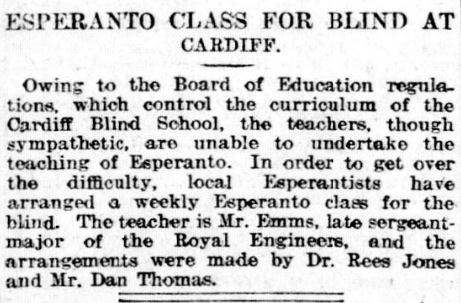
Western Mail. 27 Feb 1914 – Esperanto Class for the Blind

Glamorgan Archives have decided that because the logbooks contain personal information on individual pupils, they should be closed for 100 years (for the same reason, I have used only the pupils’ first names). Their Index shows that the Blind School moved to Marlborough Road School in 1912 and again to Cathedral Road in 1926.

The original Marlborough Road Board School opened in 1900, on the corner of Blenheim Road and Marlborough Road.

A letter from the Director of Education to the Head of the Blind School dated

27 August 1926 reads:

Dear Madam

Cathedral Road Blind School

The following is a copy of a letter dated 20 inst which I have received from the Board of Education.

1. With reference to Mr Jackson’s letter of 23 inst I am directed to thank the Authority for the information contained therein and to say that the school will in future be known as the Cathedral Road Blind School.

I am to add that the new premises provide sufficient accommodation for an average attendance of 60 children.

Yours faithfully, J.J. JACKSON Director of Education.

The Index shows the final entry in the Cathedral Road logbook is in September 1939.


I have failed to find an image of Cathedral Road Blind School but would welcome sharing one if anyone has one.
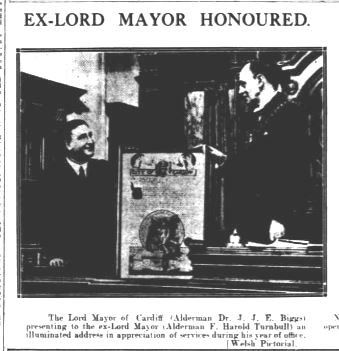
Dr J.J.E.Biggs – the first man in Wales to forget the microphone was still switched on.

It’s an unusual accolade to award someone but it tickles me. When Lord Mayor J.J.E. Biggs made his speech at the opening of the BBC in Cardiff in February 1923 he forgot the name and, forgetting the microphone was still switched on, turned to the person next to him and asked ‘What’s the name of this organisation again?’ In the same speech however he remarkably prophesised the advent of television.

I shouldn’t belittle him.  He achieved an awful lot.  He was part of the Biggs rugby playing family.  His brother Norman was the youngest person to play for Wales at 18, a record he held for 120 years.  Another brother, Selwyn Biggs, was another Welsh international.  John James Egerton Biggs himself almost joined his brothers as Welsh internationals.  In fact he was picked to play on one occasion against England but was unfortunately ill so had to pull out of the game.  All six Biggs brothers played rugby for Cardiff over the years.

J.J.E. Biggs was a doctor. He trained at Guys Hospital, and on returning to Cardiff became a surgeon, presumably at the Infirmary.

He had a distinguished medical career in WWI, promoted to Major, mentioned in dispatches and awarded an OBE.

In 1908 he became a Conservative Councillor for Roath with a record vote.  In 1911 he was re-elated councillor and became Head of Education.  In 1914 as Councillor and Chair of Education Committee his name appears on the foundation stone at Cardiff Technical College – now the Bute Building of Cardiff University. 

WWI had interrupted his involvement in politics.  In 1922 he became Lord Mayor of Cardiff which is why it fell upon him to speak at the opening of the BBC in Cardiff, 100 years ago, on 13 February 1923.

Dr J.J.E.Biggs, Lord Mayor of Cardiff 1922-23 and wife  Louisa Biggs

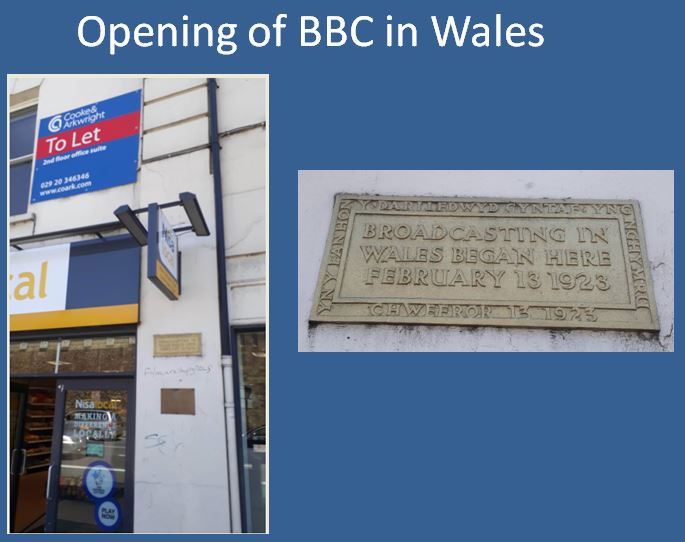
Opening of the BBC in Wales

On Tuesday 13th Feb 1923 the BBC started broadcasting radio from a tiny studio above the Castle Picture Theatre on the corner of Castle Street and Womandy Street in Cardiff.  In his speech, the Lord Mayor of Cardiff Alderman J.J.E.Biggs forecast that broadcasting would raise the standard of intellectual life, giving the poor the ‘same opportunity as the people of Mayfair to hear Paderewski and the voice of Melba.’ With great foresight he also prophesised that ‘one day vibrations of light would be projected in the same way allowing people to see the scenery, the architecture and the paintings of Italy, Greece and Egypt’.  The only hiccup of his speech came when he whispered to an aside heard by thousands ‘what’s the name of the organisation again?’

There’s no picture I can find of Dr Biggs at the BBC opening. This one is of a number of the entertainers with John Reath on the right.

Later Life

In 1926 he was present at the opening of Tredegar Hall – Roath Conservative Club by Lord Tredegar on Broadway, a building still there today. By 1939 he had moved from Cardiff and was living in Russell House, Gloucester, as a medical practitioner.  He died in aged 73 in Cheltenham.

John James Egerton Biggs timeline

1867: Born 9th July Montgomery Terrace (on Roath Road, now Newport Road, opposite the infirmary), Roath (or at least that’s where they were when he was baptised on 3rd Aug 1867).

1871: Living in St Andrew’s Place (aged 3)

1881: Living as a boarder in Cardiff Preparatory School, Dunfries Place (aged 13), even though his parents lived around the corner.

Then educated at University College Cardiff then Guy’s Medical School

Played rugby for Cardiff 18 times between 1886 and 1893 as a three-quarter and forward,  but also for other clubs including Guy’s Hospital, Richmond and Surrey

1891: Selected to pay for Wales against England at Newport in 1891 but was unable to play – reported to have been ill.

1891: Won the 120 yards sprint race at the Civil Service sports.

1891: Missing from census

1893. Qualifies as a doctor at Guy’s Hospital.

Worked at East London Hospital for Children.

Worked at Mineral Water Hospital, Bath

1895: Returns to Cardiff

1898: Marries Louisa Frances Maude Wilson (JJE Biggs is living at 147 Newport Road at the time). She was the second daughter of John Heron Wilson, a Cardiff ship owner and coal exporter

1899: Birth of son John Heron Biggs

1901: Living at 147 Newport Road, working as a Medical Practitioner, surgeon.

1906: Elected as member of Cardiff Naturalists Society

1907: Birth of son Alwyn Biggs

1908: Becomes a Conservative Councillor for Roath with a record vote

1909: Birth of son Norman Wilson Biggs

1911: Living at 175 Newport Road

1911: Re-elated councillor and becomes Head of Education

1914: Councillor and Chair of Education Committee – name on foundation stone at Cardiff Technical College – now the Bute Building of Cardiff University

1914: Joins Army. In the 2/7 Welch Regiment and promoted to Captain.

1915 Transfers to Royal Army Medical Corps, goes to Gallipoli, invalided to Egypt, recovered and went through the Sinai and Palestine campaigns.

1917. Promoted to Major, mentioned in dispatches, awarded OBE.

1920: Living at 44 Oakfield Street

1921 Census: 44 Oakfield Street, Roath.  J.J.E. Biggs –  Employment – Medical Practitioner, based at home. Living with wife Louisa and two sons, John Heron (22) mining engineering student and Alwyn (14)

1922: Become Lord Mayor of Cardiff (1922-23)

1926: at opening of Tredegar Hall – Roath Conservative Club by Lord Tredegar on Broadway

1932: Still living in Oakfield Street

1939: Living in Russell House, Gloucester, as a medical practitioner

1940: Dies aged 73 in Cheltenham

William Erbery – Founder of the first non-conformist church in Cardiff

Wales is known for its history of non-conformity and abundance of chapels.

The first Nonconformists  in Cardiff were probably the heretics, who, after the Reformation, were hanged or burnt at the stake for their faith. New ideas were a threat to the authority of the Church and the stability of society.

In Cardiff, two men were burnt for their beliefs: Thomas Capper in 1542 and Rawlins White in 1555. Rawlins White was a local fisherman. He was executed in 1555 in the centre of Cardiff for his protestant beliefs.  He is said to have been given opportunity to escape and renounce his beliefs but refused to. When his time came to be executed he asked his wife to bring him his wedding outfit so he would look his best.  It is even said he helped neatly build up the wood around his feet. There is a plaque to him in the old Bethany Baptist Church which has now been subsumed into the House of Frasier department store.

These were individuals and founded no new church, but in the 1630s all that was to change with William Erbery.  It was his followers who set up the first non-conformist church in Cardiff, Trinity chapel in Womanby Street, opposite the castle, in 1697.  William had been dead 45 years by that stage but his followers and their descendants are thought to have continued to meet in secret after his death, until in 1697 they were given the freedom to build their own church.

Life of William Erbery

William Erbery was born in Roath in 1604 or more precisely Roath Dogfield. His father, Thomas Erbery, was a merchant who had probably come across from the West Country of England to establish an iron foundry in the Merthyr Valley before moving to Cardiff.  It is probable that Thomas married Elizabeth, daughter of Rees David, a Cardiff cordwainer.

William entered Brasenose College, Oxford in 1619, graduated in 1623 and proceeded to Queens’ College, Cambridge where he earned a second degree in 1626. He subscribed for deacon’s orders in the diocese of Bristol a December 23rd 1626 and became curate in St Woolos in Newport in 1630.

He remained at Newport until 1633 when he became vicar of St Mary’s in Cardiff. He had been presented with the living by Sir Thomas Lewis of Penmarc, a member of the influential Puritan Lewis family of Y Fan. The Lewis family were patrons of William Wroth and business associates of Erbery’s father.

He became vicar at St Mary’s in August, 1633.  St Mary’s church is no longer standing.  The church was badly damaged when the River Taff flooded in 1607 with bones and coffins from its graveyard being washed out to sea. Accounts state a mini tsunami swept up the Bristol Channel! Saint Mary’s was finally abandoned in 1701. The church gave its name to nearby St Mary’s Street. A new St Mary’s church was later built on Bute Street, south of the railway station. The current Prince of Wales pub now stands on this church’s original site. On the side of the pub on Gt. Western lane entrance is an unusual outline of the original Saint Mary’s church.

Immediately after becoming vicar of St Mary’s William Erbery expressed his Puritan convictions. The ‘Book of Sports’ was issued on October 18th, 1633 and all clergy were instructed to read the King’s commands in Sunday worship. One of the aims of the Act was to root out ‘Puritans and precise people’ who would object to the playing games and sports on the Sabbath. Erbery refused to read out the ‘Book of Sports’, and as a result he was summoned to appear before William Murray, Bishop of Llandaff and subsequently before the Court of High Commission at Lambeth. The Bishop of Llandaff had branded him a schismatic   After a long process he resigned his living in 1638.

The Archbishop wrote to Charles I saying that the vicar of St Mary’s in Cardiff was very disobedient to your Majesty’s instructions.

Erbery’s refusal to read the ‘Book of Sports’ led to a lengthy struggle between him and William Murray, Bishop of Llandaf. The controversy may have begun with Murray, but it soon reached the ear of Laud, Archbishop of Canterbury, and even the King. In his annual reports to Charles, Laud referred  to his struggles with the schismatic Erbery.  Ultimately Erbery was summoned to appear before Laud at the Court of High Commission at Lambeth. Laud’s reports to the King present important and intriguing reading.

REPORT FOR 1634

The Bishop of Landaff certifies. That this last Year he Visited in Person: and found that William Erbury, Vicar of St. Maries in Cardiff, and Walter Cradocke his Curate, have been very disobedient to your Majesty’s Instructions, and have Preached very Schismatically and Dangerously to the People. That for this he hath given the Vicar a Judicial Admonition, and will farther proceed, if he do not submit, And for his Curate, being a bold ignorant young Fellow, he hath Suspended him, and taken away his License to serve the Cure. Among other things he used this base and Unchristian passage in the Pulpit, that God so loved the world, that for it he sent his Son to live like a Slave, and dye like a Beast.

In 1638 William Erbery was deprived of his occupation for refusing to read “The Book of Sports” and along with similar minded members of the congregation of St Mary’s. He preached for some years in secret in various parts of England and Wales, and on his return to Cardiff in the latter part of 1639.

Around 1640, or at the end of the previous year, the radical cleric  Rev William Erbery set up his own church with his followers but in the Civil Wars was about to start.  

His Cardiff property was plundered by the Royalists though it is unclear whether this was his house in Roath or a vicarage in St Mary’s parish.

Like his fellow Puritans in south-east Wales, Erbery was forced to flee from the Royalist forces because ‘the sword scattered us all into England’. Erbery made his way to Windsor Castle where he sought help from Christopher Love who was serving as chaplain tan Venn, Governor of the castle. s parish.

Erbery played a role in petitioning the House of Commons about the need for a godly ministry in Wales:-

The first indication of the Welsh radicals pressing their case for reform came in December 1640, when William Erbery submitted a petition to the Commons… he, and the clique of Puritan ministers associated with him, saw his role to be that of a spokesman for the whole of Wales… It was noted on the surviving copy of this petition that it was granted on 12 January 1641, and liberty was given by the Commons to a closely-associated group of Welsh radicals – quite possibly those mentioned as attending on parliament – to preach throughout Wales. They were Erbery himself, Walter Cradock, Henry Walter, Ambrose Mostyn and Richard Symonds.”

He became chaplain, when the English Civil War broke out in 1642, to the regiment of Philip Skippon in the Parliamentary Army.

Erbery played a key role in the Oxford Disputations. He was a prime cause of the growth of sectarianism amongst students and soldiers (a heady mix!) in the city.  Oxford had fallen to the  parliamentary Army in the summer of 1646, and Erbery was there soon after the city’s liberation/capture. His lectures and preaching created such a ferment in the city that parliament sent six Presbyterian ministers to maintain the orthodox line. The visitors reported to parliament that ‘they found the University and City much corrupted’.  Five separate accounts have survived of the debates between the Presbyterians and Erbery.  They make fascinating reading and provide a contemporary picture of a critical struggle between those, like Erbery, who were ‘enquiring only, and seeking the Lord our God’, and those, like Francis Cheynell, who feared that ‘a licentious spreading of damnable doctrines would be disturbing the civill peace and power’.

When Oxford fell to the parliamentary forces, Erbery was in the limelight in instructing and supporting the rebellious students and soldiers. He defended his position vigorously against six Presbyterian visitors sent by parliament to force Erbery and his followers to submit to orthodoxy. He was obliged to leave the city at the instruction of General Fairfax.

Erbery wrote a letter to Oliver Cromwell in 1652. The letter’s survival is remarkable. Found in the political papers of John Milton, it was first published by John Nickolls in his collection of Cromwell’s letters and papers of state in 1743.

Mr. William Erberry, to the Lord General Cromwell.

SIR,

Greate thinges God has done by you in warr, and good things men expect from you in peace; to breake in pieces the oppressor, to ease the oppressed of their burdens, to release the prisoners of their bandes, and to relieve poore familys with bread, by raisinge a publique stocke out of the estates of the unrighteous rich ones, or parliamentary delinquents and from the ruines of most unjust courts, judicatures and judges, brought in by the conqueror, and embondaging the commonweale; as alsoe the tythes of the preists, the fees of the lawyers, whom the whole land has longe cry’d out and complain’d against, besides the many unnecessary clerks offices, with the attendants to law, who are more oppressive and numerous then the prelates and their clergicall cathedrall company, whom (from the highest to the lowest, and least Querister) God in judgment has rooted out; by whose fall, as some have bin raysed, and many enriched, so now the poare of the nation are waiting at your gates, beseeching your Excellency to move effectually our present Governors, to hasten | a publique treasury for them, from those, that there be noe begger in Israel, nor base covetousness among Christians; but that it may be punished as double idolatry by the magistrate, as the primitive ministers of Christ did excommunicate the covetous (amonge the worst of men) out of the churches.  If this virgin commonwealth could I bee preserved chast and pure, if the oppressed, the prisoner, and the poore might bee speedily heard and helped, how would the most high God bee praysed, and men pray for you, and your most unworthy servant professe himselfe in truth, Sir,

Yours for ever in the Lord,

and in all Christian service,

WILLIAM ERBERRY

London, the 19th of July, 1652.

After this he preached for some time at Christ Church, Newgate Street. London, until he was summoned before the Committee for Plundered Ministers at Westminster in 1652 to explain the strange tenets held and the hetercdox doctrines preached by him. He published many books, one of which has an odd title : “Jack Pudding, or the Minister made of Black Pudding.” “Presented to R. Farmer, parson of Nicholas Church, at Bristol. 1654.” He was also a voluminous writer of pamphlets and tracts on religious subjects, and after his death an anonymous pamphlet was issued entitled “A small Mite in Memory of the late deceased and never to be forgotten Will Erbery.”

Finally in 1653, he was accused and tried for heresy at Westminster before a congregation of 500. This man of Roath, Cardiff did not live a quiet life. The last twenty years of his life often saw him hit the headlines, but after his death, he has been quietly forgotten.

He died in 1654 and believed to be buried in London.

Trinity Church

The original Trinity church Trinity burnt down in 1847 but was replaced soon afterwards with a fine classical frontage, the name ‘Trinity’ incised into the stonework.

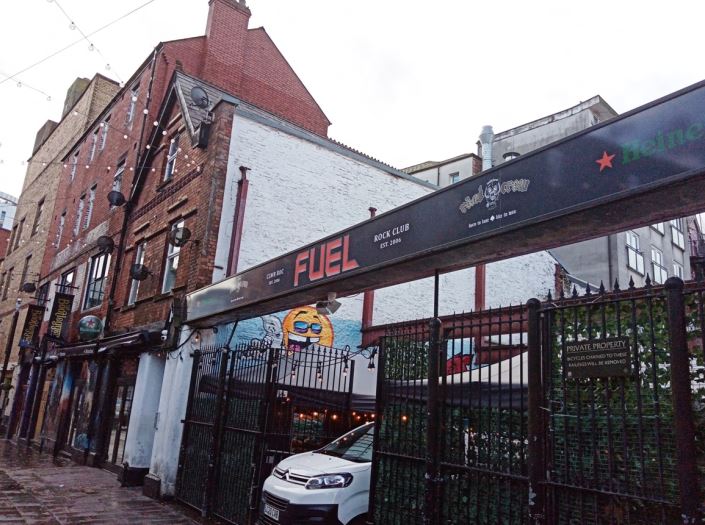
A number of daughter churches were created including Charles Street Congregational and Llandaff Road.  John Bachelor was a member of  Trinity church.  In 1888 Trinity Church was amalgamated with Llandaff Road Church and the Charity Commissioners approved the sale of Womanby Street Church, the proceeds of which were used to erect a new church in Cowbridge Road for the united congregation. The united congregation met in Llandaff Road Church until the new church, known as New Trinity Church, was opened on Cowbridge Road. The chapel on Womanby street was demolished and looks at one stage to have been a garage and when that was demolished more recently it was being used as a car park. It is now the beer garden for the Fuel Rock Club. I wonder what William would have thought of that.

Old view of Trinity Chapel, Womanby Street, Cardiff

References

This article quotes heavily from two sources:-

Cardiff Churches through Time – Jean Rose (see list of publications on our website)

and

The Honest Heretique – The Life and Work of William Erbery – John I Morgans – published by y Llolfa (2012) ISBN: 978 184771 485 5.

This is a very thorough and well researched book and recommended for anyone wanting to read more of the writings of William Erbery.

Back cover of this reference reads:-

Born in Roath, Cardiff, William Erbery (1604-1654) was a graduate of Oxford and Cambridge universities. He served as curate of St Woolos, Newport, and vicar of St Mary’s and St John’s in Cardiff. He was tried for his Puritanism at Lambeth Palace and resigned as a priest of the Church of England.

Erbery was the founder of the first Independent Church in Cardiff, and a chaplain in the parliamentary Army. He resigned as an Independent minister and was a forerunner of Quakerism. He was accused of heresy at St Mary’s, Oxford in 1646, and at Westminster in 1652. Although acquitted, he was stigmatised by his enemies as a ‘madman’. This stigma followed him into the second half of the twentieth century.

The Honest Heretique lets Erbery speak for himself. Containing 500 extracts from all of Erbery’s writings, the book presents the background to Erbery’s life and thoughts, introduces each of his tracts, and takes note of recent scholarship.

———

Mini-review by Professor M. Wynn Thomas, Swansea University of above reference on back of book:

William Erbery is one of Wales’ hidden writers. So unorthodox and daring a theological thinker was he, and so controversial was his social outlook, that many of his own and later times dismissed him as mentally unbalanced. His rebellious originality of mind has, however, proved altogether more intriguing to recent scholarship and a full-scale ‘rehabilitation’ of him, such as that attempted in Dr Morgans’ ground-breaking study, is as welcome as it is overdue.

——————————————————————–

Womanby Street, Cardiff – site of former Trinity Church

The Development of City and Albany Roads

This is a digitised version of a research paper that one of our members authored back in 2009 with some pictures added.

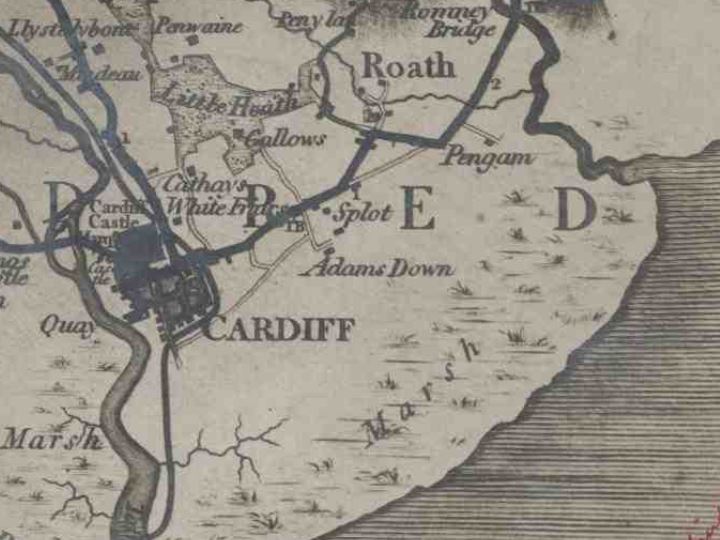
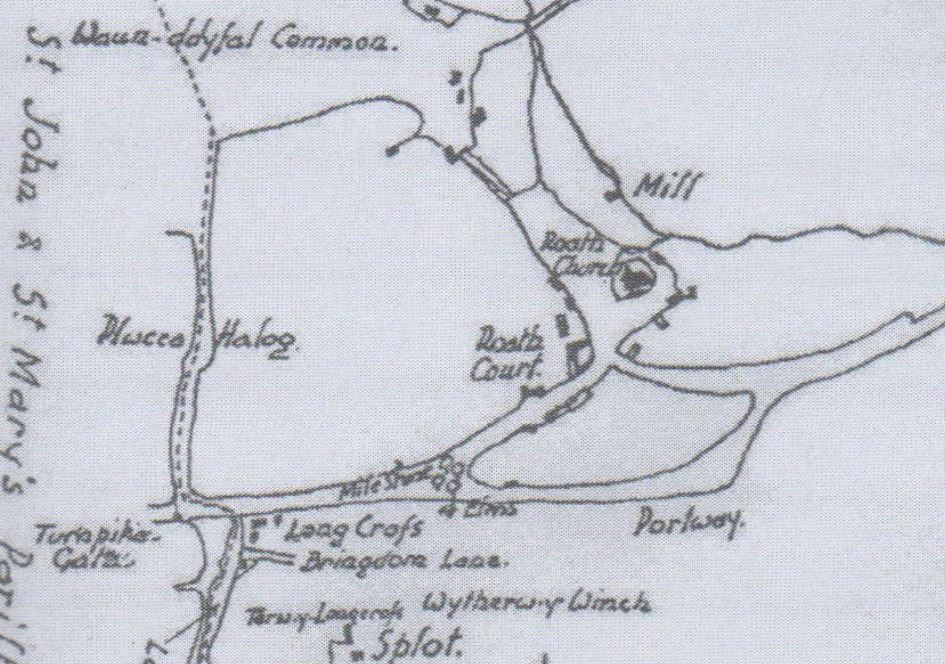
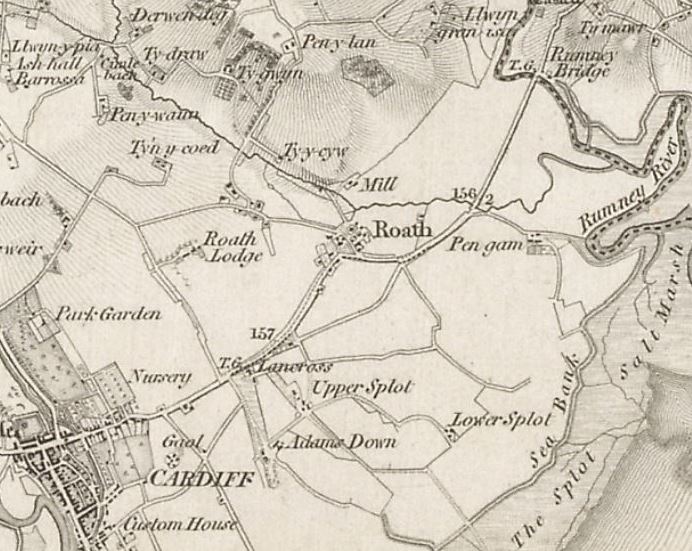
In the 17th century, Plwca Lane or Heol y Plwca (later City Road) marked the western boundary of the Parish of Roath, adjoining the Parish of St John’s, Cardiff.  The centre of the village lay a mile to the east, clustered around St Margaret’s Church.

Cardiff and Roath map from 1799
Map of Roath from 1789.

Surrounding Plwca Lane was an area of dirty wet uncultivated land.  Rushes grew in the fields and were used to make rush mats which were then sold in the streets of Cardiff.  Where City Road, Richmond Road, Crwys Road and Albany Road meet stood the town gallows.  As commemorated on a plaque on the wall of the National Westminster Bank, the Roman Catholic martyrs, St John Lloyd and St Phillip Evans were executed here, as were many others.

Plaque on the side of the Nat West bank on Crwys Road marking the site of the gallows.

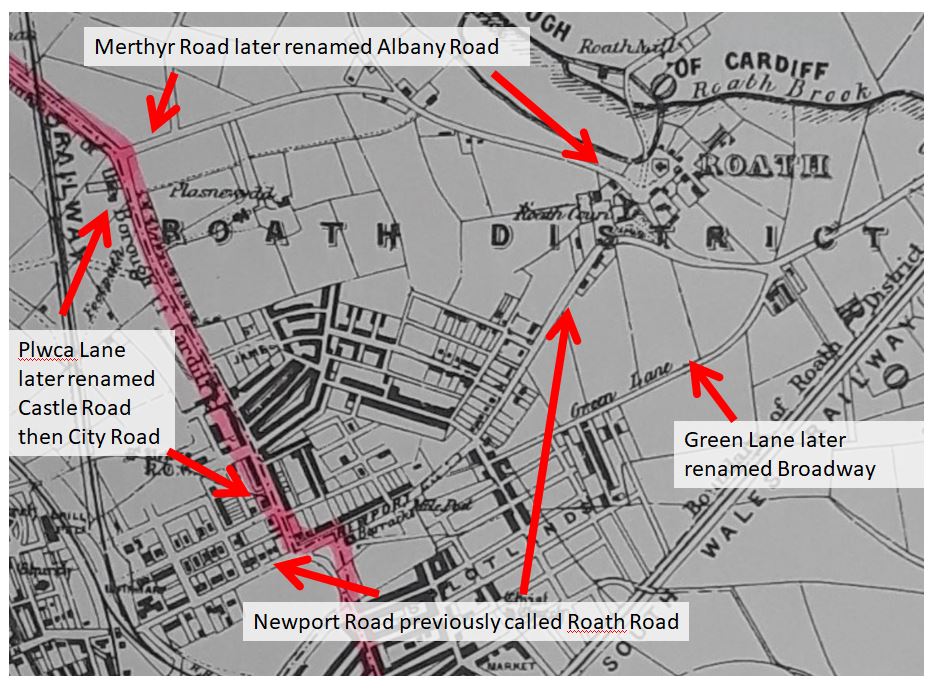
In 1802 Parliament passed the Heath Enclosure Act.  Half of the land enclosed was awarded to the Cardiff Corporation, while a sizeable amount went to freeholders who had a claim to rights of pasture.  Most of them were rich and powerful families such as the Butes and the Lewises.  The landscape of the Heath was transformed as Heath Farm, Allensbank Farm and Ton-yr-Ywen farm were created from the former rough pasture land.  Certain rights of way were upheld, among them the future Heathwood Rd, Allensbank Rd and Merthyr Rd (now Albany Rd) running east from the junction of City Rd with Crwys Rd.  Together these two roads would form the framework from which the Mackintosh Estate later developed.

In the 1840s the land surrounding the lower end of Plwca Lane where it joins what is now Newport Road was owned by the Tredegar estate, centred on Tredegar House, west of Newport.

Roath in the 1830s

Of the residents of Plwca Lane in 1851: 28 were born in Glamorgan; 3 in Monmouth shire; 9 in Wiltshire; 1 each in 7 other counties.  One woman, a soldier’s wife, was a British subject born in America.  By 1861 there were 19 houses in Plwca Lane and 14 of their occupants were born in Glamorgan; 4 in Monmouthshire; 8 were born in Somerset; 6 each in Devon and Wiltshire; 5 each in Devon and Ireland and 13 from 11 other countries.

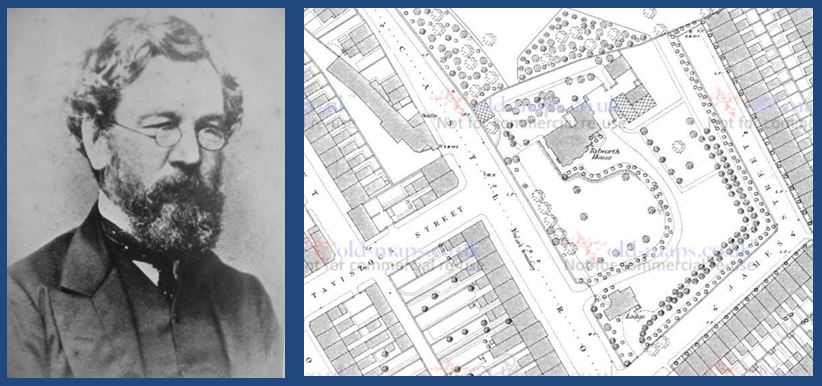
James Hemingway the elder (1802-1854), his 2 brothers and Charles Pearson were all natives of Dewsbury, Yorkshire and were contractors for the construction of the East Bute Dock between 1851 and 1859.  James the elder lived at the junction of St Peter’s St and City Rd (Perrix Wholesalers) but appears to have purchased land on the east side of Plwca Lane on which Talworth St, Pearson St and Byron St now stand. Talworth House which stood to the west of Plasnewydd (now the Mackintosh Institute) had been occupied by James Hemingway the younger, at least from November 1859.  He married Mary McGregor, step-daughter of his late father’s partner, Charles Pearson.  James the younger moved back to Northern England in January 1861.

Example of 1851 Census for Plwcca Lane – the James Hemmingway household

Before the end of 1862 Charles Pearson had moved from Leckwith to Talworth House and was appointed a member of the Roath District Board of Health.  A house in Clive St (now Byron St) was built for Charles Pearson in 1863 and plans approved for further development.  Plans were also approved for additions to Talworth House in  July 1867 and for a new street, James St, off Castle Rd (now City Rd), both for Charles Pearson.  Fourteen houses were built on James St for James Hemingway the younger and it was late: re-named Talworth St in 1872.

Development now spread on both sides of Plwca Lane.  Montgomery Place is pre- 1861 when it had 7 inhabited and 1 uninhabited house.  The 1861 census records 56 inhabited and 18 uninhabited houses in Plwca Lane but the earliest known house plans date from 1865.  Three houses are described as villas, implying a residential district.  In one lived Edward Cleavin, age 39, a civil engineer; Edward Edwards, an engine fitter from Neath and John Webb a builder from Staffordshire who employed 24 men.  Finally by 1865, Solomon Andrews had established his business at No 1 Castle Rd i.e. Roath Mews.

Waring’s plan of 1869 shows that there was no development north of James St on the even numbered side and north of Tredegarville on the odd numbered side, though an application had been made for 14 more houses to be built in Castle Rd (BC/51/90342) Plans for 6 houses in Plwca Lane were proposed in 1872 (BC/51/90657) and a further 6 in 1874, two of which were described as villas, again implying a middle class market (BC/51/9098).

1869 map. Roath / Cardiff boundary marked in pink went down the middle of Plwca Lane. The land off the southern end of Plwca Lane has been developed but the land surrounding Plasnewydd (later called the Mackintosh Institute) remains undeveloped

In 1874 Plwca Lane was re-named Castle Rd and in the following year the Cardiff Improvement Act incorporated Roath into Cardiff.  Castle Rd continued to develop, plans being submitted in 1875 for 6 proposed villas, 3 stables and coach houses, 4 shop fronts, 2 bakeries and many other alterations.  In general most new houses were still terraced buildings, 2-3 stories high, their dimensions controlled by the end of the 19th century by byelaws passed by the local authority.  At this time, water was increasingly supplied directly into houses.  This permitted internal sanitation, hot and cold water and bathrooms.

In 1877 the Borough Surveyor reported on the state of footways in Castle Rd and submitted estimates for their repair.  Further reports between 1879 and 1887 indicate continuing road maintenance activities being carried out in Castle Rd (CBC Minutes 1879-1881) but in 1880, 123 acres of land belonging to the Hemingway estate was purchased by Cardiff Borough Council for £140 for the purpose of road widening.

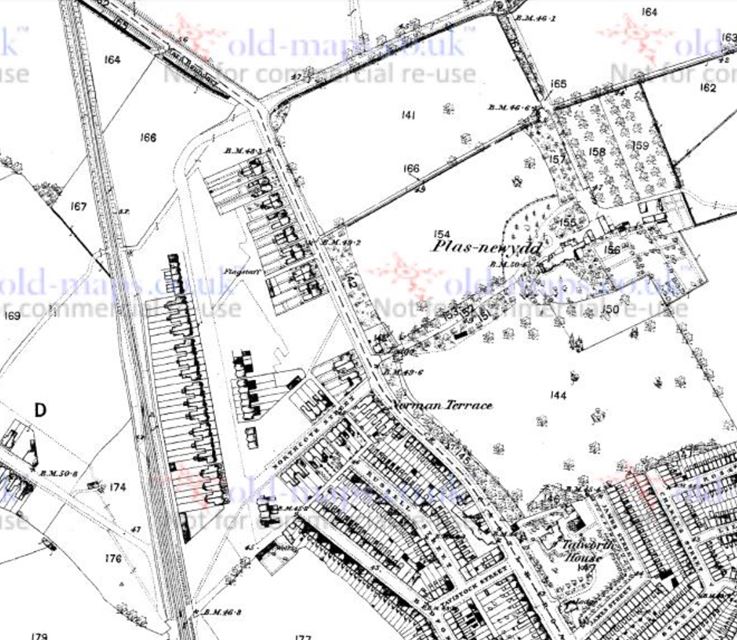
1880 map of the northern part of Plucca Lane, again marked with a dotted line indicating the Cardiff-Roath boundary. The four-way junction neat the top was later to become a five-way junction when Mackintosh Place was built. (map from Old-Maps.co.uk)

Cardiff BC had been unsuccessful in 1883 in purchasing Plasnewydd and its grounds from the Mackintosh family for use as a public park and it may well have been this which acted as a catalyst for the family to proceed rapidly with housing development on the estate (Childs, 2005:5).  By now, Merthyr Rd cut through the Plasnewydd estate from the cross roads at the Roath parish boundary with Cardiff St John in the west to Roath Court in the east.  Forty feet wide and constructed along the course of a public drain, it provided a ready-made central highway for future urban development (Childs,2005:7).

John Batchelor and Talworth House

Most of the landowning families in Roath systematically gave their land over to urban housing development during the second half of the 19″ century.  In Roath, Lord Tredegar was the largest landowner and some of the earliest street development was on Tredegar land adjacent to the Cardiff boundary i.e. The Parade.  All the landowners adopted the practice of leasing building plots for a term of 99 years and exercised  overall architectural control over the building operations on their estates.

In 1884 development begins on the Plasnewydd estate.  Harriet Richards of Plasnewydd had by now married the Mackintosh of Mackintosh, Chief of the Scottish clan, which explains many of the street names in the area.  Charles Rigg, an architect with offices in High St, Cardiff submitted plans to the local authority on behalf of the  estate, for the proposed layout of the streets and houses as and when they were ready to be built.  Usually a large number of master builders or contractors were involved in the house building operations on each estate.  They were allowed to introduce minor variations of design, thus pinpointing the work of a particular builder.  Not much is known about the individual builders.  Fluctuations in supply and demand made house building a risky form of enterprise.  Bankruptcies were common (Daunton, 1977).

Plans for 9 houses to be built in Merthyr Rd were submitted by Leonard Purnell, a builder in Calston St, Adamsdown and his partner Mr Fry under the supervision of the Mackintosh estate architect, Charles Rigg.  In the same year Merthyr Rd was renamed Albany Rd on the 10 April 1884 (Keir, RLHS).  Initially intended as a residential. development, which the estate may have envisaged as a superior type of residential road similar to Richmond Rd.  It soon became a commercial centre as houses were converted into shop fronts.

Edward Jellings who lived in no 31 also built 4 houses in Albany Rd in 1884 and another 6 in 1885. Another builder, William Geen, lived at no 1 Albany Rd (Childs, 2005:10).  He sought permission to erect 6 houses in Albany Rd in 1890.  In the area where Charles Rigg was the Mackintosh estate architect, Thomas Gough, a builder at No 1 Oxford St off lower City Rd, applied to build 19 houses.  His architect was E WM Corbett who normally acted for the neighbouring Bute estate.  Applications were made to build a further 48 houses in Albany Rd in1891.  Among the builders were David Edwards of Glenroy St and Henry Lewis of 54 Arran St and Wilde and Allen were neighbours at nos 22 and 20 Kincraig St respectively.  After a lull in 1892, when William Geen applied to build 8 houses, 16 houses were built in 1893 and 20 more by the end of the century in 1899.

Albany Road in the early 1900s looking east with St Martin’s church on the right.

By 1900, the development of the Mackintosh estate was complete.  The estate comprised about 2750 houses, various shops and commercial premises, several places of religious worship, 2  schools, 3 public houses and many trades and services needed for the maintenance of  what was a densely packed housing zone.  The total population of the area was some 15,000 (Childs, 2005:7).

By 1901, 76 houses had been built on the north side of Albany Rd and 67 on the south side, where an area of rural development still existed between Roath Court and the Claude Hotel. Castle Rd (renamed City Rd in 1905) numbered 479 houses of which only 23 of the occupants could be described as private residents.

Given the estate’s large population, the transformation of Albany Rd into a suburban commercial centre was unsurprising; indeed it could be said to be a natural development.  The conversion of the properties’ ground floors into shop fronts involved the disappearance of the low front walls and small forecourts (Childs, 2005:11).  In City Rd a Doctor’s surgery was established by 1908 at 107 when a waiting room and dispensary were added.

In 1895 there were 13 planning applications for shop fronts in Albany Rd, 23 in 1896 and 11 between 1897 and 1899.  There were also 10 applications for stables to be built in this period and G H Hodgkinson applied to build a shoeing forge in 1895.  From 1900 to 1902, 11 more shop fronts were converted in Albany Rd and 12 in the period 1903 to 1908.  Conversion also continued in City Rd e.g. at no 169 when a house was converted into 3 shops, in 2005 the site of Rent Direct.

Cardiff postcard
66 Albany Road before it had been redeveloped into a shop.

By 1912 Albany Rd is a tree-lined road with a line of tram poles running along the centre, removed by 1925 (CY 10:24).  Occupations include tripe sellers in 1910 (CY 10:53) and W H Bishop and Son, sanitary engineers at no 60 (Cardiff Dir 1910).  Cardiff Co-operative Society had premises at no 69 in 1907, as did E Snook at nos 52-54 City Rd and 113-115 Albany Rd.  Land tax returns for 1910 record a G H Snook as residing at no 126 City Rd and owning premises at no 3, but the Burgess Roll for  1911 records Geo Hill Snook as living at no 30 The Parade and owning property at no 126 City Rd!

From 1910 garages or motorhouses became the object of planning applications rather than stables.  10 were built between 1910 and 1915.  Another sign of the times was that Walter Andrews, a son of the mighty Solomon, undertook an apprenticeship in the motor trade in his father’s garage in the former livery stables and in 1910 Daimler cars were introduced into the car fleet, to be replaced by Austin limousines in 1929.

Gaiety Cinema, City Road, Roath, Cardiff
Gaiety Cinema, City Road, Roath, around 1912

Other commercial enterprises in City Rd were Smith & Bedoe, decorators at no 5 in 1910 and William Lamerton, a butcher at no 195 but at no 236 by 1920 (CY8:48).  W H Wormleighton was a sculptor or monumental mason at no 197, next door to the Gaiety Theatre.  T Shapcott is still a fruiterer at no 119a and Samuel Milkins, once of the Bedford Hotel, at no 185.  According to the land tax returns for 1910, Samuel Milkins is also the owner of a house at no 21 City Rd, where Albert Stone is the occupier, and at no 189

John and Minnie Rich at no 103 City Rd seem to have owned a group of properties in City Rd.  Minnie also seems to have owned houses at nos 105 and 109.  By 1920, John and Ethel Rich are living at no 109.

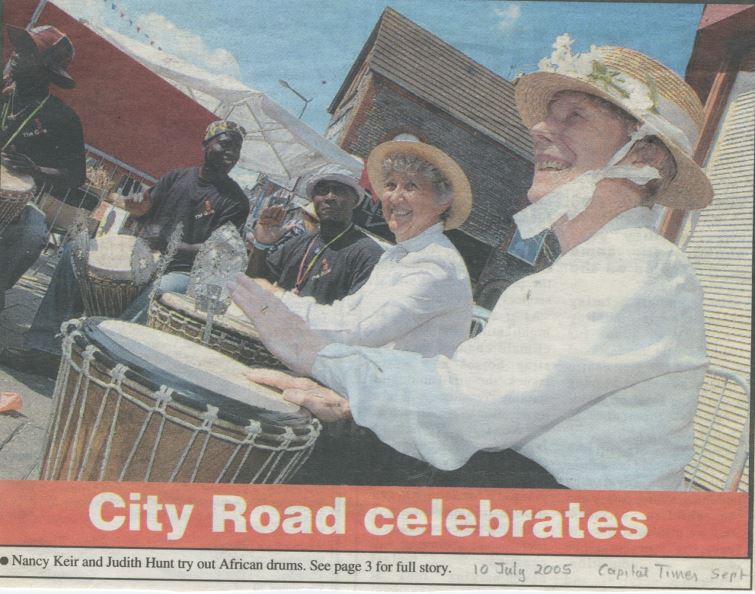
Finally, City Rd celebrated its 100th birthday in 2005, when part of the road, north from the Roath Park Public House to its junction with Albany Rd, was closed on the 10th July.  In addition to dancing and live music, the stalls were filled with displays and exhibitions by local schools and Societies, together with street performance workshops, community information and charity stalls.

City Road centenary celebrations in 2005.

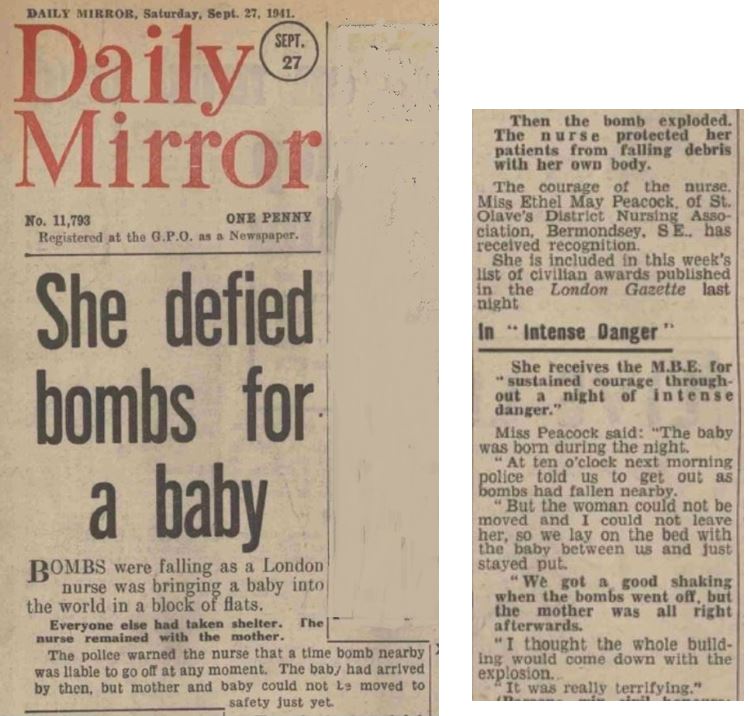
Former Stacey Road Primary schoolgirl awarded MBE for Blitz Bravery

With headlines like that I admit I could reasonably be accused of clickbait but I hope like me you find the story of Ethel and the Peacock family fascinating.

Ethel was born in Cardiff in 1907, the youngest of the Peacock family that lived at 21 Sapphire Street, off Clifton Street.  She attended Stacey Road Primary School and later went on to take up a career in nursing.

In WWII she was a nurse in London at the height of the blitz.  The following accounts speak for themselves so I’ll not try to paraphrase them:

Report from those on duty on the night of the raid:

An extract from the book ‘Southwark in the Blitz’ by Neil Bright:

Ethel Peacock, from Southwell in the Midlands, had worked for the St Olave’s District Nursing Association and was based at the nursing home at Cherry Garden Street. Ethel, who was training as a Queen’s District Nurse, set off from Cherry Garden Street to visit an expectant mother, Mrs Louisa Ludgrove, in Renforth Street. Her colleagues were sheltering in the nursing home cellar, but they made sure Ethel had a strong cup of tea before she set off on her five-minute cycle ride.

Ethel arrived at the property in Renforth Street as the raid was intensifying; she had already seen incendiary bombs find their mark on buildings along the route. She was greeted by an Air Raid Warden, a Mr Walker, who suggested that they should evacuate the property  immediately, particularly as the block of flats Mrs Ludgrove lived in had caught fire. However, the patient was in a serious condition as birth was imminent. Other residents of the block had left for the local shelter.

A baby girl, Lillian, was born at 10.30 a.m. the following morning; Ethel had been tending to and comforting her patient all night. Just as Lillian was born, there was a knock on the flat door. A policeman was at the door, ordering them out as an unexploded bomb was about 100 yards away and was liable to explode. Ethel explained that Louisa and Lillian couldn’t be moved; instead, she put her arm across mother and child to shield them from any blast. The bomb exploded, lifting the bed off the floor, but the building held firm and all three survived. Ethel Peacock went on with her midwifery career, working as tutor of midwives at the nursing home, winning a succession of awards for her skill in her chosen field.

‘Southwark in the Blitz’ by Neil Bright

So how did I know that the Ethel May Peacock in these reports was the same person that grew up in Cardiff?  Well, that’s where the genealogy research comes in.

I found an entry in the 1939 Register for Ethel May Peacock, born 26 May 1907, a Hospital Sister at Queen Charlotte’s Hospital Nurses Home, Marylebone, London.


I also found Ethel Peacock in the Stacey Road Primary School records book, born 26 May 1907, living at 21 Sapphire Street, father’s name Thomas.

The reason why on report describes Ethel Peacock as being from Southwell in the Midlands is because the Peacock family moved around quite a bit. Fortunately with a relatively unusual surname they were relatively easy to trace.

Again I’ve taken a liberty with the headline for this piece in that Stacey School records show Ethel moved away in 1912 when she would have been just five, so her stay at the school would admittedly been brief.  

As for the lady Ethel assisted, Louisa Ludgrove, she was a chocolate packer and lived in Bermondsey.  She was born Louisa Rich in 1918 and married Henry Victor Ludgrove in 1940. She passed away in 2000 aged 81.  As to what happened to the baby, Lillian, born in the blitz I don’t know.

Harold Peacock – brother

The reason I was looking at the Peacock family in the first place was that I was researching the name Harold Peacock that appears on the Broadway Methodist Church war memorial plaque.  

Broadway Methodist no longer exists. The church closed in 1950 when the congregation merged with Newport Road and Roath Road Methodist Churches to form Trinity Methodist Church where the war memorial plaque is now housed.  The former Broadway Methodist Church building then became a studio building for the BBC and then later a mosque.  The building was sadly destroyed in a fire on 19 Sept 1989. 

Broadway Methodist Chapel

Finding Harold Peacock was a bit of a challenge.  I made the breakthrough when I found a newspaper cutting referring to a Thomas Harold Peacock from Rumney, Cardiff, who was killed in 1918. I was then able to trace the family back to having previously lived in Sapphire Street in the 1911 census.

 The following summary of Harold Peacock now appears on our Roath Virtual War Memorial:

THOMAS HAROLD PEACOCK

Second Lieutenant, 1st Battalion, attached to 14th Battalion, Worcestershire Regiment

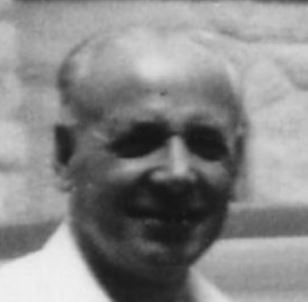
Thomas Harold Peacock pictureThomas Harold Peacock was born in Grimsby, Lincolnshire in 1895 the eldest child of Thomas Peacock, a basket weaver, originally from Kimbolton, Huntingdonshire and Ellen Peacock née Bond originally from Southwell, Nottinghamshire.  The Peacock family moved to Cardiff in 1906 and lived at 21 Sapphire Street, Adamsdown. In the 1911 census Harold is described as a Commercial Student. He went on to work for some time with H.T.James, Barrister, in Windsor Terrace before moving to the offices of the Vacuum Oil Distillery in Cardiff Docks. The family moved to Whitchurch in 1912, and later to The Grove, Rumney, Cardiff.  Harold joined the Devon Regiment in Aug 1914 and received rapid promotion. He fought at Loos in 1915, where he was shot through the left lung. He returned to Britain for treatment.  After recovering he served with his regiment and returned to France in May 1918. Harold was killed by a bursting shell on the night of 27 Jun 1918 aged 22. He is buried at the Acheux British Cemetery in France (Plot 1. Row E. Grave 17). Harold is remembered on the Broadway Methodist church war memorial plaque, now at Trinity Centre. Commonwealth War Graves Commission record.

Thomas Peacock – father

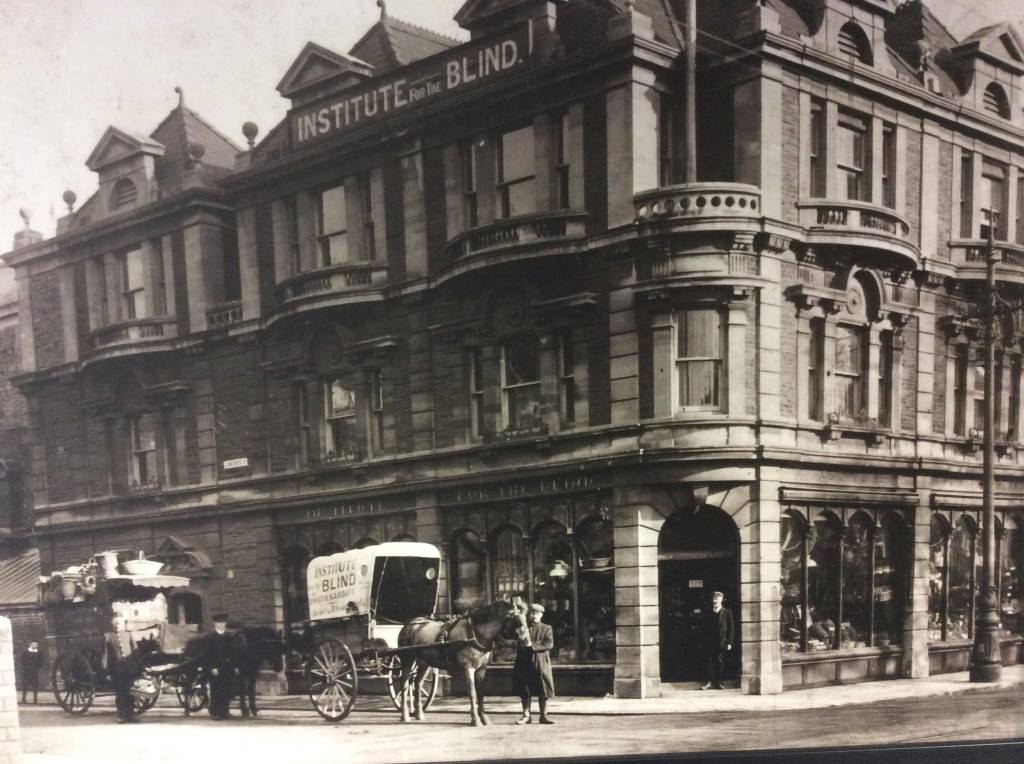
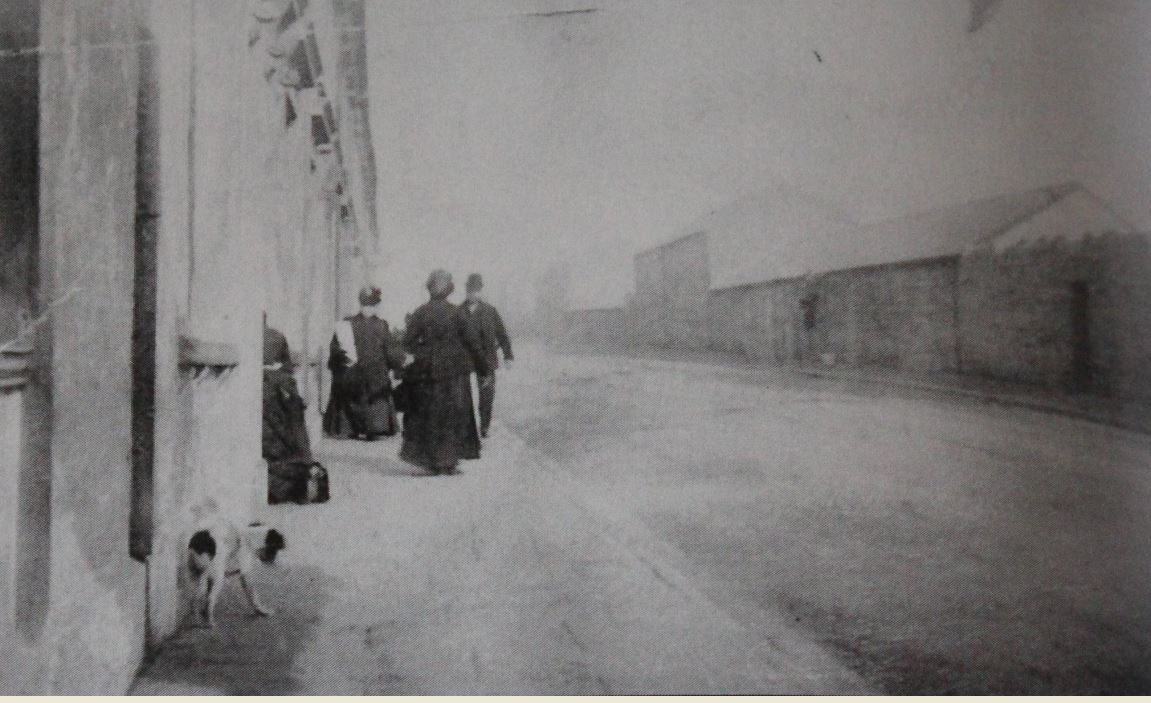
Ethel’s father Thomas looks an interesting character. In the 1891 census, aged 21, his profession was described as basket maker and local Wesleyan Preacher. In the 1911 census he was described as a Foreman at the Blind Institution.  This was the fine building on the corner of Longcross Street and Glossop Road that later got bombed in WWII.  I wonder if Thomas appears in any of the old pictures of the time of the card selling woven produce from the Blind Institute.  

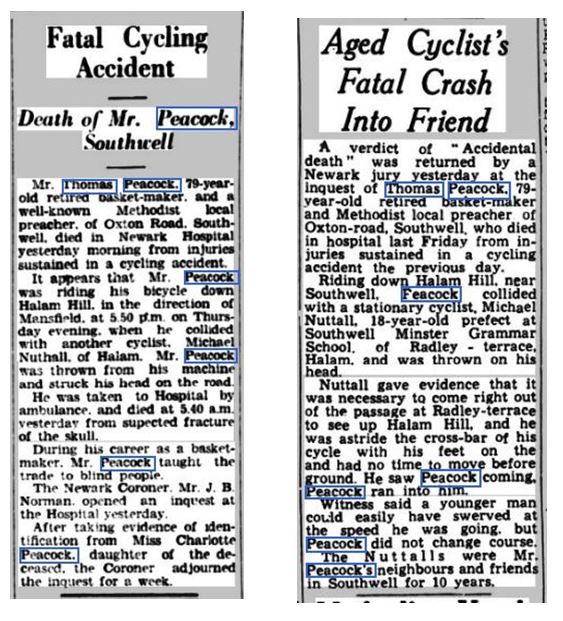
After living in Rumney, Cardiff the Peacock family moved to Bridgend and then up to Nottinghamshire.  Thomas died in 1949 aged 79 as a result of a cycling accident.

Charles Egerton Peacock – brother

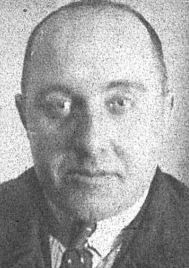
Charles egerton Peacock picAnother of Ethel’s brothers was Charles Egerton Peacock.  He also served in WWI but was fortunate enough to survive. He later became a Methodist Missionary and went to Canada where he settled and was ordained into the ministry.

SS Stanwell – Searching for crew relatives

We were contacted recently by a historian working in Tarragona, Spain.  They are interested in any information on the Cardiff crew members of the S.S.Stanwell that was bombed in Tarragona harbour on  March 15th 1938 during the Spanish Civil War. 

The aim of the project in Spain is to remember the British seamen who died during the bombing of the vessels Thorpeness and Stanwell in Tarragona harbour on 1938 and the consequences of the attacks and to make people know who the Blockade Runners were and the important role that they played during the Spanish Civil war.

A report in the Western Mail of 16th March 1938 gave the following information about the Cardiff crew members:

  1. John L. Davies, (“Master”), (46 Claude-road (Cardiff).
  2. D. E. Jones, (“first mate”), (99 Monthermer-road, Cardiff).
  3. D. G. Owen (“second mate”), (Rumney, Cardiff).
  4. N. Harries (“third mate”), (4 Bangor-street, Roath Park, Cardiff).
  5. C. A. Glus (“ship’s cook”) (Bath-street, Cardiff).

We were also sent a photograph from Spain. The ship’s master, John Davies, is believed to be the person in the white hat in the photo.  

Our research to date has thrown up the following likely matches and pictures from merchant navy records:

John L Davies – 46 Claude Road – Master

John Davies SS StanwellThis appears to be John Davies, born in Newport, Pembrokeshire in 1881. In the 1939 Register Georgina M Davies (b.1881) was living at 46 Claude Road (John was not there).  In the 1921 census Georgina Maud Davies née Stephens (aged 40) was living in Fern Cottage, Newport, Pembrokeshire, with John Davies (master mariner – out of employment) and her father-in-law John Davies (retired water mariner). John and Georgina had married in 1909 in Barry.  Georgina died in Newport, Pembs in 1941 aged 60. We can’t find any record of them having children, nor of when John died. The middle initial ‘L’ appears to be a typo?

D E Jones 99 Monthermer Road- First Mate

David Jones SS StanwellThis is David Edward Jones,  born 1903 in Cardiff to David Edward Jones, a master mariner, originally from Llanon, Cardiganshire and Mary Jane Jones née Williams, originally from Dowlais, Glamorgan. When David was born the family were living at 220 Inverness Place.  He attended Roath Park School.   In the 1921 census that were living at 99 Monthermer Road and David was an apprentice in the Merchant Navy working for the Western Counties Shipping Company. We haven’t been able to find out if he married as he has a common name.  He died in Cardiff in 1981 aged 78.  He did have siblings so there may well be living relatives.
D G Owen, Rumney, Cardiff- Second Mate

David Owen SS StanwellWe think this is David George Owen, born 19 Feb 1895 in Dinas Cross, Fishguard, Pembrokeshire.  David George Jones married Lily M Davies in Cardiff in 1924. In the 1939 Register Lily M Owen is living at 65 Wentloog Road, Rumney, Cardiff with, by the looks of it, two children.


N Harries – 4 Bangor Street – Third Mate

Haldon Harries SS StanwellWe think this is Haldon Osborne Harries, born 1902 in Aberavon.   The initial ‘N’ looks to be a typo. In the 1939 Register 4 Bangor Street was occupied by James Osborne Harries (b.1876), a commercial traveller in the clothing trade, and his wife Emily Harries (b.1879) and their married daughter Vera Gwendoline John (b.1908). In the 1911 census Haldon, aged 9, is living with the family is Aberavon.  Haldon is living at 4 Bangor Street in 1964 with his elderly mother. The 1911 census for the family when they were living in Aberavon shows no reference to a N Harries and all births were accounted for (i.e. no children away from home at the time of the census).  I purchased the 1921 census for the family and again no evidence of an N Harries. Haldon Osborne Harries goes into the merchant navy (the only one of the family to do so). He died in Llanishen, Cardiff in 1987. There are records of him leaving and arriving at various ports, indicating he had a navy career.  We can’t find any records of him being married. 
C A Glus – Bath Street, Cardiff

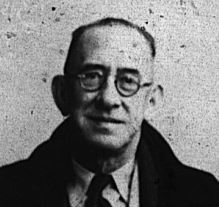
Clifford Guias SS StanwellWe think this is Clifford John Guias, born 1898 in Cardiff to Augustus Guias, a master mariner, who was born in Montreal, Canada and Emma Guias née Turpitt.  Clifford was baptised at St Mary’s, Cardiff. He went to school in Grangetown. Served in WWI with the Royal Army Medical Corps, 14th Field Ambulance. In 1942 he records his career as being Merchant Navy, Chief Steward.  I admit it is a bit of a jump from C A Glus to C J Guias, but not impossible.  He lived at 50 Halsbury Road, Victoria Park, Cardiff.  The newspaper article on the Sandwell says he lived at Bath Street which is a mystery, as there is no Bath Street in Cardiff.  Also his rank was Chief Steward in some records.  Is this too different from Cook or not I wonder?  His elderly mother lived in Broadway which gives a Roath connection, thereby making all 5 crew members having East Cardiff connections – intriguing. He died in Bexley, London in 1977.  He does not appear to have ever married.  His siblings did marry and have children.

Although we think we have identified the men and where they came from, the bad news is that not many of them seem to have been married and have had families meaning that finding direct offspring is less likely. We never give up hope though. If you are a relative of any of these men it would be good to hear from you.

Read more about local involvement in the blockade busting in this article in the Penarth Times.

A market in Adamsdown – a century of livestock trading

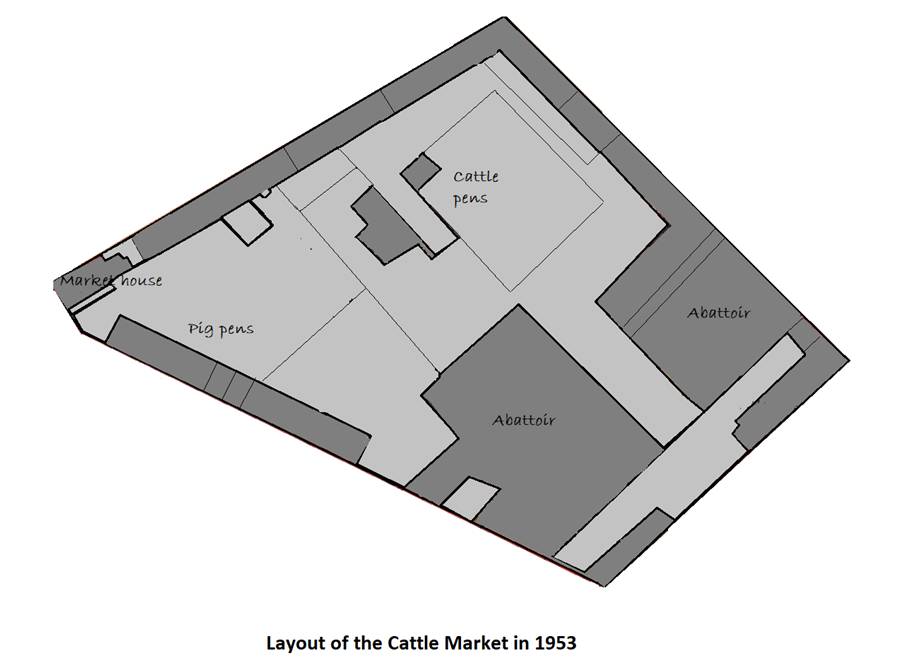
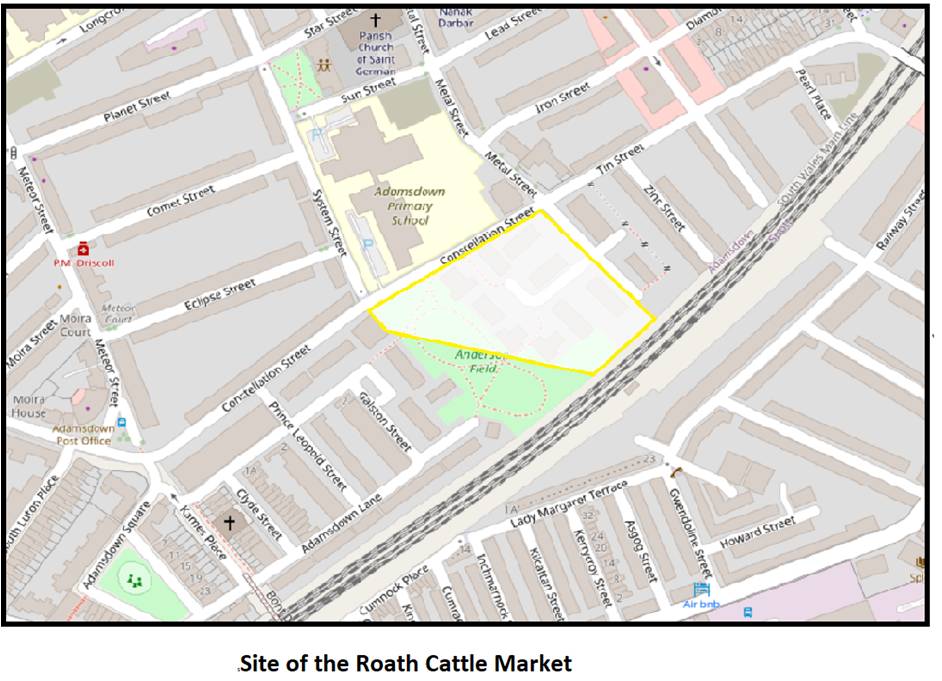
Roath Cattle Market, somewhat confusingly, was located in Adamsdown, immediately north of the Great Western Railway line and south of Constellation Street, where Anderson Place is today. It was bounded to the east and west respectively by two lost roads, Platinum Street and Cycle Street.

Up to the middle of the 19th century, Cardiff’s cattle market used to be held in the open air in Cardiff town centre, with cattle and other livestock being driven through the streets. A cattle market was established in Canton in 1857, but between the River Taff and Cardiff’s eastern boundary, there were 8000 acres (12.5 square miles) of arable land, and those farming that land wanted to avoid having to pay the turnpike toll necessary to take livestock across bridges crossing the Taff.  Although Cardiff Bridge (the one near the castle) was rebuilt in 1859, one witness said that to reach the Canton Cattle Market, it would be necessary to drive cattle via Llandaff, which suggests that Cardiff Bridge would be unsuitable. 

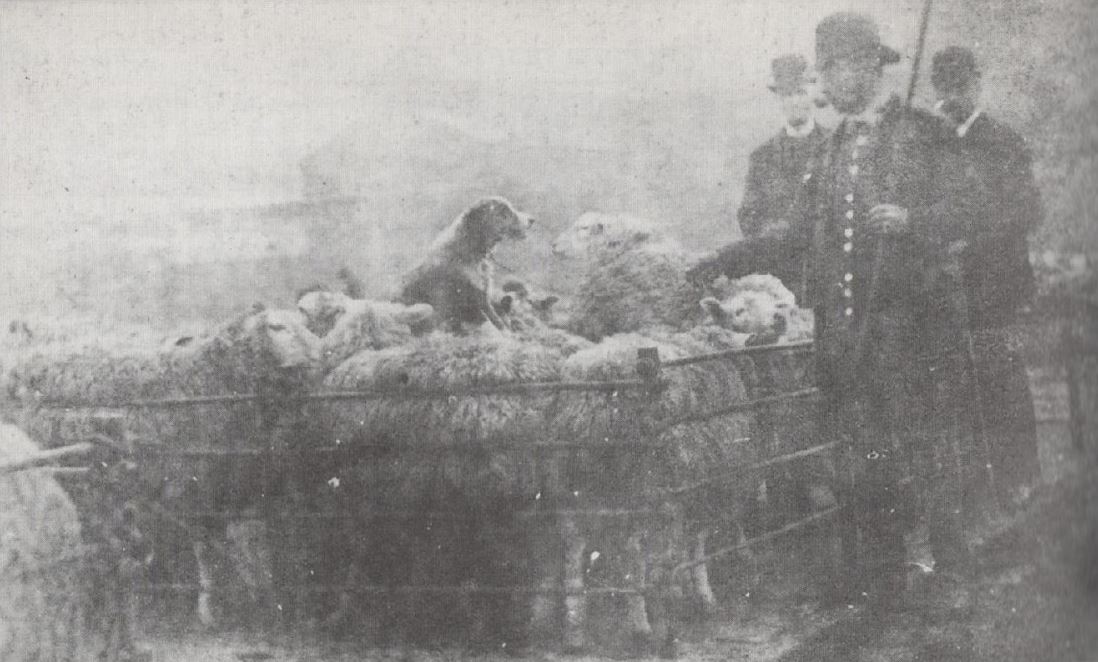
Roath Market in 1891. Note what looks to be a sheepdog in the middle of the sheep.

And so, in 1860, land owned by Lord Tredegar was put forward as a site for a new cattle market on Constellation Street. The decision to site a market there was a hotly debated one, and because of the petitions both for and against, the Home Secretary was called on to carry out a public inquiry and for the Inspector to report to him with a recommendation before he decided the matter. Some of the opposition was said to be at the behest of the Canton Market operators, but the most vocal arguments focused on the lack of demand, and the likelihood that the construction and upkeep of the market would fall on the ratepayers of Roath.

The inquiry was held on 11 January 1861 at the Clifton Hotel in Roath. The main parties to the inquiry were the Roath Board of Health as proposer and the various objectors to the scheme.

Today, a proposal for a cattle market next to a residential area would be met with an absolute furore, with objections about smell, noise, traffic, etc, etc. However, the scope of this inquiry was a narrow one. It arose as a consequence of the Roath Local Health Board having sent a memorandum to the Secretary of the Home Department asking for powers to borrow £1,000 upon the mortgage of the rates, for the purpose of establishing amarket, and the receiving of a counter-petition containing an allegation that such a marketwas unnecessary. The rate-payers were local landowners, rather than the occupiers, so the battle was between some of the well-known and well-off citizens of the town. Local residents who, in the main, were not property owners and therefore did not pay rates, were not considered to have sufficient standing to object to the proposal.

Unsurprisingly, Lord Tredegar’s agent (who also farmed land in the area) was vocal in support of the scheme. Other supporters included the Trustees of Lord Bute and the Trustees of the late C.C. Williams of the Roath Court Estate. All of the estates owned by these landowners contained farms.  Opponents seized on arguments that the Roath Local Board needed to fund sewerage works on the “poet streets” – Byron Street, Shakespeare Street and Milton Street, none of which were connected to a sewer, were subject to frequent flooding, properties all owned by Lord Tredegar.

Constellation Street with the buildings of Roath Market on the right.

However, the Government Inspector, William Ranger, put paid to this argument, saying that “Property had its duties as well as its rights, and it was the duty of the owners to put their streets and sewers in order and then hand them over to the Local Board of Health”. He also suggested that tenants whose properties were flooded should withhold their rents! What Lord Tredegar made of this admonishment was not recorded.

The evidence that the market was not needed was thin. A temporary open-air market had been established in Splott, which averaged 720 head of livestock a week, and on that basis, the market would be viable, and no charge would fall on the ratepayers of Roath. And so, in May 1861, following the recommendation of his Inspector, the Secretary of State approved the market, which opened in July 1862.

The original plan was to provide a market house, to provide offices and a home for the market manager, as well as cattle and horse stalls, a cattle pen, 60 sheep pens, 12 pig pens, a building to accommodate poultry and cheese sellers, and large open areas for hay and straw storage. Over the following decades, numerous alterations were made to the market, not least the addition of large abattoirs, which, in 1907, despatched 224 cattle a week, and was then overcrowded.  Additional sheep pens were provided in 1891, when 2000 sheep a week passed through the market.

Roath Cattle Market continued on that site for over a hundred years, so questions about its necessity seem to have been well and truly answered. However, the market was not without problems; in 1864 complaints were made to the Board of Health about the state of Constellation Street, along which much of the market traffic travelled, claiming that it has not been cleansed or scraped in 2 years.  In 1884, the market was acquired by Cardiff Corporation under an Act of Parliament, but in the same year, butchers complained that the site was a quagmire, ankle-deep in mud and slush, and a councillor proclaimed it to be “a more filthy place than any of the kind probably in England”. Even in the middle of the 20th century, there were reports of cattle escaping from the market and running around Adamsdown, even knocking down walls.

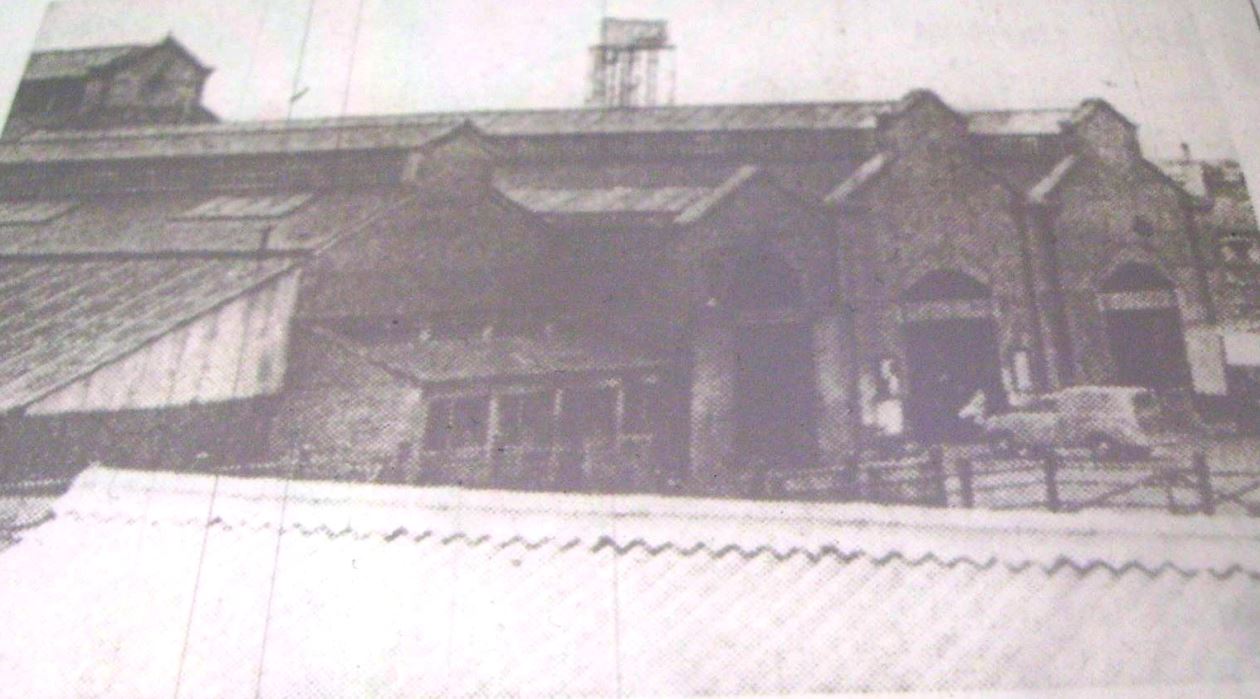
The abattoir at Roath Market

Despite talk of creating a siding to access the market directly from the adjacent Great Western Railway line, this does not seem to have come about, possibly because, in its heyday, the market had no spare capacity to accommodate additional livestock, and later there may have been problems in funding it.

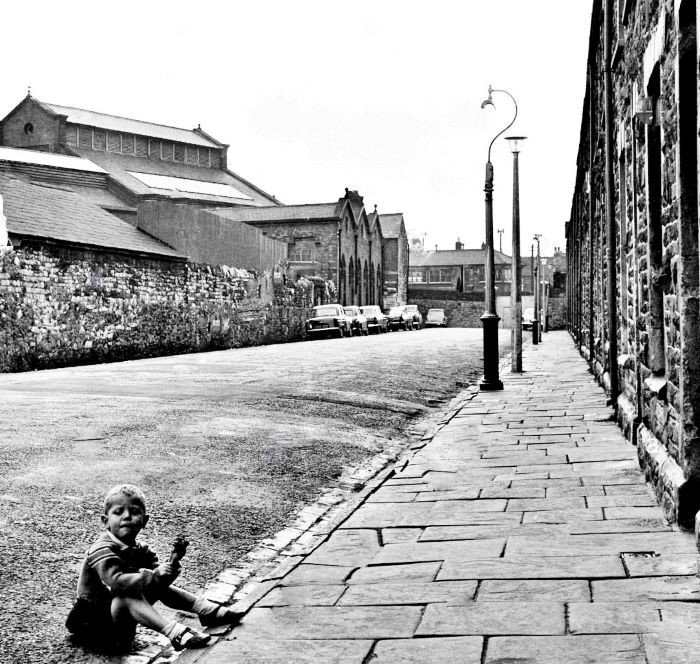
View of the old Roath meat market and abattoir on Constellation Street from Cycle Street junction 1960s

The market closed in the 1960s and since the early 1970s the site has been occupied by houses, flats and a playground. It is thought that Anderson Place was named after a Deputy Health Inspector of Cardiff.

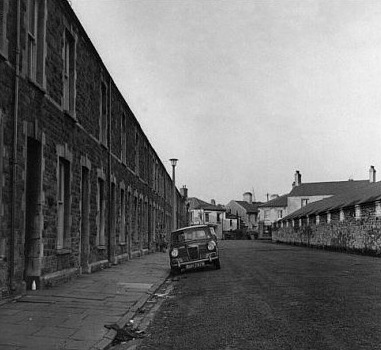
Cycle Street 1965

Footnote: Photographs of Roath Cattle Market seem to be rare – if anyone has a photograph, we’d love to see it. Recollections of the market would also be welcomed.

Secrets of the Secret Bakery 

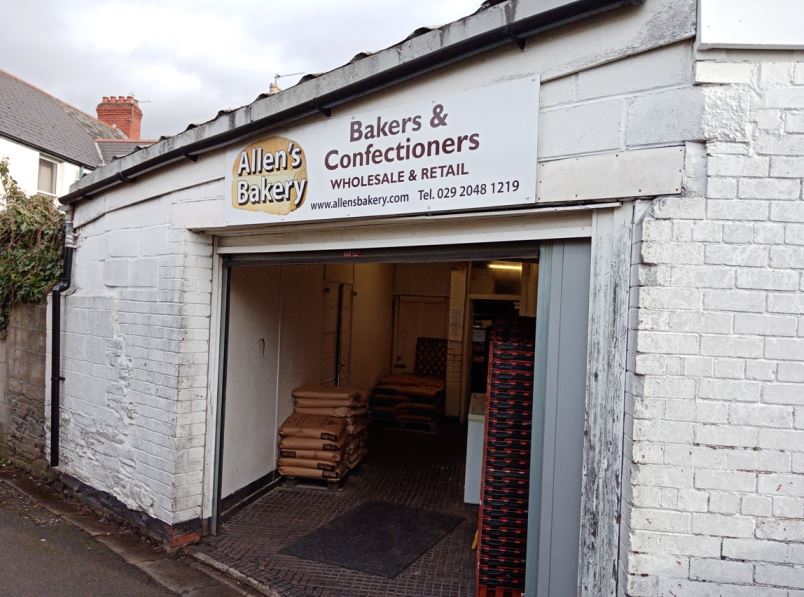
Tucked away at the intersection of lanes in the triangle formed by Arran Place, Roath Court Road and Roath Court Place, a small bakery has been turning out fresh bread for 110 years. It is very much off the beaten track, and many Roath residents are unaware of its existence. Signs at either end of the lane serving the bakery were put up when the lane was gated in 2013, but these have now faded into illegibility, maintaining the anonymity of the premises. Despite the lack of advertising or “high street presence”, the bakery has flourished, and the Saturday morning queues speak to its popularity.  But on Friday 9th September, the roller shutters will descend, possibly for the last time, when the current owner, John Allen, retires. 

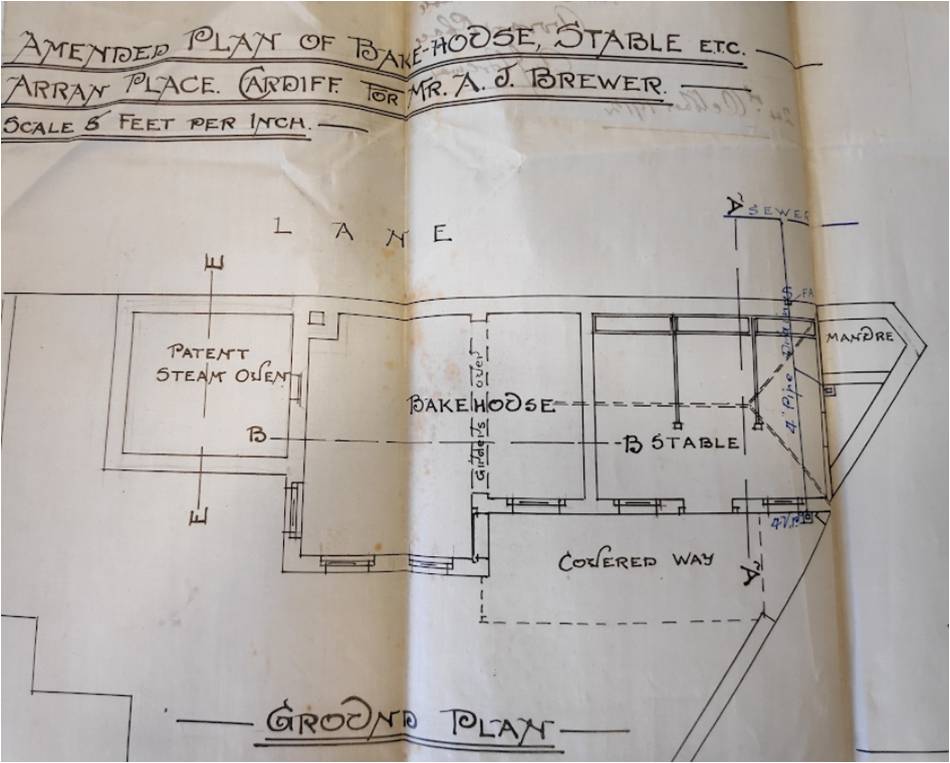
The bakery was established in 1912/1913 as a purpose-built bakehouse, around the time that the houses on Arran Place and Roath Court Road were being constructed. The developer was the 39 year-old Arthur John Brewer, a master baker, who lived at 135 Monthermer Road in Cathays.  The architects were William Ware and Williams, who had been engaged by the Roath Court Estate to design many of the houses in the area. 

The 1912 plans for the bakehouse

The design incorporated a patent steam oven at the rear, and the front of the bakery comprised stabling for 3 horses, with a manure store on what is now an open triangle of land where the wheelie bin is sited. Horse-drawn deliveries were made from the premises for many years, until the 1930s. The steam over is still there, visible as you enter the shop. It was converted to diesel fuel by John Allen but was replaced by electric ovens in about 2000. 

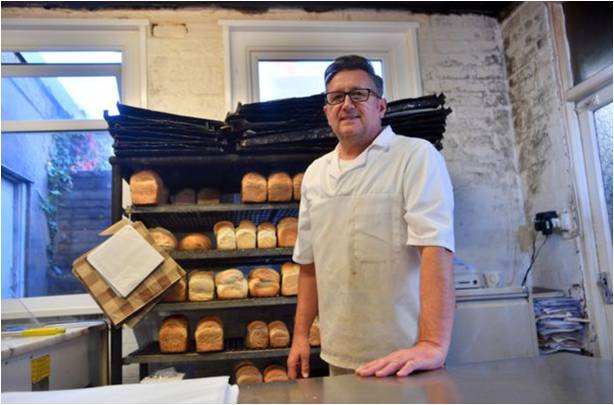
At some time prior to 1939, William H Adams and his two sons, Douglas (Dougie) and Leslie (Les) Adams took over the running of the bakery, at which time they lived in the adjacent house at 11 Arran Place. The two brothers were involved in running the bakery over the next 40 or so years, Dougie having moved to Cosmeston Street and Les to Blenheim Road.  The Adams van was a common sight in Roath as it delivered bread to retail customers. After Les retired, Dougie continued to run the bakery along with his wife, until he retired in 1984 and sold it to John Allen, who then lived with his parents at 39 Roath Court Road, just a stone’s throw away from the bakery. John had studied food technology at college and had worked in Bruton’s Bakery in Grangetown, and was able to buy the business with a loan from Midland Bank, guaranteed by his parents. 

John Allen in 2018

The bakery features (briefly) in the 2001 film “Very Annie Mary” starring Rachel Griffiths, Jonathan Pryce, Ioan Gruffudd and Matthew Rhys. 

Sir Jonathan Pryce as  Jack Pugh, the opera-singing baker

The bakery has kept customers in Roath and further afield well-supplied with bread, cakes, pastries and pizza dough, although the main part of the business has been the wholesale supply of bread and pizza dough to cafes and restaurants in the city centre and as far away as Pendine in Carmarthenshire. Famous customers have included the former First Minister of Wales, the late Rt Hon Rhodri Morgan, who used to call in when visiting family in the area. The business has also employed numerous people over the years, not least local youngsters for whom a Saturday job was almost a rite of passage. 

John and his bakery will be much missed, but we wish him all the best in his retirement, and fervently hope that the ovens may once again waft out those mouth-watering smells so enjoyed by neighbours.         

Jon Roberts

Allotment Gardens in Roath

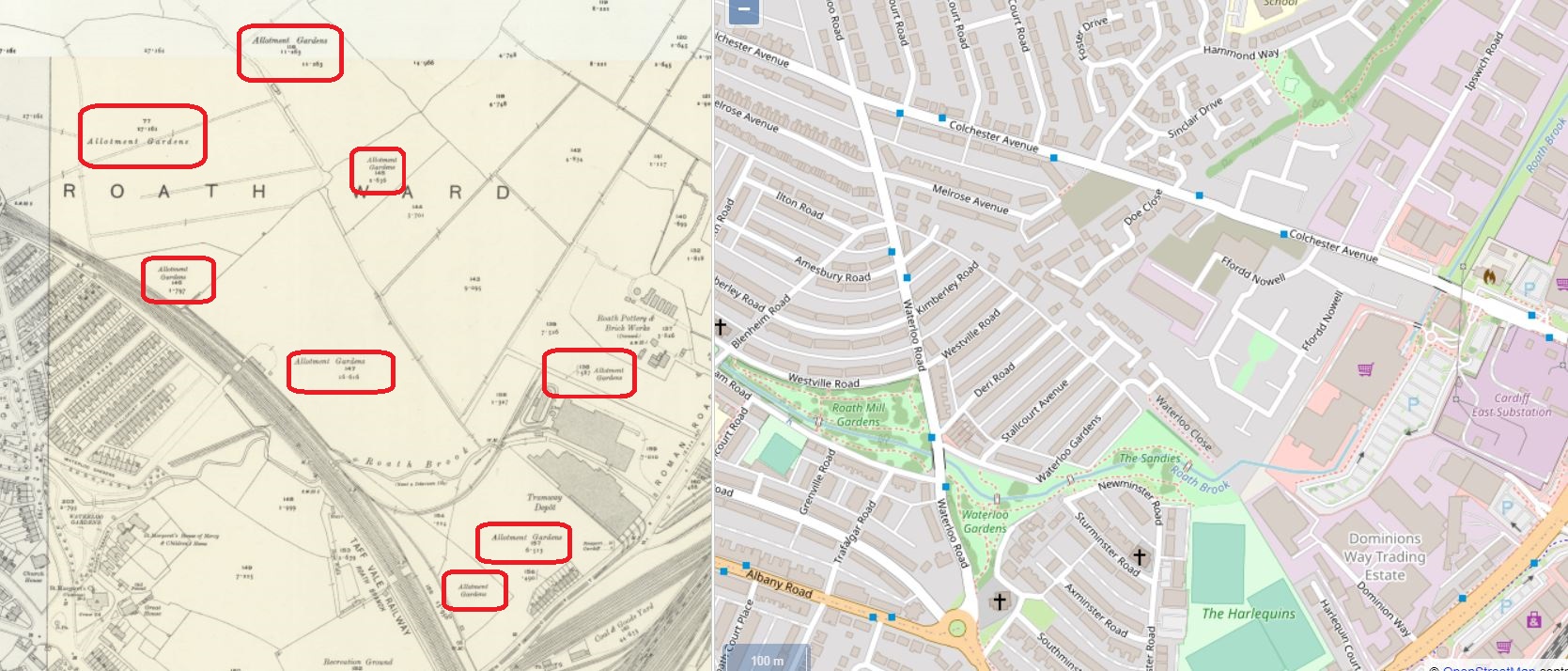
Another of our ‘Occasional Papers’ researched be our members in the past, this time from 2008.  This paper is best read in conjunction with another written the same year and previously published as a blog: Allotments in Roath – Personal Reminiscences of Margaret Reeves.  Unfortunately the coloured map referred to in the paper below is not available but a map of some sorts has been included.

Allotment gardens used to be fairly well scattered throughout Roath.  I suspect that they were mostly established on land earmarked for a different purpose and disappeared with the building of Eastern Avenue, Howardian School, Timbers Square, Melrose Avenue …until now there are no allotments left in Roath, the nearest being visible from Allensbank Road where it crosses Eastern Ave or on Highfields Road near its junction with Lake Road West.

LEGISLATION

On 20 July 1910, under the Smallholdings and Allotments Act 1908, the City of Cardiff confirmed Rules as to the Sale and Letting of Holdings and Preventing any undue Preference in the Sale or Letting thereof.  Among much else, the Rules require the Council to keep “a list of the smallholdings intended … and a map or plan showing the size, boundaries and situation of each holding. Every holding … shall be distinguished by a separate number.”  Unfortunately, I haven’t found this list in the Glamorgan Record Office (GRO) or the Central Library.

In the Rules, among the conditions placed on tenancies are:

“(h) The tenant shall not without the written consent of the Corporation … erect on the smallholding any dwelling house, toolhouse, shed, greenhouse, fowl house, pigsty or other building or structure whatsoever;

(i) The tenant shall not use or permit to be used any dwelling house or building on the holding for the sale of intoxicating liquors;

(j) The tenant shall not break up any pasture … All remains or objects of archaeological or other scientific interest on the holding are to be the property of the Corporation and the tenant on discovering any such remains or objects shall forthwith report same to the Town Clerk.”

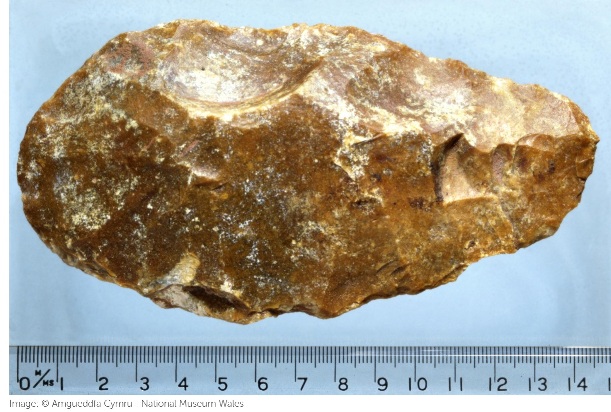
With regard to (j), at least one such “object”, a Neolithic hand axe was discovered on the site between Colchester Avenue and the River Rumney in the 1940s.

LOOKING AT PLANS

GRO has a map dated 1936, coloured green to indicate allotments and striped or hatched, with a Key to divide them into the categories below.  There are also some plots coloured pink and marked as allotments but not included in the Key. (I have put green and pink plots in roughly the same area together and added some description).

Permanent allotments, in use as such

Pengam – 7 acres between Rhymney River and the Great Western Railway line.

In pink, 2 sites east of the Great Western Railway and north of Splott Park.

Temporary allotments in use or to be acquired for permanent allotments

Colchester Avenue — 40.68 acres (includes site of the present Howardian Adult Centre and the former School playing fields. There is an oddly shaped “‘bite”’ out of this site to the south where Lady Margaret High School was probably under construction).

In pink, on either side of the Electric Power Station (present Sainsbury’s/KwikSave).

In pink, between Ty Gwyn Road and Railway (extends as far as Fairoak Farm)

Clodian Avenue — 16.25 acres (west of Allensbank Rd – still existing!)

In pink, Allensbank Rd, north and south of TVR (now Eastern Ave).

Permanent allotments, boundaries undefined

North of the Clodian Avenue site above (part of present University Hospital of Wales)

Ordnance Survey Maps are available in the Central Library and GRO and for the early 1900s the Roath and Cathays sheets show:

OS Sheet Dated 1881 revised 1898/99.    Allotments shown:                                                                                            

North of Taff Vale Railway, east of Penylan Road (present Melrose and Colchester Avenues).  Field Nos.119 and 137.

OS Sheet Dated 1901.   Allotments shown:                                                                                                                          North of TVR, north of Deri Farm.  Field Nos. 39, 139, 142.

Splott/Pengam, east of GWR directly across from Biscuit Factory. Field No. 203.

OS Sheet Dated  1919.    Allotments shown:     

North of Newport Rd, around Tramways Depot. Field No.157.

Area north of above, includes Roath Brook (now Sainsbury’s?). Field Nos. 77, 145, 157.

Around Roath Pottery and Brickworks. Field Nos.138, 139, 136.

Splott/Pengam alongside GWR. Field Nos.174,175, 184, 186, 188 (184 is same field as 203 on 1901 sheet).

Between TVR and Colchester Ave. Field No. 204.

OS Sheet Dated  1936 (not OS sheet – existing and proposed allotments on previous page)

OS Sheet Dated  1947 (surveyed in 1941).  Allotments shown:     

Albany Road east of Princes Street, opposite Marlborough Road junction (present Timbers Square).

West of Allensbank Rd, north and south of Taff Vale Railway, (present Eastern Ave).

North of Ty Draw Rd and north of railway, immediately west of Convent of the Good Shepherd.

FURTHER RESEARCH

There is more research that could be done on allotments in Roath.  GRO holds the minutes of Cardiff Borough Council’s Parks, Open Spaces, Allotments and Gardens Committee and its Smallholdings and Allotments Committee in their Repository. The latter Committee’s minutes extend from 1890-1974 in volumes and the question is, how much of that relates to allotments? Still, it would be interesting…

Geoffrey Biggs – Best excuse ever given for turning down a Wedding Invitation.

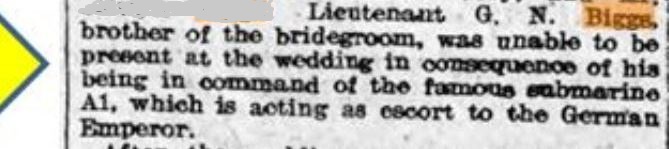
Ever received one of those invitations where you wish you had a good excuse handy to say no? I challenge you all to beat this for an excuse:- In 1907 Lieutenant Geoffrey Biggs was unable to attend his brother’s wedding in consequence of him being in command of the famous submarine A1 which was acting as escort for the German Emperor.

Wedding excuse

It took me a while to realise that in 1907 Britain and Germany were on friendly terms and linked by the family ties in the Royal Family.

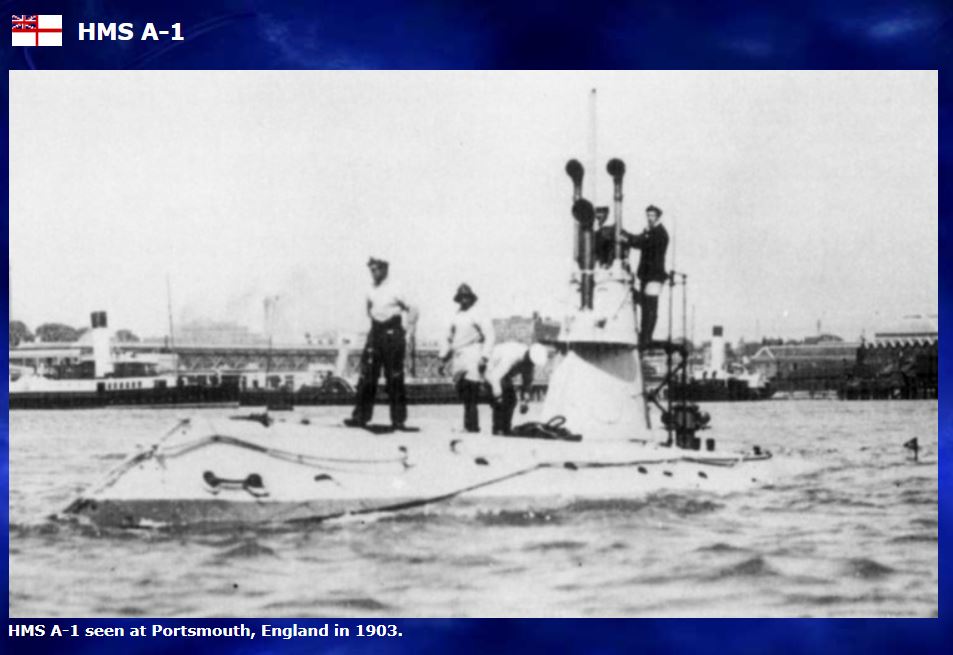
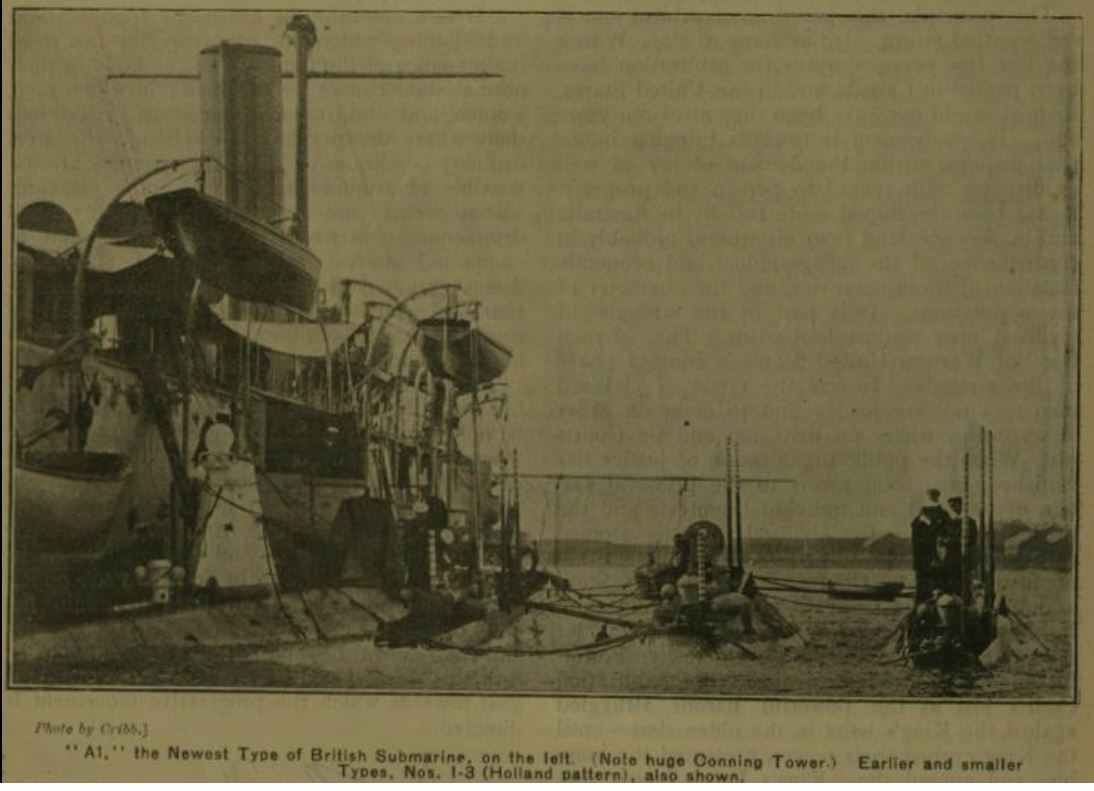
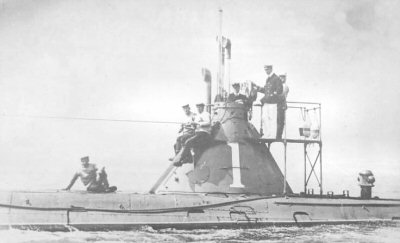
The A1 Submarine

A1 1903
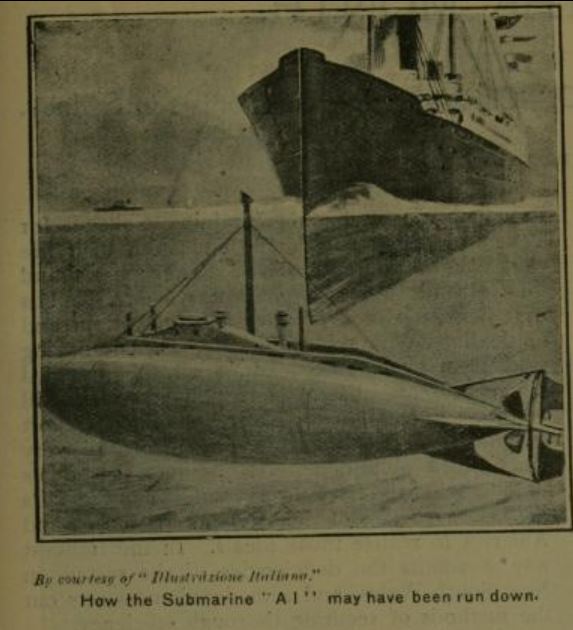
The A1 submarine wasn’t quite the first British submarine but was certainly a very early one. It had an unusual history in that it sunk twice. She was accidentally sunk in the Solent on 18 March 1904 whilst carrying out a practice attack by being struck on the starboard side of the conning tower by a mail steamer, SS Berwick Castle, which was en-route from Southampton to Hamburg. She sank in only 39 ft (12 m) of water, but the boat flooded and the entire crew was drowned.

A1 Submarine run down

One consequence was that all subsequent Royal Navy submarines were equipped with a watertight hatch at the bottom of the conning tower. She was raised on 18 April 1904 and repaired and re-entered service, in time for Geoffrey Biggs to take command of her in 1907. Following a petrol explosion in August 1910, she was converted to a testbed for the Admiralty’s Anti-Submarine Committee. She was lost a year later when running submerged but unmanned under automatic pilot. Although the position of her sinking was known at the time, all efforts to locate her were fruitless. It was not until 1989 that the wreck was discovered by a local fisherman.

A1 Submarine

a1b

Geoffrey Biggs was one of six Biggs brothers who all played rugby for Cardiff. I’ve written about his brother Norman Biggs previously and how he died after being shot with a poisoned arrow. All six brother however have a story worth telling so here I focus on the younger brother Geoffrey.

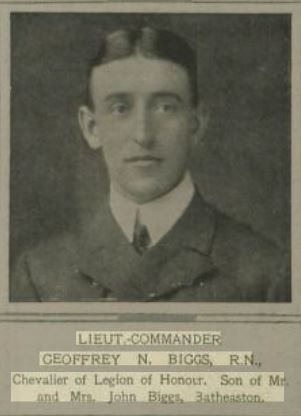
Geoffrey Nepean Biggs was born in Cardiff on 12 Jun 1885 to John Biggs, a brewer, originally from Cardiff and Emily Sophia Biggs née Clarke originally from Usk. He was baptised at St Andrew’s church on 16 Jul 1885 when the family were living at 37 Park Place, Cardiff. Soon after the Biggs family moved to their new house they had had constructed, ‘Oldwell’ on Pen-y-lan Road.

Oldwell, Pen-y-lan in the 1950s

Oldwell, Pen-y-lan

He was educated at Bath College on a scholarship. Geoffrey enrolled in Royal Navy in 1900 and the following year, aged 15, passed out fourth at the Navel Cadet training ship HMS Britannia, Dartmouth, Devon. He had a successful naval career gaining promotions fast. becoming a Sub-Lieutenant in July 1904 and a Lieutenant in April 1906. In 1904 he gained a distinction when he served as midshipman on HMS Eclipse in the China despite blood poisoning in his right hand. After that he chose became a submariner.

1916 Dec 16th Illustrated London News
His military records make interesting reading. He was described as trustworthy, capable, processing excellent judgment, zealous, and painstaking. It added that he was very skilful and dashing in making attacks. At the same time he was noted to be not good socially but processed a fine physique and good at all outdoor games.

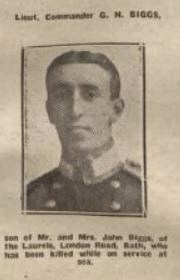
G N Biggs (2) sent to me by Gwynn Presscott therefore must give credit to him - CopyGeoffrey Biggs went on to command other submarines after working on the A1. A 1910 newspaper article regarding his finances referred to him as Lieutenant Biggs of the ‘submarine B6’ and late of the ‘Forth’. Between Nov 1913 and Sep 1915 he was in command of C16 as the war started. He died on 22 Nov 1916, aged 31, when the submarine he was commanding, E30, is thought to have stuck a mine at Orfordness, Suffolk. He had been awarded the Crois de Chevalier by the President of the French Republic in recognition of services during the war a few months before his death. He was also posthumously awarded the Japanese Order of the Rising Sun. He is remembered on the Portsmouth Navy Memorial and the Bath College Memorial in Bath Abbey.
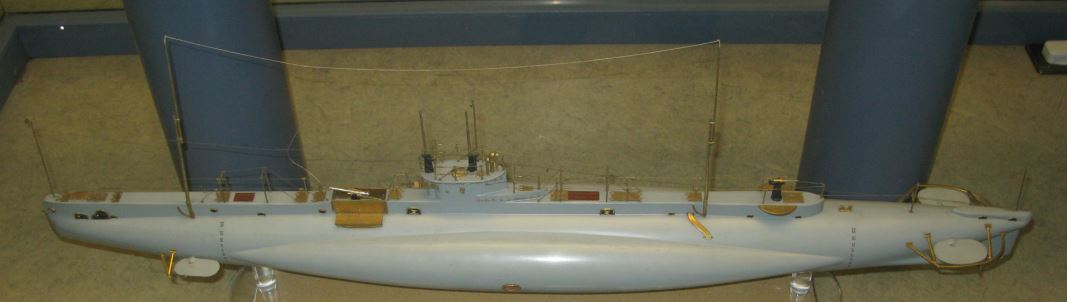
Model of an E Class submarine

Model of an E Class submarine

Outside the Navy

Geoffrey Biggs was a good rugby player and played at centre for Cardiff in 1906 versus the Barbarians. He also played for Bath, United Services, Royal Navy and Somerset. I haven’t quite figured out why he played for Cardiff in 1906 as evidently he had moved from Cardiff quite a few years previously. Was it just so that it could be said that all Biggs brothers played for Cardiff I wonder.

In 1910 an order of bankruptcy was made against him. His naval records record that a fifth of his pay was to be set aside to pay his debt. There is no indication as to how the debt arose other than it was for ‘money lent and work done’.

Family Life

Geoffrey Biggs married Daisy Elizabeth Boys in Portsmouth in 1907. Four of Geoffrey’s brothers married wealthy heiresses but Geoffrey’s marriage seems different. His naval records record that he made ‘a very undesirable marriage’. Daisy was daughter of naval man William Boys. The 1911 census records the following information: he was aged 25, born Cardiff, Glamorganshire, Wales, married, Lieutenant – Royal Navy, resident with his in-laws at 53 Winter Road, Southsea, Eastney, Portsmouth, Hampshire. Geoffrey and Daisy appear to have had one child together, Gilbert Hugh Kellett Biggs, whose birth was registered as Gilbert Hugh Kellett Boys in 1906 but then re-registered again as Gilbert Hugh Kellett Biggs in 1928. In Aug 1923 Gilbert was charged with stealing six books from a bookshop in Southsea.  A few month later he left for Australia in search of a new career as a farmer. He subsequently returned to England but died in Brighton in 1929 aged just 23. Daisy Elizabeth Biggs died in Camden in 1981 aged 93.

.