
The Billups family come to Tredegarville, Cardiff
Walking along The Parade in Tredegarville, Cardiff these days it’s sad to see No.28 looking empty and neglected. It is a fine building with a fascinating history. In this article we look at the first people who lived there, the Billups family and uncover some of their past. In future articles I hope to cover some of the educational bodies that were based there after the Billups moved on.

Mr Jonathan Edwin Billups was not just a wealthy industrialist who could afford to have a grand residence like 28 The Parade built for him and his family. The Billups family history is also closely intertwined with the history of the Salvation Army. In fact there is even one newspaper article that claims Mr Billups devised the name The Salvation Army, but that’s probably going a bit far. As we shall see however the Billups family were close friends and financial supporters of the founders of the Salvation Army, William Booth and his wife Catherine. The Booths even named one of their children Marian Billups Booth. But let’s not jump ahead of ourselves. Let’s start at the beginning.
Jonathan Billups was born in Chatteris, Cambridgeshire in 1820. His father, Thomas Billups, was a fen farmer. Looking back at old maps from the 1800s there was Billups Sidings Farm just south west of Chatteris.

Rather than become a farmer Jonathan leaves Cambridgeshire and works in the burgeoning railway business in London as a platelayer, a person who maintains the railway track. In 1842 he married Susannah Coutts Cooper at St Paul’s Church, Deptford one of London’s finest Baroque parish churches.
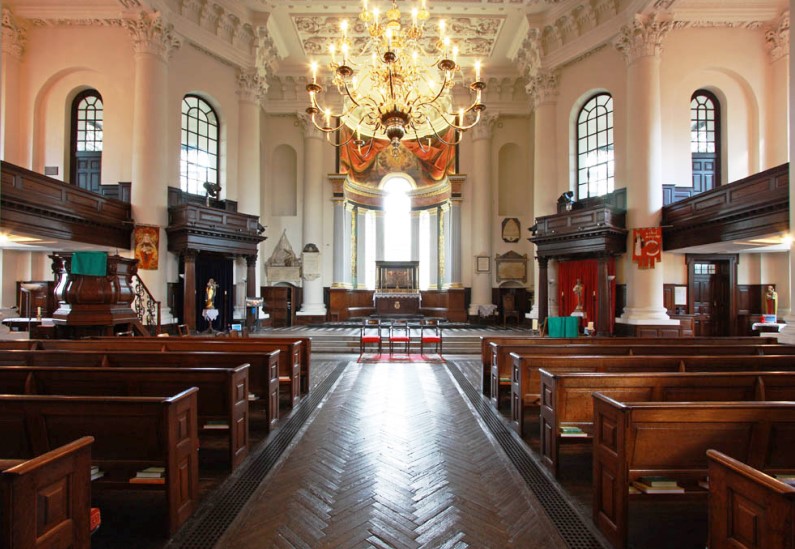
Their first daughter Mary Coutts Billups was born in Deptford in 1844. By 1849 the Billups family have moved to Newport where their second daughter, Susannah Coutts Billups, was born in 1849. In the 1851 census the family are living on Cardiff Road, Newport with Jonathan still working as a platelayer.
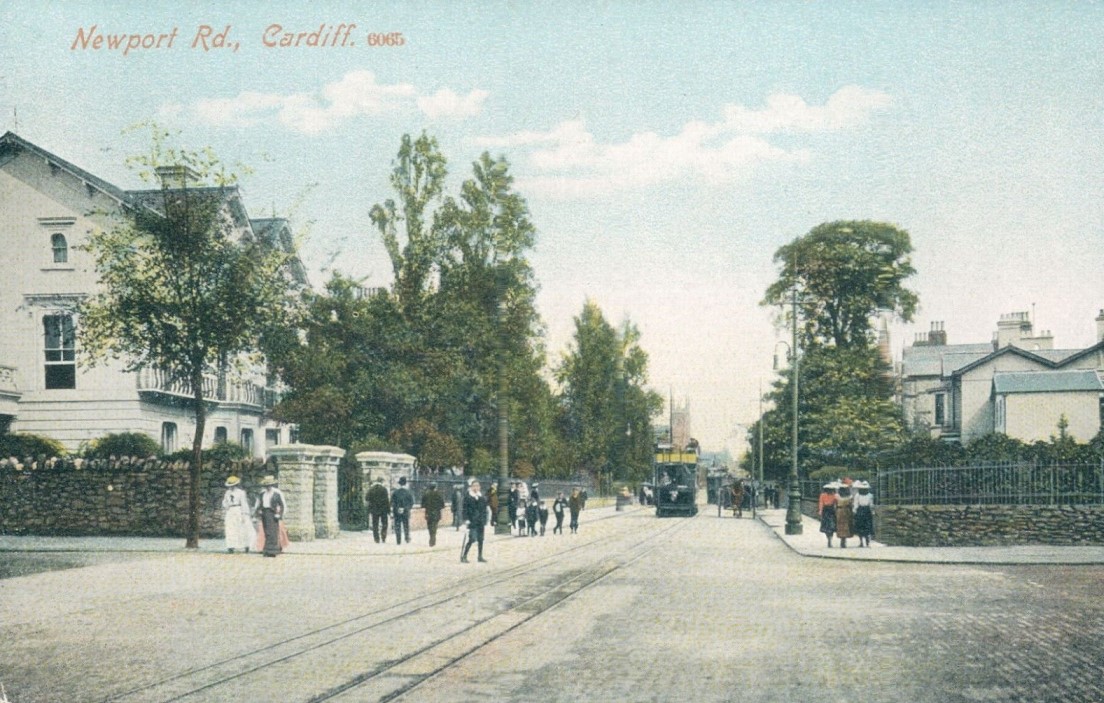
Sometime over the next ten years Jonathan Billups’s entrepreneurial spirit must have mushroomed for in the 1861 census the family are living in Cadiz House, Halswell Terrace, a large property on Roath Road (later renamed Newport Road), Cardiff and in between the wealthy Cory brothers; John Cory, the ship broker and Richard Cory the coal merchant. Jonathan Billups was by this time a ‘railway contractor’.
The Salvation Army connection
The Billups family has a fascinating connection with the Salvation Army that was founded by William Booth with strong support from his wife Catherine Booth.
The Booths were strong believers in roaming evangelism which didn’t sit well with the Wesleyan Methodist church who he worked for. The church would have preferred he spend more of his time supporting his parishioners at home rather than roam the country with his fervent preaching in other parishes and possibly showing up the inadequacies of the incumbent minister. Things came to a head in 1862 when he split from the Wesleyan Methodist church and became an independent evangelist.
William and Catherine Booth had spent much of 1862 in Cornwall evangelising to Cornish fishermen with mixed results. In 1863 they acted on a suggestion received form Cornish fishermen working in Cardiff that they visit. They were no longer welcome or pride prevented them using Methodist churches so William Booth’s first venue in Cardiff was Tredegarville Baptist Church in The Parade where he preached for a week. William Booth however didn’t feel comfortable preaching in a Baptist church. It was then that they saw an advertisement for an abandoned circus in St Mary Street and decided to rent it. Catherine voiced her concerns about such a venue prior to the first service there on 18 Feb 1862 but soon changed her mind when it became a success. The Booths no longer had to wait for invitations from local churches to carry out their work. This circus venue can perhaps be seen as a turning point in the history of what was to become the Salvation Army.

But where was this circus? It was not the circus that was to be built at a later date on the corner of Westgate Street and Park Street. By the 1860s the River Taff had been diverted by Brunel so that Cardiff station could be built. One newspaper article refers to some of the piles for the circus being in the river. The river in this case was probably the remnants of the River Taff which were probably not drained until the construction of Temperance Town. Thus would put the circus somewhere at the southern end of St Mary Street.


The Booths, having severed their ties with the Wesleyan Methodist church, had to raise sufficient money to support them and their children. Their target congregation was the poor and destitute, not the type of people who had money to give. They therefore had to find benefactors. Arriving in Cardiff in 1863 they were lucky to meet the Billups and the Cory families.
John Cory as a Wesleyan Methodist and used to preach himself at Roath Road Wesleyan Methodist church at the corner of City Road and Newport Road, the church destroyed in WWII. John Cory was able to see above the differences between the Methodist church and William Booth and became one of his benefactors as did his brother Richard.
Jonathan Billups also became a key financial supporter of William Booth, but more than that, he and his wife Susannah became close personal friends of the Booths. The closeness of these ties is evidenced by the fact that the Booths named their daughter born in 1864 Marian Billups Booth and their daughter born in 1866 Eveline Cory Booth.

The Cory brothers went as far was naming one of their new ships ‘William Booth’ and setting aside a proportion of the expected profits for the cause. Unfortunately the vessel was soon wrecked off the coast of Bermuda but the Cory brothers still kept to their original intention to support the Booths. Some years later Cory was involved in helping set up the ‘Salvation Navy’, an idea beset with problems and a story recently told by BBC How the Salvation Army’s navy was sunk – twice.
But it was the Billups and the Booths that built up a strong personal friendship. After Cardiff revival the two families went on holiday together to Weston Super Mare.
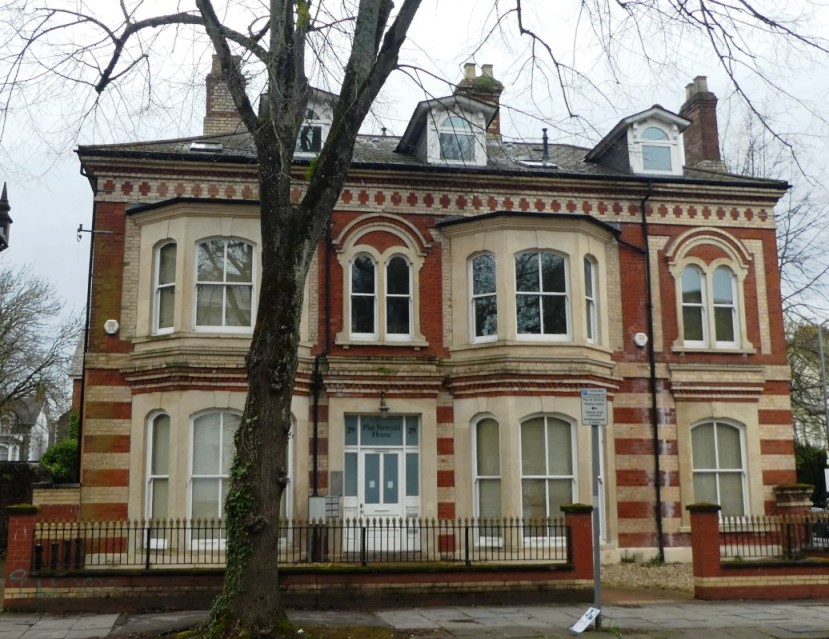
28 The Parade
Let’s park the story of the Salvation Army there for a moment and take a look at the main subject of this article that of 28 The Parade.
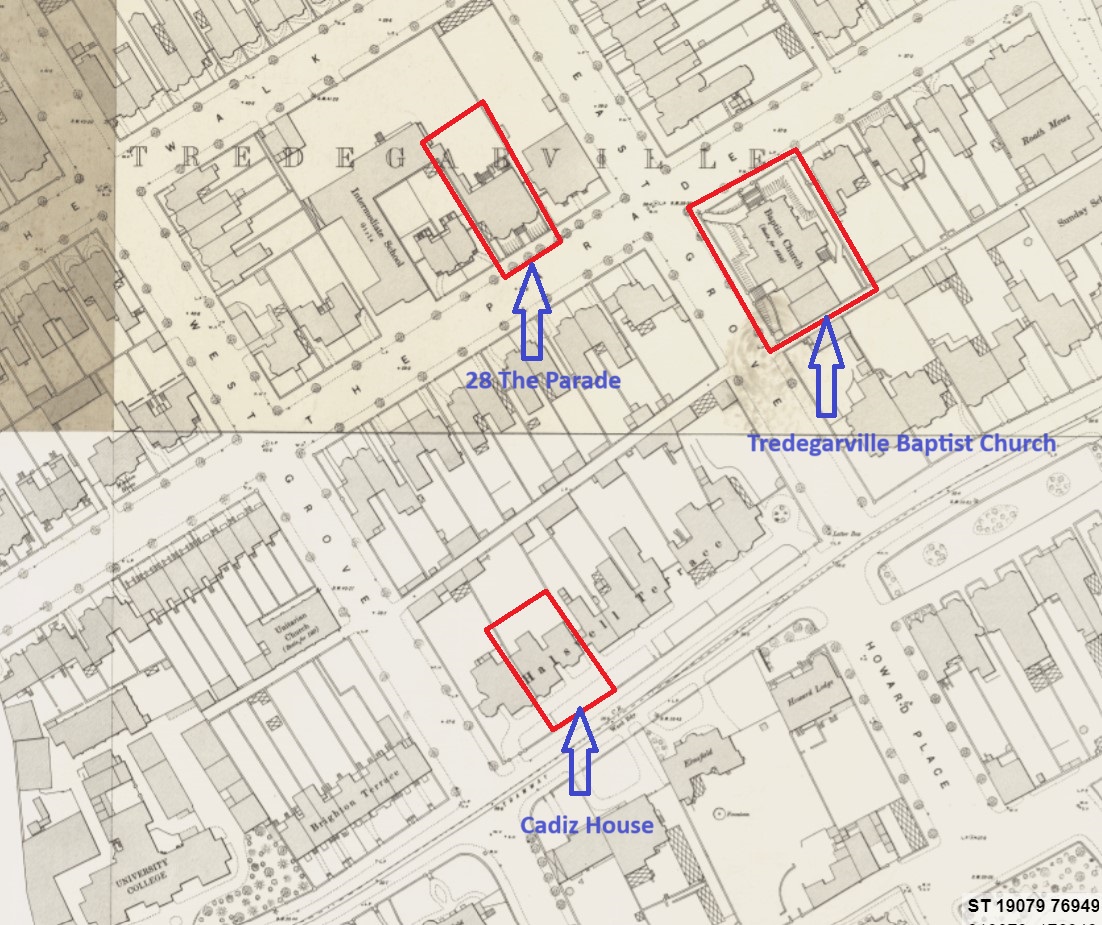
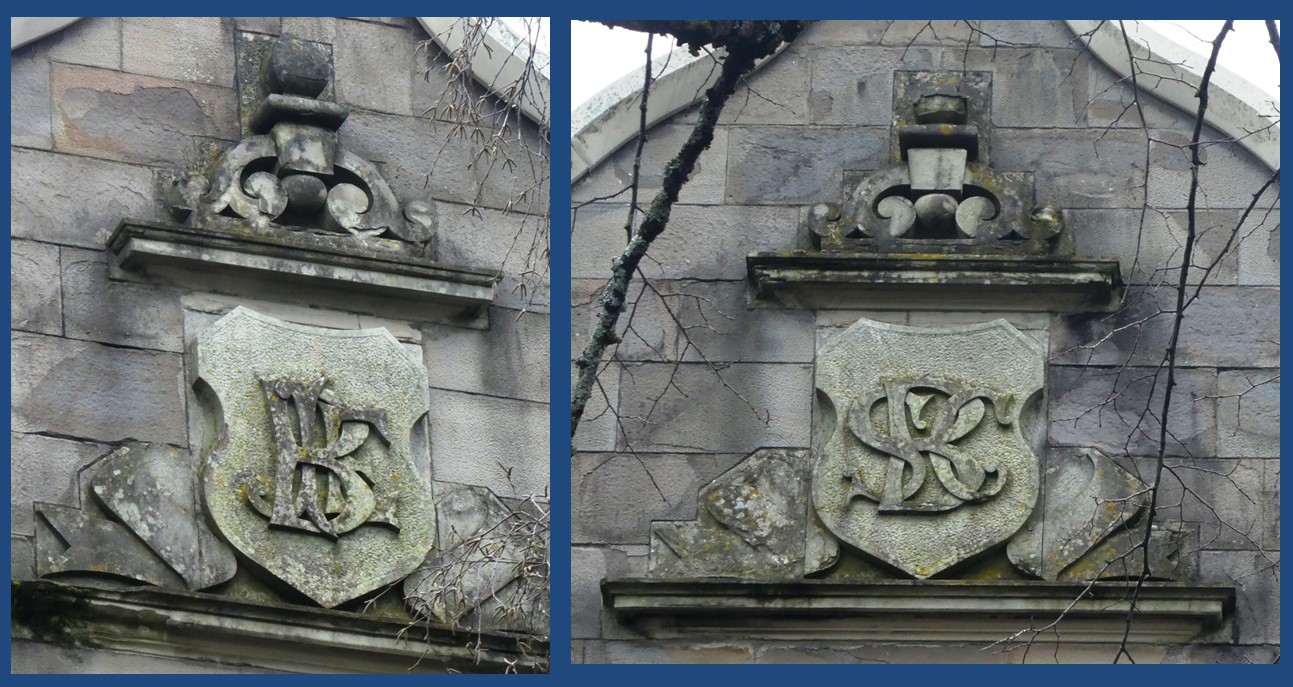
The house was built for the Billups family, there is little doubt about that. Their monograms are still there at the roof apexes.
If you are asking me when it was built then I would estimate around 1868. The family seem to be living there at the time of the 1871 census, though the house at the time has neither a name nor a number (the properties in The Parade were not numbered till a later date). Jonathan Billups was by then described as a Railway Contractor and he lived there with his wife, two daughters and two servants. The 1871 Cardiff Directory however still has his old address of Halswell Terrace on Roath Road, which seems to indicate their move to The Parade was around that date.
28 The Parade is now a Grade 2 listed building. The listing states it was probably built by W.G. Habershon, architect to the Tredegar Estate. It is a Jacobean style 3-bay villa of 2 storeys and attic. The central stair hall has a fine Jacobean full-height open-well stair, which is the principal interior feature.

In 1890 Cardiff council were looking to purchase an existing property for use a Judges’ Lodgings. Mr Billups offered up 28 The Parade for a price of £7,000. There was 78 years to run on the ground rent and the rent being £18 9s per annum. His offer was turned down in preference to an offer by Mr James Howell, (presumably his house at the corner of The Walk and West Grove which was later to become the first Mansion House).
In 1894 Mr Billups offers the house for sale to Cardiff Intermediate School for Girls at a price of £5,000 stating that it had originally cost £8,000 when built. The offer was accepted by the board of governors provided that the lease can be purchased from Lord Tredegar.
Jonathan Billups – the businessman
In twenty years Jonathan Billups went from being a plate layer to a railway contractor who could afford to have the grand house at 28 The Parade built for him. Newspaper cuttings over the years give us a clue as to his business.

He was a principal contractor for the Taff Vale Railway and in 1870 in charge of building a double line from Ystrad to Treherbert.
In 1874 he was the main contractor responsible for laying a new sewer under the Taff in Cardiff.
In 1877 he was the contractor for the Taff Vale Railway being built to Penarth and in 1880 for the Clydach Valley Railway.
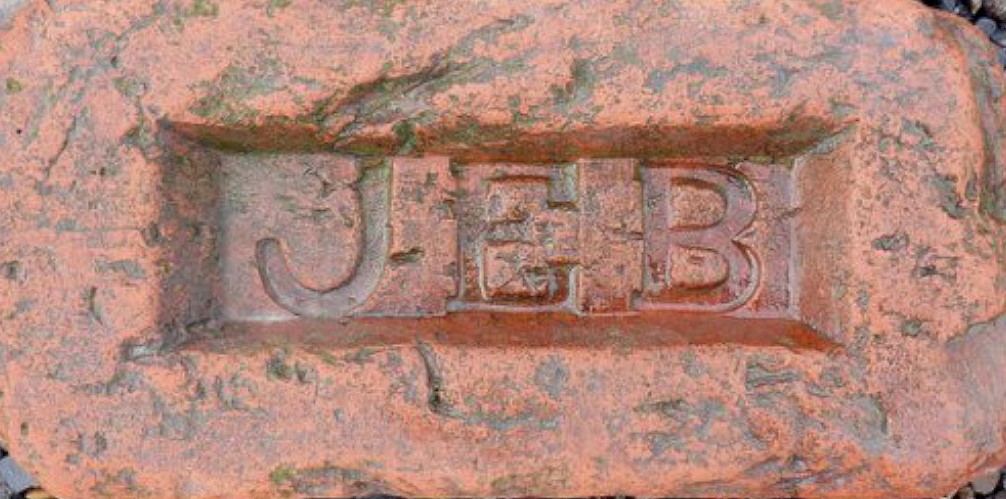
There are quite a few references over the years to brickworks owned by Mr Billups. In 1879 he had a brickworks in lower Grangetown.
In 1879 he was busy building houses, in this case Nos 1 & 2 Richmond Crescent.
In 1881 the newspaper reports that he is sinking coal shafts into the Nantgarw and Llantwit seams in the hope of realizing up to 100tones a week. Whether he ever found coal we are not informed.
There’s even reference in 1881 to Mr Billups being the first importer of cattle into Cardiff.
1883 has some interesting references in the newspaper to Mr J E Billups being the leaseholder on two farms in Barry which are needed for the construction of Barry Dock and railway.
In 1884 he was applying for a patent for the manufacture of hydraulic cement from local limestone called ‘Aberthaw pebbles’.
In 1885 he is masonry contractor of a new railway bridge in St Andrew’s Place, Cardiff.
Perhaps one of his largest jobs was the construction of the Dry Dock in Roath Basin 1885.
In 1888 we find him working much closer to home as the main contractor for the Roath branch of the Taff Vale Railway. In a related article it mentions Billups as the owner of the Roath Brick Works where two fatalities occurred. The brickworks were where the Sainsbury’s car park is now.

Just a year later he is a contractor on the Dowlais East Moors steel works.
1890 wins the contact for a giant 200 feet Portland cement chimney in Penarth.
In 1894 he sets up a company called Billups Brick Company at Roath and Llandough with a capital of £15,000 and £5 shares.
Also in 1894 he bid to be the contractor for the second phase of the development of Roath Park i.e. the construction of the Roath Park Lake.
His railway contract work it appears was not confined to this country. His obituary states at one period he undertook large contracts in Sweden.
Jonathan Billups was responsible for constructing the railway line at The Salvation Army Colony and for starting up the brickworks in Essex.
Jonathan Billups – outside work
There are numerous newspaper references to Mr Billups outside his work sphere. The most frequent references refer to him speaking at or chairing meeting or debates, often of a religious nature or associated with the subject of temperance. Public debates in the 1800s were could be noisy and sometimes riotous affairs with a police presence. In 1863 he chaired a debate on ‘Purgatory’ in the packed Music Hall in Cardiff, with hundreds locked outside. In 1874 he was present at a meeting supporting women’s suffrage. In 1876 he spoke in favour of Sunday closing for public houses.
He presided over a meeting of the Christian Mission (the original name for the Salvation Army), in 1876 at Stuart Hall in the Hayes.
He was evidently a keen gardener and would regularly win prizes in the amateur sections of competitions, ‘for gentlemen not having regular gardeners’. It begs the question as to what part Mrs Billups played in growing the prize winning blooms.
In July 1871 we learn Mr Billups from Tredegarville had lost his dog Fido, a black and tan King Charles spaniel. Perhaps Fido didn’t like it at 28 The Parade and wandered back to his old house.
Susannah Coutts Billups – his wife
Susannah Coutts Billups was born Susannah Coutts Cooper in Deptford, London in 1821.

Mrs Billups and Mrs Booth had a very strong friendship bond and were in regular correspondence. These letters form a good resource for those researching the Salvation Army. In one letter Mrs Booth displays her dislike of vaccines. ‘I would sooner pawn my watch to pay the fines, and my bed too, for the matter of that, than to have any of my children vaccinated. Who knows how much some of us have suffered through life owing to ‘the immortal Jenner?’ (Goodness knows what she would have thought of the relief sculpture of Jenner on the Cardiff University building on Newport Road close to The Parade, but that admittedly wasn’t unveiled till much later)
Mrs Billups died at 28 The Parade on 19 Nov 1883. She had suffered a long illness. During her illness the Salvation Army band would gather in the garden and Susannah would ‘convey to them her dying messages’. Catherine Booth was at her bedside when she died.
Her funeral was large, attended by 1000 Salvation Army soldiers from Cardiff and beyond and augmented by a large crowd and carriages. It set off from The Parade and would have progressed up along what is now City Road and Crwys Road to the new Cathays Cemetery. There were banners and flags waving and bands playing and lots of whoops. General William Booth had travelled from Scotland to lead the graveside service. Her grave is marked by one of the largest headstones in the cemetery and made from Aberdeen red granite on which is a Salvation Army shield and ‘Blood and Fire’ motto. The stonework is said to have cost in excess of £400 (or £40,000 in today’s terms). Her husband Jonathan and sister Ann (Jonathan’s second wife), are buried in the same grave.


Jonathan Billups maintained his support for the Salvation Army after Susannah had died. In 1886 he is at a wedding in Glasgow of a prominent Salvation Army member alongside William Booth.
In 1889 Jonathan chairs a meeting of the Salvation Army where General Booth’s 22 year old ‘third daughter’ speaks on ‘Torquay Swelldom and London Slumdon’. The speaker would have been Eveline Booth, actually their fourth daughter, which adds weight to the theory that Marian Billups Booth was overlooked (see below).
Mary Coutts Billups – the elder daughter
Mary comes across as an interesting character. She left the Billups home on The Parade in the 1870s and went to lodge with William and Catherine Booth in London. She was keen to learn a foreign language and wanted to learn from a tutor who was teaching one of the Booth sons. The move to London was however prior to her having converted to Christianity so lodging in the Booth household was difficult. She found adhering to the practices problematic. All was solved however at a later date when she saw the light and had a dramatic conversion in a Christian Mission meeting in London.
In April 1875 she married Rev James Elliott Irvine in Cardiff in a packed Charles Street Wesleyan Chapel. Reports describe him as an American Evangelical preacher but he was in fact born in Ireland in 1830. After the wedding the party retired to 28 The Parade for a reception where the cake was reported to have been 4ft tall.
There is an interesting description of Rev Irvine and Mary preaching in Leighton Buzzard in late Dec 1875. She too by this stage is described as ‘an American lady’. It is written very much from the fear of outside evangelists coming into the town uninvited and pinching soles from existing churches in order to form a new church. Mary was described as ‘the more powerful of the two evangelists’. The report states they were part of an organization called ‘International Christian Association for the promotion of Scriptural Holiness’, which seems to be different to the Salvation Army which was at that time called ‘Christian Mission’.
James and Mary emigrated to America shortly after. They were living in New Jersey in 1880 with James working as a clergyman. They later moved to Washington DC and Mary worked as a music teacher. Mary died aged 58 on 26 Jun 1903 and is buried at the Congressional Cemetery in an unmarked grave.
James died in 1916 aged 86 and is buried in Arlington National Cemetery. His obituary makes interesting reading:-
Rev. James E. Irvine, am ordained evangelistic minister for the Methodist Episcopal Church for over half a century, died at his home, 601 4th Street NW, Saturday, from the effects of a fall received about three months ago. Interment was in Arlington Cemetery. Rev. Irvine was born in Ireland and came to this country when a boy. He was ordained shortly before the civil war, and when hostilities began he enlisted in a New York regiment, in which he served as chaplain. During the war he rose to the rank of sergeant.
Rev. Irvine took up active evangelistic work at the close of the war, and traveled extensively over the United States and in England. He was married but his wife died a number of years ago. He is survived by an adopted daughter, Mrs. Alamado Rivera, wife of Judge Alamado Rivera of Puerto Rico.

Susannah Coutts Billups – the younger daughter
Susannah married Edwin Palmer Lee, originally from Plymouth, in 1872 in Cardiff. Initially they lived in 28 The Parade with Jonathan Billups but as their family grew larger with their eight children they moved next door to 29 The Parade. Edwin Palmer Lee was a managing director of a brickworks. Whether 29 The Parade was built for them I am not sure, but it is certainly brick built as opposed to stone built like others in the row.
The Salvation Army
In 1882 the Salvation Army took out a lease on Stuart Hall in the Hayes in the centre of Cardiff. It was still being used by the Salvation Army in the 1960s but was later demolished.
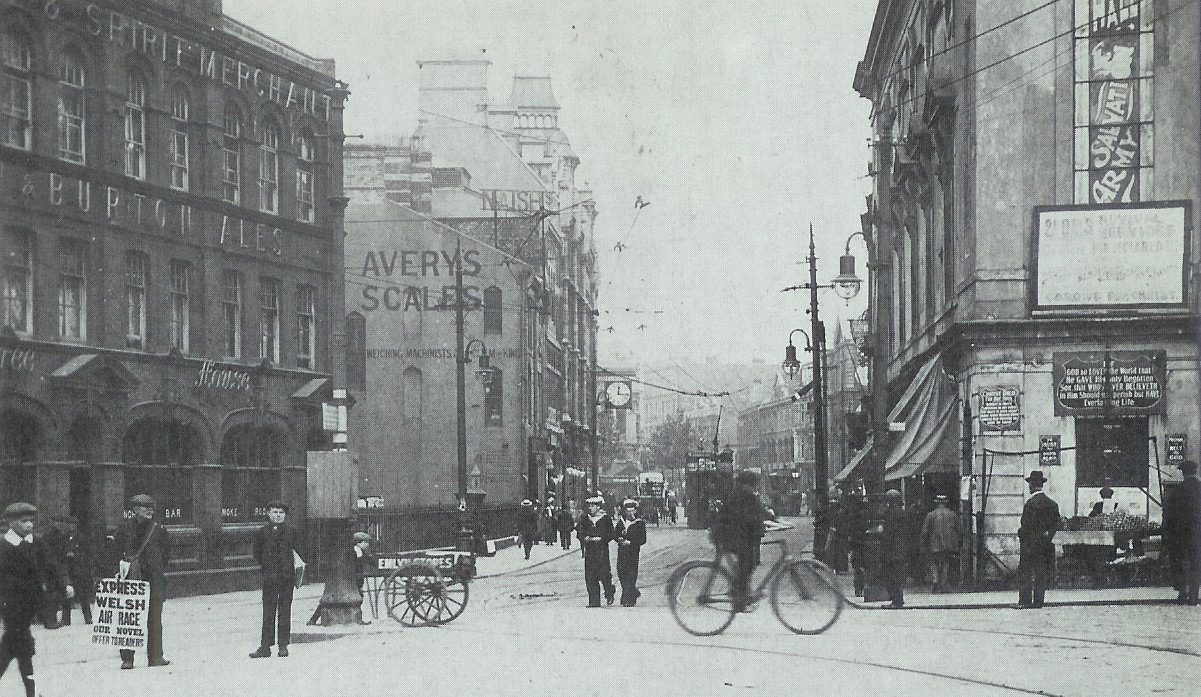

Another Cardiff connection with the history of the Salvation Army is seen in a newspaper article in 1891 reporting on a meeting held in Roath Road Wesleyan Chapel of the in connection with Salvation Army Homes for the relief and rescue of friendless girls. The meeting was attended by Bramwell Booth, son of William and Catherine Booth. The Chair, Lewis Williams JP spoke of how he may lay claim, along with his friends Mr R.Cory, Mr Billups and Mr J.Cory who ‘fought the first battle that was fought in this country in relation to the right of the Salvation Army to preach the Gospel in the public streets of their country’.
General Booth visited Cardiff on a number of occasions to preach. In 1894 the venue was Wood Street chapel and he was a guest of Mr Billups that day. The obituary of Mr Billups states that whenever William Booth visited Cardiff he invariably stayed with Mr Billups.
The Death of Jonathan Billups
Mr Billups died in Clifton, Bristol on 25 Nov 1896 aged 76 having moved there a few years before his death after 28 The Parade had been sold.
His obituary describes him as a man of considerable energy and force of character. He was a member of Charles Street Congregational church, his politics were liberal and did yeoman service in connection with elections in town.
His body was returned to Cardiff and a large funeral procession set off from The Parade to Cathays Cemetery consisting of more than 20 private carriages and 60-70 members of the Salvation Army marching behind the coffin. The service was conducted by the minister of Charles Street Congregational and Bramwell Booth, son of William Booth. He was laid to rest alongside his first wife Susannah Billups.
The following month a memorial service to Mr Billups was held at the Park Hall led by General Booth in which he was full of praise for Jonathan Billups and the support he had given to the Salvation Army describing him as an honest businessman, a saintly man and ever anxious to promote good works and not only in the cause of religion but of charity and befriending the working man. General Booth wished to correct the notion that had got aboard that the deceased gave a lot of money to the Salvation Army. Mr Billups did not give beyond his means, and helped other good causes beyond the Salvationists.’

Some reports say that although he was very generous with his money some of his investment decisions may have been poor. His estate when he died was worth £600, not a lot considering probable prior earnings. His Will makes interesting reading. It financially supports his second wife Ann and his children but in the case of his daughter Mary Ann Irvine in America it is made clear that the money should not be in the control of her husband and if Mary predeceases him and there are no children then the money be returned to, and held in trust, for the children of her sister Susannah.
Ann Cooper – Second Wife
After Jonathan Billups lost his first wife Susannah in 1883 he lived with her sister Ann Cooper. Whether they ever officially married is unclear. His will refers to her as ‘my wife or reputed wife Ann Cooper….’ And there is no trace of there marriage being registered. They had no children together and she outlived him, dying in Bristol in 1904 leaving £3000 in her estate.

Marian Billups Booth
Marian Billups Booth, known as Marie, the sixth child of William and Catherine Booth was born in Leeds on 4 May 1864, a year after the Booths and Billups family had become close friends. Marie suffered from convulsive fits from a young age so unlike her brothers and sisters she did not go on to take a full part in Salvation Army evangelism. She was however assigned a rank of Staff Captain.
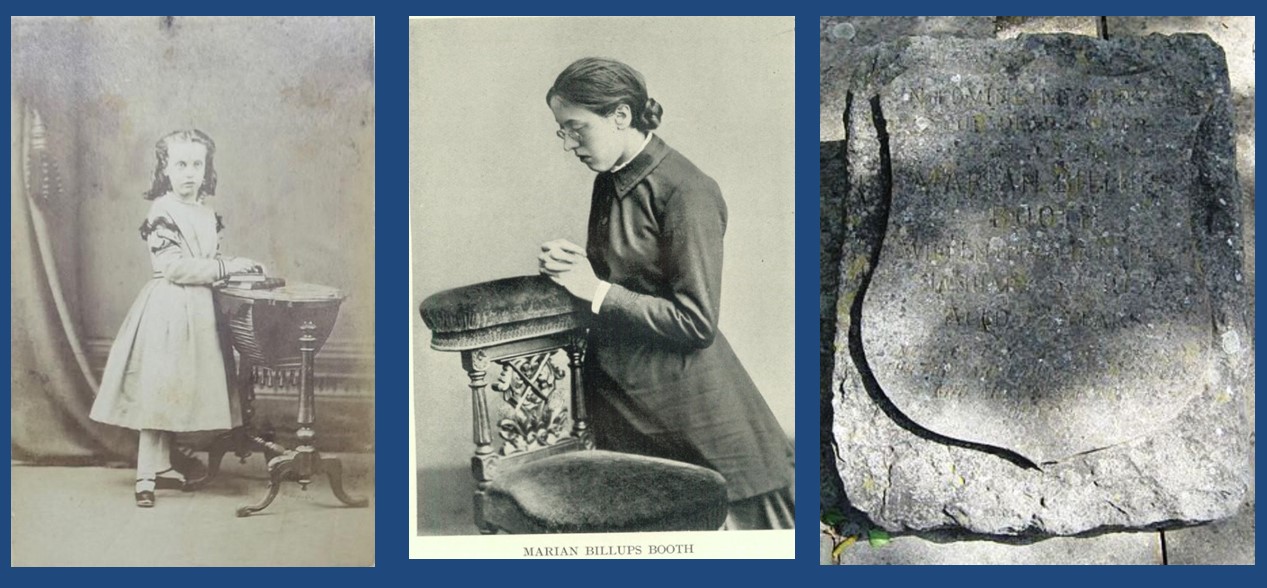
Unlike her siblings Marie led a largely private life. The exact nature of her disability is unknown. Some recent research of the Salvation Army archives has led to the question of whether she was in effect infantilised by her family. Marie herself may have felt undervalued as in one letter she wrote:
‘I think by so doing the officers of that establishment find me very useful & appreciate me being amongst them. But I suppose that is for others to say, only it is necessary to blow your own trumpet sometimes for I expect you don’t hear much about me or my good qualities’.
She died in London in 1937 aged 72 and is buried alongside her parents in Abney Park Cemetery, Stoke Newington, London. .
Barry Island visits and the Salvation Army name
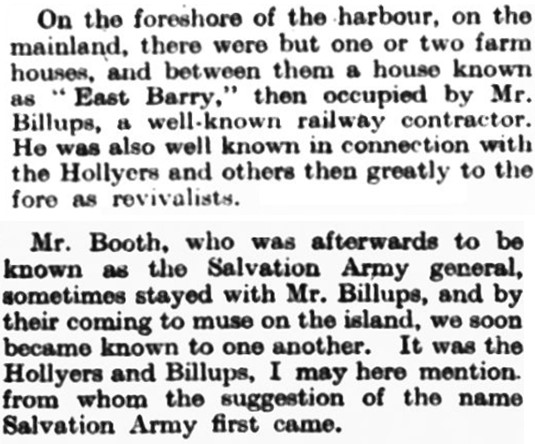
Perhaps the most fascinating newspaper cutting I came across was in the Western Mail 28 Apr 1926 and about the history of Barry Island written by S A Tylke, a former owner of the island. It says:
On the foreshore of the harbour, on the mainland, there were but one or two farm houses, and between them a house known as East Barry,’ then occupied by Mr.Billups, a well-known railway contractor. He was also well known in connection with the Hollyers and others then greatly to the fore as revivalists.
Mr. Booth, who was afterwards to be known as the Salvation Army general, sometimes stayed with Mr. Billups, and by their coming to muse on the island, we soon became known to one another. It was the Hollyers and Billups, I may here mention from whom the suggestion of the name Salvation Army first came.
Could it be true that the name Salvation Army was first suggested by Mr Billups? Possibly, but it does very much contradict the widely accepted theory that the name “The Salvation Army” developed from an incident in May 1878. William Booth was dictating a letter to his secretary and said, “We are a volunteer army.” Bramwell Booth heard his father and said, “Volunteer! I’m no volunteer, I’m a regular!” The secretary was instructed to cross out the word “volunteer” and substitute the word “salvation”.
A General Returns
In 1936, who should turn up at the doorstep of 28 The Parade, then Cardiff High School for Girls, but General Eveline Cory Booth, then leader of the Salvation Army. She had come for a look around the house she remembered staying at with her parents when she was a child. She even found the little dressing room she had slept in as a child, now a form room.
Until the next time ……..
There was me thinking I would cover the history of this fine building all in one article, but no, there’s far too much to tell. We’ll come back another day. In the meantime let’s all hope that 28 The Parade is somehow preserved and its history not forgotten.
Ted RIchards, May 2024
References
The Short Life of Catherine Booth, The Mother of the Salvation Army – by F de L Booth-Tucker.
Blood & Fire, Wiliam and Catherine Booth and their Salvation Army – by Roy Hattersley.
The Grace of Giving – Richard Cory; the BIllups Family – Nigel Faithful
 Roath Local History Society