Lord David Owen – Official portrait, 2018 (souce: Wikipedia)
There’s little sign that 86 year old David Owen is winding down. The man who was Foreign Secretary in James Callaghan’s Labour government and who then went on to be a founder of the SDP party will be 87 in a few weeks time. Yes, he retired from a House of Lords last year but is still a prolific writer and gives regular radio interviews offering his opinions on modern politics.
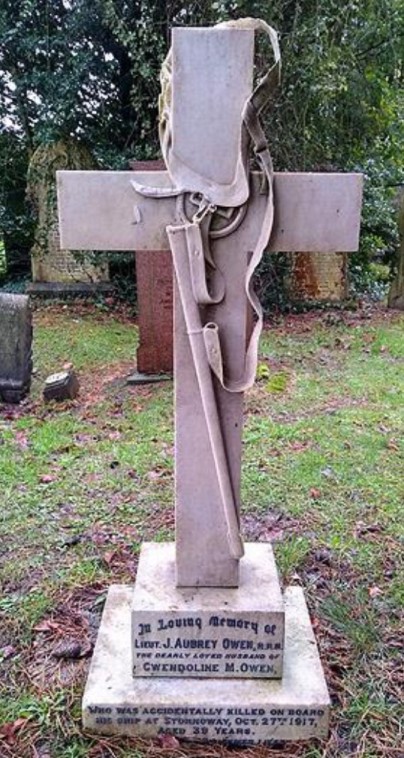
It wasn’t my intention to research David Owen and his Cardiff connections. It was rather an accident. My attention had drawn recently to an unusual grave headstone at Cathays Cemetery. It is unusual in it’s design. Cathays Cemetery, the third largest Victorian in the country, still contains many examples of elaborate headstones despite a harsh clearance scheme that took place in the 1960/70s aiming to make cemetery maintenance easier. There are still examples of Celtic crosses, obelisks, pedestals with urns, angels, broken columns signifying a life cut short and a couple of polished granite globes. There is however only one example of a sword and belt draped around a cross. It is the headstone of Lieutenant John Aubrey Owen.
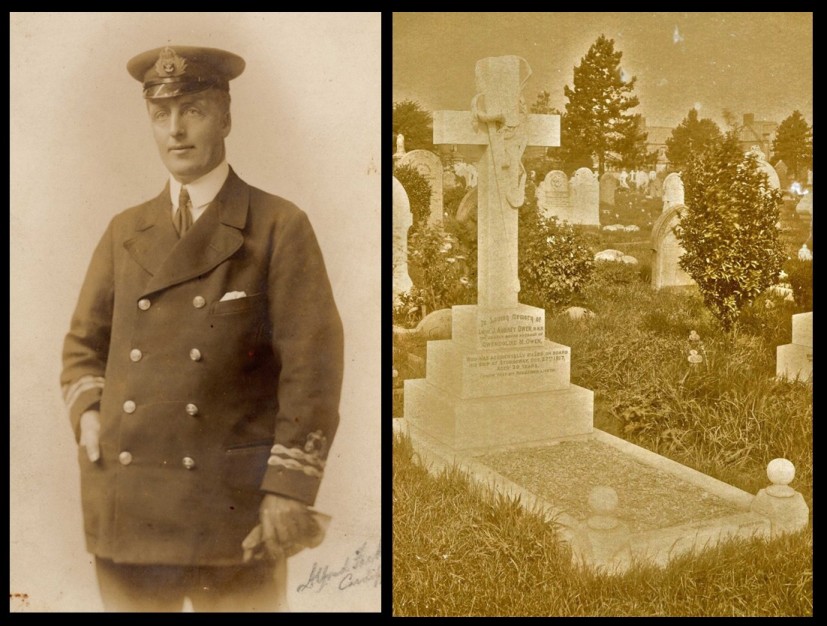
Even this elaborately carved headstone may have suffered as a result of the clearance scheme. Comparing the present headstone with a historical picture shows the kerbing is no longer present and the headstone itself is lower than it originally was. Maybe this was as a result of the clearance scheme or just sinkage into the ground. The elaborate sword and belt carving and cross too has suffered some damage over time. The sword’s hilt is sadly no longer present.
Lieutenant John Aubrey Owen it turns out was Lord David Owen’s grandfather. Not that David Owen ever knew his grandfather sadly. Lieutenant Owen died during WWI as a result of an accident.
Lieutenant John Aubrey Owen headstone at Cathays Cemetery.
Having found that connection I did some research and ordered David Owen’s biography ‘Time to Declare’ (1991). David Owen was born in Devon in 1938 but has a lot of Welsh blood in him. His biography details how he spent time in South Wales when his father was away involved in WWII. My intention here isn’t to repeat all his South Wales family history but to tease out his interesting connections to us here in Cardiff, starting with his grandfather.
Lieutenant John Aubrey Owen (1876-1917) – Grandfather
John Aubrey Owen was born on 12 Jun 1878 at at 14 Park Street, Temperance Town, Cardiff to William Frank Owen, a coal merchant, originally from Cardiff and Selina Maud Owen nèe Rees originally from Bridgend, Glamorgan. By 1881 the family were living at 9 Crwys Road, Cathays, which is now a hairdressers. He was baptized on 18 Mar 1885 at St Augustine, Panarth and in 1891 the Owen family were living at 24 Pembroke Terrace, Penarth. John joined the merchant navy as a boy sailor at the age of 16, working on the four masted ships sailing out of Cardiff docks. In the 1891 census he is recorded as living at 10 Belle View Terrace, Penarth, aged 22, and a sailor.
9 Crwys Road, Cathays where John Aubrey Owen was living as a child in 1881.
On 8 Nov 1905 John married Gwendoline Mary Morris, the daughter of a Congregational minister. They may well have met each other as teenagers when they both lived on Pembroke Terrace, Penarth. After getting married they settled in Cwmgwrach, in the upper Neath Valley and had two sons.
John’s career soon progressed in the merchant navy, gaining his First Mate’s certificate in 1905 and then his Master’s certificate in 1907. John was employed by Messrs Evan Thomas Radcliffe and Co, Cardiff, one of the more prosperous and better-known of Cardiff-based shipowning companies. John had had been in command of three of their steamers by the time the First World War arrived where he served in the Royal Naval Reserve and was made a temporary lieutenant in February 1917. He served on H.M. Trawler ‘John Pollard’. He however sadly died from a fractured skull on 27 Oct 1917, after falling from the upper deck of his vessel into the stoke hold, while the ship was docked in Stornoway on the Isle of Lewis in the Outer Hebrides. He was aged 39. He is buried in Cathays Cemetery (grave S 509A). Commonwealth War Graves Commission record.
Lieutenant John Aubrey Owen and old image of his headstone at Cathays Cemetery, Cardiff..
David Lewis (1797-1860) G-G-G-Grandfather – Mayor of Cardiff
Researching the Owen family history is made a lot easier, not only by David Owen’s autobiography, but by there being a very comprehensive family tree on Ancestry put together by another Owen family member. In that family tree it details the life of David Lewis (1797-1860). He married Margaret Aubrey, which is where the Aubrey name passed down through the family comes from. In 1841 he lived on Quay Street, Cardiff.
His lengthy obituary in the newspaper in 1860 details how he was a victualler, landlord of the Ship and Dolphin in Church Street, and afterwards became Master of the Ship on Launch, in Quay Street which was the favorite resort of the Cardiganshire seamen when they visited Cardiff. He also speculated in coal and had a rope making business and donated money to the Wesleyan Chapel in Charles Street. In 1854 he was Mayor of Cardiff. He is buried at Llandaff Cathedral.
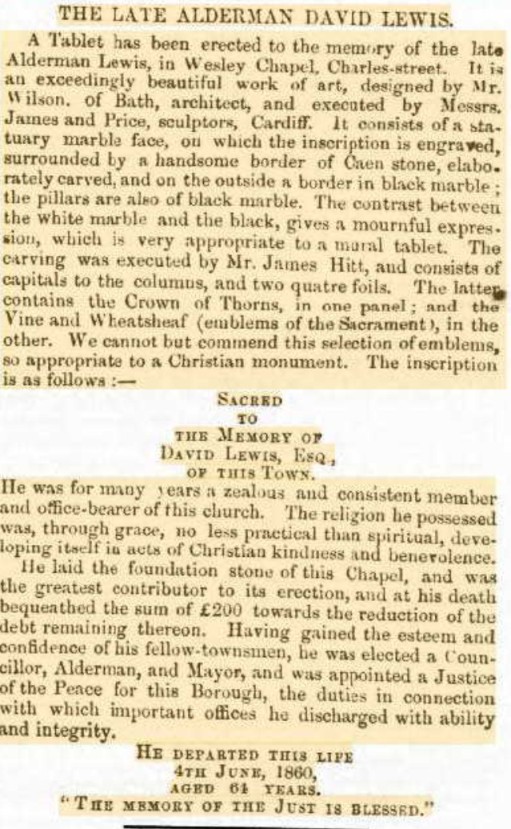
Wesleyan Chapel, Charles Street, Cardiff, opened 1850. The chapel was destroyed by fire in 1895 and then rebuilt. The rebuilt chapel was demolished in 1984. The plaque to David Lewis (described below) could well be one of those in the sketch under the eaves of the balcony.
A plaque to David Lewis was erected in Charles Street Wesleyan Chapel after his death.
Alderman William Llewellyn (1850- 1923) – Maternal G-Grandfather
William Llewellyn was both a liberal politician and shopkeeper. David Owen writes that ‘Alderman William Llewellyn, was chairman of Glamorgan County Council and chairman of the Bridgend Bench of Magistrates. A staunch Liberal, he was a moving spirit in first the Mid-Glamorgan then the Ogmore Divisional Liberal and Labour Party, of which he also became chairman. He had started life as a grocer and provision merchant in Ogmore, having moved there from Llantrisant. Over the years The Gwalia, as his shop was called, grew until it was described as `a mecca of the valley and neighbourhood’. The shop used to be in Ogmore Vale but has been moved and many of you will have been there. Gwalia Stores closed in Ogmore Vale in 1973 but was then moved and rebuilt at St Fagans National Museum of History in 1991. The ground floor is set up as it would have been during the 1920s.
Gwalia Stores originally in Ogmore Vale now at St Fagans National Museum of History, Cardiff.
Dr Edgar Llewellyn (1890-1964) – G-uncle
Alderman William Llewellyn had eight children, or more accurately his wife Mary did. One was George ‘Gear’ Morgan Llewellyn (1877-1951), David Owen’s maternal grandfather. He was a blind church minister and lived at Llandow in the Vale of Glamorgan and a big influence on David Owen’s life. David spent time living there as a child when his father was away in WWII.
Another son of Alderman William Llewellyn was Dr Edgar Llewellyn and it is he that has connections with our area. He became a GP in Splott and had his surgery on Splott Road. He was Cardiff Commissioner of the St John’s Ambulance Brigade and the works’ doctor at Guest Keen steel works, and also became a Cardiff Councillor.
In his autobiography David Owen recalls the following:
The brother whose career most closely paralleled my own was Edgar. He was a family doctor in Splott which is an area of Cardiff dominated by the steel-works. He was a great character and adored by his patients His unique way of sorting out their ailments was, according to my mother, to go into his surgery and announce, “Those buggers who are ill can move to the right-hand side of the room and be seen now: those who are not can wait on the left and see me later or chance their luck tomorrow.’ After the war he became infuriated by the politicians on the City Council and so decided to join his wife who was already a Ratepayer Councillor. He was elected in 1951. A photograph of him in a pony and trap, bedecked in a massive rosette, electioneering shows the first combination of doctor-politician in the family’s history. His wife Jenny, who had first stood and won as a Ratepayer in 1946, was a strikingly good looking woman and a considerable character. She was the first person in eighteen years to beat the Labour candidate in her Ward. She stood again in 1949 and won and then lost her seat three years later. The wish to be an independent in local government and to stand against party politics was later mirrored by my mother and, some will say, by me too.
‘
Dr Edgar Llewellyn, Ratepayers Candidate in the Cardiff 1951 Local Government elections (picture credit: Cardiff Yesterday Vol XVI)
Dr Edgar Llewellyn of the Ratepayers Part campaigning in 1951 (Picture credit: David Owen’s biography ‘Time to Declare’ (1991))
What started as a bit of research into the grave of John Aubrey Owen at Cathays Cemetery turned up many interesting stories about the history of Cardiff. Fascinating stuff is histoy.
The installation of the new cycle and pedestrian route in Roath Recreation Ground last year certainly raised some criticisms.
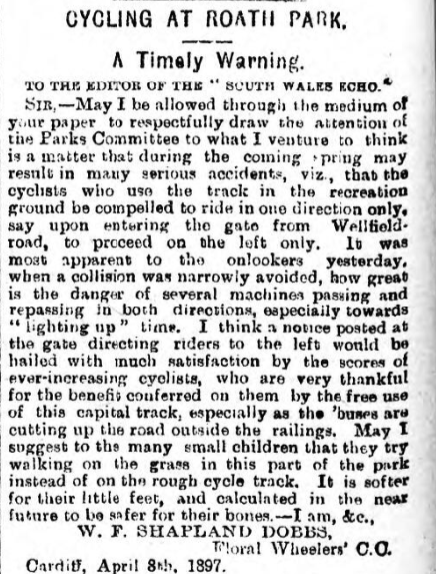
What many however may not realise is that the Rec used to have cycle lane around it. Cycling was a popular a pastime at the turn of the 19th century. In a letter to the editor of the South Wales Echo in 1897 one reader was encouraging cycling in one direction only and that children should keep to the grass.
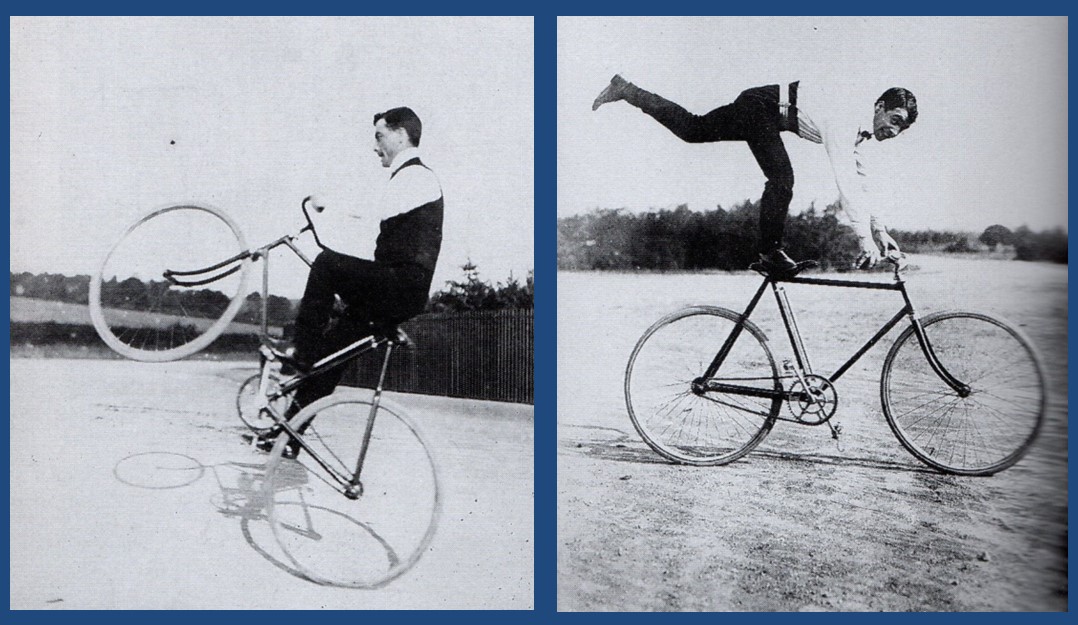
I recently came across some pictures in a book Cardiff Remembered by journalist Brian Lee of Welsh Champion trick cyclist Billy Brian taken at Roath Park Rec. I thought I’d have a look to see if he had any local connections and sure enough he did.
Billy Brian prforming his balancing acts at Roath Park in 1905.
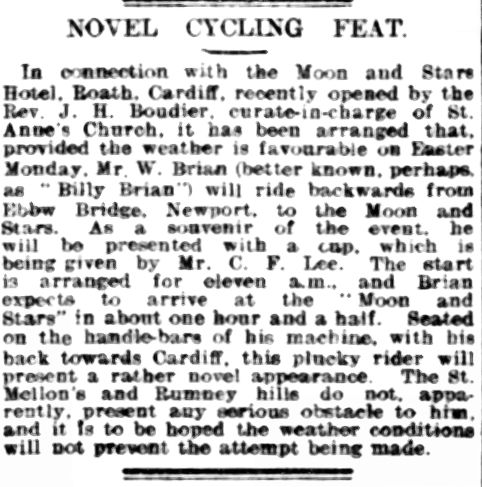
On 1st April 1904 it was announced that Billy Brian would be attempting to ride from Newport to the recently opened Moon & Stars Hotel, Roath and if successful be presented with a cup by C.F.Lee, (grandfather of Brian Lee the journalist previously mentioned I think).
Western Mail 1st April 1904
The attempt was indeed successful and Billy was presented with the cup on April 4th 1904.
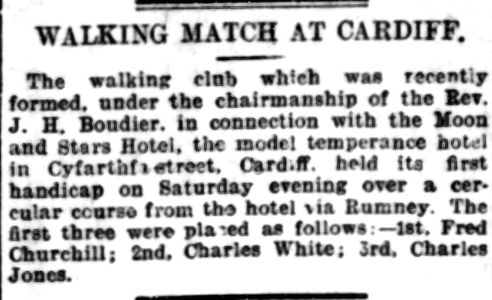
The Moon and Stars was on Cyfarthfa Street and was a temperance hotel i.e. only served non-alcoholic beverages. It had a short lifetime and closed after about a year. Mentions of the Moon and Stars in the press:
Western Mail 23rd May 1904
Western Mail – 13th Aug1904
Some of Billy Brian’s other feats:
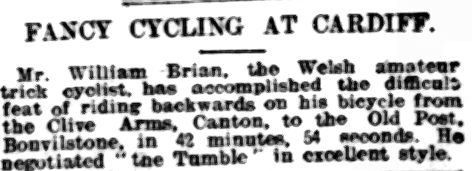
Western Mail – 11 June 1906
Evaning Express: 11th Aug 1906
Evening Express: 4th Jul 1908
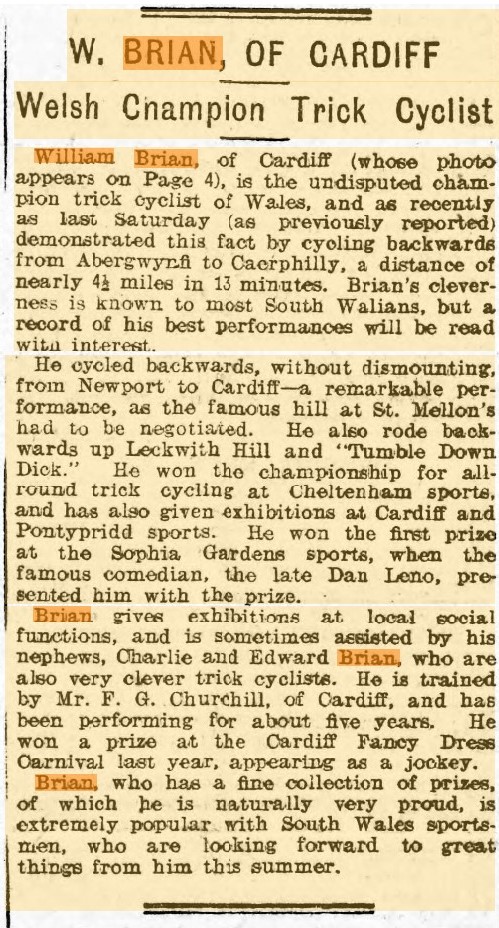
The above cutting refers to number of interesting aspects:-
Cycling backwards from Abergwynfi to Caerphilly, a distance of nearly 4½ miles in 13 minutes: I don’t understand this as Abergwynfi and Caerphilly are more than 20 miles apart by road so it looks like the time and distance are incorrect or the names towns?
He won first prize at the Sophia Gardens sports when the famous comedian, the late Dan Leno, presented him with the prize. Dan Leno died in Oct 1904 so the presentation must predate this.
He cycled backwards from Newport to Cardiff…….. : Already covered previously.
He also rode backwards up Leckwith Hill and “Tumble Down Dick”: I have never heard the Tumble referred to as Tumble Down Dick previously but it apparently comes from a story that it is where the stagecoach of Richard Cromwell (the son of Oliver Cromwell) struck a pothole with such a jolt that the impact threw him from his seat and out onto the road.
Brian gives exhibitions at local social functions, and is sometimes assisted by his nephews Charlie and Edward Brian, who are also very clever trick cyclists: I’ve researched the Brian family tree and one of Billy Brian’s nephews was Charles Phillip Brian b.1898, died in 1919 of pulmonary TB after serving in WWI and is buried in Cathays Cemetery. He is remembered on a memorial plaque thought to have been in Clifton Street Calvinistic Methodist chapel.
He is trained by F.G.Churchill of Cardiff and has been training for about five years: This looks to be Frederick George Churchill, a sign writer living in Treharris Street, Roath in 1911.
When Billy Brian’s son, also called Billy, was interviewed in 1997, aged 84, he recalled that the great German trick cyclist Bud Snyder, who was appearing at the Empire Theatre at the time, begged his father to join him in his act. But he turned him down, and stayed with Spillers and Bakers where he worked as a clerk for 40 years.
Among other places Billy Jnr recalled his father trick cycling was backwards around Roath Park Lake and up Thornhill. He said he continued trick cycling into his 50s and then took up the piano as he loved the idea of entertaining people.
Brian Family History
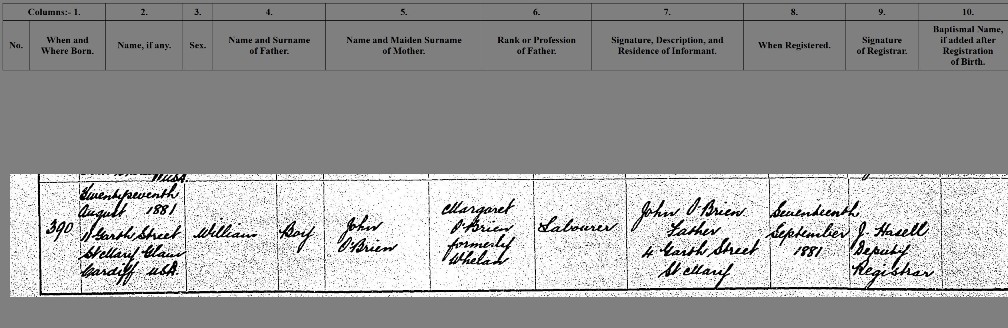
Billy Brian was born William O’Brien on 27 Aug 1881 at 11 Garth Street, Newtown, Cardiff. He was the youngest of seven children born to John O’Brien, a labourer, originally from Clonakilty, County Cork, Ireland and Margaret O’Brien nèe Whelan also originally from Ireland.
William O’Brien, Birth Certificate
Billy’s mother died when he was less than a year old and his father never remarried. Billy it seems was bought up by his father and older siblings. By 1891 the family had moved to 118 Cyfarthfa Street, Roath. In 1901 the family were living at 25 Croft Street and by now William was working as a clerk in a flour mill.
The spelling of the family surname changed over the years, which wasn’t unusual at the time. In the 1901 census it had changed from O’Brien to O’Brian. Shortly afterwards it appears they dropped the ‘O’ and the whole family adopted the surname Brian.
Billy’s trick cycling exploits seem to have been around the years 1904-1908. In the summer of 1910 he married Florence Thomas, originally from Newport. At the time of the 1911 census Billy and Florence were living at 92 Glenroy Street, Roath. In 1915 they had a son, William Lionel Brian. At the time of the 1921 census they were still living at 92 Glenroy Street and Billy working as a flour milling clerk for Spillers Industry Ltd in Bute Street. By 1939 he had retired and was living at Heol Nest, Whitchurch. He died in Cardiff on 8 Feb 1951 aged 69.
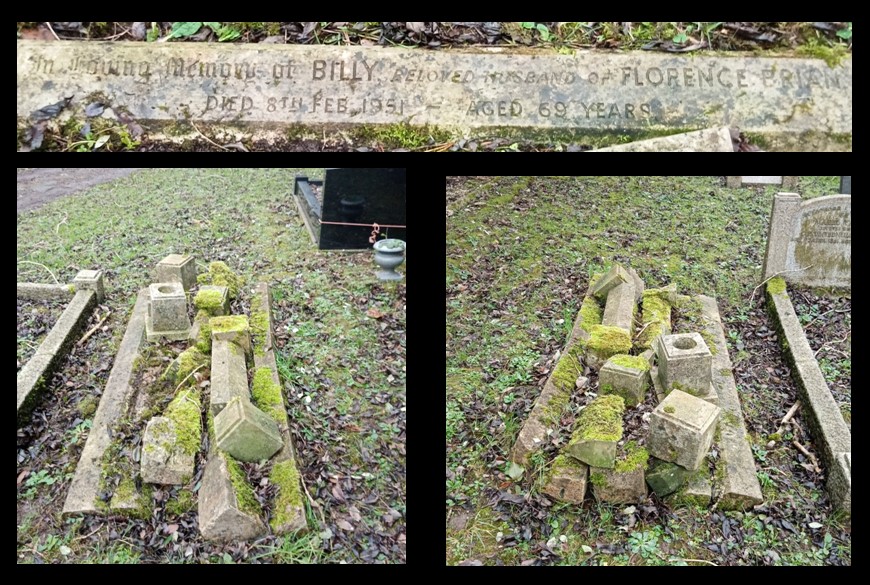
Billy Brian is buried at Cathays Cemetery. After a bit of a search I managed to locate his grave (plot C2115) where the stonework is somewhat damaged but could still make out his name.
Billy Brian’s grave at Cathays Cemetery (plot C2115).
So next time you cycle or walk along the new cycle/pedestrian route on the Rec think of Billy and the awesome feats he achieved and that he practiced those skills here on Roath Recreation Ground.
Towards the top of Pen-y-lan Road, on the corner with Bronwydd Avenue, there stood until the mid-1980s, a rather grand house called Oldwell. It was built the mid-1880s for owner of the South Wales Brewery, John Biggs. It was one of the grand houses of Pen-y-lan along with its neighbour Wellclose and other nearby houses including Bronwydd, Greenlawn and Pen-y-lan House.
Oldwell, Pen-y-lan
I recall visiting Oldwell in the 1970s when it was a residential home for the elderly owned by the local authority. The other owners are listed in an article by Glamorgan Archives. It was demolished in the 1980s and the land repurposed for flats.
Oldwell in 1980s.
Oldwell must have been an idyllic residence when it was first occupied by John and Emily Biggs and their six boisterous teenage boys back in the mid 1880s. It had a snooker room to entertain them in times of wet weather and a stable at the back for them to learn horse riding skills. But the boy’s real passion was playing rugby. All six would go on to play rugby for Cardiff and two for Wales. There is a story associated with each of them. One boy, John James Egerton Biggs went on to be Lord Mayor of Cardiff, Norman Biggs ended up being killed by a poison arrow and Geoffrey Biggs was captain of one of Britain’s first submarines, the A1.
In this article we concentrate on John Biggs, the man who couldn’t stop brewing. His name crops up in newspaper articles from the time and we are able to piece together bits of his life story but admittedly its an incomplete picture.
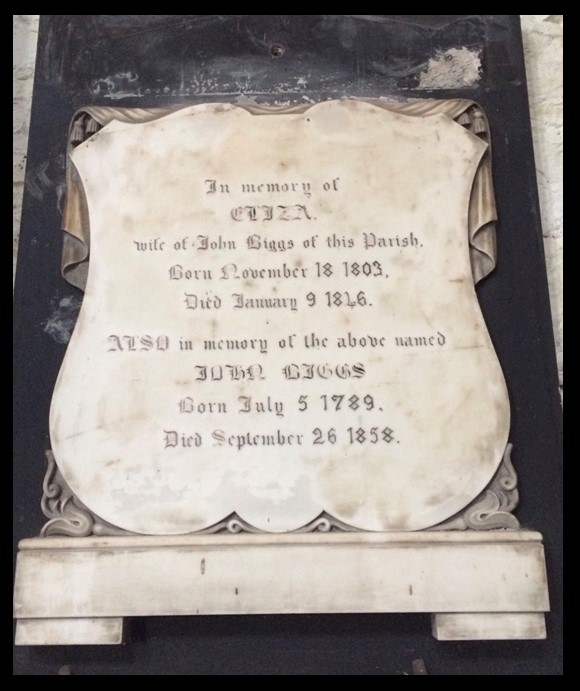
John Biggs was born in St Mary Street in 1833 to John Biggs, a wine and spirits merchant, originally from Bristol, and Eliza Biggs née Jones, originally from Glamorgan. John and Eliza Biggs are worth a mention in their own right as they have a plaque in their name at St Mary the Virgin church in Bute Street, probably indicating that they were one of the benefactors who helped pay for the building of the church in 1843.
Plaque to Eliza and John Biggs, St Mary, Bute Street,
John Biggs (our future brewer) was baptised at St John’s church in Dec 1833. In the 1841, 1851 and 1861 census he was living in St Mary Street. By 1861, aged 27, his parents had died and he himself was now working as a wine and spirit merchant and living with his three sisters. John Biggs (Snr) died in 1858 and was buried at St Margaret’s, Roath though virtually all the grave headstones at St Margaret’s have now been removed so I haven’t been able to identify his precise resting place.
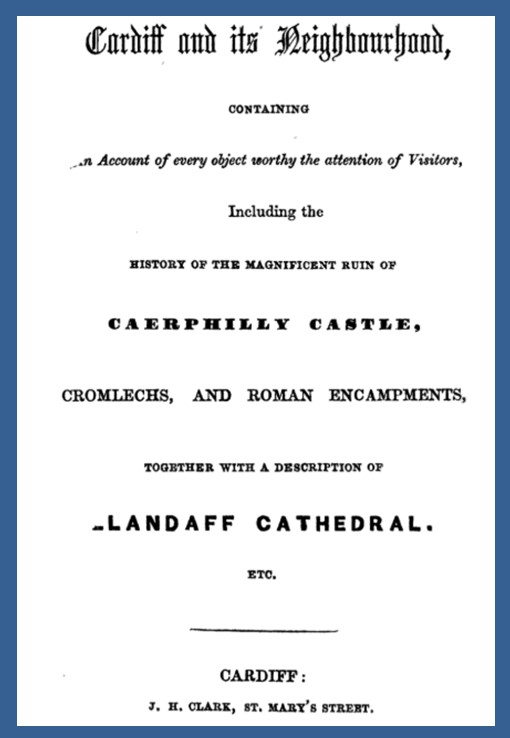
In 1866 John Biggs (Jnr) married Emily Sophia Clark, originally from Usk. She was daughter of a newspaper editor and publisher James Henry Clark. Please allow me another brief aside. In 1850 Cardiff was growing rapidly and J.H.Clark came down from Usk and opened a branch of his business in Saint Mary Street. In 1853 he wrote and published ‘Cardiff and its Neighbourhood’ which was the first guide book about Cardiff to be published. After four years however he sold the business because of the inconvenience and expense of regular travelling down to Cardiff.
Cardiff’s first guidebook.
Engraving of Cardiff Castle from Cardiff and its Neighbourhood
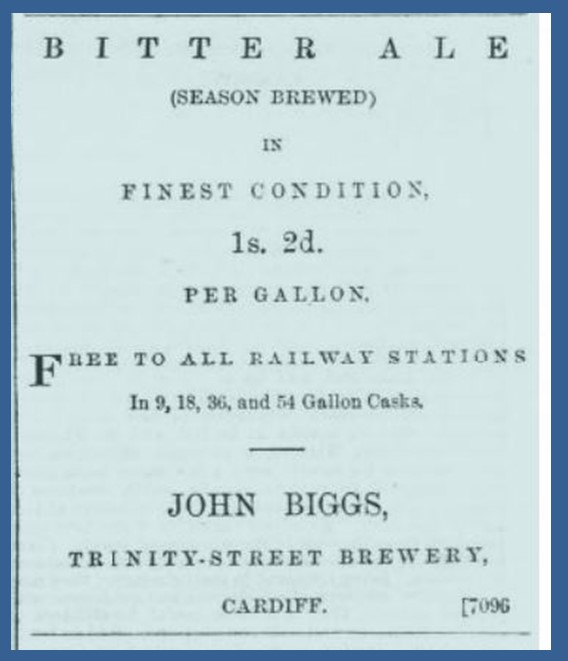
By the time of the 1871 census John Biggs is now describing himself as a ‘wine merchant and brewer’. He’d realized that that the workers of the burgeoning town of Cardiff are thirsty people and enjoyed a beer or two. An advert from 1872 identifies him as the owner of Trinity Street Brewery which would have been adjacent to the present indoor market. Trinity Brewery was later sold, probably to cater for the expansion of James Howell, the department store.
Trinity Street Brewery, Cardiff, brewery owned by John Biggs, advert from 1872
With the proceeds of that sale John Biggs built the South Wales Brewery in 1876. The drawings for the brewery offices are still in Glamorgan Archives with his signature on. The brewery was situated on a triangle of land on Salisbury Road between the two railways. The buildings would later be used for offices of the Taff Vale Railway and today the land is occupied by university accommodation.
South Wales Brewery
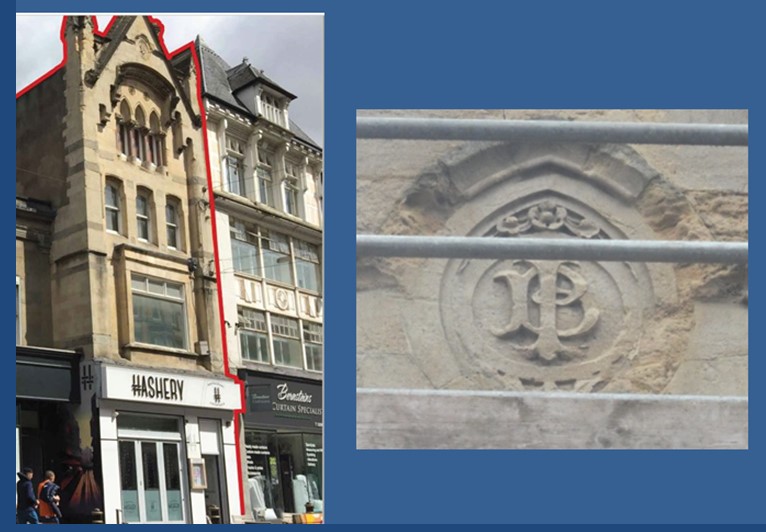
In the 1870s things were going well for John Biggs. Not only was his brewing business successful but he finds time to invest in buildings. In the Western Mail of 22 Sept 1876 there is an article entitled ‘Street Architecture in Cardiff’ in which it congratulates John Biggs on a new building in High Street which from the description I have been informed was 6 High Street, now home of Temple Bar. When I went to visit I looked up to the very top of the building and was surprised to see what looks like his initials, though the bottom of the J seems to have fallen away.
6 High Street, Cardiff with what could well be the initials of John Biggs at the very top.
John and Emily Biggs had ten children together, one girl and nine boys, though four of the children, including the daughter, died in infancy. The family lived in St Andrew’s Place in 1871 and Park Place in 1881 before their house Oldwell in Penylan was built in 1885. I’ve tried to find the family at Oldwell in the 1991 census but have never succeeded (now there’s a challenge for you all) as both Oldwell and Wellclose seem to be omitted from the census.
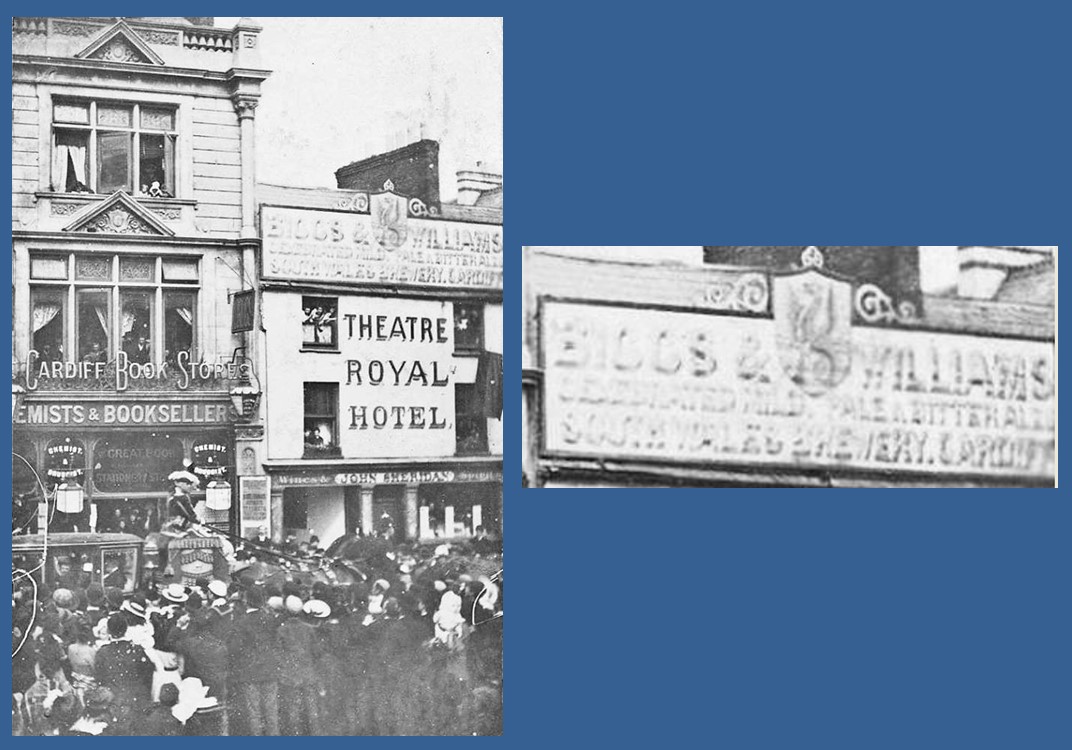
The South Wales Brewery was owned by John Biggs and a John Vaughan Williams. There would also have been a number of hotels/pubs owned by the brewery. One was the Theater Royal Hotel at the southern end of Queen Street. I have discovered an old picture of the hotel with an advertising hording for the South Wales Brewery.
Theatre Royal Hotel, Queen Street with advert for the South Wales Brewery.
In 1888 the John Biggs and John Williams appeared in court charged with adding saccharine to their beer thereby increasing the specific gravity. They were found guilty and ordered to pay £100. One of those hearing the case was Dr Paine who is buried virtually next to John Biggs at Cathays Cemetery. The following year, 1889, William Hancock buys South Wales Brewery. It appears that as part of this deal John Biggs became a Director of Hancocks Brewery.
His stay on the Hancocks Brewery board was however short lived as in 1892 John Biggs resigns and takes over the Canton Cross Brewery on Cowbridge Road. The Canton Cross Vaults pub is still there to this day but no longer a brewery.
Canton Cross Vaults, Cardiff – used to be Canton Cross Brewery owned by John Biggs then Hancocks.
In 1898 the Theatre Royal Hotel in Queen Street is back in the news. Police object to a licence being renewed on the grounds had been frequented by prostitutes. John Biggs objects saying the landlord at the time has been replaced. The hotel is sold later that year.
It appears that the love of John Biggs’s love of brewing is coming to an end. In 1900, with the children by now having left home, Oldwell is put up for sale with son Selwyn Biggs, a solicitor, handing the sale. In the 1901 census John Biggs is living with his in-laws in Usk giving his profession as a Retired Brewer. The Canton Cross brewery is sold to Hancocks in 1904 together with 5 pubs.
In the 1911 census John and Emily Biggs have retired to The Laurels, London Road, Bath. Emily Biggs died in 1919 and John Biggs in 1920. Both their funerals are held back in Cardiff and they are buried in Cathays Cemetery (plots L1211/L1235). What surprises me is that there is no headstone on the grave and no record of there ever having been one. Four of their children were still alive at the time of the funerals; one, Selwyn Biggs was a solicitor and one John James Egerton Biggs becomes Lord Mayor of Cardiff in 1922. There is however large tree nearby so perhaps the headstone suffered damage over the years. It remains a bit of a mystery.
I was looking for something on the Friends of Cathays Cemetery website the other day when my eye was caught by the fact the William Curtis Brangwyn is buried in Plot R2486. True, I’d never heard of him, but the name of his son, Frank Brangwyn, rang a bell. The Brangwyn Hall in Swansea is named after him, somewhere I walked past on a daily basis many years ago to and fro from college and even went into a few times; to see Sutherland Brothers and Quiver, Chris Bonington deliver and excellent lecture, and to receive a degree certificate wearing a funny hat. Anyway, I digress, a common ploy for someone trying to write something that know nothing about – not my fault – I was told to do it as an exam technique.
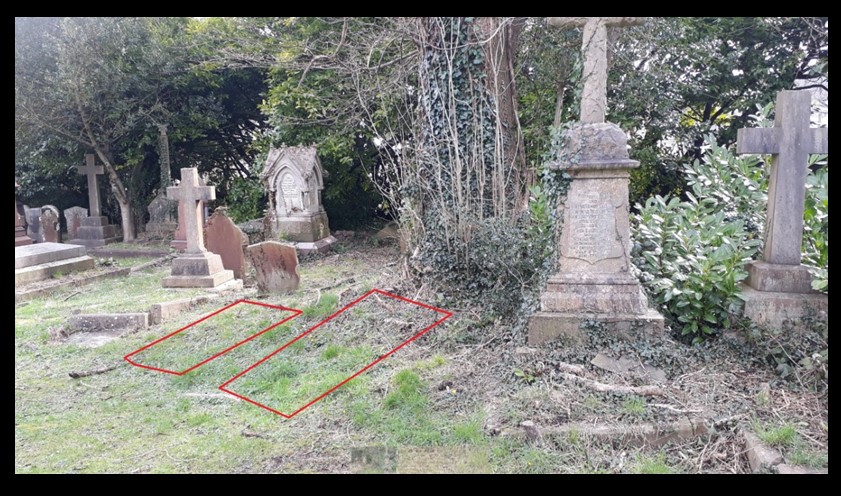
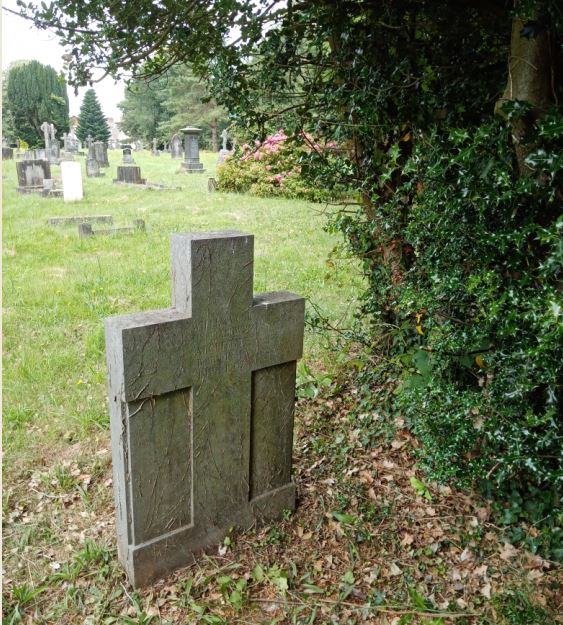
I paid a visit Plot R2486 at Cathays Cemetery. The headstone was covered in ivy and in the shadow of an holly tree. Gently removing some of the ivy revealed an unusual headstone design on which William’s middle name Curtis is split between two lines without even a hyphen. That’s architects for you! My interest was now piqued and I was asking myself why has this grave been seemingly forgotten. I began to research him and another interesting life story slowly revealed itself.
The Genealogy Bit
Many articles written about Frank Brangwyn state his parents were Welsh. Well, his mother Eleanor was for certain but try as I might I haven’t found any Welsh connections with William Curtis Brangwyn – other than he is buried in our beautiful city and his surname sounds like it should be of Welsh origin. True, his family history isn’t straightforward, particularly as the spelling of Brangwyn has changed over time from Brangwin to Brangwyn. If there are any family historians out there keen to take a look then I’d be glad of a helping hand.
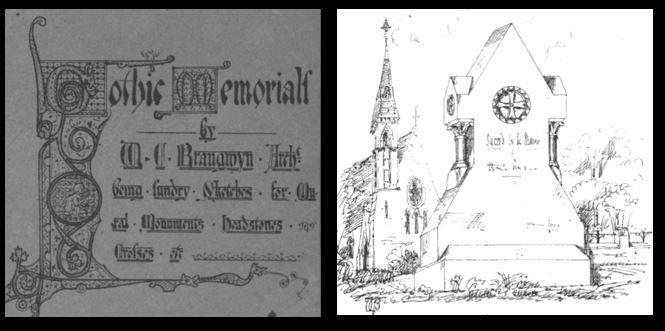
Census returns consistently give William Curtis Brangwyn’s birthplace as Crendon, Buckinghamshire. It seems he was born on 10 Aug 1837 to William Brangwin, a cattle dealer and Mary Curtis and baptised on 21 Nov 1837 in Long Crendon. In 1851 he was a scholar living with his uncle Thomas Brangwin in Long Crendon. In 1861, he is 23 and living in Scarborough, Yorkshire working as a trainee architect and by now his surname has morphed to Brangwyn. The same year he publishes a booklet entitled ‘Gothic Memorials: Being Sundry Sketches for Headstones, Monuments and Crosses’ (available for free download on Google Play).
It appears his career was about to take off – he became an ecclesiastical architect and designing not only the churches themselves but everything inside them, especially the tapestries. Perhaps we shouldn’t be surprised by this, after all he came from Long Crendon, which used to be the centre for the England steel needle-making industry in the mid 16th-century.
Eleanor Brangwyn nee Griffiths
His wife Eleanor was born in Llanstephan, Radnorshire and grew up in the village of Glasbury, daughter of James Griffiths, a house servant and Ann Griffiths. In 1861 at the age of 19 she was working as a housemaid for Rev Walter Powell Jones, the rector Llyswen.
Eleanor married William Curtis Brangwyn on 24 Jun 1865 at the Sardinian Roman Catholic chapel in St Giles, London. It puzzled me for a while how Eleanor, a country girl from deepest Radnorshire, ended up marrying William Curtis Brangwyn in London. I have a theory about that. I discovered that her employer Rev Walter Powell Jones had moved from LLyswen to London and in the 1871 census we find him working as a clergyman in Marylebone. I think therefore that Eleanor probably went with the family to be their housemaid in London. Perhaps, one day, a budding young ecclesiastical architect William Brangwyn knocked on the door hoping to entice Rev Walter Powell Jones into buying some of his latest tapestry designs. Eleanor answers the door. “Hello Mr Brangwyn, unfortunately Rev Jones is busy at the moment but perhaps you’d like to come in for a glass of communion wine?” “That would be nice” says young Mr Brangwyn “Perhaps you’d like to see my etchings?”. And the rest as they say is history.
Their first child, Edith, was born in Jun 1864, prior to them getting married. After their marriage they moved to Bruges, Belgium so that William can further his career as an ecclesiastical architect. Eleanor has three more children whilst they are in Bruges including Frank Brangwyn in 1867 who was actually baptised Guilliaume Francois Brangwyn.
Life in Bruges
William’s time in Bruges appears to have been pretty successful. He won a prize in 1865 for the best designed parish church awarded by the Belgium Guild of St Thomas and St Luke. Whilst in Bruges he was appointed to help carry out the decoration of the Holy Blood Chapel (Bruges) in neo-Gothic style. He also decorated the now disappeared chapel of the Saint Juliaangesticht (1870) in the Boeveriestraat. In 1868 he also designed the neo-gothic extension of the Saint Vedastus church in Zerkegem.
The work of William Curtis Brangwyn at the V&A Museum
He was certainly up there with the top embroiderers. The book ‘English Church Embroidery 1833 to 1953 – The Watts Book of Embroidery’ describes his work alongside other renowned artists of the time such as Pugin and Bodley.
When you are working in the field of ecclesiastical embroidery I guess the top endorsement you can get is from an Archbishop and this is what William got in 1868. The newspaper carried an advertisement quoting a letter from Henry Manning, Archbishop of Westminster. ‘I have much pleasure in testifying to the beauty and excellence of your Ecclesiastical Embroidery of which this Diocese processes several rich specimens. I feel it only needs to be seen to be appreciated. ……’
Return to England
The family returned to London in the 1870s with offices at 6 John Street, Adelphi. It is written that after returning to England, Brangwyn went to work in the studio of architect Sir Horace Jones (the man credited with designing Tower Bridge).
Whilst in Bruges it seems William Brangwyn had an emphasis on embroidery but may be that fell away when he returned to England. In 1872 William Curtis Brangwyn of Baker Street, ecclesiastical embroiderer, went into liquidation. Having said that, as late as 1892 he designed the alter hangings used at the Royal Wedding of Princess Marie of Edinburgh and Prince Ferdinand of Romania.
Although it is possible to find building designs by William Brangwyn, finding actual completed structures is more difficult. He did design a school and church in Langsett, South Yorkshire but I’m afraid you are out of luck if you wanted to visit nice though the village looks. It was demolished in 1988.
Langsett School, Yorkshire
There are pictures of his competition entries for building designs including the Middle Class Schools for the Grocer’s Company in Hackney (1874) and the Board of Works Offices In Greenwich (1875). The Cardiff Times of 1874 describes a competition submission for a school design by W C Brangwyn and L A Withall (London) which included twin turrets. It is not known if they won the tender.
Relocating to Wales
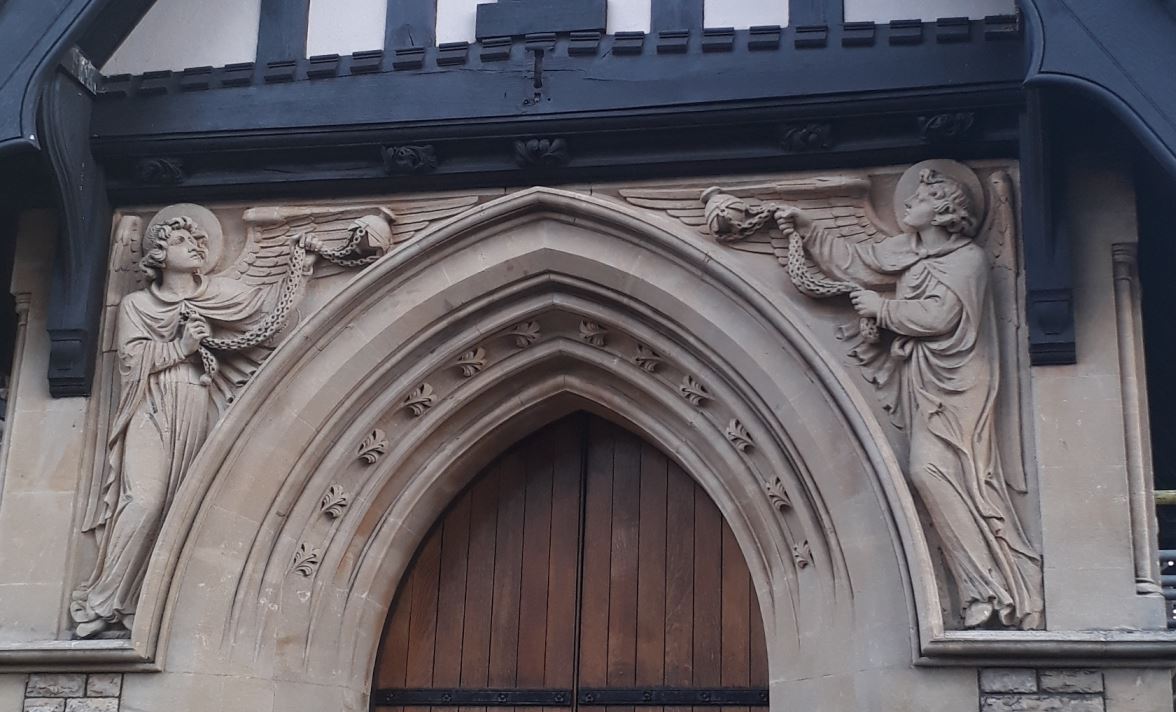
William moved to Cardiff where he became a draughtsman employed by the renowned architect Col. Bruce Vaughan. There seems to be little documented information on William Brangwyn’s time in Cardiff. He isn’t accredited with any of Bruce Vaughan’s pieces directly but may well have leant a hand on one of his best pieces, St James the Great church on Newport Road. It has been written that ‘The appealing artistry here, for example in the depiction of two angels swinging censors over the porch entrance, would have owed something to his collaboration in these years with the Welsh designer William Brangwyn’. The church is currently being converted into flats but the angels above the door can still be seen from the road.
The angels above the doorway on St James the Great church, Newport Road, Cardiff
In the 1901 census we find William Brangwyn, architect, aged 61, living as a boarder at 121 Crwys Road. He died at 36 Salisbury Road on 19 Nov 1907 of intestinal obstruction and cardiac failure. The informant was Catherine Williams, present at death. The age on his death certificate is given as 72 though he was probably more accurately 70. The newspaper was advertising rooms for rent at 36 Salisbury Road earlier that year. I am wondering if William Brangwyn was boarding in the house, Catherine Williams was the landlady and whether he was somehow estranged from his family. His death was only reported in the newspaper in Feb 1908 where he was described as an authority in Gothic architecture. Eleanor was still alive in 1901 but I haven’t found her anywhere on a census. She was living with her son Frank in the 1911 census and she passed away in 1918 in Hertfordshire.
The man behind the ecclesiastical architecture
An interesting insight into the life of William Curtis Brangwyn comes from the book Frank Brangwyn and his works – by Walter Shaw-Sparrow. It was written in 1911, not long after the death of William Curtis Brangwyn and reads as it had good access to family information. In fact it refers to William Curtis Branwyn being known as Curtis Brangwyn and newspapers after this date also called him Curtis Brangwyn. It describes his life as one of ups and downs and of a man who preferred undertaking art in various forms rather than the business of trying to sell it. Here are some extracts:
…. But (Frank) Brangwyn is not drawn to Wales by any strong feeling of affection, although his art owes so much to his mother’s race and country, and although his father, Mr. Curtis Brangwyn, spoke always of Wales with great enthusiasm, and himself claimed some descent from that country.
Mr. Curtis Brangwyn was a very remarkable man, and his name has been coupled with that of Pugin, for he greatly loved Gothic and helped to reawaken the public taste for mediaeval arts and crafts. His temperament was Anglo-Welsh ; and when he chose architecture as his profession, he did not know that building methods had lost their old-time freedom, and that they needed long office hours and stern business habits. Painting would have suited him much better; and although he gained the confidence and admiration of distinguished architects like G. E. Street and Sir Horace Jones, Mr. Curtis Brangwyn was thwarted all his life by his inability to be at the same moment an artist and a man of business. Many writers on architecture have deplored the effects of a mercantile routine on men of imagination. Fergusson went so far as to say that modern architects in practice “could never afford to give many hours to the artistic elaboration of their designs,” and that they generally succeeded ‘more from their business-like habits than their artistic powers.” Fergusson was right, and the career of Mr. Curtis Brangwyn was a case in point.
The racehorse could not be broken to the plough; that is to say, the artist could not adapt himself to relentless methods of routine in a city office, so he worked in the employ of other men rather than bear the many responsibilities that Fergusson hated and condemned.
Mr. Curtis Brangwyn married early, and his education in architecture having brought him in touch with the energetic school of thought known as the Gothic Revival, he kept his home for some time by doing for church uses such work as many could afford to buy. Then, believing that life on the Continent would be less expensive than it was in London, he decided to make his home in Belgium, at Bruges; here he set up his quarters at No. 24 in the Rue du Vieux Bourg, and then opened workrooms for the reproduction of old embroideries for altar-cloths and vestments. At Bruges his son Frank was born, May the 12th, 1867. Mrs. Brangwyn was then twenty-three, and her husband twenty-seven. Frank Brangwyn was their third child. He had two sisters for playmates, and Bruges -she has been called the Dead City – was a quiet nursery.
One thinks of Bruges as a fitting birthplace for a Fernand Khnopff or a Maeterlinck; but Brangwyn and Bruges?
And I find, too, that Brangwyn has very little to tell about his birthplace, though he remained there for eight years. Some recollections are clear-cut, but they have nothing to do with boyish mischief in the town. They are all connected with art. He remembers many a visit to his father’s workrooms, where exquisite needlework lay on tables, shimmering with bright colours ; and one day in his father’s garden he found by chance a bundle of photographic negatives, half broken, and looking up from them he saw, against a background of houses and blue sky, a tree covered with red blossoms, such as the Japanese love in their lightly touched prints. Colour was to him what music was to the boy Mozart. He has related that the home garden in old Bruges was an enchanted place to him, where great beasts lurked in the shadows, where trees were giants and ogres, and flowers little lords and ladies.
More important still, I think, is another recollection. There was a portfolio of prints at home, and the boy was allowed to play with it. A good many artists were represented, but only one really delighted him ; it was Charles Degroux, a painter of the Belgian poor, who died in 1870. ………..
Yet Brangwyn at the age of eight not only enjoyed Degroux, but struggled to copy from engravings after Degroux’s pictures. The boy was father to the man. His present work (to a great extent) was foretold by his native tastes in childhood. ………
At the beginning of 1875 Mr. Curtis Brangwyn left Bruges for England. “I remember dimly our embarkation, though it might have resulted in the days of my youth being ended once for all, for – at least, so I am told I was discovered crawling along one of the sponsons of the steamer. From this highly perilous position I was rescued in the nick of time, and – here recollection becomes more vivid – soundly spanked and put to bed. In England I went first of all to a dame’s school, and then to a big middle-class school, the name of which has totally escaped me. For reasons into which I need not enter, but which have nothing to do with myself, my schooldays came to an abrupt end, and I made myself useful in my father’s office.”
When Mr. Curtis Brangwyn arrived in London he took an office at No. 6 John Street, Adelphi, and sent two architectural designs to the Royal Academy, “ Hastings Town Hall,” and “Schools of the Grocers’ Company, Hackney.” Next year, 1876, he exhibited again, ‘‘ Design for Offices of the Board of Works at Greenwich,” and also, in 1879, “ Yarmouth Town Hall,” and a fine sketch in water-colour of a pulpit at Canford Church. The R.A. catalogues give me no other information, but Mr. Curtis Brangwyn is permanently represented at the Victoria and Albert Museum by a beautiful piece of embroidery – a banner carried out from his designs in his own establishment. After a life of hard work, chequered with ups and downs, he died in December 1907.
Offspring
William Curtis and Eleanor Brangwyn had six children. Edith (b.1864) born in England, Eleanor (b.1866), Frank (b.1867) and Philip (b.1870) born in Bruges and then Cuthbert (b. 1876) and Lawrence (b. 1879) born back in England.
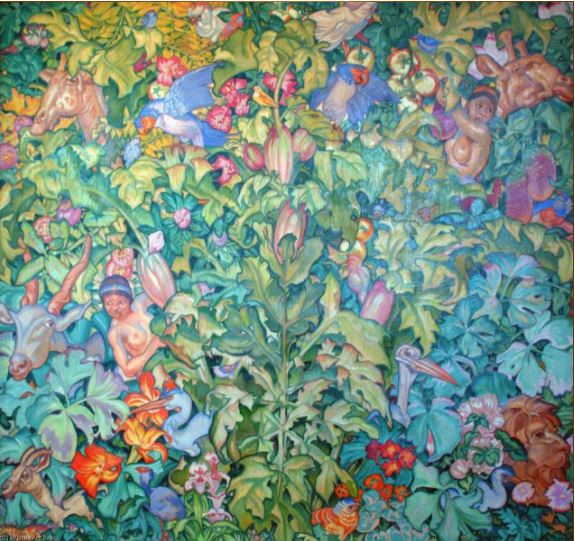
Frank Brangwyn was an artistic jack-of-all-trades and difficult to categorise. As well as paintings and drawings, he produced designs for stained glass, furniture, ceramics, table glassware, buildings and interiors, was a lithographer and woodcutter and was a book illustrator. The life of Sir Frank Brangwyn has been well recorded. There is a synopsis on Dictionary of Welsh Biography and a nice piece by Phil Carradice. If you prefer to view a biography on him rather than read something then I would recommend this Goldmark video. He was initially taught by his father, then spotted by Mackmurdo and also no doubt benefited from his short time working for William Morris. The history of the British Empire Panels at Brangwyn Hall is nicely covered by Andrew Green.
One of the British Empire Panels at Brangwyn Hall, Swansea
Frank Brangwyn is reputed to have produced over 10,000 works of art. You would have thought among those there would have been some of his Mum and Dad, but unfortunately I haven’t come across any as yet.
Two of the other sons also benefited from being taught by their father William Curtis Brangwyn. Cuthbert Patrick Joseph Brangwyn (1875-1911) went to America and became an designer and interior decorator for McCreery & Company’s Pittsburgh branch. Philip Brangwyn also became an interior decorator in Canada but I haven’t been able to find any further information about him or for that matter the other siblings.
The work of Cuthbert Brangwyn
As part of my research into this article I did an internet search on “Brangwyn” and “Architecture” and came across Caitlin Brangwyn who is studied architecture at Liverpool School of Architecture, following in the family footsteps and uses embroidery in her work. Here’s wishing Caitlin all the best in her future career.
So next time you are taking a walk around the peaceful Cathays Cemetery, take a careful look under the ivy. You’d be surprised what story you may unearth.
The grave of William Curtis Brangwyn at Cathays Cemetery, Cardiff
Postscript
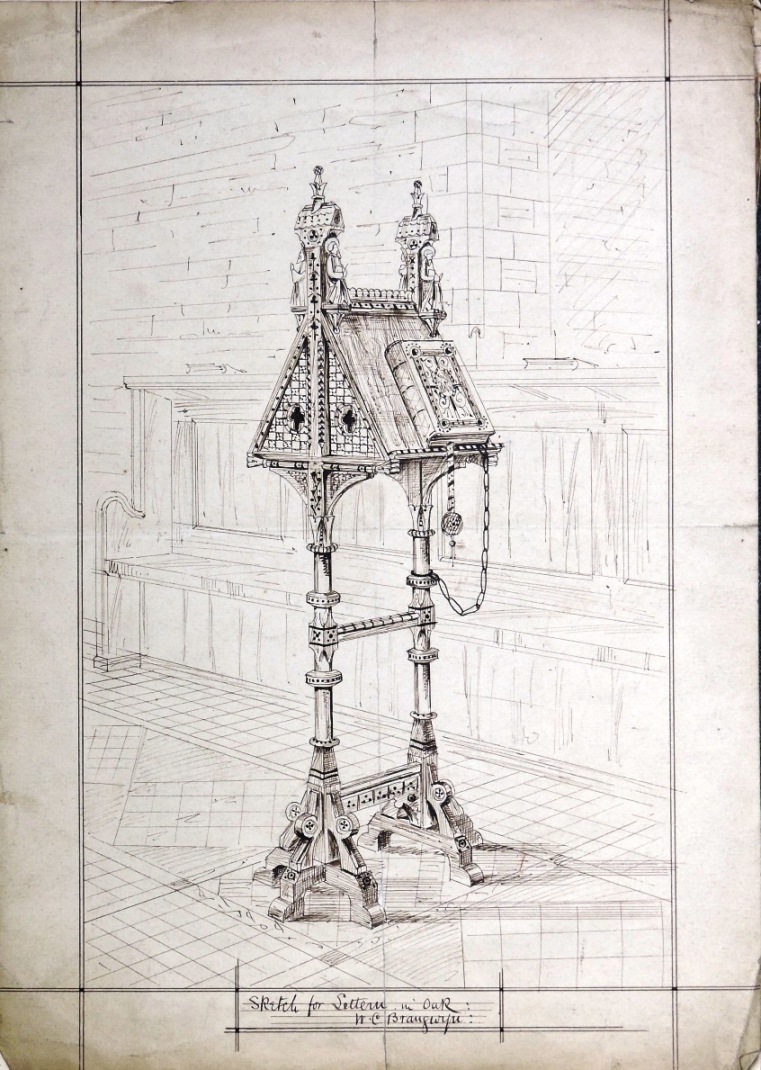
Sketch of lectern in oak by W.C.Brangwyn. This sketch was found in the archives of W.Clarke of Llandaff, a building, sculpting and church furnishings company. Whether the lectern ever got carved and placed in a church is not known. (photo credit: Cardiff Libraries and Michael Stratham)
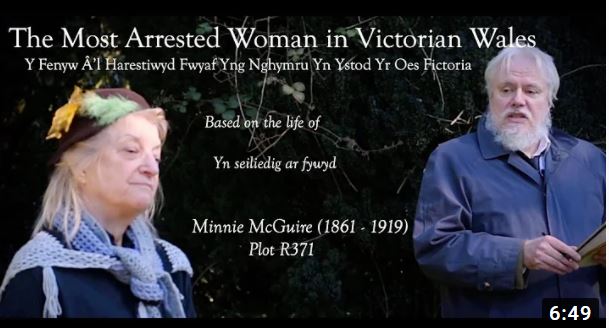
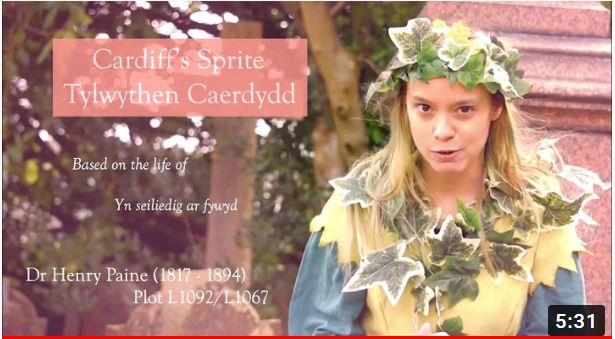
The A48 Theatre Company and the writers Living Lines have joined forces to produce “12 Stories from Cathays Cemetery” which was made possible through a grant received from The National Heritage Lottery Wales and CADW. The films are on the A48 Theatre Company YouTube channel and well worth a watch. Quite a few of the people that feature in the stories have Roath connections.
You can get to the individual films by clicking the links or pictures in the summaries below. Credits to the writers of both the short films and the short biographies are given on the A48 Theatre YouTube channel. Eleven of the films are in English and one in Welsh. The English films also have subtitles available.
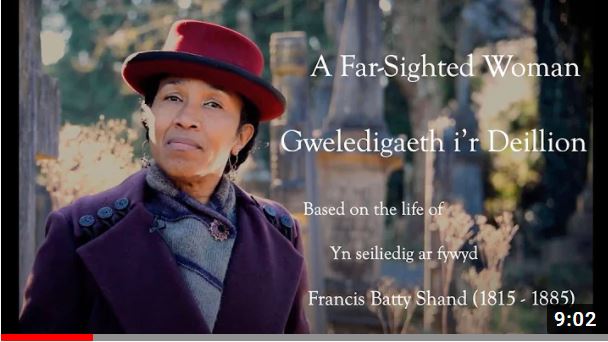
Francis Batty Shand was the youngest daughter of planter John Shand and his long-term partner, a free woman of colour called Frances Brown. She was born in Jamaica but removed to Scotland when she was 4 years old, probably in the care of her aunt Helen Shand of Elgin, Moray. All of Frances Brown’s seven children were taken from her. She had a portrait painted when each one left and, on writing her will in 1834, asked that each child be given their portrait as a momento of her. While living with her brother in Cardiff Francis Batty Shand was instrumental in founding the Cardiff Institute for the Blind: “Miss Shand was concerned with the “ragged” children she saw in Cardiff and toured the city offering help and support. Miss Shand first opened a small workshop in the Canton area of Cardiff, employing four blind men making baskets for the coal ships sailing from Cardiff ports. Within a year, larger premises were purchased at Byron Street in the Roath area, and ten men were employed. In 1868 a third move was made to Longcross Street off Newport Road, and a fourth move to the iconic Shand House.” In her will, Frances left c. £2,600 in small legacies, £1,000 and a life interest in her property at Moss Terrace, Elgin to Ann Allardice, £1,000 to the trustees of the Cardiff Association for Improving the Social Conditions of the Blind for the ‘Shand Memorial Fund’ and the residue to the Glamorganshire and Monmouthshire Infirmary for the maintenance of a children’s ward named for her late brother John Shand as the ‘Shand Memorial Ward’. Her estate in Scotland was valued for probate at £11,777 2s 5d.
James Driscoll, commonly known as Peerless Jim, was a Welsh boxer who fought his way out of poverty. Driscoll was British featherweight champion and won the coveted Lonsdale belt in 1910. Driscoll was born in Cardiff in 1880 and was brought up on Ellen Street in the Newtown region of the town. Driscoll’s parents were both Irish, and both Catholicism and the local St Paul’s Church played a key part in his life. Driscoll’s father died in a goods yard accident before Driscoll was one. His mother was forced to accept parish relief to bring up her four children. Driscoll was an apprentice with the Western Mail printing works when he began boxing in the fairground booths of South Wales. He turned professional in 1901 and by the end of the year he had secured twelve wins without defeat. On 22 February 1904
Driscoll fought his first match at the National Sporting Club in London, a points decision win over Boss Edwards. That year he also suffered his first defeat in a return bout against Mansfield, losing by points in a ten-round clash.
On 26 February 1906, Driscoll took the British Featherweight title by defeating Joe Bowker in a 15-round contest at the National Sporting Club. He undertook four more fights before his first defence, which included beating Mansfield by knockout in their fourth meet. His first title defence was a twenty-round match and Driscoll stopped his opponent in the seventeenth via a knockout. The 24 August 1907 is recorded as a non-contest fight between Driscoll and fellow Welshman Freddie Welsh.
Boxing historians such as Andrew Gallimore have cast doubt on this being a professional contest and instead regard it as a display fight at a fairground. Welsh supposedly took advantage of this situation and attacked Driscoll with kidney and rabbit punches. Driscoll never forgave his former friend for taking such liberties. On 24 February 1908, Driscoll faced New Zealander Charlie Griffin for the vacant Commonwealth Featherweight title. Again fought at Covent Garden, the match went the full fifteen rounds with Driscoll declared champion on a points decision. After claiming the British and Commonwealth featherweight titles Driscoll went on to prove himself in the U.S.. American boxing fans of the era favoured all-action boxers, but they were won over by the Cardiffian’s skills, giving him the nickname ‘Peerless Jim.’ Featherweight champion Abe Attell faced Driscoll in 1910; the Welshman dominated the fight, but with the “no decision” rule in place, without a KO, he couldn’t take the crown. Driscoll declined a rematch in order to attend an exhibition match in aid of the orphans of St. Nazareth House: “I never break a promise.” He returned to the United States the next year, but a chest infection and an injury in a road accident meant a poor showing.
He never got his title shot at Attell. After becoming the first featherweight to win a Lonsdale Belt, Driscoll prepared for an eagerly-anticipated fight against Freddie Welsh. The match was a disappointment, though, as Welsh’s spoiling tactics upset Driscoll’s style. By the tenth round Driscoll’s frustration boiled over, and he was disqualified for butting Welsh. Driscoll’s boxing career was interrupted by World War I. In succeeding years, he continued to box despite failing health, relying on his skills to keep him out of trouble. When he died in Cardiff of consumption at the age of 44, over 100,000 people lined the streets for his funeral. A statue was erected in his honour near the Central Boys’ Club, where he trained, in 1997.
Ernest Thompson Willows was a pioneer Welsh aviator and airship builder. He became the first person in the United Kingdom to hold a pilot’s certificate for an airship when the Royal Aero Club awarded him Airship Pilots Certificate No. 1. Willows was born in Cardiff, Wales on 11 July 1886. He was educated at Clifton College in Bristol, entering the school in 1896 and leaving in 1901 aged 15 to train as a dentist. He built his first airship, the Willows No. 1, in 1905 when he was 19. It was first flown from East Moors, Cardiff on 5 August 1905, the flight lasting 85 minutes. This was soon followed by an improved Willows No. 2, in which he landed outside Cardiff City Hall on 4 June 1910. No. 2 was re-built as No. 3 which he named the City of Cardiff before he flew it from London to Paris in 1910. This was the first airship crossing of the English Channel at night and the first from England to France. The journey was not without incident, including dropping the maps over the side during the night, and problems with the envelope caused the airship to land at Corbehem near Douai at two o’clock in the morning. With the help of the local French aviator Louis Breguet the airship was repaired and arrived at Paris on 28 December 1910. He celebrated New Year’s Eve with a flight around the Eiffel Tower. Willows moved to Birmingham to build his next airship, the Willows No. 4. First flown in 1912, it was sold to the Admiralty for £1,050 and it became His Majesty’s Naval Airship No. 2. With the money from the Navy Willows established a spherical gas balloon school at Welsh Harp, Hendon near London, although this did not stop him building Willows No. 5 in 1913, a four-seater airship designed to give joy rides over London. During the first world war Willows built barrage balloons in Cardiff. After the war he continued with ballooning but on 3 August 1926 he died in a balloon accident at Hoo Park, Kempston, Bedford instantly, together with a passenger. Three other passengers died later that day either in hospital or on their way to it making 5 deaths in all. There is a school named Willows High School built on his old airfield to remember him. There is also a pub called The Ernest Willows which is situated not far from the school.
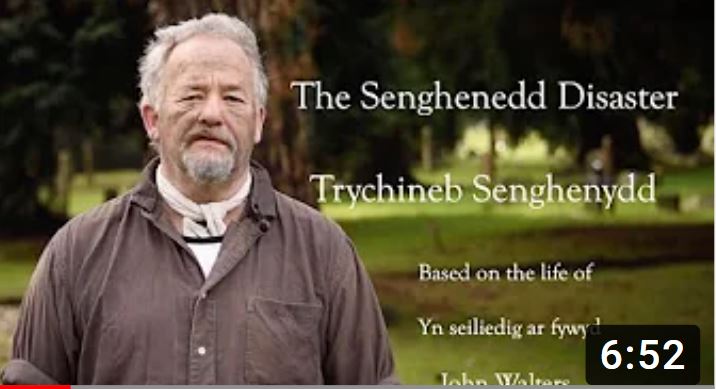
Senghenedd Disaster. On the morning of Tuesday, October 14, 1913, 950 men and boys were underground at the Universal Colliery in Senghenydd, near Caerphilly. John Walters was not amongst them. He overslept as his young daughters had kept him awake much of the night. At 8am, there was a massive explosion with such force that it sent the cage in the Lancaster pit up the shaft and crashing into the pithead gear. The force of the blast smashed the wooden platform on which the banksman, John Mogridge, was standing and he was decapitated by a large splinter of timber. As there was little damage to York pit, the manager and other men descended the shaft but they were blocked by girders 530 yards down. Mine rescue teams from the Rhymney Valley, Porth, Aberdare and Crumlin raced to the scene but they were hampered by raging fires, thick smoke and roof falls. One rescue worker William John was killed in a roof fall. At 11.30am, an advanced party of rescuers managed to find a man and young boy alive and unharmed in the Bottanic district of the mine. By 1am the following morning, a group of 12 trapped miners were found alive behind a roof fall. A short distance away, another four were found unconscious but still alive. Twenty bodies were recovered from that district. Rescue teams continued to be hindered by further outbreaks of fire, roof falls and gas. After three weeks, only a third of the victims had been brought to the surface. Eventually rescuers reached the districts known as Ladysmith, Pretoria, Mafeking and Kinberly where the majority of bodies were found. More than 90 bodies were so badly mutilated that they could not be recognised. Some had to be identified by their clothing. One young boy’s identity was confirmed when his mother recognised a patch she had sewn into his vest. Another was identified by a champagne cork in his water bottle given to him by a friend and Aaron Manders was recognised by the new boots worn for the first time that day. By the end of the rescue mission, 439 were confirmed dead. Nearly every household in Senghenydd had lost somebody. It was estimated that 1,500 dependants were left without a bread winner. During a Court of Enquiry, several breaches of regulations were uncovered, the most serious being the inability of the ventilating fans to reverse the airflow contrary to legislation implemented on January 1, 1913. It is estimated that if the current of air had been reversed, hundreds of lives might have been saved. This led to 17 charges against the colliery manager and four against the company and they were fined a total of £24. The disaster was the second explosion to cause loss of life at the colliery. Just 12 years before, on Friday, May 24, 1901, a gas and coal dust explosion killed 81 of the 82 men underground at the time.
Mr. William Jones JP resided at Pencisely House, Cardiff with his wife Martha. He was the General Manager of the Cardiff Channel Dry Dock and Pontoon Company. This company, founded by the Cory shipping family, were instrumental in building the new graving dock in the Bute Dock, Cardiff. He was a JP and magistrate, a philanthropist and great supporter of the Cardiff Naval Brigade, an organisation established by Sir Edward Nicholl. The Cardiff Naval Brigade sought to encourage young men to take an interest in ‘everything that pertained to sound discipline and manliness giving them the necessary skills to fall in line for the defence of their country when required’. An article in the Evening Express on 26th September 1910 describes how 180 officers and men from the Cardiff Naval Brigade were entertained to tea at Pencisely House by Mr. William Jones JP. The lads were warmly complimented by Mr. Jones on their smart appearance.
The tragic story of Louisa Maud Evans, the Balloon Girl, is told in Welsh. An English translation is provided below together with a synopsis of her life:
“To be famous. To be known. To have people whisper my name as I pass them in the streets. There she is. That’s her. That’s Louisa. On a signal, I fell, and I felt Exhilaration, picturing the sea of eyes below mine, there, far, far, below me – 100,000 pairs of eyes looking up at falling me. And all of them, in that moment of time, they all knew my name, they all knew I existed. This moment, it was perfect, a window of utter release, and freedom, and a gleeful understanding that, unlike those who watched me from below with their Sunday best and their feet on the ground , I knew what it was to be a bird, and I knew what it meant to fly and everything beneath me, the city, the country, spread out like a painting drying in the sun. I could see the spires on the churches and the endless ribbon of the river. I could see the clustered trees and the scattergun tin pot houses. I could see the clouds high above me and the crowds far below me and best of all, they could all see me. Whatever they did, whoever they were none of that mattered. I was their focus, the reason their mouths fell open. I could feel the breath of the wind as it chased me through the sky . Then a realisation , there, that morning, cold and dawning , that I was drifting. That I was drifting away from where I should be to where I should not and that I could not do this and that I would not survive this. The dawning on high that I was so small and I was oh so out of control and that the world, one moment, so far below me, was getting bigger, larger, more apparent by the moment like looking at something through binoculars . I was falling like a paper doll with nothing to clutch at but a wind without handles, a fear, rising, hot against the cold, that we are not invincible and though we may think it, we can fall , we can certainly fall. And as I spiralled I thought back to the thing that, since a girl, I had prized above all things and I realised, yes, as I twisted and twisted , that I would be famous , that I would be known, that the city would remember my name. To be famous. To be known. To have people whisper my name as they pass me in the cemetery. There she is. That’s her. That’s Louisa.”
Louisa Maud Evans, otherwise known as Mademoiselle Albertina, fell to her death during a ballooning accident at the Cardiff Exhibition on July 21, 1896. It is estimated that 100,000 people had gathered at the Cardiff Industrial and Maritime Exhibition in Cathays Park in Cardiff, to see Louisa’s ascent by balloon. She was supposed to have landed by parachute on the outskirts of the city to be returned to the crowds via horse and carriage. However, she never reappeared and her body washed up three days later near the village of Nash, a few miles east of Cardiff. It is thought that Louisa was born in Barton Regis in Bristol in late 1881 and was adopted at 16 months old. She went on to work in a cloth factory but, wanting more in life, ran away at the age of 14 to become a circus apprentice and a trapeze artist. An inquest jury reached a unanimous verdict: “The deceased was accidentally drowned in the Bristol Channel whilst attempting to descend by parachute from a balloon.” A member of the inquest jury said: “We wish to censor Mr Gaudron, showman and balloon aeronaut, in that he showed great carelessness and disregard for the safety of such a young girl by allowing her to attempt her descent during such high winds.” Moved by her death, the people of Cardiff gave Louisa a decent burial and a headstone.
Winifred Fortt. Winifred Ellen Fortt’s father ran a lodging house for Greek Sailors in Cardiff Bay. She became the girlfriend of a lodger, Alec Bakerlis, 24, a fireman, who became jealous every time his 19-year old girlfriend spoke to any of the other residents. This got so bad that Winifred’s father gave him notice to quit and Bakerlis moved to other lodgings. Winifred broke off the relationship and asked a friend to return the ring and some letters Bakerlis had given her. Bakerlis refused to accept them from the friend and insisted Winifred returned them herself. On Christmas evening 1916 Bakerlis approached Winifred and her friend in Bute Street and asked her for the ring. Bakerlis then knocked her over and stabbed her repeatedly, seven or eight times on the head and body. A nearby police officer, Arthur Moss, saw Bakerlis running with a bloodstained knife and apprehended him. Bakerlis admitted to stabbing Winifred. Winifred died 3 days later from Blood Poisoning. Bakerlis was charged with wilful murder, found guilty and executed at Cardiff Gaol on 10 April 1917 by John Ellis.
James Power was born into a rebel family in Crooke, County Waterford, Ireland in 1889. Like his father, he worked on the land. In 1911 James was arrested and found guilty of “riotous behaviour.” When war broke out in 1914 Irishmen were encouraged to fight for Ireland as soldiers in the British Army and James joined the Royal Irish Regiment. He was not a model recruit. His military Charge Sheet cites offences such as “highly irregular conduct in barracks” and being absent without a pass. James did his training at Richmond Barracks in Dublin during 1916. This was the time of the Easter Rising, when Irish Republicans launched a rebellion against being ruled by Britain. The British reacted by mobilising troops onto the streets of Dublin – James Power amongst them. During six days of fighting British troops (including Irishmen such as James) either killed or captured all the rebels. The captured Republicans were imprisoned at Richmond Barracks. Sixteen of them were given a death sentence and were executed. This ruthless punishment made them into martyrs. The Royal Irish Regiment departed from Devenport and James served in Salonika, Egypt and the Battle of Jerusalem. He was awarded the Victory Medal and the British Medal. On returning to Ireland James joined B Company, Third Battalion, East Waterford Brigade as a 1st Lieutenant – the IRA. In the 1920s this was the military wing of the Irish Republican movement that was fighting for Ireland’s independence from Britain. James returned both of his medals. Servicemen who had previously been in the British Army in WWI now needed to prove their Republican credentials to their fellow fighters and one way of doing so was to return their British Army medals. In 1921 a truce was called in the conflict and the next year saw the creation of the Irish Free State when independence was granted to the south of Ireland. There was little work in Ireland at this time and James took up a job in the Merchant Navy, becoming a fireman and trimmer on a ship called the Sheaf Lance that sailed out of Barry in South Wales. It was hard, hot, filthy work – four hours on, four hours off round the clock. In December 1926 James was on a voyage destined for Brazil and Argentina. Its return passage brought it back to Wales, arriving in Penarth near Cardiff on the 5th of April, 1927. James Power left the ship that day, and is not recorded as sailing on any other voyages. His family were told he had died at sea but his death certificate shows that, at the age of 37, James Power was found dead in the Glamorganshire Canal in Cardiff on the 19th April, 1927. He died from “shock from distended stomach acting on diseased heart.” An inquest confirmed that he was not drunk and it is likely that he had a heart attack and fell into the canal. A local shopkeeper identified him, “particularly by his ginger moustache.'” James’ wife, Julia, died in childbirth less than two months later. Their two daughters were adopted. One of them, Mary-Anne, married Albert Martin and had a son, Paul Martin – or Paul Merton as he is better known. Paul said: “It’s 92 years ago this happened. I’m the first member of the family to find out his (James Power’s) final resting place. That is rather remarkable, isn’t it? It’s a long time ago 1927, and it’s taken this long for us to find out the truth.”
Thought to be the most arrested woman in Victorian Wales, the facts of Minnie McGuire’s life can mainly be found in court records and newspaper reports, which variably spell her surname as McGuire, Maguire and Macguire. Minnie’s exact birth date is unknown, but it’s estimated that she was born around 1860. She was descended from Irish immigrants and, during her many court appearances, her address was often given as ‘no fixed abode’, although she lived in bedsit rooms in various houses in the poorest areas of central Cardiff. Throughout her life, she was arrested multiple times for violence, drunkenness and lewd behaviour, and served many spells in prison. An article in the Cardiff Times of 18th July 1885 described her as “an incorrigible woman” and detailed her prison sentence of three months with hard labour, as a result of the charge of being “a disorderly prostitute”. Almost four years later, the South Wales Echo of 29th May 1889 reported that, at her seventy-second appearance at court, the same sentence was inflicted on her for being drunk and disorderly. Such reports brought her infamy and her exploits were well-known to the people of Cardiff. Minnie was also known to have travelled from town to town selling inexpensive wares as a ‘hawker’, although newspapers from subsequent years suggest that she was still getting into trouble in these places, having made appearances at several other courts in South Wales and as far afield as Taunton and Cheltenham. By this point, her total number of convictions was well over a hundred. Elm House, a workhouse for adults in Cardiff, was where Minnie spent her final days. Her death certificate gave her age as fifty-four. She was given a ‘pauper’s burial’ and her grave in Cathays Cemetery is unmarked.
Hamadryads are Greek mythological beings or sprites that are bonded to trees. Cardiff’s Hamadryad gave her name to a ship, a hospital and more recently, a Welsh medium primary school. Here, she introduces us to Dr Henry Paine, Medical Officer of Health, now a resident of Cathays Cemetery but best known for the public health improvements he brought to Cardiff and for the seamen’s hospital ship, The Hamadryad. In the face of a rapidly growing population throughout the nineteenth century, many of Cardiff’s inhabitants faced poverty, unsanitary conditions and repeated outbreaks of disease. Dr Paine made improvements to the water and sewage infrastructure of the city and is credited with saving many lives over the course of his career. In 1866 Dr Paine bought and fitted out the Hamadryad, a 43 year-old frigate, as a hospital for seamen, with a doctor, medical staff, matron, nurse and cook. The ship was moored on “Rat Island” and was used for thirty years. To celebrate the Diamond Jubilee of Queen Victoria, a permanent seamen’s hospital was built and was opened on 29 June 1905. The Royal Hamadryad Seamen’s Hospital provided free medical treatment for seamen until 1948, when it was incorporated into the National Health Service. The hospital ship was broken up, but the ship’s bell and figurehead were preserved. Today, the figurehead is exhibited in the Cardiff Story Museum.
Edward Kaltenbach and his brother Adrian Kaltenbach sought asylum in Cardiff from Baden (now part of Germany) in the late 1860s. Cardiff was expanding rapidly thanks to coal. They set up their watch, clock and jewellery business in Caroline Street, a business which continued to flourish on the same site for nearly 150 years. The main shop premises were always at 22 & 23 Caroline Street where Edward Kaltenbach advertised “WATCHES! WATCHES! WATCHES! Silver patent lever watches, chronometer balances, all kinds of other gold and silver watches, and gold and silver jewellery”. Kaltenbach’s contemporaries were William Weichert and Polish born Wladyslaw Spiridion Kliszezewski. A measure of Spiridion’s prestige is the fact that James Keir (1839–1921), another Cardiff watch- and clockmaker and jeweller, always paid tribute to him in his advertisements, proudly stating that he had been ‘10 years with Spiridion’. Another watchmaker, George Best, was not so well-renowned. His business was located at 27 Talbot Street Cardiff and later in the High Street Arcade. In 1889 he was declared bankrupt, a circumstance which he blamed on the failure of the shares he had bought in Allsopp’s brewery. The Official Receiver stated that his assets would produce only 1d in the £. His Honour granted the debtor his discharge but suspended his business operations for 18 months, Best having previously been declared bankrupt in 1885.
Margaret Jones-Morewood was a well-known soprano soloist in the late 1800s. Born Margaret Ann Jones on 17th August 1863 in the Swansea Valley, she was singing locally by the age of ten, and benefit concerts were arranged so that she could hire a singing coach. When she was seventeen, she went to train at the Royal Academy of Music in London and graduated with the distinction of medallist. Margaret’s father was employed at the tinplate works owned by Messrs. E. Morewood & Co. in Llanelli and, as his colleagues were very supportive of her aspirations, she adopted Morewood as part of her stage name during her time at the academy, along with the informal version of her first name, Maggie. Further success beckoned, including performances at the National Eisteddfod, leading parts with the Turner Opera Company, and top-billing at the Cardiff International Exhibition of 1888. In 1890, Margaret married John Jones, the manager of a silversmiths, and moved to Cardiff, where they had a daughter and a son. When she was expecting her third child, she went into labour two months early and gave birth to a stillborn baby. Two days later, on 9th October 1894, Margaret died. An inquest was held and her youngest sister, Gwendolyn ‘Gwennie’ Jones, was called as one of the witnesses along with the couple’s servant, who claimed that John had been physically violent towards Margaret, including during her most recent pregnancy, a claim that he denied. Following the post-mortem, the verdict was that she had died from natural causes and that premature births were common. However, although the jury concurred, they requested that the Coroner severely censure John for his conduct towards her and he agreed, stating that he could not understand how any man could treat his wife in the manner alleged, especially in her condition. Before long, most of the family left Wales for new lives in the United States. Their connections to the metal industry continued, however, as Gwennie married William H. Davey, General Manager of a tinplate works in Washington, Pennsylvania.
In this video, Roger Swan (Memorial Manager, Bereavement Services, Cardiff Council) introduces us to the cemetery, some of its history and emphasised the benefit of visiting and having a walk around.
We will probably never know quite why exactly Captain Baselow decided to relocate with his family to Cardiff from the German port of Rostock in the 1860s. It is likely that he had heard of the burgeoning port of Cardiff and the economic opportunities that lay ahead.
By that time the two Bute docks had been constructed together with the railways bringing coal down from the mining valleys. Cardiff was beginning to boom and for people like Captain Baselow with maritime experience and his entrepreneurial skills great times lay ahead.
In the year 1870 there were 783 steam ships in all that called at Cardiff Docks. The same year there were 6129 sailing ships docking. By 1900 there were 6527 steams ships that docked and only 2617 sailing vessels.
I must admit that until a month ago I hadn’t heard of the Baselow family. I suppose that’s not surprising. They never turned out to be one of the great ship owning families of Victorian Cardiff such as the Seager, Readon-Smith or Radcliffe families. The family does however contain some very interesting stories well worth sharing.
I probably wouldn’t have come across Captain Baselow at all had it not been for an enquiry from a member of ‘Living Lines’ – a group of writers affiliated to A48 Theatre Company. Every year this company put on performances in Cathays Cemetery called ‘Graveyard Voices’. Sadly the performances are unlikely to take place this June due to the Covid 19 pandemic, but the company are hoping to be able to tell the Baselow family story in September. Keep an eye on their website for updates.
Scenes from past performances of Graveyard Voices
More of the connections between the Baselow family and Cathays Cemetery and the Roath area later but in the meantime let’s see what we know about Captain Baselow. It’s not a huge amount if I’m honest. It’s more a case of piecing together the snippets we can find and going from there.
Captain Baselow
Captain Baselow, or to give him his full name, Captain Hans Henrich Jacob Baselow, was born in the port of Rostock, Germany on 26 Jan 1816. He went by the name of Henrich. By the time he emigrated to Wales in the 1860s he presumably had lots of maritime experience to have the title of Captain. In the 1871 census the Baselow family are living at 162 Bute Street. He is a partner in a ship chandlers and sail making company Baselow, Gensz & Goulter. He is also working in the maritime insurance industry. In 1874 however Captain Baselow and his business partner Albert Goutler are declared bankrupt.
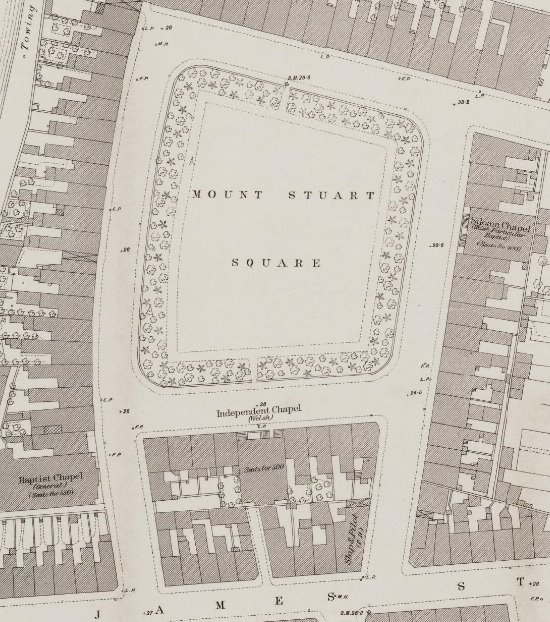
By 1880 his fortunes have evidently bounced back. The Baselows had moved to 17 Mount Stuart Square, residences for the upwardly mobile overlooking the leafy green.
The layout of Mount Stuart Square in the 1870s
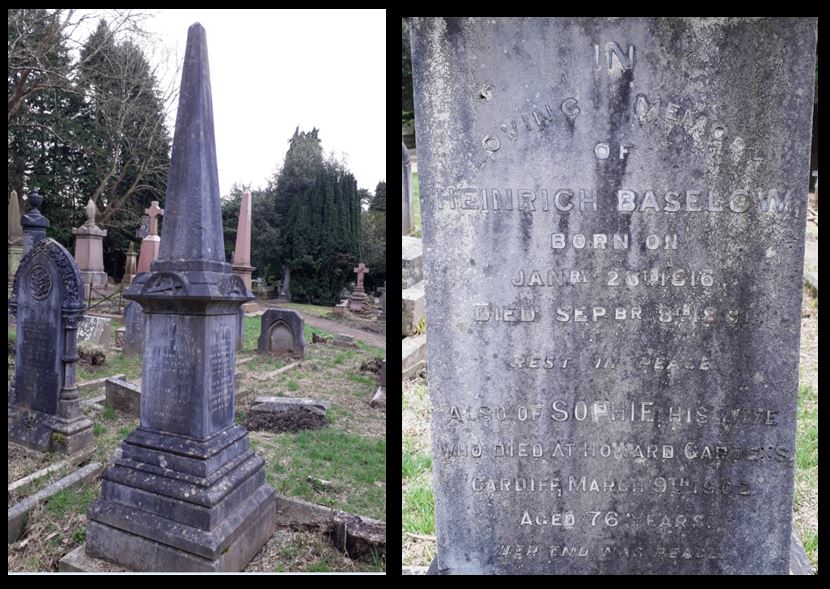
Henrich was working as an agent for German Lloyd’s a company that existed till 2013. Captain Baselow however died on 8 Sep 1881 aged 65. He is buried at Cathays Cemetery (plot L1276).
Mrs Baselow
Marie Henrietta Sophie Olerich was born in around 1826, also in Rostock, and went by the name of Sophie. She married Henrich on 4 Dec 1846 in Rostock and went on to have four children before emigrating to Wales.
The 1891 census tells us that after Henrich died she continued to live on her own means at 17 Mount Stuart Square with her children and still employing a servant. In 1901 however we find she had moved to 1 Howard Gardens with her son, a house they called Rostock. This was presumably because they preferred for their house to overlook a pleasant green rather than the Coal Exchange building which was built on Mount Stuart Square.
Sophie died on 9 Mar 1902 aged 76 and is buried alongside her husband Henrich in Cathays cemetery.
The grave of Captain Baselow and Sophie Baselow at Cathays cemetery.
The Baselow children:
Henry Baselow, the German soldier and cigar manufacturer.
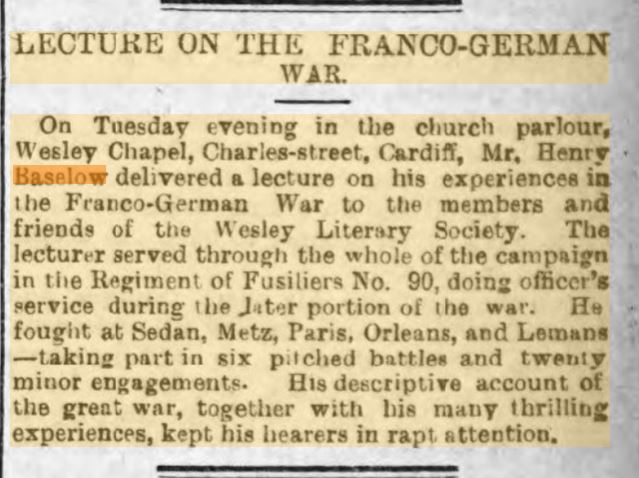
Henry David Frederick Baselow was born in 1848 in Rostock. The newspapers provide an interesting insight into his life. He fought right through the Franco-Prussian war of 1870 on the German side serving in the regiment of Fusiliers No.90, fighting in Sedan, Metz and Paris. He was to later deliver lectures in Cardiff on his experiences in that war.
He became a naturalised ‘Englishman’, as did all the Baselow family. In the 1881 census he is in boarding house in Middlesbrough describing himself as an iron merchant. In 1891 he married Alice Emma Bielski at Broadway chapel in Roath, Cardiff. She was daughter of a Polish shipbroker and had grown up in the Roath area. They went on to have four children three of which survived into adulthood.
Henry attended Broadway Wesleyan Methodist church and was evidently somewhat conservative in his views. In 1894 he chaired a meeting of the Roath branch of the British Woman’s Temperance Association. In 1898 he campaigned against the introduction of trams being allowed to run on a Sunday.
His business interests included running a large cigar factory in Mexico. He even became the British vice-consul in Vera Cruz, Mexico. His obituary stated that the adverse climate in Mexico undermined his heath leading him to relinquish his business in later years.
In the 1901 and 1911 census we find the family living in London where Henry describes himself as a cigar manufacturer. When he dies however in 1913, the funeral takes place back in Cardiff officiated by the minister of Broadway and attended by the German Consulate and W H Seager the Cardiff ship owner.
In 1893 Henry Baselow lectures on his experiences in the Franco-German war.
After Henry dies, Emma Baselow returns with the children to live in Cardiff close to her family. They live at 55 Westville Road, Penylan. Henry and Emma’s son, Henry Frank Baselow, worked in the accounts department of Morgan Wakely and Co, coal exporters, Mount Stuart Square. He enrolled in the British army in 1915 and is sent to the Western Front but was killed in action on 5 Oct 1917 aged 20. He is buried in Belgium but is remembered on a war memorial plaque that used to be in Roath Park Wesleyan Church (corner of Wellfield and Albany Roads). When the church closed down the plaque was evidently removed for safe keeping. It was discovered in recent years propped up against a wall in one of the chapels at Cathays Cemetery, nobody knowing its origin. In a strange sort of way it’s as if he was reconnecting with his grandfather, Captain Baselow, buried not far from the cemetery chapel. The plaque is currently in safe storage at Thornhill Crematorium.
Henry Frank Baselow, grandson of Henrich Baselow, died in WWI on the Western Front in Belgium. His grave headstone in Belgium and his name on the war memorial plaque that used to be in Roath Park Wesleyan Methodist Church, Albany Road.
Frank Baselow – the flamboyant merchant
Franz ‘Frank’ Ernst Baselow was born in Rostock in 1852. After his father Captain Baselow died in 1881 he and his mother continued to live in Mount Stuart Square and Frank was a provisions agent supplying the constant stream of cargo vessels leaving Cardiff and taking coal around the world.
Again the newspapers provide some interesting snippets of maybe a flamboyant character. In 1888 he is advertising in the Lost and Found section of the paper for the return of a ‘massive gold watch seal with green and red stone’. The finder is promised to be handsomely rewarded.
In 1907 he had a diamond tie pin stolen from outside a restaurant in Soho, London. The pin was said to be worth £23, almost £3,000 in today’s money.
When he and his mother are living at ‘Rostock’ 1 Howard Gardens in 1901 it is Frank who is described as head of household. His mother dies in 1902 and later the same year he marries Florence Lydia Smith from Buckinghamshire. They go on to have one child, Frank Thomas Henry Baselow.
‘Rostock’, No 1 Howard Gardens is at the far end of the terrace. The Victorian pillar box in the picture still stands there today.
Franz ‘Frank’ Baselow dies in 1915 aged 64. His probate records that he leaves a surprising small sum of £105. I say surprising because his tomb at Cathays Cemetery is one of the most grand in the whole cemetery and perhaps depicts his flamboyant character and German heritage. The tomb has a carved stone sculpture of a mother reading to a child. This may depict his widow Florence reading to son Frank.
The grave of Frank Baselow Grave at Cathays Cemetery.
Sophie Baselow – the shipbroker’s wife
Johanna Eliza ‘Sophie’ Baselow was Captain Baselow’s only daughter. She married Carl Johann ‘Emile’ Martin in Cardiff in 1875. Emile, was born in Oldenburg, Germany. He was a shipbroker and similarly lived in Mount Stuart Square.
They went onto have eleven children, nine of whom survived into adulthood. As their family grew they moved from Mount Stuart Square to Stacey Road in Roath. Emile died in 1923 in Bath and Sophie in 1833 aged 81. They are both buried in the same grave as Captain and Mrs Baselow at Cathays Cemetery.
Sophie and Emile Martin insription on grave of Captain Baselow.
Arthur Baselow – the New York pharmacist
Arthur Jahanas August Baselow was Captain Baselow’s youngest child, born in 1862 in Rostock. In the 1881 census he is living at home in Mount Stuart Square and working as a chemist’s assistant. The profession seems to have appealed to him but Cardiff less so and in 1888 he emigrates to America.
On 1 Mar 1888 he arrives in New York and works as a druggist (pharmacist) in Manhattan. He becomes an American citizen and married Joanna Salinger in 1897 and they have two daughters, Marjorie Louise Baselow and Dorothy Lorna Baselow. I haven’t yet found if Joanna Salinger was related to the New York author J.D.Salinger but you never know.
In 1911 they were living on E 96th Street. Arthur Baselow managed the Altamont Pharmacy on 7th Avenue in the very heart of Manhattan, a few yards from Times Square. He died suddenly of a brain haemorrhage in 1914 in Manhattan aged 52, the funeral taking place at St Peter’s church, Manhattan.
So if you ever find yourself standing in Times Square, take a look up 7th Avenue and think of Arthur Baselow, born in Germany, grew up in Cardiff and died in New York.
Times Square, as it used to look. Interesting scenes from New York in 1911 can be studied in this YouTube video: New York in 1911
The Baselow name lives on?
It looks like not. From Captain Baselow’s three sons there were only two male offspring. One of them, died in WWI and the other never married. Even more reason then that we eagerly await for an opportunity to hear the Baselow story to be part of the ‘graveyard voices’ depictions. And there is much more information about Cathays Cemetery on the excellent Friends of Cathays Cemetery website.
Many thanks to Kathy Thomas of the ‘Living Line’s group in the A48 Theatre Company for her help in researching the Baselow family.
The pictures that never made the cut.
Invariably I gathered more pictures than I needed in researching the article so if you are still awake here are some more:
Captain Henrich Baselow making a presentation in 1877
20 Oct 1894 Henry Baselow chairs meeting of the British Woman’s Temperance Movement





























 Roath Local History Society