
We recently received an enquiry from someone who had visited Coffee#1 on Wellfield Road a few years ago and noticed an old military trunk on display. They wondered if we knew anything about it. Well, I didn’t but it certainly piqued my interest.

I spend quite a bit of time researching people from the area who lost their lives in WWI and WWII and adding them to our Roath Virtual War Memorial. I wondered if the war trunk had belonged to one of Roath’s fallen.
One of the first things I did was to suggest to my wife that we go out for a coffee and investigate if the trunk is still there. She didn’t take much persuading. Sure enough, there at the top of the stairs on the first floor we found the military trunk, two in fact, seemingly used for storing Christmas decorations.

The chest trunk in question was marked as belonging to ‘Capt B M Dunn MC, 2nd Bn, the Welch Regt’. And no, that’s not a typo. The Welsh Regiment used to be called the Welch Regiment around the time of WWI.
The first thing I did when I got home was to see if he had survived the war by looking to see if he had a Commonwealth War Graves Commission record. I found none indicating he had survived.
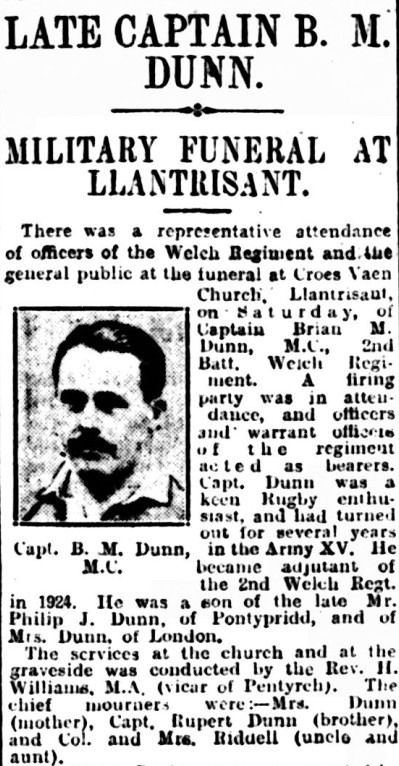
I search the newspaper archives and was soon able to identify him. He was Captain Brian M Dunn from Groes-faen, near Llantrisant, who sadly passed away in Oct 1926.

I had initially thought that if I discovered he wasn’t from the Roath area I would leave the enquiry there, but having read the interesting newspaper clipping I decided to keep going. Here was a man who won a number of awards for gallantry and had had a Welsh Rugby trial.
It was time to call in some reinforcements. I copied members of our Society’s research group. I also contacted my friends Gwyn Prescott (military and rugby historian) and Ceri Stennett (military historian and all round good egg) who were a great help. Between us all and our other contacts we managed to piece together the following:
Brian Morgan Dunn was born on 23rd March 1895, one of five children born to Phillip Dunn, a Justice of the Peace and Estate Agent, originally from Carmarthen and Anne Margaret Dunn nèe Morgan from Llantrisant. The family lived at a large house called Crofta, on the outskirts of Groes-faen village.

At the time of the 1911 census Brian is 16 years old and attending Uppingham School in Rutland.
Piecing together the military history of Brian Dunn has been difficult as is often the case with those of officer rank. It appears he enlisted early in WWI and joined the 2nd Battalion, Welsh Regiment, was made a 2nd Lieutenant on 11 Nov 1914, temp Captain on 9 Jun 1915 and Adjutant on 1 Jul 1916.
The war diary of the regiment records that on 17 Aug 1916 at Becourt Wood during reconnaissance of a new divisional front he was wounded and left the regiment for hospital. On 28 Oct 1916 Capt B M Dunn led a review of a Company of 200 men from the 2nd Welch regiment which had taken part in the Battle of Loos, in front of the King.
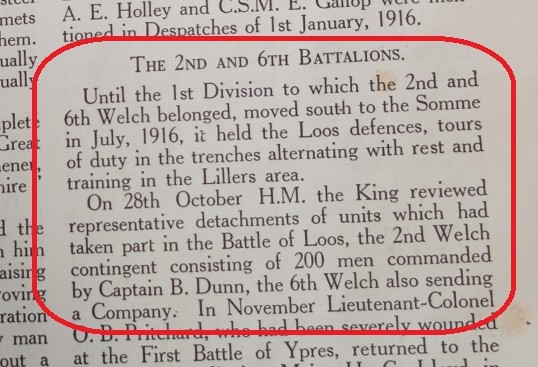
The MC after his name on his military trunk is an abbreviation for Military Cross, awarded for acts of gallantry. It is often possible to find a citation to the specific act for which a MC has been awarded but in the case of Capt Brian Dunn he was awarded it in the New Years Honours list (mentioned in the Edinburgh Gazette, 17 Jan 1916), probably for multiple acts of bravery. He was also awarded the Croix de Guerre (Ref – London Gazette 14th July 1917), a French military award for acts of heroism.
Capt Dunn survived the war and continued in the military afterwards. At the time of the 1921 Census we find him at Richmond Barracks in Dublin.
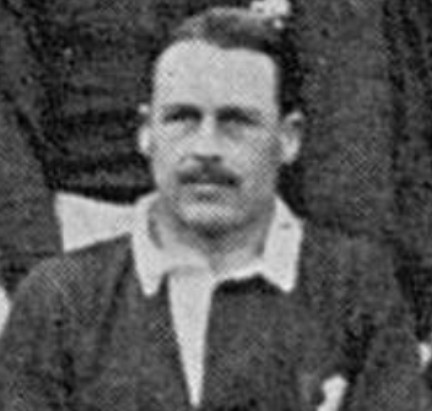
He was evidently a gifted sportsman and well-liked. Between the end of the war and his early death in 1926 we find references to him playing rugby at a high level. He was the recognised hooker for the Army team and appeared in Welsh International trials but was never capped.

Here are some of his rugby highlights:
- He was selected for Hampshire against Yorkshire in the final of the county championship in April 1926 but he did not play. Yorkshire won 15-14 and one report says his hooking was badly missed.
- He was a member of the 2nd Welch (Pembroke Dock) team which won the Army Cup in 1919-20. He kicked a penalty in their 9-0 win over 2nd Life Guards. Also played for United Services Portsmouth at one point.
- He played in a Welsh rugby trial for an Anglo-Welsh XV v the Probables in December 1925.
- H played regularly for the Army for several seasons and was in the Army XV which won the Inter Services Championship for the first time in 1925-6 when they beat both Royal Navy and RAF at Twickenham in front of the King.

He was still in the army when he died at Tidworth Barracks Hospital in Hampshire on 6 Oct 1926 aged just 31. He was buried in the family grave at St David’s church, Groes-faen. The papers report that it was a military funeral with warrant officers of the regiment acting as bearers with a firing party present too.
I visited St David’s, Groesfaen and found the grave. It is the largest plot in the cemetery. It appears that the wealthy Dunn family may well have been benefactors to the church at the time it was constructed in the early 1890s.


Brian was one of five children, four boys and one girl, born to Philip and Anne Dunn. All four brothers served in WWI and two were killed.
The eldest brother, Captain Philip Morgan Dunn (b.1888) attended Clare College, Cambridge and then served with the 8th Battalion of the Royal Welsh Fusiliers. He was killed in action during the advance on Kut, Mesopotamia on 3 Feb 1917, aged 28. He is commemorated at the Amara War Cemetery, Iraq. This was of personal interest to me as my grandfather served with the same battalion in Mesopotamia.

Another brother, 2nd Lieutenant Gwynne Morgan Dunn (b.1893), served in the 9th Battalion, Duke of Wellington’s (West Riding Regiment). He died of wounds on 23 Feb 1917 at the Somme, France, aged 23, just 20 days after his elder brother died. He is buried at Grove Town Cemetery, Meaulte, France.

The two brothers are remembered on an attractive plaque in the chancel at St David’s Church, Groes-faen, was well as on their parents grave.

The other brother, Rupert Morgan Dunn (b.1890) served as a 2nd Lieutenant in with the Royal Fusiliers and the Machine Gun Corps. He survived the war, married in 1924 and worked as a safe deposit manager in London. There don’t appear to be any offspring from that marriage. He died in London in 1953, aged 62.
The sister, Eileen Victoria Dunn (b.1897), never married and died in London, aged 85, in 1983.

Having found the Dunn family grave and the resting place of Capt Brian Morgan Dunn, owner of the military chest in the coffee house, I was left wondering what had killed a seeming very fit young rugby player. I ordered his death certificate which led to another surprise. He died of gonococcal septicemia, a rare but serious complication of gonorrhea. That in itself isn’t a surprise given it was before the days of widespread use of barrier contraception and pre-antibiotics. The surprise is more the reference to 1 month, 5 days, 10¾ hours. Given the seriousness of this condition that is more likely to be the time since infection rather than the time since diagnosis. It appears he shared some close personal information with the medical team at the military hospital.

I’m always surprised where some of the enquiries we receive via our website lead. If ever you find yourself on the A4119 road from Cardiff to Llantrisant may I suggest you drop into see St David’s church in Groes-faen and have a wander around the cemetery. The Dunn family grave is at the back (west side) of the church.
How the trunk got to end up in Coffee #1 on Wellfield Road I don’t know. My guess would be that it was part of a house clearance sale at some stage.
My thanks goes to Jon Roberts and Jon Lloyd at Roath Local History Society, Gwyn Prescott, (military and rugby historian) and Ceri Stennett, (military historian and broadcaster) as well as others for help with this research. And also of course Alex for making us aware of the military trunk in the first place.
 Roath Local History Society