
Jacques and Jacqueline De Guélis were brother and sister. They led very different lives but were both to die young in motor accidents but in very different circumstances. Jacques de Guélis you may have heard of. He was a spy in WWII. He has a blue plaque in his honour in Museum Place, off Park Place, in Cardiff. Jacqueline you probably won’t have heard of, though there may still be a memorial desk in here memory somewhere at Cardiff Royal Infirmary.

Before we look at Jacques and Jacqueline De Guélis in detail lets go back a generation and examine the Roath connection. Jacques and Jacqueline were the only children of Raoul and Marie De Guélis.
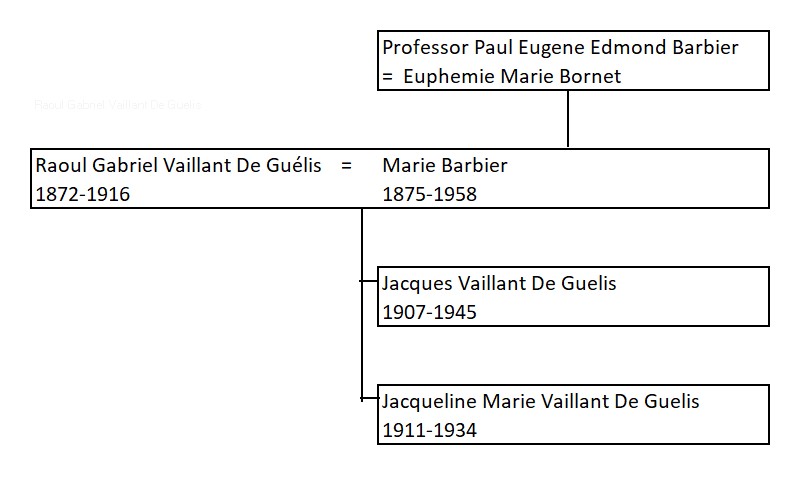
Raoul Gabriel Vaillant de Guelis as born on 26 Dec 1872 in Herry, Cher, France. He came to Cardiff around 1900 and worked as a coal export agent, ending up as a business partner with Sam Powell coal exporter. In the 1901 census he lived at 28 Ruthin Gardens, Cathays. He was a member of the Cardiff Anglo-French Society where he delivered lectures periodically. In Aug 1904 he married Marie Stephanie Barbier, daughter of Paul Barbier, French professor at the University. They went on to have two children together, Jaques (b.1908) and Jacqueline Marie (b.1911). At the time of the 1911 census they lived at 3 Richmond Terrace (now called Museum Place). He joined the French army upon the call to arms in Aug 1914 and served as a Brigadier with the 11th Artillery Regiment. He died of pneumonia on 19 Apr 1916, aged 44, whilst serving in Argonne, France. He is remembered on the Cardiff Coal Exchange war memorial.

Marie De Guélis née Barbier was one of nine children born to Professor Paul Barbier originally from France and his wife Euphémie Barbier née Bornet, originally from Switzerland. The family lived in Oakfield Street in Roath in 1891 and Fitzalan Place in 1901 before moving to Corbett Road. The Barbier family is well-researched and there is an archive of their family papers in Cardiff University Library. In Nov 1914 Marie de Guélis and others were busy raising money for the establishment of a field hospital in France called the Glamorgan and Monmouth Hospital for French Soldiers. In early 1915 she was coordinating the Belgium Soldiers Fund in Cardiff raising money for field kitchens in Belgium. After her husband died in April 1916 in France Marie was left to raise her two children on her own.
Jacqueline De Guelis attended Cardiff High School for Girls in The Parade before going on the study Art. She was tragically killed on a dark December evening in 1934, aged just 22, after being knocked down by a motor van at the bottom of Penylan Hill, at the junction of Ty Draw and Kimberley Roads. After the accident she was taken to a nearby doctor’s surgery where she sadly died a short time later. Just a week earlier the paper reported that Jacqueline had played a leading role in a production of ‘The Aristocrat’ in front of a full house with the proceeds going to the Infirmary. Her funeral was held a few days later at St John’s Church and she is buried at Cathays Cemetery.
A few weeks after Jacqueline’s death, her brother wrote a letter to the paper pleading for road safety improvements at the Penylan Hill, Kimberley Road, Ty Draw Road junction. He describes the defective lighting leaving the corner in almost complete obscurity and how a few feet from the corner is a fire alarm box standing on the edge of the pavement blocking the view. He noted that most motorist passing do not blow their horns and have got up to maximum speed to negotiate the hill. This dangerous state of affairs was made worse by the fact that the bus stop at the time was on the corner of Kimberley Road. Jacques said that the family agrees with the jury’s verdict exonerating the driver but pleaded with the authorities to improve lighting and placement of bus stops.


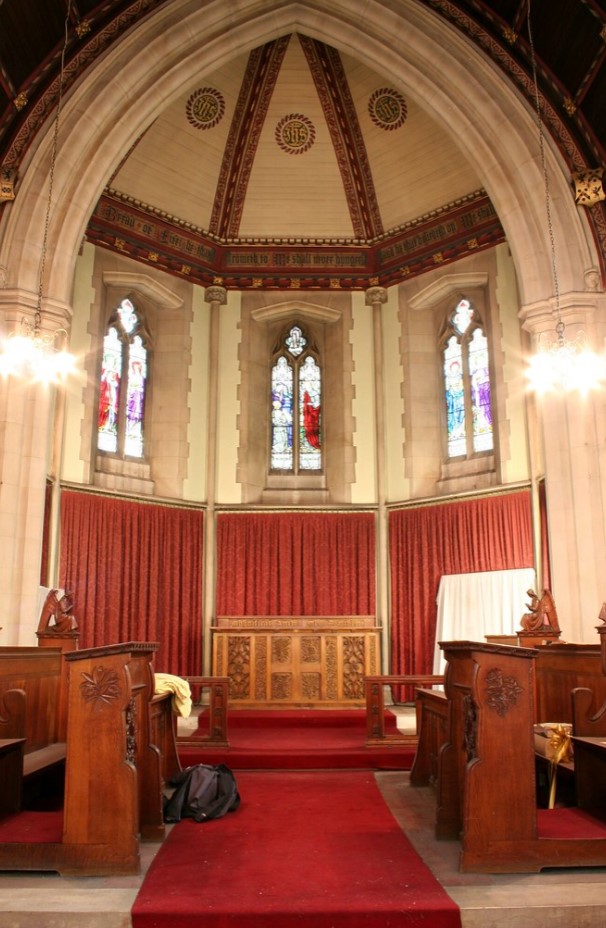
The proceeds of the production Jacqueline had taken part in prior to her death were used to purchase a litany desk for the Infirmary Chapel. On the anniversary of her death a service was held at the Infirmary Chapel where the Bishop of Llandaff dedicated the desk in front of a large congregation. The Infirmary Chapel lay empty and unused for a number of years but in recent years has been converted into Capel I Bawb; a library, café and meeting place. There are some pictures of the old chapel. I don’t know if the litany desk is pictured in the old chapel or whether it has survived.

Jacques Theodoule Paul Marie Vaillant de Guélis was born on 6 Apr 1907. Jacques went to school in Wrekin College, Shropshire before going onto Magdalen College, Oxford. He had dual French/British nationality, and was therefore required to undertake French national service which he did with the French Cuirassiers in the 1930s. At the time of Jacqueline’s death in 1934 Jacques was reported to be the director of the press advertising firm in Paris. He married Beryl Richardson at St Augustine’s church, Kensington, London on 26 Feb 1938 after which both Jacques and Beryl worked in press advertising in London. He had a handle-bar moustache and was 6 feet 4 inches tall.
In WWII Jacques initially served with the French Army. He was appointed liaison officer to the British II Corps, escaped via Dunkirk, but then returned to France. He then found himself escaping the enemy again via the Pyrenees into Spain. On returning to UK he was recruited to the Special Operations Executive (SOE). He undertook many missions behind enemy lines and saw service in France, Algiers and Italy. He rose to the rank of Major, receiving many awards for his bravery including the Croix-de-Guerre with palms, Military Cross and MBE.

After the liberation of France, he was assigned to the Special Allied Airborne Reconnaissance Force (SAARF) to help coordinate the resistance and to provide feedback information, mainly on the conditions of prisoners of war and concentration camps. He was sent across Europe to search for information. As Nazi Germany surrendered in May 1945, Jacques de Guélis arrived in Germany on an urgent mission to find captured agents and make sure they were not subjected to any last minute vengeance. His investigations centred on a number of concentration camps, including Flossenburg in Bavaria.
Whilst in Germany, he was involved in a serious car accident with a car driven by a German soldier near Flossenbürg concentration camp on 16 May 1945. He was badly injured. Some reports say the circumstances of the accident were suspicious and speculate whether it was to stop Jacques carrying out his investigative work.
After the accident Jacques was immediately flown to Paris for an operation, and a while later repatriated to a hospital in Burtonwood, Staffordshire, but was to lose his life after further unsuccessful operations on 7 Aug 1945 at the age of 38. His body was returned to Cardiff and cremated and the ashes buried in Cathays Cemetery (plot I.22E) alongside his sister Jacqueline. His wife Beryl died in Paris in 1978. His life has been recorded in the book ‘Jacques de Guélis SOE’s Genial Giant: His Life, His War & His Untimely End’ by Delphine Isaaman in 2018. Other articles include those found in Wikipedia, the Western Mail and on BBC. He is remembered on Wrekin College WWI memorial plaque and Magdalen College WWII memorial plaque as well as a blue plaque on 3 Museum Place. Commonwealth War Graves Commission record.

There was one other accidental death that I stumbled upon when researching the family. In 1915 Uline Barbier, sister of Marie de Guelis née Barbier, married Charles Hepburn in London. They had a son together called him Raoul Hepworth born in Cardiff in 1916, quite possibly named after Raoul de Guelis who died in France around the same time. The marriage appears not to have lasted as Uline had returned to using her maiden name by 1921. Raoul Hepworth had a military career and in WWII became a Major Raoul Paul Cuthbert Hepburn and served with the Royal Army Service Corps. He died in Germany in Nov 1945, after the war had ended, as a result of an accident and is buried in Cologne.
 Roath Local History Society