
This Roath Local History Society Occasional Paper was researched and written by M.C.Ranson in 2011.
William Richards an Alderman of Cardiff who died c 1695 had two sons Michael and William. Michael Richards (1672-1729) married Mary Powell of Energlyn, Caerphilly and obtained lands from that union. Their son, another Michael purchased lands in Cardiff, but had already purchased parts of the Llancaiach Fawr estate from Jane Prichard. Most of this land lay outside Cardiff in the Taff Valley, but some of the land was in Whitchurch and Rhiwbina, particularly Rhiwbina Farm. This is the estate which passed down to Harriet Richards who married the Mackintosh of Mackintosh in 1880.
A reproduction of a 1789 map of the parish of Roath gives no indication of the existence of Plasnewydd in the late 18th Century. Not even Heol y Plwca is shown with any certainty and was probably just a muddy track at that time crossing an area known as Plwca Halog.
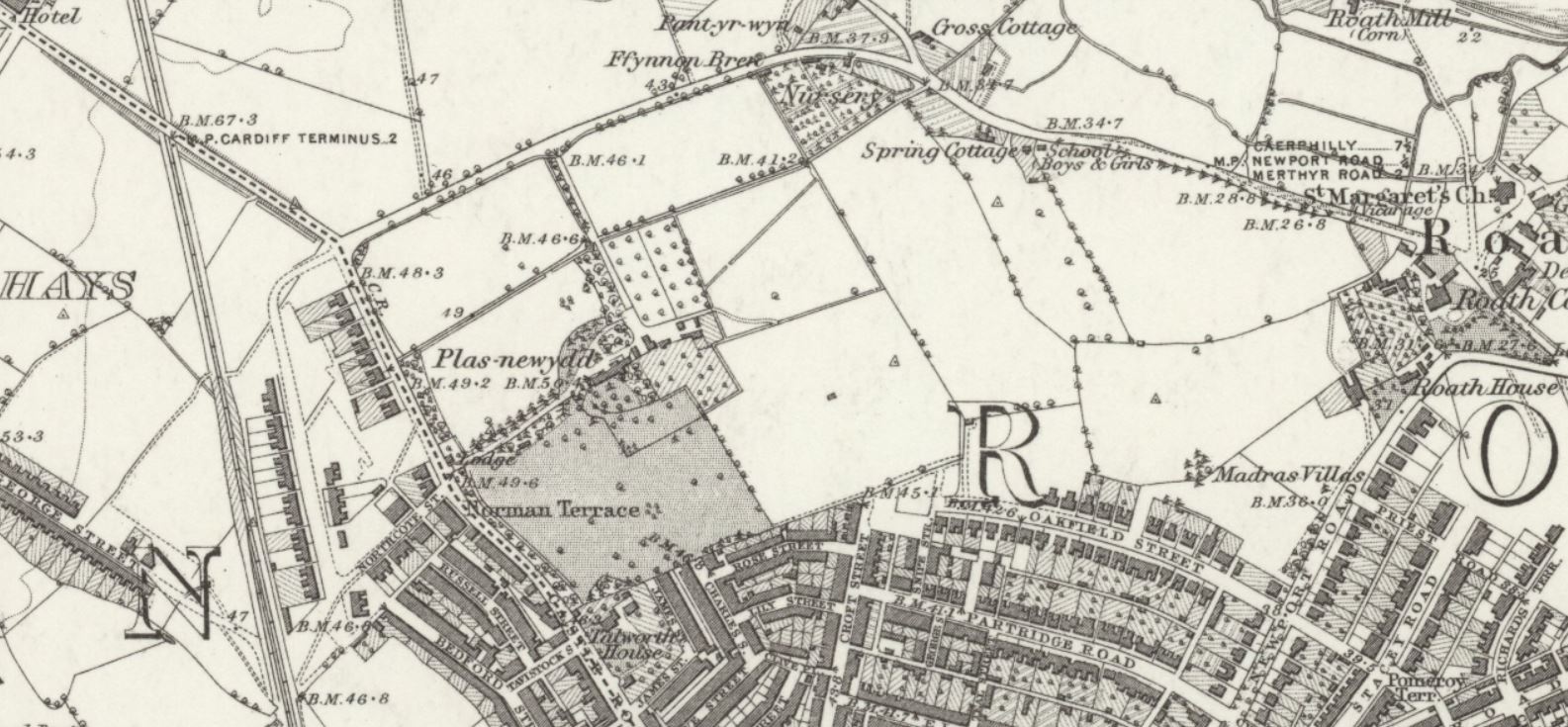
Around 1811-— 1812 Roath Court (now Summer Funeral Home) was sold to John Wood, a Cardiff banker and attorney and probably included the land on which Plasnewydd had been built around 1800, possibly replacing an earlier building c 1782. Newman (1995, p308) describes the present building as “a survivor of the Georgian style of building. Rendered, battlemented, sash windowed, it has a south front of three bays linked to single bay wings by concave pieces”.
In 1824 Roath Court was again advertised for sale and was acquired by Mrs Anne Williams, the mother of Charles Croft Williams. Also at this time Plasnewydd is advertised for sale as Roath Lodge where it is described as a “most desirable freehold estate…consisting of a modern villa containing dining and drawing rooms, excellent bedrooms [and] every necessary attached office”. In addition there is a coach house, stables, thriving plantations, a good garden and farmyard, and several pieces of productive land surrounding the house (Childs, 1995, p38). By 1829 Plasnewydd is becoming known as Roath Castle on account of its crenulated design.
Up until this time, there is no evidence that I can find, that any member of the Richards family had ever lived at Plasnewydd. On the contrary, Roath Court is advertised to be let in 1830 and is described as the residence of J. M. Richards Esq., but probably as a tenant, since applications to rent were to be made to Mr Charles C Williams in Duke St, Cardiff (Cambrian, 2 Oct 1830, p3). By 1831 Roath Castle had come into the ownership of John Matthews Richards (1803-1843).
The largest landowner in the parish of Roath in 1840 was Lord Tredegar (964a) 40%, followed by the Marquis of Bute (648a) 27%. Thereafter the next largest holdings were held by Thomas William Edwards (283a) 10%, William Mark Wood (137a) 6%, and John Mathews Richards (121a) 5%.The remaining 12% was held by 19 small landowners. John Mathews Richards held several parcels of land throughout the parish. His tenants included John Skyrme (6a), James Noble (43a), J Howell Rees (1rood) and the tenant of Tyn y Coed Farm, Henry Griffin who rented 67a in the parish of Roath and a further 90a in the parish of Cardiff St John.
John Mathews Richards had married Arabella Calley of Burdsoke, Wiltshire and their third son was Edward Priest Richards the Younger (1831-1856) a great nephew of his namesake Edward Priest Richards the Elder. The latter was the fifth son of John Richards and the first by his second wife Mary Priest. For 40 years he was the chief agent for the Marquis of Bute’s estates in Glamorgan and was instrumental in amassing the Bute fortune. During his life he held almost every public office in Glamorgan as well as in the Borough of Cardiff and established a powerful and intricate network of local control. He died in 1867 (Childs, 2005, p2).
On 5 February 1856 Edward Priest Richards the Younger married Harriet Georgina Tyler, eldest daughter of Sir George Tyler of Cottrell, St Nicholas. According to an eye witness, Edward was short sighted, wore an eyeglass, and walked with short steps and a curious little hop. He died in the first year of the marriage, when after having attended a ploughing match dinner, he and his horse were involved in a fatal collision with a cartload of manure in Heol y Plwca (now City Road). His pregnant wife then moved back to her childhood home and their daughter Harriet was born at Cottrell House, St Nicholas in June 1857. Thereafter Roath Castle was let to a succession of short term tenants including Frederick Greenhill, a colliery proprietor and his family from 1859 and Mr L.V.Shirley, agent for the Richards/Mackintosh estates in Glamorgan between 1875 and 1884.

Cardiff Corporation had shown interest in purchasing Roath Castle for use as a public park. In 1883 they changed their policy, accepting an offer made by Lord Bute to release land in order to develop what is now Roath Park. Housing development began on the estate in 1884, though the Mackintosh family did agree to the sale of land at Plasnewydd for the purpose of improvements to Albany Road in 1889. (Cardiff Records, vol V, 1889, p143)

In 1880 Harriet ‘Ella’ Richards had married Alfred Donald Mackintosh (1851-1938) of Moy Hall, Invernesshire, the 28th Chief of Clan Mackintosh and the 29th Chief of Clan Chattan, and for the first six years of their marriage divided their time between Mayfair, Moy and Cottrell. By 1891 the urban development of the Plasnewydd estate had been completed and in 1889 plans were made to donate Roath Castle as a community asset for the people living on the estate. The house then became known as the Mackintosh Institute.
Reference:
A Short History of the Mackintosh Estate, Roath. Jeff Childs (2005)
See also:
The Mackintosh of Mackintosh comes to Cardiff and Alf and Ella get hitched.
 Roath Local History Society