Lord David Owen and his Cardiff connections

Lord David Owen – Official portrait, 2018 (souce: Wikipedia)

There’s little sign that 86 year old David Owen is winding down. The man who was Foreign Secretary in James Callaghan’s Labour government and who then went on to be a founder of the SDP party will be 87 in a few weeks time.  Yes, he retired from a House of Lords last year but is still a prolific writer and gives regular radio interviews offering his opinions on modern politics.  

It wasn’t my intention to research David Owen and his Cardiff connections.  It was rather an accident. My attention had drawn recently to an unusual grave headstone at Cathays Cemetery.  It is unusual in it’s design.  Cathays Cemetery, the third largest Victorian in the country, still contains many examples of elaborate headstones despite a harsh clearance scheme that took place in the 1960/70s aiming to make cemetery maintenance easier.  There are still examples of Celtic crosses, obelisks, pedestals with urns, angels, broken columns signifying a life cut short and a couple of polished granite globes.  There is however only one example of a sword and belt draped around a cross.  It is the headstone of Lieutenant John Aubrey Owen.

Even this elaborately carved headstone may have suffered as a result of the clearance scheme.  Comparing the present headstone with a historical picture shows the kerbing is no longer present and the headstone itself is lower than it originally was.  Maybe this was as a result of the clearance scheme or just sinkage into the ground.  The elaborate sword and belt carving and cross too has suffered some damage over time.  The sword’s hilt is sadly no longer present.

Lieutenant John Aubrey Owen it turns out was Lord David Owen’s grandfather.  Not that David Owen ever knew his grandfather sadly.  Lieutenant Owen died during WWI as a result of an accident.
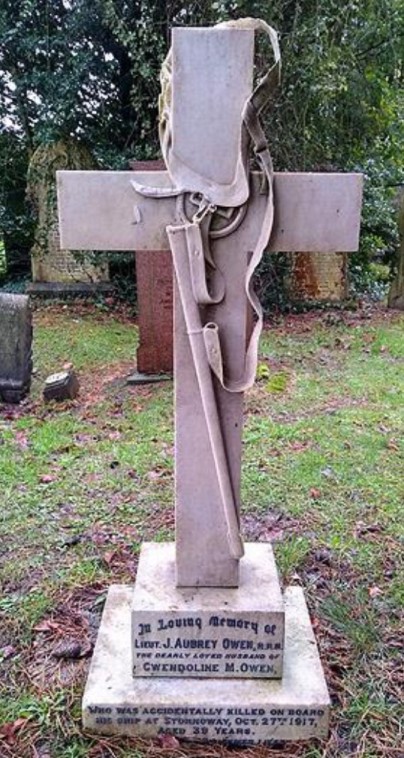
Lieutenant John Aubrey Owen headstone at Cathays Cemetery.

Having found that connection I did some research and ordered David Owen’s biography ‘Time to Declare’ (1991).  David Owen was born in Devon in 1938 but has a lot of Welsh blood in him.  His biography details how he spent time in South Wales when his father was away involved in WWII.  My intention here isn’t to repeat all his South Wales family history but to tease out his interesting connections to us here in Cardiff, starting with his grandfather. 

Lieutenant John Aubrey Owen (1876-1917) – Grandfather

John Aubrey Owen was born on 12 Jun 1878 at at 14 Park Street, Temperance Town, Cardiff to William Frank Owen, a coal merchant, originally from Cardiff and Selina Maud Owen nèe Rees originally from Bridgend, Glamorgan.  By 1881 the family were living at 9 Crwys Road, Cathays, which is now a hairdressers.  He was baptized on 18 Mar 1885 at St Augustine, Panarth and in 1891 the Owen family were living at 24 Pembroke Terrace, Penarth.  John joined the merchant navy as a boy sailor at the age of 16, working on the four masted ships sailing out of Cardiff docks.  In the 1891 census he is recorded as living at 10 Belle View Terrace, Penarth, aged 22, and a sailor. 

9 Crwys Road, Cathays where John Aubrey Owen was living as a child in 1881.

On 8 Nov 1905 John married Gwendoline Mary Morris, the daughter of a Congregational minister.  They may well have met each other as teenagers when they both lived on Pembroke Terrace, Penarth.  After getting married they settled in Cwmgwrach, in the upper Neath Valley and had two sons.

John’s career soon progressed in the merchant navy, gaining his First Mate’s certificate in 1905 and then his Master’s certificate in 1907.  John was employed by Messrs Evan Thomas Radcliffe and Co, Cardiff, one of the more prosperous and better-known of Cardiff-based shipowning companies.   John had had been in command of three of their steamers by the time the First World War arrived where he served in the Royal Naval Reserve and was made a temporary lieutenant in February 1917.  He served on H.M. Trawler ‘John Pollard’.  He however sadly died from a fractured skull on 27 Oct 1917, after falling from the upper deck of his vessel into the stoke hold, while the ship was docked in Stornoway on the Isle of Lewis in the Outer Hebrides.  He was aged 39.  He is buried in Cathays Cemetery (grave S 509A).  Commonwealth War Graves Commission record.
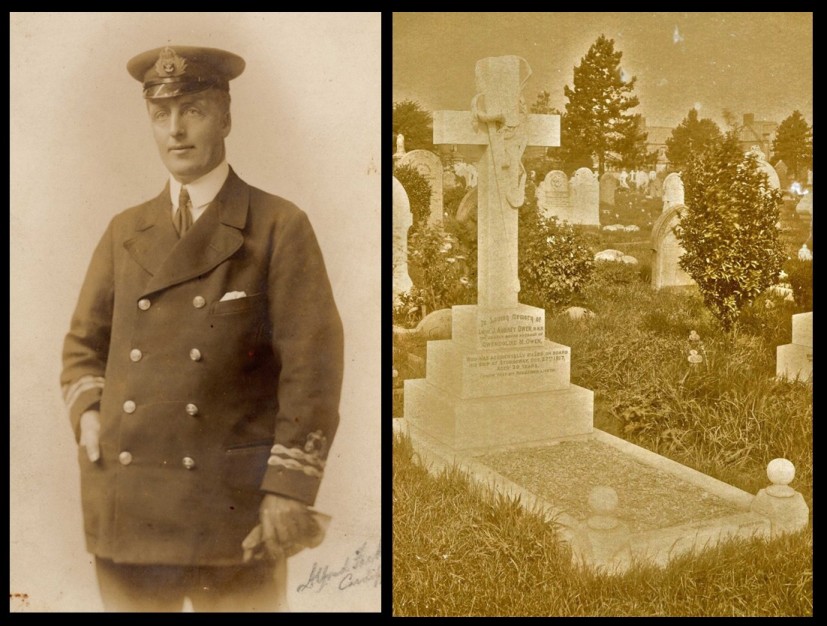
Lieutenant John Aubrey Owen and old image of his headstone at Cathays Cemetery, Cardiff..

David Lewis (1797-1860)  G-G-G-Grandfather – Mayor of Cardiff

Researching the Owen family history is made a lot easier, not only by David Owen’s autobiography, but by there being a very comprehensive family tree on Ancestry put together by another Owen family member.   In that family tree it details the life of David Lewis (1797-1860).  He married Margaret Aubrey, which is where the Aubrey name passed down through the family comes from.  In 1841 he lived on Quay Street, Cardiff.

His lengthy obituary in the newspaper in 1860 details how he was a victualler, landlord of the Ship and Dolphin in Church Street, and afterwards became Master of the Ship on Launch, in Quay Street which was the favorite resort of the Cardiganshire seamen when they visited Cardiff.  He also speculated in coal and had a rope making business and donated money to the Wesleyan Chapel in Charles Street.  In 1854 he was Mayor of Cardiff.  He is buried at Llandaff Cathedral.

Wesleyan Chapel, Charles Street, Cardiff, opened 1850. The chapel was destroyed by fire in 1895 and then rebuilt. The rebuilt chapel was demolished in 1984.
The plaque to David Lewis (described below) could well be one of those in the sketch under the eaves of the balcony.
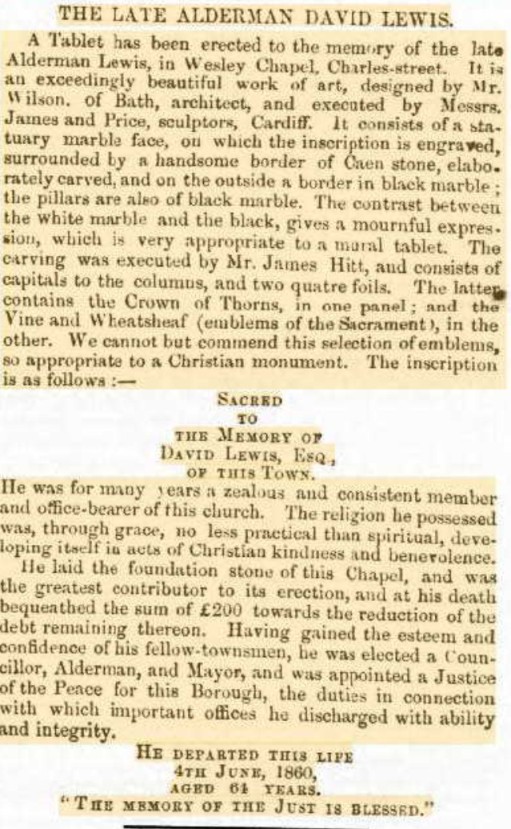
A plaque to David Lewis was erected in Charles Street Wesleyan Chapel after his death.

Alderman William Llewellyn (1850- 1923) – Maternal G-Grandfather

William Llewellyn was both a liberal politician and shopkeeper.  David Owen writes that ‘Alderman William Llewellyn, was chairman of Glamorgan County Council and chairman of the Bridgend Bench of Magistrates.  A staunch Liberal, he was a moving spirit in first the Mid-Glamorgan then the Ogmore Divisional Liberal and Labour Party, of which he also became chairman.  He had started life as a grocer and provision merchant in Ogmore, having moved there from Llantrisant. Over the years The Gwalia, as his shop was called, grew until it was described as `a mecca of the valley and neighbourhood’.  The shop used to be in Ogmore Vale but has been moved and many of you will have been there.  Gwalia Stores closed in Ogmore Vale in 1973 but was then moved and rebuilt at St Fagans National Museum of History in 1991.  The ground floor is set up as it would have been during the 1920s.

Gwalia Stores originally in Ogmore Vale now at St Fagans National Museum of History, Cardiff.

Dr Edgar Llewellyn (1890-1964) – G-uncle

Alderman William Llewellyn had eight children, or more accurately his wife Mary did.  One was George ‘Gear’ Morgan Llewellyn (1877-1951), David Owen’s maternal grandfather.  He was a blind church minister and lived at Llandow in the Vale of Glamorgan and a big influence on David Owen’s life.  David spent time living there as a child when his father was away in WWII.

Another son of Alderman William Llewellyn was Dr Edgar Llewellyn and it is he that has connections with our area.  He became a GP in Splott and had his surgery on Splott Road. He was Cardiff Commissioner of the St John’s Ambulance Brigade and the works’ doctor at Guest Keen steel works, and also became a Cardiff Councillor. 

In his autobiography David Owen recalls the following:

The brother whose career most closely paralleled my own was Edgar. He was a family doctor in Splott which is an area of Cardiff dominated by the steel-works.  He was a great character and adored by his patients His unique way of sorting out their ailments was, according to my mother, to go into his surgery and announce, “Those buggers who are ill can move to the right-hand side of the room and be seen now: those who are not can wait on the left and see me later or chance their luck tomorrow.’  After the war he became infuriated by the politicians on the City Council and so decided to join his wife who was already a Ratepayer Councillor. He was elected in 1951. A photograph of him in a pony and trap, bedecked in a massive rosette, electioneering shows the first combination of doctor-politician in the family’s history. His wife Jenny, who had first stood and won as a Ratepayer in 1946, was a strikingly good looking woman and a considerable character.  She was the first person in eighteen years to beat the Labour candidate in her Ward. She stood again in 1949 and won and then lost her seat three years later. The wish to be an independent in local government and to stand against party politics was later mirrored by my mother and, some will say, by me too.

Dr Edgar Llewellyn, Ratepayers Candidate in the Cardiff 1951 Local Government elections (picture credit: Cardiff Yesterday Vol XVI)
Dr Edgar Llewellyn of the Ratepayers Part campaigning in 1951 (Picture credit: David Owen’s biography ‘Time to Declare’ (1991))

What started as a bit of research into the grave of John Aubrey Owen at Cathays Cemetery turned up many interesting stories about the history of Cardiff. Fascinating stuff is histoy.

Sir William Crossman

William Crossman – the first Labour Knight 

(22 March 1854 – 23 January 1929)

As its Labour Day allow me to present to you the life William Crossman, probably one of Cardiff’s unsung heroes.  He was the first labour Lord Mayor of the city and the first labour person and trade unionist ever to be knighted in Great Britain.  That’s quite a claim.  I think its true.  It was certainly a headline in the Echo at the time.

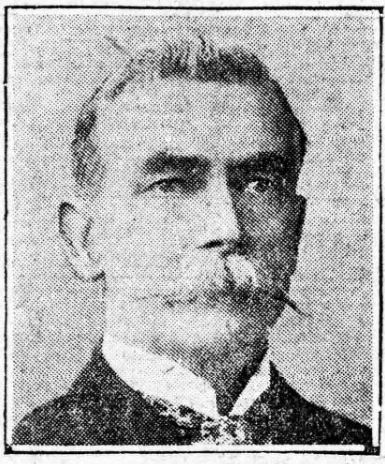
William Crossman picture unknown date

William Crossman wasn’t a Cardiff man.  He was one of the thousands of people that came to Cardiff from the West Country in the late 1800s.  As an aside, I’ve often wondered if that’s the reason why the Cardiff accent is so different from the nearby valleys accent.

Crossman was born in 1854 in Tavistock, Devon, son of John Crossman, a ‘captain’ in a copper mine.  He married Mary Ann Moore on 29th Dec 1885 at the Roath parish church, St Margaret’s.  His address at the time is given as Myra Place.  I’ve not been able to find Myra Place and am left wondering if it is in fact a misspelling of Moira Place in Adamsdown.  After their marriage they lived at 31 Harriet Street, Cathays for the rest of their lives and never had children.

31 Harriet Street, Cathays, Cardiff, home of William Crossman

31 Harriet Street, Cathays

William was a mason by training.  He came to Cardiff to work as a foreman mason on the Roath Dock at Cardiff in 1884.  He became a labour leader in 1892, at the time of the great building trade dispute. As a member of the conciliation committee he did much to bring that strike to a satisfactory end.  He was said to have been a reasonable man, standing for his principle, but not spoiling for a fight. His sincerity and simplicity is said to have won him the respect and confidence of his opponents. For many years his life was devoted to labour representation, what we would now call trade unionism.

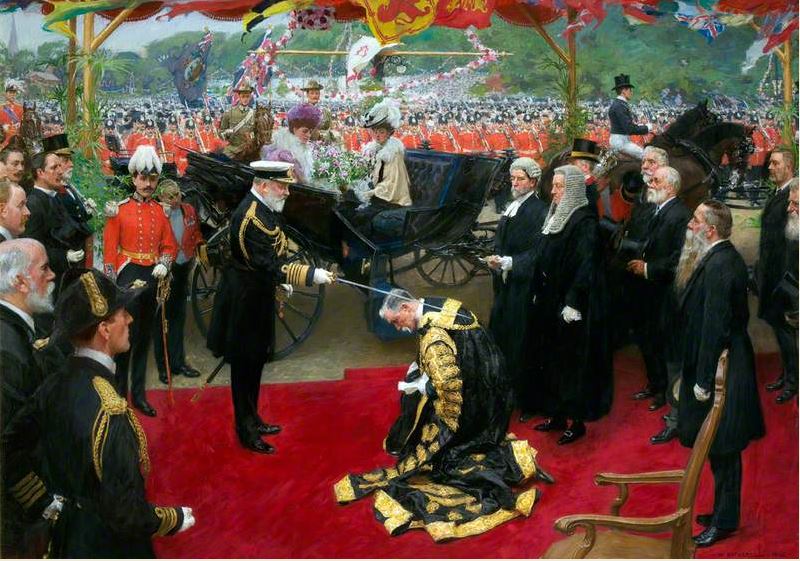
His conciliation skills must have been widely admired.  In the early 1900s be became Chief Magistrate and was appointed as Lord Mayor of Cardiff in 1906.   He was knighted whilst still in office by Edward VII on his visit to Cardiff on 13 July 1907, when the King came to open the Queen Alexandra Dock.  A crowd of some 50,000 people is said to have gathered in front of the City Hall to witness the ceremony.  The papers reported that he was the first labourer to have been knighted and probably also the first trade union leader.  At the civic ceremony that followed the ceremony, King Edward VII is said to have commented to William, “I quite understand my man” upon seeing him refuse an alcoholic drink. Sir William was a devoted church member and one of the two Sunday school superintendents in the Bible Christian Methodist Church in Miskin Street, Cathays, Cardiff.

Knighting of William Crossman by King Edward VII in Cardiff by William Hatherell

Painting of Knighting of William Crossman by King Edward VII in Cardiff by William Hatherell

In January 1910 Crossman was appointed President of the new Labour Exchange in Bridge Street, Cardiff  by Winston Churchill, then President of the Board of Trade. His appointment appears to have been welcomed by politicians of all shades in Cardiff at the time.

Sir William Smith Crossman died on January 23rd 1929 aged 74 years.  He is buried at Cathays cemetery.

William Crossman Gravestone at Cathays Cemetery

Inscription: In loving memory of WILLIAM SMITH CROSSMAN Kt. JP. Lord Mayor of this city 1906-7, who died January 23rd 1929 age 74 years. “Until the day break and the shadows flee away” Also of Dame Mary Ann CROSSMAN the dearly beloved wife of the above who died April 29th 1935 aged 91 years. “In peace they lived together and peacefully they passed away”

The best insight into William Crossman’s life I’ve been able to find is, from of all places, the New Zealand Herald.  From the first part of the interview Crossman comes over as a very humble man.  Just as the interview is about to conclude he gets the opportunity to express his religious views and importance of abstinence. I wonder if the garden in Harriet Street still looks good!

New Zealand Herald.  September 7th 1907

FROM STONEMASON TO KNIGHT.

STORY OF SIR W. CROSSMAN’S LIFE.

Working, rather than talking, is the strong point in the character of Sir William Crossman, Lord Mayor of Cardiff, the Labour representative whom the King has just honoured with a knighthood.

There is certainly squareness and massiveness about Sir William’s appearance suggestive of speech—few words and weighty —and himself or his doings form above all others the subject he is most reluctant to speak about.

After some persuasion, however, he consented to give some account of his life and bringing up, telling the tale of quiet, steady work in the simplest possible language.

“I was born in Devonshire,” said Sir William Crossman, though, perhaps, I can hardly be called a Devonshire man, as I was ‘raised’ in Cornwall.  I was born at Tavistock in 1864.  My father was then the captain of the copper ore mine.

“I have not had a great deal of schooling.  All the education I ever had was at the Tavistock national school.  I remained there till I was fourteen, and then I set out to earn my own living.

“That was what took me to Cornwall.  I became apprenticed as a stonemason in the Gunnisiake Granite Quarries and served the usual term of five years.  Then I worked for a while as journeyman at the same quarries.

“After that I went to work at Bristol, and since then I have been engaged in my trade there and elsewhere, but generally working on public works.’’

Nearly half Sir William’s life has, however, been spent in the capital of South Wales; and it is his splendid record of public work in that city which has led to the dramatic contrasts in his life; so that the man who worked as a foreman mason on the building of one dock represented his city in the reception of the Sovereign at the opening of the next.

“It was more twenty years ago that I came to Cardiff,” said Sir William; “indeed, it was 1884.  The new Roath Dock was then being built, and I came as foreman-mason under the contractors, and held the position till the contract was completed.”

“‘Afterwards I was engaged on a good many other important building works in the town—the castle wall in the North Road, and I was foreman mason again at the erection of some big warehouses at the West Dock.”

LEADER OF LAROUR.

What first brought Sir William Crossman into prominence in the public life of Cardiff was a dispute in the building trade between employers and employed.

This led to a strike of a somewhat obstinate character which lasted several months, and was accompanied, as is usual by a considerable amount of embittered controversy.  Into this controversy Sir William Crossman entered as a cordial advocate of the claims of Labour, but at the same time the position he took up was so reasonable, and the manner in which he defended, it was so tactful, that he was successful in gaining not only the support of his fellow workmen but the respect and confidence of the employers.

William Crossman

On this aspect of the subject, Sir William Crossman had, however, nothing to say, only remarking that it was in the year marked by this dispute -1902- that was first elected a member of the Cardiff Corporation.

“I was put up for Cathays Ward,”  he said, ‘by Cardiff Labour Progressive League and I was returned for the ward by a good majority, “I have kept my seat ever since. though I have had to fight for it twice.  I have always contested the ward as Labour and Liberal.

“It is the same district – the Cathays Ward- that I represent on the Board of Guardians.  I have been on the board for some eight or nine years.  “But I not know,”’ said Sir William, smiling. “that if I were to enumerate all the different positions I do hold or have held it would be interesting.”

THE SIMPLE LIFE.

Though, since his public duties have absorbed so much of his time, Sir William Crossman has ceased to wield the hammer and chisel himself, he still leads the simple life of a working man.  His little home in the Cathays Ward of Cardiff, over which Lady Crossman presides with pleasant and kindly hospitality, is only rented, at £20 a year.

The garden is but a little oblong patch usually attached to such villas, but the most is made of it.  It is overflowing with flowers, and the little conservatory, which opens out of Sir William’s tiny study, displays a wonderful variety of blossom and colour.  Gardening is Sir William’s hobby in his leisure moments, which, however, especially since his accession to the Mayoral duties, are not very numerous.

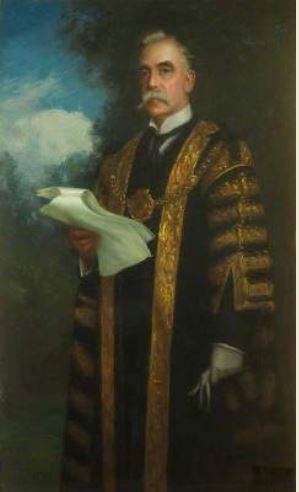
Lord Mayor William Crossman portrait by Parker Hagarty

Lord Mayor William Crossman portrait by Parker Hagarty

“I have always found great pleasure in gardening,” he said. ‘‘After the busy life of the day I find working among my flowers restful.  I think, especially in towns, you can tell a great deal about the character of people by the way they keep their gardens.  Perhaps you see one a squalid wilderness and the next one ablaze with flowers.

“I do not think I have anything more to say,” said Sir William in conclusion.

“If you ask me to what I think I owe most in my life I would like to say I had the great advantage of being brought up by Christian parents and of knowing the benefit of total abstinence from my youth.  My father was a very strong temperance advocate”.

Miskin Street Bible Christian Chapel

“Then I was fortunate in choosing as a friend and companion when I left my home a man who was steady in habits and a good friend to have. That was when I left Cornwall for Bristol. “It is  in the choice of their friends and companions that I always feel young men should be so careful. I am sure their future often greatly depends on their companions in early life.  I have so often known young men who had good parents, but when they left home they allowed themselves to be led away by careless companions.  It is often simply for want of a little consideration on their own part, they forget the teaching of the old home life and cast it all aside.

Young men by the time they have passed through their apprenticeship, are launching out in their life on their own account, have generally picked up a friend.

The two start out together, and their characters influence each other a good deal.  A good friend then may make a lot of difference in a young man’s life.

“Since I have grown to manhood and taken part for some years now in Sunday-school work, I have always tried my best to instil into young people an idea of their responsibility in future.  I have tried to make them see how important it is for them, when they launch out into life for themselves to carry with them the influence of a good home as the best means to help them to grow up and useful citizens.

“For, of course, if a young man his character and grit, and can resist temptation, it is a great advantage for him when he has finished his apprenticeship  not to stay all the time at the same works, but to travel a bit, to ‘spread about the country’ as we say.  He needs to see other methods; to find out what other firms are doing, and the ways of other districts.

“That is generally how the best men are made, the men who become foremen of large worker. They have generally travelled and seen of variety of work.’

—————————————————————————————————————————–

William Crossman being knighted by King Edward 1906

William Crossman being knighted by King Edward VII in 1907

Family History

William Crossman had six siblings though three of them died in infancy.  There also appears to have been quite a lot of child mortality in the offspring of the three remaining siblings so the Crossman family history isn’t spread very wide it seems.  There may be some living offspring living in Canada.

Mary Ann Moore, Lady Crossman

Mary Ann Moore, Lady Crossman

William Crossman’s wife, Mary Ann Moore, as from the Isle of Man.  ‘Annie’ as she was known was baptized on 21st March 1844 at St. Barnabas Church, Douglas, Isle of Man . She went into service as a cook working for an upper class family in England where Henry Bingham Mildmay was the man of the house. There she  met her future husband, William Crossman, who was a guest of her employer one evening. After dinner, Crossman asked his host whether he could meet the cook who had prepared such a wonderful meal. And the rest as they say is history.

They didn’t have any children, but Charlotte Moore, a niece, and her two young daughters, Dora and Rita (Marguerite), lived in Cardiff with the Crossmans for a couple of years following the death of Charlotte’s young husband, Mr Bond. Lord Crossman was known to send a regular supply of good quality second hand clothing to his brother-in-law, William Preston Moore, for him to distribute to the needy and destitute in Liverpool.

Mary Ann and her spinster sister Catherine Ellen were very close and they lived their final years together in Cardiff. Ellen had worked as a Ladies Companion to a member of the aristocracy. She was an expert in etiquette and mixed with high society. When her sister, Mary Ann was widowed, Ellen came to live in Cardiff . They are buried together along with William Crossman in the grave in Cathays Cemetery.

Mary Ann came from a maritime family.  Her father Peter Moore (1813-1880) was a sailmaker,  is listed in  Slater’s Directory in 1846 and 1852 as living at 5 James St., Douglas, Isle of Man. He is also listed as being a joint ship owner of the vessels “Dolphin” and “”Laburnum”. Peter is buried in the Old Kirk Braddan Cemetery in Douglas. Mary Ann’s mother was Anne Preston (1816-1857) also from Douglas, Isle of Man.  She had eight children the last of which was born in 1856, just a year before she died.

Pg 6 Glamorgan Gazette 19 July 1907

Glamorgan Gazette 19 July 1907 p6

Addendum

This piece of research into the life William Crossman originates from a U3A (University of the Third Age) Family History Group.  We wanted to learn together about tracing someone’s family history and someone suggested choosing someone not connected with any of our families and why not look at the life of a Cardiff Mayor.  As the fruit of that research didn’t seem to have a natural home and as William Crossman does have Roath ties, I thought why not post it here.  Thank you to the members of that U3A group for their efforts.