
Who invented the radio?
Well, as with many scientific breakthroughs it is often a case of an accumulation of small scientific advances by many different individuals and some good teamwork.
The man most often accredited with the invention of radio is Guglielmo Marconi.
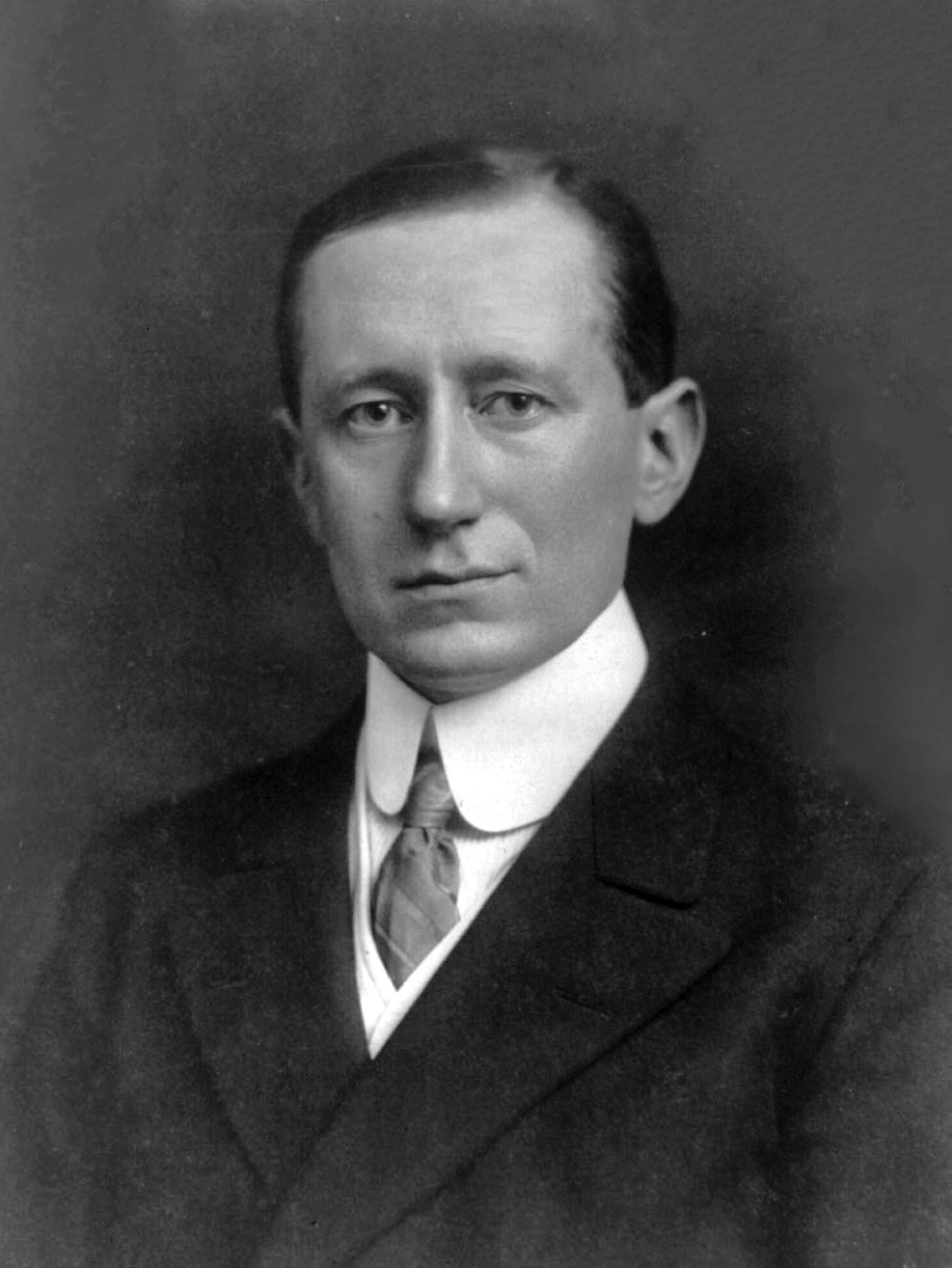
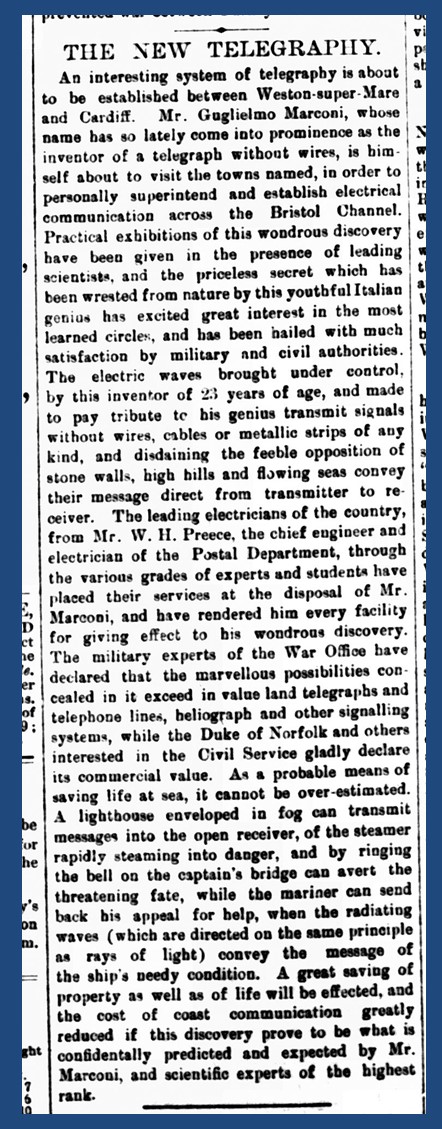
On 13th May 1897 a message was sent by Marconi on Flat Holm island over to Lavernock Point near Penarth. It was heralded as the first time a message was sent over water. The breakthrough would quickly lead to wireless telegraphy and later the wireless radio.
It was hardly the most inspiring of messages. It is reported to have said: ‘CAN YOU HEAR ME’. It was sent in Morse code and it was picked up at Lavernock Point by Marconi’s assistant George Kemp, who replied ‘YES LOUD AND CLEAR’. The recording slip for the first message is now kept at the National Museum of Wales.

The initial experiments were not successful. It was only a few days later when the equipment had been modified by extending a wire down onto Lavernock beach that a signal was successfully received. A report states:
On the 11th and 12th his experiments were unsatisfactory — worse still, they were failures — and the fate of his new system trembled in the balance.
An inspiration saved it. On the 13th May the apparatus was carried down to the beach at the foot of the cliff, and connected by another 20 yards (18 m) of wire to the pole above, thus making an aerial height of 50 yards (46 m) in all. Result, The instruments which for two days failed to record anything intelligible, now rang out the signals clear and unmistakable, and all by the addition of a few yards of wire!
A week later, on 18th May 1897 the same equipment was used to send a message between Lavernock Point in Wales and Brean Head, near Weston-Super-Mare in England. This was probably the first international telegraph message ever sent.
And here I make a bold claim. That first ever international wireless message may have been sent by a man from Roath.
I haven’t found any pictures of Marconi or Kemp sending or receiving their messages. The picture most often associated with these events is below. For years I assumed one of the men was Marconi or Kemp but apparently not.

The picture is in the National Museum of Wales collection and is labeled:-
The actual transmitting apparatus and Morse Inker used for the Lavernock – Brean Down demonstration of wireless telegraphy for the first time across water in May 1897, being inspected by three Post Office officials associated with the occasion.
By courtesy of the G.P.O. Cardiff, these officials have been identified as (from left to right) :-
Mr. G.N. Partridge, Superintending Engineer
Mr.H.C, Price, Engineer
Mr.S.E.Hailes, Linemen
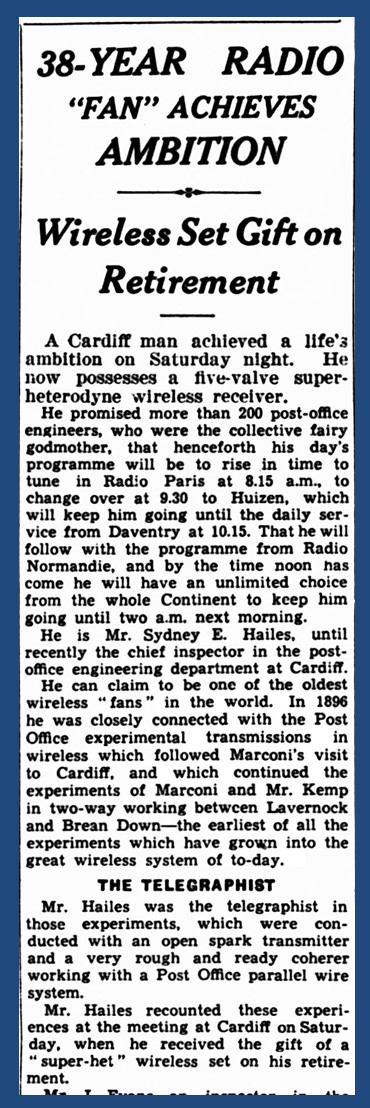
Sydney Hailes

Sidney Edward Hailes (pic credit: Ancestry)
I believe the man sat down at the front is Sydney Edward Hailes. In 1891 he was 17 and living at 8 System Street, Adamsdown and working as a telegraph messenger. By 1901 he had married and was living at 26 Swinton Street, Splott and working as a GPO Telegraph Linesman. In 1911 the Hailes family were living 26 Alfred Street, Roath and Sydney an Inspector 1st Class working at the Engineering Department of the PO Telegraphs. By 1921 he had worked his way up to be Chief Inspector Engineering Department G.P.O.
I was led to looking at Sydney Hailes and the Marconi story when I was researching one of his brothers, Frank Uriah Hailes, who was killed in WWI and remembered on the St James the Great Church war memorial, now at St John’s Church in town. On Ancestry there is a picture of the Hailes family with Sydney identified and looking remarkably like the man in the foreground of the photograph, sat down next to the telegraph equipment in the Brean Down photograph. The man on the right in the photograph appears to be the oldest and is probably Hugh Price (b.1858), who lived at Rectory Road, Canton. The man on the top left would therefore have been George Noble Partridge (b.1873) who lived at Llandaff Road, Cardiff.
What part these men played in the Marconi experiment is hard to tell. The caption describes them as ‘inspecting’ the apparatus. The family tree on Ancestry however describes Sydney was being a technician to Marconi. In his retirement speech in 1934 Sydney Hailes described himself as the telegraphist in those early experiments. So maybe he did indeed send that first international message or maybe he didn’t but he certainly appears connected with the event.
It remains a bit of a mystery as to why there are no pictures of Marconi or Kemp themselves but maybe they were keeping a low profile until the invention was patented a while later.
William Preece

William Henry Preece (pic credit: Wikipedia)
Let me introduce you to a couple of other men who played a big part. The first is William Henry Preece (b.1834), engineer-in-chief at the British Post Office. He was a Welshman from Caernarfon, Merionethshire. There’s a strong case actually for arguing that he was the first person to send a telegraph message over the water. He did this at Loch Ness a few years prior to the Marconi experiment at Lavernock. In fact it seems from a newspaper report that William Preece himself has transmitted a message from Lavernock over to Flat Holm in 1894, three years prior to Marconi. The William Preece apparatus however had no way of recording the Morse code message received. What Marconi did was to add the last piece in the jigsaw, a method to record the Morse onto a paper tape. To be honest there were probably other technological differences between what William Preece had been working on in 1894 and what Marconi ended up in 1897 with but they are beyond my comprehension.


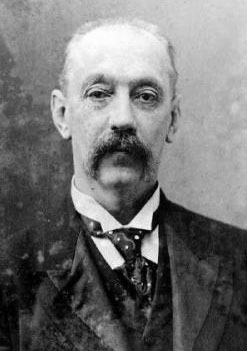
Sir John Gavey (pic credit: Guernsey Society & Cardiff Naturalists)
Working alongside William Preece at Loch Ness and other events was another man who lived in Roath, John Gavey. He was originally from St Hellier, Jersey (b.1842) but at the time of the 1881 and 1891 census he was living at 152 Newport Road, Roath and working as ‘Superintendent engineer post office telegraph’. He was a prominent member of the Cardiff Naturalists’ Society, holding the office of hon. secretary for three years, and the presidency of the society in 1890.
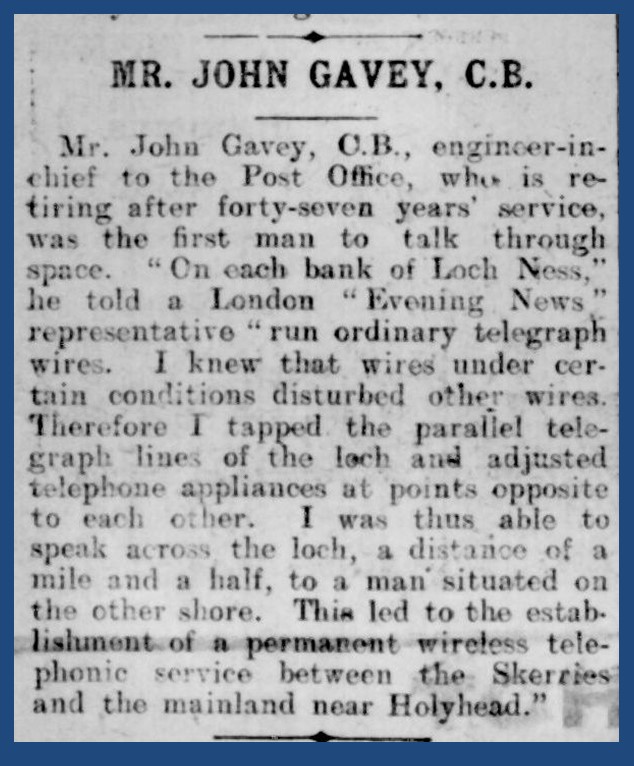
Now here’s something I never knew. In 1881 Gavey opened the first telephone trunk line connecting two British towns, namely, Newport and Cardiff.
In 1894 he worked with William Preece at Loch Ness and succeeded in establishing communication between the opposite sides.
He moved to London and would go on became Engineer-in-Chief and Electrician to the General Post Office.
It was Gavey who was responsible for the organisation of the complete telephone trunk system for Great Britain, and he organised the Post Office telephone exchange system for London. He was Knighted in 1907.
Marconi it seems was a prodigy of William Preece and both Preece and Gavey were involved in the Flat Holme experiments. Marconi was introduced to William Preece when he arrived in England in 1896 and the two worked together.
Link to article on John Gavey by Cardiff Naturalist’s Society
So having looked at some of the others involved in the Marconi experiment it is time to have a look at the man himself.
He sounds Italian, and indeed he was, well, half-Italian. Guglielmo Marconi (b.1874) was born in Bologna, Italy His mother was in fact Irish. She was Annie Jameson, part of the Jameson Irish Whiskey family. He lived part of his childhood in England and with it is believed paid periodic visits to Ireland.
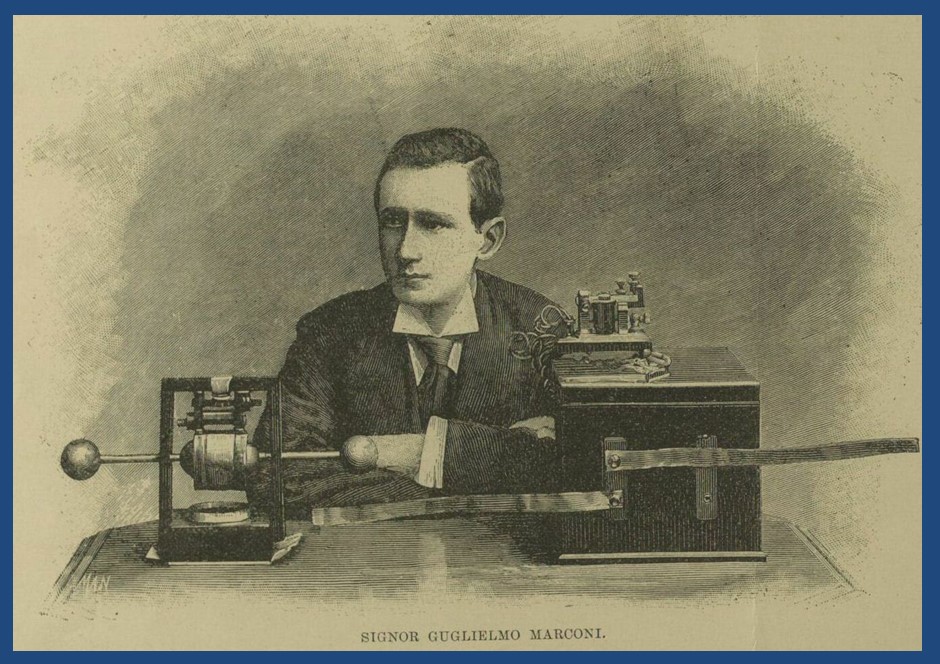
He was home-schooled and coming from a wealthy family his parents hired personal tutors for him. He never went on to attend university, and judging by his success he had no need to. He homed in on the idea of Wireless telegraphy. This wasn’t a new idea and quite a few people were working in the area. What Marconi seems to have done is make a breakthrough in certain areas and have the vision and commercial sense to turn those ideas into something.
There are a number of things that amaze me about this achievement. How on earth did he gain access to technical information. It was the days pre-computer, pre-radio, and pre-telephone etc. Being home-schooled he would not have had access to academic libraries or alike. Fascinating to think how he managed, but manage he did to come up with lots of ideas.
When the Italian authorities didn’t appear receptive to his ideas his mother bought him to England and it was then that the association between Marconi and Welshman William Preece formed.
His mother Anne Jameson wasn’t Marconi’s only connection with Ireland. He married an Irish lady, Beatrice O’Brien in 1905. They had four children together and moved to Italy. Beatrice served as a lady-in-waiting to Queen Elena of Italy. The marriage however ended in divorce in 1924. He converted to Catholicism to enable him to marry his second wife, Maria Cristina, who was half his age.
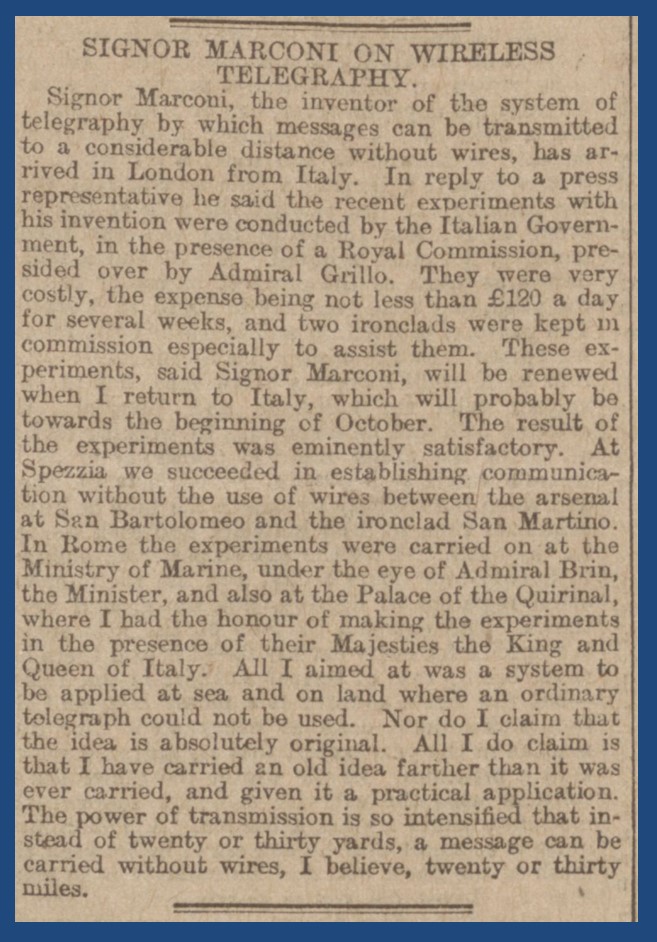
Let’s rewind a few years. After the 1897 Flat Holm experiment things moved on apace. Marconi demonstrated his apparatus in many places in Great Britain and Italy including both sets of Royal Families. He patented the invention and his charisma and marketing acumen led to commercial success. In 1909 he was jointly awarded the Nobel Prize for Physics.
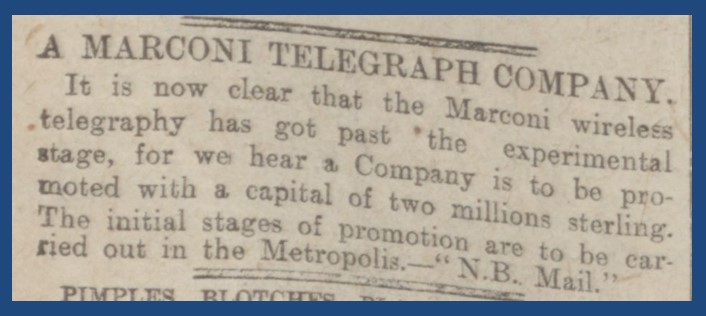
His first commercial venture was the Wireless Telegraph & Signal Company (1897–1900), renamed Marconi’s Wireless Telegraph Company in 1900. It became a mainstay of the British telecommunications industry. It was acquired by GEC in the 1960s but the Marconi name lived on in subsequent subsidiaries all the way through to 2006. Not a bad achievement for a man sat in a hut on top of Lavernock Point in 1897.
Marconi’s later years were less admirable. He joined the National Fascist Party and Mussolini appointed him President of the Royal Academy of Italy and the following quote is attributed to him. “I reclaim the honour of being the first fascist in the field of radiotelegraphy, the first who acknowledged the utility of joining the electric rays in a bundle, as Mussolini was the first in the political field who acknowledged the necessity of merging all the healthy energies of the country into a bundle, for the greater greatness of Italy”. I’m guessing this is why the 2024 Radio sculpture on Cardiff Barrage makes no reference to Marconi himself.
Other Players
I’d like to introduce you to a couple of other people who were involved in a small way with the wireless telegraphy and the arrival of the radio.
Fast forward a decade or so following Marconi’s Lavernock to Flat Holm experiment and his invention has been commercialized. Ships are making use of wireless telegraphy to communicate with the shore to relay important messages and save them having to dock.
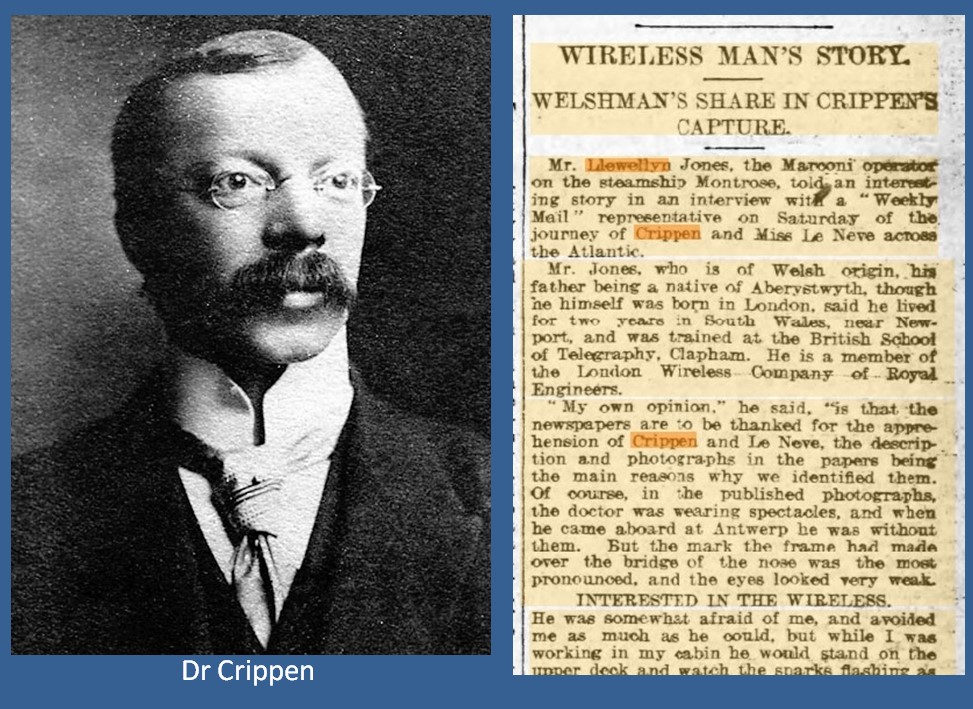
It was in 1910 that Dr Crippen the notorious London murderer had been rumbled. The body of his music-hall singer wife Cora, had been dug up from under the kitchen floor in Holloway, London. Dr Crippen and his lover Ethel le Neve went on the run, first making their way to Antwerp and then boarding a transatlantic steam ship S.S.Montrose to escape to Canada. Ethel dressed as a boy to avoid being identified. Unfortunately for them the Captain of the S.S.Montrose was very observant and identified Crippen and le Neve from a ‘Wanted’ poster he had seen posted. His priority however was to get the S.S.Montrose to Canada on time. As the ship was passing Cornwall he got his telegram operator to send a message ashore and alert the police as to who was aboard. When the police received the message they promptly sent a party to Liverpool who boarded a faster trans-Atlantic vessel meaning that when Dr Crippen and Ethel le Neve disembarked they were promptly arrested about bought back to England for trial. Dr Crippen was subsequently found guilty and sent to be hung. So why do I tell you this? Well, it was the first time that wireless telegraphy was used in a murder case and the person who sent the telegraph message from on board the S.S.Montrose was Mr Llewellyn Jones who had in Newport for two years (a somewhat tenuous link to our topic I admit).
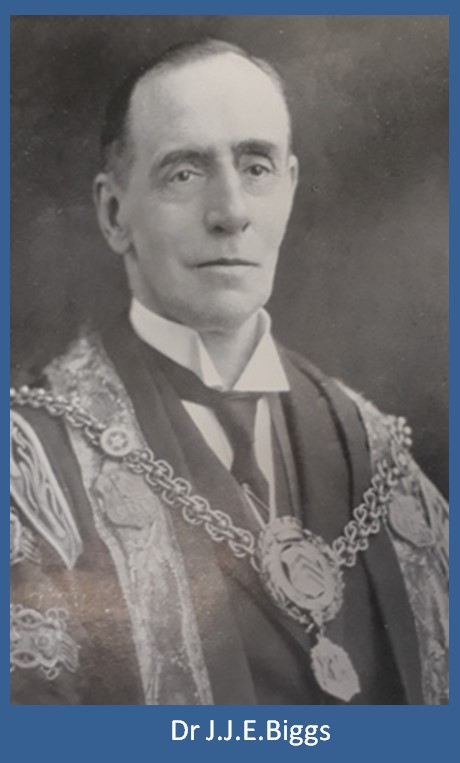 The other story I like is that of Dr.J.J.E Biggs and he certainly was a local man and lived on Newport Road, Roath. A lot of scientific advancement had happened between 1897 when Marconi sent his first message over water to Flat Holm and 1923 when wireless broadcasting first began in Wales from a little studio opposite Cardiff Castle. Have a look for the plaque on the wall next time you are passing. The man whose job it was that day to open the first BBC studio in Wales was Lord Mayor Dr.J.J.E Biggs. He gave a speech acknowledging the invention of radio and cleverly predicting the advent of TV. The only blip was he forgot the name of the BBC and then when turning to someone, asking them to remind him of the name, he forgot he still had his microphone on so everyone heard his blooper. I’ve written about him previously in Dr J.J.E.Biggs – the first man in Wales to forget the microphone was still switched on.
The Legacy in the area
There is a plaque on the wall outside St Lawrence Church in Lavernock celebrating the Marconi-Kemp transmission. It was erected 50 years after the event in 1947 by the Rotary Club of Cardiff. I still haven’t been able to find out anything about the shield on the plaque. The building attributed with the historic event is some 50 meters away, precariously perched on the cliff top.

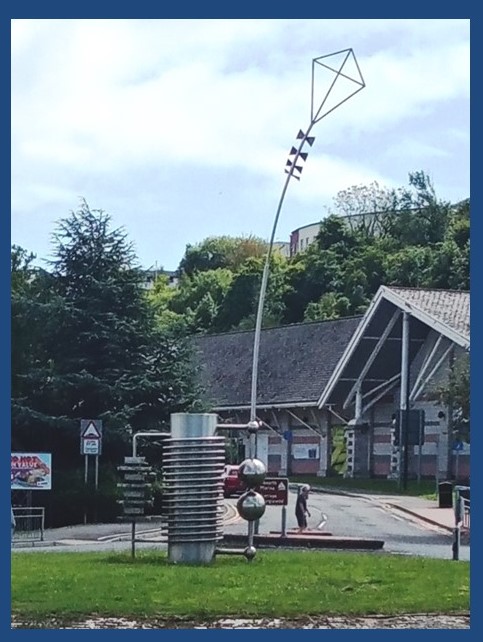
There is a sculpture on a roundabout at the entrance to Tesco in Penarth. It is a representation of the equipment used by Marconi at Lavernock by the artist Ray Smith (b.1949 Harrow, London, d.2018), It was commissioned by Tesco Stores with Cardiff Bay Arts Trust and unveiled in 1996.
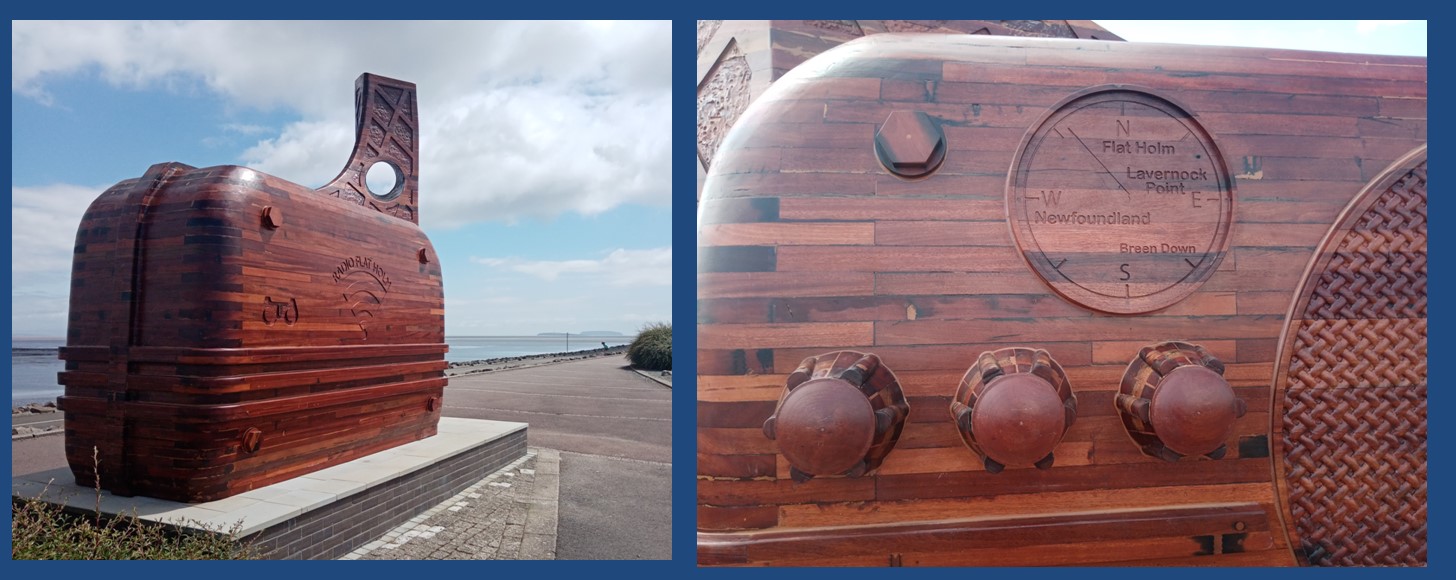
The newest nod to the historic event of 13th May 1897 is a giant wooden radio sculpture on Cardiff Barrage. I think it was conceived and designed by artist Glenn Davidson and carved at Boyesen Studios in Llangranog, West Wales. The sculpture, titled ‘Radio Flatholm’, re-uses the heritage materials, configuring them through the modem CADCAM technique of 3D carving. It is made from recycled Jarrah or Hornbeam ironwood railway sleepers, originally imported from Southeast Asia during the Victorian era. I think it is a fine piece of artwork, very tactile.
Conclusions
So whist I am sat here reflecting on the achievements of Marconi, William Preece and John Gavey and pondering the possibility that it was Roath man, Sydney Hailes, who sent the first ‘international’ telegraph message between England and Wales, I think it is time to celebrate it all and have a glass of Jameson’s Irish Whiskey. Thanks for reading.
Additional Material you may find interesting





Refs: Newspaper cuttings – FindMyPast & Welsh Newspapers Online











 Roath Local History Society