Headlines

There are so many headlines I could have used for this article such as ‘Wales’s youngest rugby international‘ or ‘The fastest man in the world?‘ or ‘Where’s his missing memorial?‘. I was spoilt for choice.
I’ve been researching Norman Biggs now for a couple of years – a fascinating character. It’s not just him – there’s a story to tell about the whole of the Biggs family, but let’s concentrate on Norman for now.
Norman’s early life
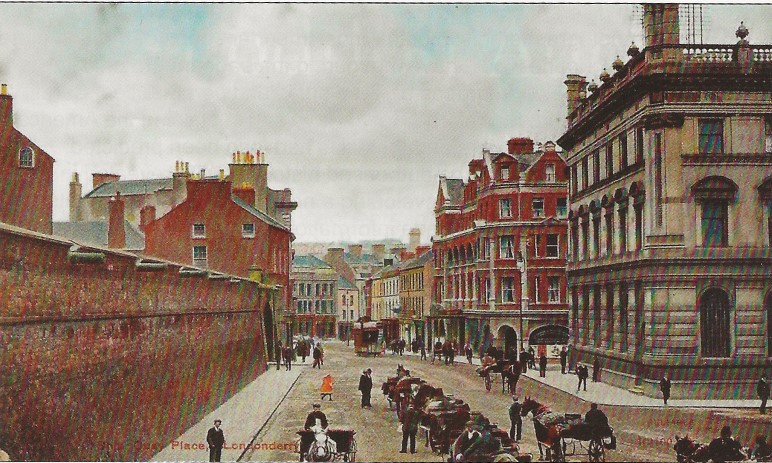
Norman Witchell Biggs was his full name. Yes, I thought it was a misprint too and it should have been Mitchell, but no, it really was Witchell. He was born in 1870 in St Andrew’s Place in the middle of Cardiff, to John Biggs, owner of the South Wales Brewery and Emily Sophia Biggs née Clark. Norman was baptised a few months later in St Mary the Virgin church on Bute Street. This confused me for a while as it’s not the nearest Anglican church to St Andrew’s Place until I found out that the Biggs family had strong associations with the church; there is a plaque in the church to Norman’s grandparents John and Eliza Biggs. Perhaps they were benefactors when the church was being built.
In the 1881 census we find Norman Biggs in Lewinsdale School, Weston-Super-Mare. I’m always amazed by how much travel there seemed to be between Cardiff and Somerset 150 years ago. There is no sign of the school there nowadays, just Lewinsdale Lodge, now a B&B.
When Norman Biggs returns to live in Cardiff he attends Cardiff Proprietary School, also confusingly known as Cardiff College. I say confusingly because the building was on Dumfries Place, and later went on the become part of the University and later still the Student’s Union.

Cardiff College building on Dumfries Place, later became part of the University and later still the Student’s union (Pic credit: Cardiff Libraries)
Norman’s sporting prowess started to show though at a young age. In 1884, aged just 13, he is playing for Cardiff College (Cardiff Preparatory School) against the University 2nd team and scores two tries. A year later the paper reports Norman, aged 14, playing cricket for Cardiff College versus Llwynypia 2nd XI.
International debut
In 1887 Norman Biggs plays first match for Cardiff on March 9th 1887, aged just 16 years 4 months and scores a try. His speed makes him a natural winger. He had a meteoric rise and a year later, he is picked to play for Wales against New Zealand. He becomes the youngest player to play for Wales aged 18 years 1 month 19 days. He held that record for 120 years until Tom Prydie made his Wales debut in 2010 at age of 18 years and 25 days.
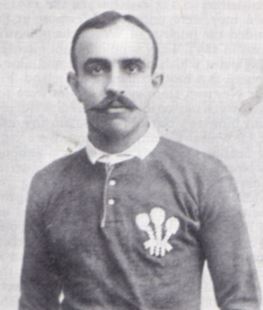
Norman Biggs in Wales jersey (pic credit: Wikipedia)
Norman’s first game for Wales didn’t go well. Although Wales won Biggs was ‘palpably nervous’. The game was held in Swansea where the crowd was hostile towards Wales players from Cardiff and the east of Wales. Newspaper quotes include: ‘The crowd positively pooh-poohed Biggs’, ‘Biggs I am bound to admit disappointed me’, ‘He is a rattling good man, next to George Morgan, the best in Wales’.
A week later, on 29th December 1888, Norman Biggs faced the same tourists, this time as part of the Cardiff team. Biggs had been disappointing in his international debut, but regained his form on the pitch at the Cardiff Arms Park. Within 90 seconds of the start of the match, Biggs scored a ‘sparkling try’. Biggs should have scored again, but dropped the ball after crossing the line in the slippery conditions. Cardiff won by a goal and a try to one try.
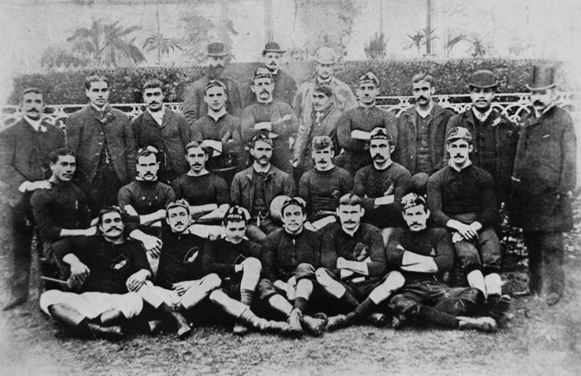
1888-89 New Zealand Native team
In January 1889 Norman is picked again to play for Wales, this time against Scotland, but pulls out as part of the ongoing dispute between east and west Wales clubs.
In March 1889 the papers report on Norman taking part in a debate at Cardiff University on smoking, speaking on the side that smoking causes harm and winning. That’s pretty insightful considering it was 60 years before the link between smoking and ill health was proven scientifically.
On March 2nd 1889 he plays again for Wales in Swansea, this time against Ireland. Wales lost with Ireland scoring two unconverted tries. Biggs had a bad game being at fault for at least one of the Ireland tries when an overhead pass of his was intercepted. Wales finished bottom of the table that year; bottom of three – England didn’t participate that season.
Let’s take another break from the rugby now for this story that demonstrates the athletic ability of Norman Biggs. It is reporting on the Cardiff University sports day on May 11th 1889: ‘The lion of the day was Norman Biggs, well-known Cardiff Football player who pulled off the 100 yds, 220 yds, the quarter, the hurdles, the high jump, the prize for throwing the cricket ball, and then crowned a phenomenally successful day by bringing himself and partner in first at the three-legged race’. How many modern day rugby internationals would take part in a three-legged race!
Reports of him partaking in a fun three-legged race are somewhat contradicted by his appearance in team photos. He always seems somewhat grumpy and surly.

Cardiff 1888-89 team Norman Biggs, middle row 2nd from left. perching on a backwards facing chair (pic credit: Cardiff Rugby Museum)
Fastest man in the world?
Watching Norman Biggs sprint down the wing with ball in hand must have been an exhilarating experience given his outstanding pace. There’s even an argument for saying he could have been the fastest man in the world. In 1889 Norman Biggs goes Cambridge University. It is not clear what he studied or whether he ever graduated. Here’s an extract from an obituary of Norman Biggs:
“Leaving the Cardiff College he graduated at Cardiff and took up his residence at Trinity Hall. Here one of his first accidents occurred. In playing football he had a couple of ribs broken and the necessary rest robbed him of his blue. He however made a name in sprinting and it is on the record that he did the 100 yds in even time. He had against him such fine flyers as Monypenny. It was a remarkable thing that in the 100 yds Norman could beat Monypenny but in the 120 yds the latter could always reach the line first, the explanation being that Norman was the better starter.”
The Monypenny in the quote above was Charlton Monypenny. Here’s what it says about him in Wikipedia: “While at Cambridge he achieved two running records, the World Record for the 150-yard dash (14.8 secs) and the Cambridge quarter of a mile track record (49.5 secs) which stood until 1931. In 1891 Monypenny was recognised as the seconded fastest man in the world behind American Luther Cary, recording a time of 10.8 seconds in the 100-metre sprint on 22 July. The next year, although recording an identical time of 10.8 seconds, he was judged the joint fastest men in the world that year, along with American athlete Cecil Lee”
Put those two articles together, the fact that Biggs could beat Monypenny over 100 yds and the fact that Monypenny was judged one of the fastest men in the world, and it could be argued that Norman Biggs was possibly the world’s fastest. An obituary and Wikipedia are hardly ‘primary sources’ for history researchers I admit but it makes you wonder. Add to it that he was only doing athletics because an injury prevented him playing rugby and those sprint times would have been made from a standing start rather than using blocks or spiked shoes and it is all pretty remarkable stuff.
International Success
Biggs plays again for Wales in 1892 against Ireland but again ends up on the losing side. In 1893 however his fortunes change and he finds himself part of the first Wales team to win a Triple Crown. On January 7th at the Arms Park, Wales beat England 12-11 in what has become known as the ‘Devil’s match’ because fires were lit around the ground the previous night to keep the pitch frost-free and enable the game to go ahead. Biggs scored. ‘After each of the three quarters had handled the ball, Norman Biggs having cleverly been given the ball by Conway Rees, sprinting away from Lockwood, got the better of Field, and scored a really fine try’.
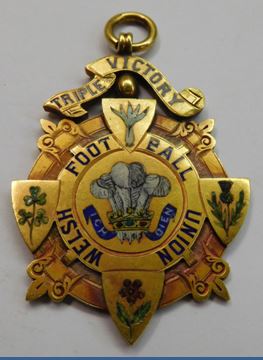
Medal awarded to players of Wales’s first triple crown winning side. This one belonged to Frank Hill and is on display at Cardiff Rugby club Museum.
The following month Wales travel to Scotland and win 9-0 and again Norman Biggs scores a try. The 1893 away game against Scotland is described as Biggs’ best international match and ‘his speed and general play were the main factors in securing the first victory of the Principality over Scotland at Scotland’.
In March Wales play Ireland at Stradey Park, Llanelli. Wales win 2-0 though a try from Gould. Ireland fielded one more forward than Wales (it was a choice how many forwards and backs were playing at the time). Quotes from the papers included: ‘Gould and Norman Biggs time after time stopped rushes, the later player saving his front rank by screw punting’, ‘the most uninteresting international contest for years past’.
Cricketing Skills
In the summer of 1893 Norman plays cricket for Glamorgan against a Cardiff team that includes his brother Selwyn, thereby becoming one of a select band of players to play both cricket for Glamorgan and rugby for Wales. Selwyn in fact later goes on to play for Glamorgan and become their opening bowler for a number of years.
Club Loyalty
Club rugby was somewhat different in the 1890s. Players weren’t contractually bound to a club as they are now and sometimes turned out for other clubs if they found themselves in different parts of the country. Norman Biggs played for London Welsh in matches against both Cardiff and Swansea in 1890. He also plays a fair bit for Richmond over the years. At one time in 1893 he gets collared by a reporter on his return to Cardiff. Norman explained ‘he was in London for a fortnight seeing a doctor every day, after he had an operation. Playing for Richmond there was no need to exert himself and nobody cared who won’.
Conclusion of International Career
Norman Biggs plays two more matches for Wales. In January 1894 against England at Birkenhead Park in front of a crown of 7,000 Wales suffered a heavy defeat, losing 24-3. In a post-match interview Biggs was asked why he had failed to tackle Harry Bradshaw, who scored the first try; Biggs responded “Tackle him? It was as much as I could do to get out of his way!”
In March 1894 Wales beat Ireland 3-0 in a game where all the backs were from Cardiff. The very next international saw Norman’s younger brother Selwyn selected for the first time, the brothers missing each other by just one match. Selwyn also goes on to have a very successful international career.
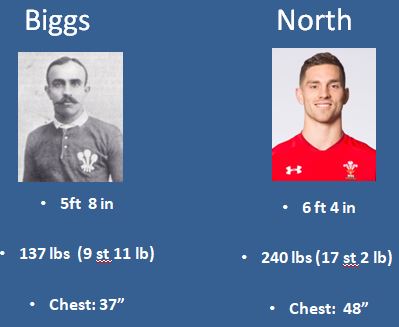
Norman Biggs compared to today’s Wales winger George North – note the difference in weight!
Cardiff Captain
In the 1893-94 season Norman Biggs captains Cardiff. During the season Biggs scored 58 conversions, 25 tries and two dropped goals bringing his points tally to 199 points, a record that remained till 1972–73 when it was surpassed by John Davies.

1893-4 Cardiff Rugby Club. Norman Biggs captain with ball and Selwyn Biggs top right (picture credit: Cardiff Rugby Club Museum)
Biggs played for Cardiff from the 1886–87 season through to 1898–99. He played in 166 matches for Cardiff, was one of the highest scoring players the club has produced. Biggs ended his Cardiff career with 107 tries, four less than another of his brothers Cecil. He scored five or more try conversions in a single match on seven occasions, six in the same season (1893-94), against Gloucester, Bristol, London Welsh, Penygraig, Exeter and Cardiff & D.R.U.
The last notable club Biggs represented was Bath. He turned out in the 1886-89 seasons sometimes. His decision to go to Bath was probably guided by the fact that his father’s brewery may have had an interest in the area. Some match reports also mention him and Selwyn promising to turn up but not and instead playing for Richmond. Norman was said to be captaining the Bath senior team during the 1899–1900 season but did not appear in the match reports, instead diverted by the next stage in his life.
The Boer War
On 5th January 1900 he joined the Glamorgan Imperial Yeomanry, a volunteer force. In the British army at the time the officers were from the gentry and the professional middle classes and the recruits from the poorest sections of society. You wonder how much horse riding experience Norman Biggs had before joining the yeomanry. It is true that the Biggs house Oldwell, Penylan, Cardiff did have stables so he had probably built up some experience.
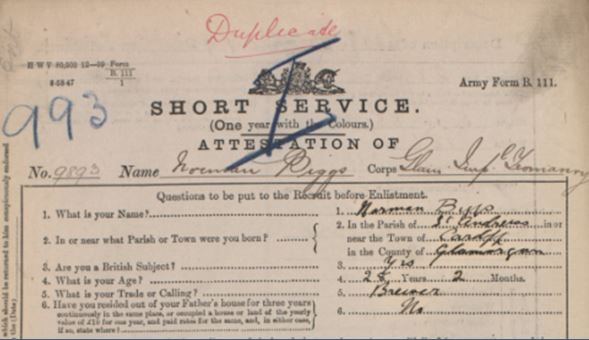
Norman Biggs signs up
His exploits in the Boer War are relatively well reported in the papers. People were naturally keen to hear how one of their rugby stars was fairing. In May 1900 he had arrived in South Africa and sends a drawing home to his brothers which was published in the Western Mail. The letter included a picture of the cook and wood gatherers. At this time his unit was still undergoing training near Cape Town. The papers also report Biggs was keen for a photograph he’d sent to be forwarded to the Conservative Club in St Mary’s Street, so we learn of his political affiliation.
By December 1900 his unit is on the front line. A letter from R S Jenkin the old Swansea football forward describes how Norman Biggs the ex-international three quarter was wounded. He says “Six miles from Vrede, our left rear flankers were fired on by almost a dozen Boers. We on the right flank heard the firing and saw the state of affairs and opened fire. Shortly the rearguard came back and things got interesting. Norman Biggs, G F Williams (late of Llandovery) and Sergeant Thomas were in the centre and as soon as they heard the firing on the right they concluded that the right flank was in trouble. They came across and Norman, mad like, went galloping towards the Boer fire, in spite of orders to the contrary being shouted to him. He having got the idea into his head that I and the others were concerned, and he meant to find out. Anyhow, he got within a hundred yards and found things getting hot, when he was wounded in the uppermost part of his thigh. He turned about but had only got a few yards when his horse was shot dead. He lay down behind it, and was about to aim, when he saw the Boers mounting and getting into position to cut off his retreat, so he picked himself up and ran off. He was shortly picked up by one of our officers, who put him on a horse and caught hold of the stirrup himself. The horse shield (sic), and Norman once more embraced mother earth. Then Major Wyndham-Quin put him on a horse, and this time he was taken in safety to the hospital. He is now much better as it is only a flesh wound.”
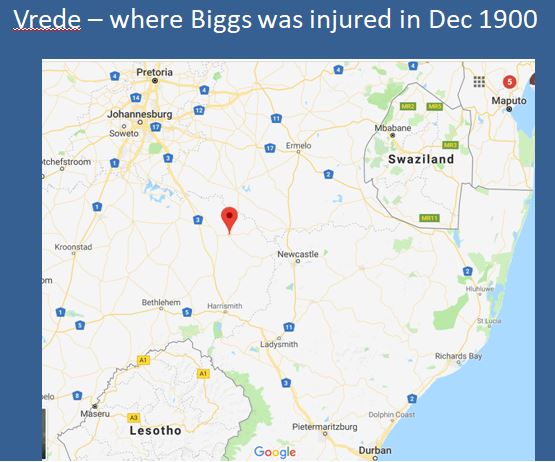
map credit: Google
Norman was sent initially to the military hospital in Harrismith. On December 19th 1900 he returns to UK on board the hospital ship Simla with 284 other men. It seems he was not home long.

Hospital ship Simla
In February it is announced he is to join ‘Paget’s Horse’, an elite horseback unit, as a Captain. He returns to South Africa but in May we read he is in hospital in Winberg with fever. In September he is discharged from hospital and in November fighting again. We don’t read much about him in the following year. He arrives home in late 1902.
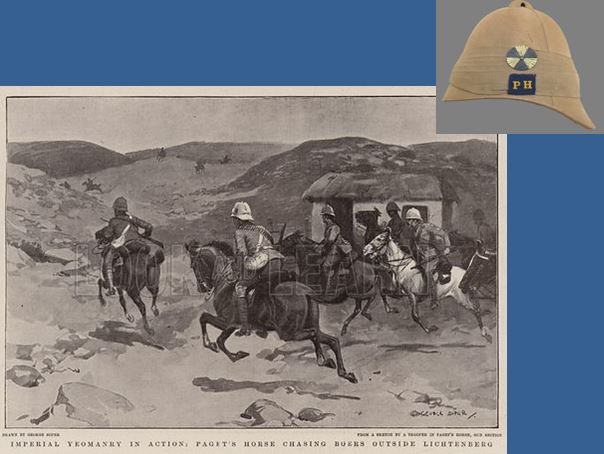
Paget’s Horse (picture credit: Look and Learn)
Extended military career
On returning home Norman appears to have made a decision to extend his military career rather than return to the family brewing business which by now was in its twilight years. He joins the regular army. He is initially stationed in Cardiff Barracks training recruits, then Aldershot, then Hythe where he takes a course in the School of Musketry.
He serves as the District Superintendent of the Northern Nigerian Constabulary. The papers say he returned to Nigeria in October 1907 having been on leave in England that summer, so must have been there previously at some stage.
Poisoned Arrow
He was killed 27 Feb 1908 at Chinuku, Northern Nigeria, after being hit by a poisoned arrow in a brush with natives whilst on patrol duty. Newspaper reports say he was trying to arrest some ‘Pagans’ who had been pillaging and were hiding in a village. On approaching the village they were attacked.
Biggs did not reload but instead rode onto the next village to allay fears of the natives who would have seen the neighbouring village burning. His intention was to warn them that their force had no quarrel with them and that they had nothing to fear.
The papers report that unfortunately his mission was misunderstood and before he could get close enough to explain his mission he was shot in the thigh by a poisoned arrow. Biggs pulled out the arrow and a fellow officer cauterised it with a red hot knife. Biggs was removed by horse to Sakaba, some 50 miles away but he died four days later. He was buried at Fort Sakaba with full military honours attended by 30 officers. It is theorised that his heart may have been weakened having had a couple of bouts of malaria. The arrow was sent home for analysis, but I can’t find any record of the outcome of the analysis.

Chinuku, Northern Nigeria (map credit: Google)
The poison used in poison darts varies throughout the world. In South America it is often taken from a venomous frog, in southern Africa from a poisonous beetle and in Northern Nigeria from the plant Strophanthus. Cardiac poisons tend to be fast-acting. The fact that Biggs died four days after being hit by the arrow would seem to indicate to me he probably died of a resulting hemorrhage rather than the poison itself – but why spoil a good story.
Norman Biggs’s Grave
The grave of Norman Biggs is marked with a simple metal cross that is talked about in a YouTube video. It looks in remarkable condition even after all this time. The cross appears to read: In loving memory of Norman W Biggs of Cardiff, Great Britain. Cpt 3rd Welch Rgt. DSG N Nigeria Killed in action. Died 27 Feb 1908.

The cross on grave of Norman Biggs
There is a fascinating YouTube video interviewing a local man who seems to be saying that it is thought they were missionaries but the locals thought they were cannibals. Click the CC button at the foot of the YouTube video to get the subtitles.

Cardiff honours Biggs
The news of the death of Norman Biggs was widely reported in the papers. A large service was held in his honour on March 16th 1908 at St John’s church, Cardiff. Mr W T Morgan and a large number of Cardiff Rugby Club assembled at the Drill Hall in Dumfries Place and marched along Queen Street to St John’s along with members of the Glamorgan Yeomanry and the Welch Regiment. The members of the Wales rugby team were unfortunately delayed on the train on their return from Ireland so arrived 90 minutes after the service.

I always think it’s best to treat obituaries with a note of caution but they do make interesting reading. One obituary says that at the age of 16 Norman Biggs was chosen to play for Wales but that his headmaster, Mr Birbeck Terry, vetoed it on the grounds that he was not sufficiently well set to stand the gruelling game of twenty years ago. The obit says that he worked for his father initially at the Salisbury Road brewery and then at the Canton Cross Brewery.
Another obituary says Biggs had ‘a fund of humour yet could be caustic in his criticism of colleagues, but he was a good judge of character and seldom mistook his man, realising that an exaggerated compliment was the best way to bring out the best in some men and a whip of sarcasm the best for others’.
The Missing Memorial
A year later on March 27th 1909 the Weekly Mail reports of a meeting held at the Angel Hotel to discuss the idea of a memorial tablet to Norman Biggs and that St John’s or St Andrew’s church commended itself. The meeting was attended by members of Cardiff Rugby and Cricket clubs, the Glamorgan Yeomanry and the Welch Regiment. The vicar of St John’s was even on the committee.
I have visited both churches and never found a memorial tablet or memorial window.
Two years later another interesting snippet appears in The Clifton Society of May 16th 1912. The idea now seems to be the idea is for a stained glass window at St John’s and it has been placed in the hands of Cardiff Football Club.
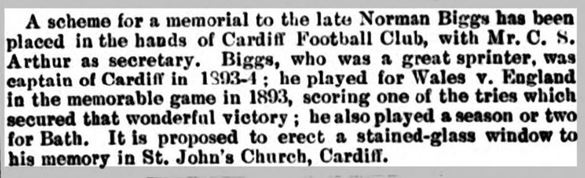
It appears that this remarkable athlete is remembered by a simple metal cross in Nigeria but not in any way in his home city of Cardiff and am left wondering the reason for that. Is it because the people of Cardiff were already beginning to question the actions that took place in Britain’s colonial past I wonder.
Many thanks to rugby and military historian Gwyn Prescott for his assistance, especially in the early days of my research into Norman Biggs.
I have a talk prepared on Norman Biggs and the Biggs family. If you are a member of a group that may be interested in hearing the talk please don’t hesitate to get in contact.

51.499586
-3.161967
















 Roath Local History Society