Memories of Growing up in Wellfield Road and Albany Road

The article below was written in 2008 by one of our members, the late Cathie Mabbitt (née O’Connor). It is supplemented by pictures featuring some of the shops mentioned in her reminiscences.

I was born in 1930. We lived behind the off-licence in Wellfield Road (Ed: No15 now occupied by Troy Meza Bar).  I always say that’s why I enjoy a drink.  Our front door was the gate leading into the lane.  Next door was Day’s Ice Cream shop and, further down, the Penylan Bakery where my brother was sent on a Saturday evening for 6 pennyworth (2½ new pence) of cream cakes and I was allowed to lick the cream off the paper bag when he came back.  It was Louis, who lived there, who let me ride his tricycle to Roath Park School when I was 4.

No 15 Wellfield Road was Continental Wine and Spirits in 1972, to the right of Thayers

When I was 5-6 we moved to the flat behind Singer’s Sewing Machine shop in Albany Road, next door to the Misses Bowen’s Wool shop.  Next door to them was the Post Office, then I think five private houses before a few more shops, including Mr Roberts the Jewellers in whose porch we would shelter while waiting for a tramcar. The other side of us was the Music Shop, with usually a grand piano in the window. Opposite us was Percy Thomas the Florist, Cadogan’s the Photographer, A G Meek who are still there, a good Ironmonger’s and The Cabin Sweetshop.  Further up was  “the Direct Grocers, where my Grandfather would sit smoking a pipe until he was served.  The Welcome Newsagents, a Sweet Shop, then Woolworth’s – still in the same place now.  Littlewoods was on the comer of Diana Street.  On the opposite corner to Woolworth’s was either Hopkin Morgan the Bakers or Lipton’s the Grocers.  At the top of the road, taking up the entire block apart from [Hopson’s] the Tobacconists,  was Collins the Drapers, where you went to the department you wanted, sat on a seat at the counter and, when you had made your purchase, your money was sent in a little capsule on a wire across the store to the cashier and your change winged back the same way.  There were lots more shops in Albany Road but these are the ones I remember.

60 Albany Road (Rediffusion) in 1980, Telefusion at No.62 and the Post Office at No.64

In Albany Road we had a porch and a large front door, a wide hall leading into a large living-room with a big pantry in the corner with a large cold slab for keeping everything cool and fresh.  Then a kitchen-scullery and outside a toilet and out-house, where you could light a fire to boil the wash and a large mangle which I don’t think I ever liked using.  We had quite a good sized back garden with a good piece of grass on one side where I could play and, on the other side, vegetables and flowers.  My Irish Grandfather, who lived with us, grew tomatoes.  My brother would be sent out with bucket and spade to collect the droppings from the dray horses and dairy horses.  My Grandfather would water it down and always seemed to be feeding his tomato plants with it as my Mother would be getting the tea, with the kitchen door wide open.  We had a side entrance opening on to Albany Road.  During the day, it was never locked so it was not unusual for my Mother to arrive home to find half-a-dozen of my brother’s friends in the kitchen having tea and biscuits.

1964 Albany Road. Chain Library was at No.84, corner of Alfred Street.

When I was 7, I was sent to St Peter’s School and made friends with Mary from Angus Street and Evelyn from Treharris Street.  We are still friends now.  Summer evenings were spent either in the street, playing all the street games, or else at the ‘Rec’ (Recreation Park) paddling in the stream or climbing down ditches.  We could spend hours over there with a couple of sandwiches and a bottle of pop, quite safe with just an occasional lecture on not to talk to strange men.

Albany Road in 1959 – extract from the Cardiff Directory. Left is south side of the Albany Road, right is the north side

My parents were credit traders, that is they sold clothes, men’s, ladies’ and children’s clothes and household goods.  Customers paid weekly for them.  My Mother had started the business and then, just before I was born, my Father lost his job so started working with her.  They were out every day and in the evenings the customers would come to the house to choose clothes.  Our big front room upstairs was the stockroom and, while waiting their turn, they would sit in the living room having a cup of tea.  It was a struggle for my parents.  Years later, my Mother told me that sometimes, to pay an urgent bill, they would borrow coppers from my money box (I was always the saver in the family) replacing it when they could.  My brother had 6d (six pence) a week pocket money, I had 4d.  Out of his, he bought my Mother a 2d bar of chocolate and I bought her a penny bar.  The other 3d was spent on a pennyworth of sweets and 2d to go to the Globe Cinema on Saturday morning.

The Globe

I was almost 9 when war was declared.  I remember the day for we all listened to Mr Chamberlain’s speech on the radio. We had the radio two years before in time for [King George VI’s] Coronation.  After his speech, I played ball quietly in the garden, wondering what it meant.  At first, life carried on as normal with black-out material lining the curtains and the street lights going out, being taught to use a gas mask and carrying it over my shoulder everywhere.  My parents sold gas mask cases and black-out material.

We had a large cellar. The coal would be delivered through the manhole in the front but then my Mother would sweep it into a tidy pile and the rest of the floor and steps were washed. (Years later, when the Rent Act altered and the new landlord gave us notice to go, all the new small houses in Roath Court Road had been sold but one came back on the market.  There were several people wanting it but the estate agent, remembering our house and how clean the cellar was, thought my Mother deserved it! But I’m going ahead of myself).  When the bombing got heavier, a single bed was put down in the cellar for me to sleep, with chairs for the others.  A neighbour in the top flat above the music shop would come in most nights, waiting for the sirens to go. The Misses Bowen had a Morrison Air Raid Shelter which they used as a dining table, with cushions and blankets underneath.  The houses, I think, had Anderson Shelters.
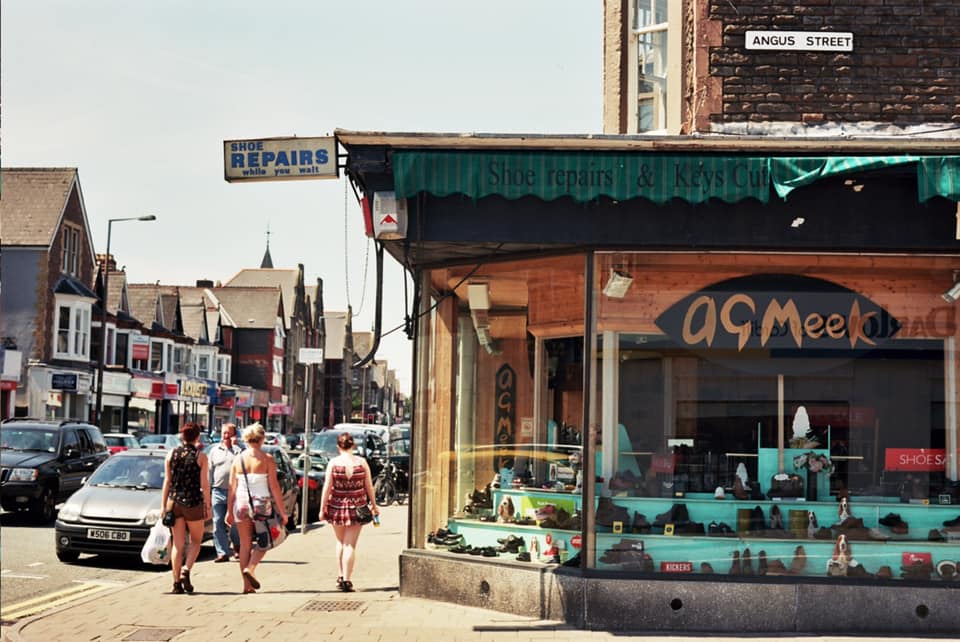
A.G.Meek before they relocated. Site now occupied by Sainsbury’s

Albany Road and Angus Street had the first bombs in Cardiff.  Most people think it was Canton and Neville Street, but no – it was us.  My Mother was in hospital, she had been in the Infirmary but was now in the [William Nichols Convalescent Home] in  St Mellons so my aunt with her baby daughter had come from Ebbw Vale to look after us.  The sirens had gone but we weren’t paying much attention when there was a huge BANG! and my Grandfather came rushing from the outside toilet with his trousers half-down and there was a crashing of glass as the greenhouse windows  broke.  The bomb had hit the Antique Shop just past Mr Roberts the Jewellers.  They  were Canadian friends of my aunt and their eldest daughter was buried under the rubble and killed.  I think they all went back to Canada ‘til the end of the War In Angus Street, it was two houses and a boy a bit older than me with big dark eyes, very shy, was also killed.
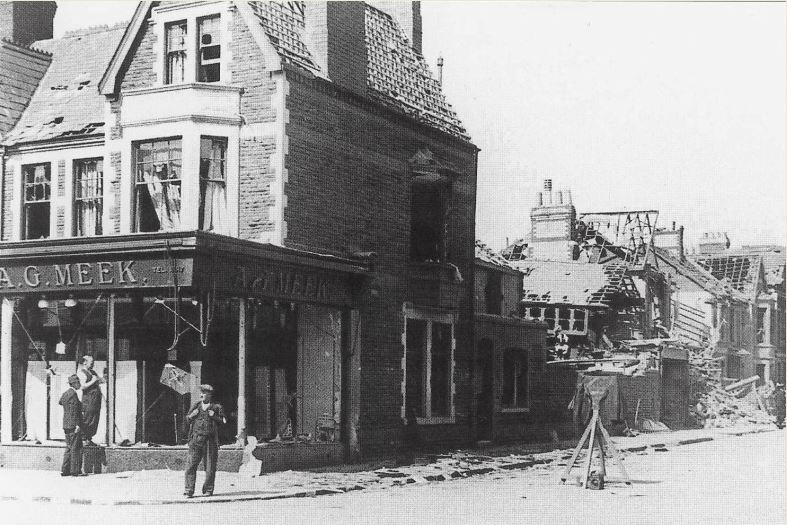
A.G.Meek on corner of Albany Road and Angus Street following the bombing in September 1940

Next morning, my friend called for me as usual for school but when we came home at lunchtime the barricades were up because sightseers had come in dozens to see what had happened.  I remember going up to the policeman to ask to go through the barriers because we lived there and the crowd looking at us with awe.

As the raids increased, Littlewoods had a big fire and St Martin’s Church also went up in smoke. I remember watching both.  Because sleep was disturbed we started school later, first 10 am and then 11 am and home at 12 for dinner!

The tramcars started at 4 am, I think they were later on Sundays.  We were so used to them, it didn’t disturb us but our visitors always woke up.  My brother had a dog, Bubble, part Airedale, who would get on a tramcar in Albany Road, change in town to the one for Pier Head and get off in Louden Square to see my Grandfather who was the park keeper there.  Then he would make the journey in reverse.  I can remember being on the tram with him.

My Mother didn’t like shopping so, before the War, though we had two grocers within a hundred yards, a man used to call every week to take her grocery order. That was how he earned his living. What we needed otherwise, my Grandfather, my brother or myself would get it.  It was this man who advised my Mother to  buy an extra bag of sugar and tea and other dried foods each week, in order to have a  Store in hand when the War came.  My Mother was careful, so we always seemed to have enough and some to share.  One customer was a Slaughterman, so often my Mother arrived home with sweetbreads for my Father’s tea, which I shared.  My uncle worked for Armours the Meat Importers, so he always gave us the turkey for Christmas.

Albany Road looking east. Albany Road School can be seen on the right. The Wellfield Road junction is just beyond the church on the left.

I never liked margarine and never ate it.  When ice cream stopped, we used to buy the cones and imagine the ice cream. When sweets were rationed, I’m sure I must have had my parents’ allocation. I would go to friends in Llandaff every week and come home with eggs and fruit from their vegetable garden.  We must have had a big cheese ration, at one time our favourite tea was our own tomatoes fried with melted cheese on top.  It didn’t look very interesting but it tasted delicious. When I learned to cook, I made marzipan. with soya flour and toffee with condensed milk.  My friend’s father worked on the Docks and one day he came home with a banana, one banana which she took to school and the nuns raffled it for charity!


More photos and links to Albany Road articles on our Albany Road page.


No.60 Albany Road is in the news at the moment as it is currently occupied by squatters protesting against landlords.
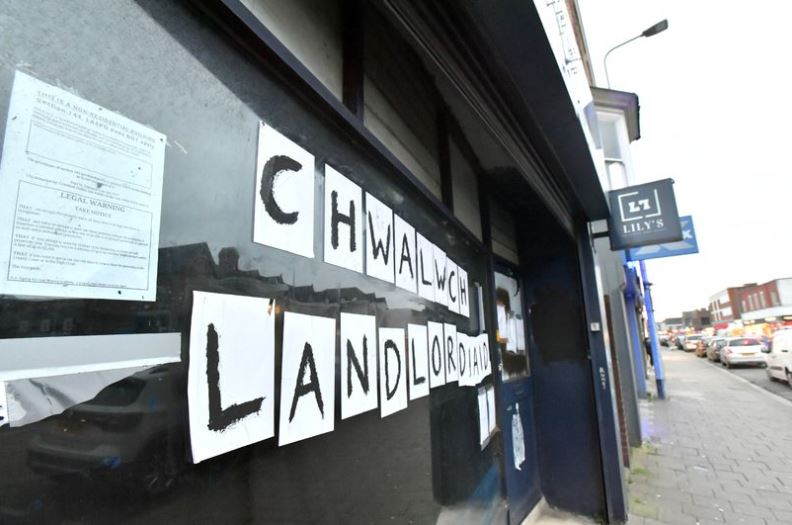
60 Albany Road – Oct 2020 – Pic Credit: Google Streetview

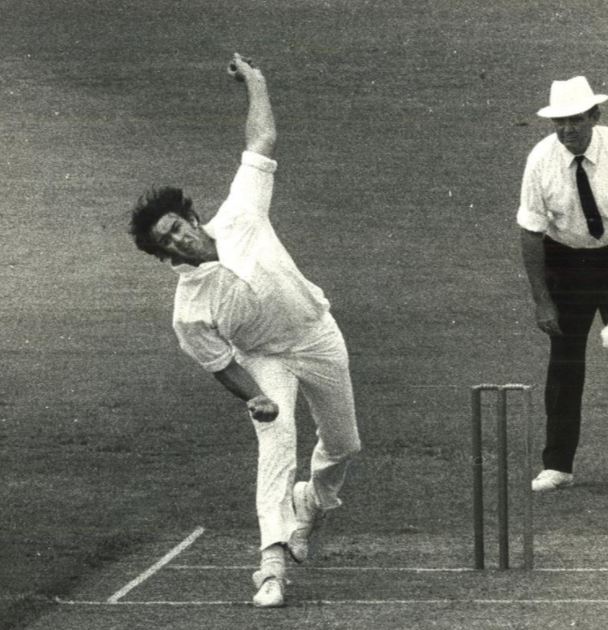
Tony Dell – Howardian pupil who played in the Ashes – for Australia

Tony Dell only played one Ashes match, but it was certainly a memorable one.  It was the 1970-71 series in Australia.  Dell played in the seventh and final game of the series and was present at the crease when Australia lost the game and England won the Ashes.  The game was memorable for all sorts of reasons.  It was Ian Chappell’s first game as Australia Captain.  It was the game England captain Ray Illingworth led his team off the ground, without permission from the umpires, following crowd trouble.  And it was the only time England have completed a test series in Australia undefeated.

So what was an ex-Howardian pupil doing playing for Australia?  Well, it’s an interesting and traumatic story that has only recently been told in full in a book about Tony’s life; And Bring the Darkness Home written with the journalist Greg Milam.

Tony Dell was born Anthony H Ross Dell on 6 Aug 1945 in New Milton, Hampshire to Alfred H R Dell and Barbara Dell née Panrucker. He was born on the same day as the bombing of Hiroshima. As such, Wikipedia states his parents gave him the middle name “Hiroshima”, with the initial “H” listed on his birth certificate.  Tony’s father joined the Royal Navy in 1934 and after leaving the navy took up a job with Hoover, initially as a travelling salesman.  After Hampshire the Dell family lived in Hemel Hempstead before moving to Cardiff.  Tony’s father was still working for Hoover and involved with the production factory at Merthyr Tydfil.

They lived here in the 1950s at 52 Llanedeyrn Road. Details of Tony’s time in Cardiff was made aware to me by Graham Barrett who interviewed Tony as part of his Once Upon A Time In The Ashes podcast series. Tony tells how on moving to Wales he attended Howardian High School in Pen-y-lan and started playing rugby.  He was in the Scouts and during the 1958 Empire Games ran errands on his bike delivering reports from the swimming and boxing back to the Games headquarters. His father was a keen rugby supporter and member of Cardiff Rugby Club and a friend of Cliff Morgan who visited their house on a number of occasions.  I don’t know if Tony ever played in any of the Howardian rugby of cricket teams.

In 1959 Tony and the family moved to Australia where his father had been given the responsibility of opening a Hoover factory. In his interview Tony says he was 12 at the time but was probably 15.  This oversight probably stems from Tony having  gone through most of his life understating his age by a couple years, an error that has only recently been corrected in the Wisden Cricketers’ Almanack.

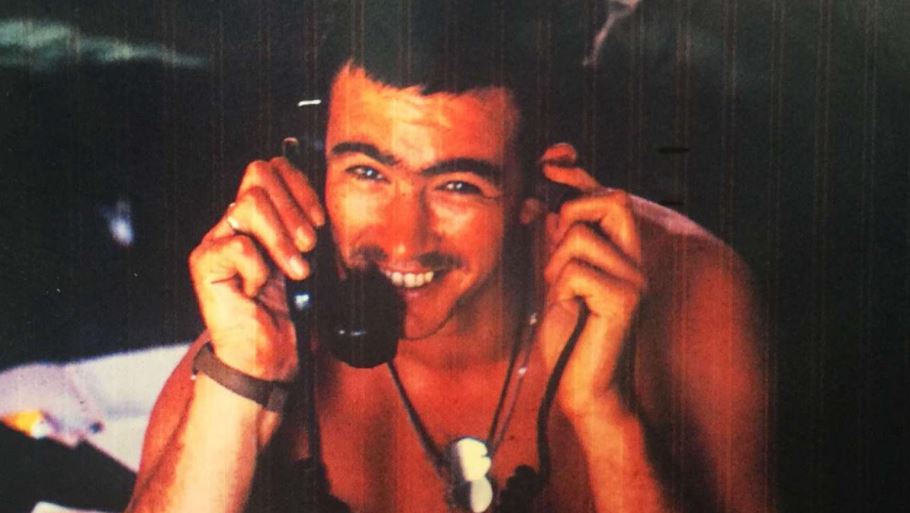
 In Australia he lived in Brisbane and started playing cricket for his school and later commenced a club cricket career.  However, he found himself called up to serve in Vietnam in 1967.  He served a ten month duty principally as a radio operator in the field.

Tony Dell serving in Vietnam

On returning from Vietnam he took up cricket again.  As a fast-medium left-arm bowler he played for Queensland and after just a handful of games was quickly selected to play for Australia.  He, like many of the Vietnam vets, didn’t talk about his war experiences.  Most people had no idea he’d even served in Vietnam.  He played just twice for Australia, once in the famous 1971 Ashes game where he took five wickets in a new-ball partnership with Dennis Lillee and then in 1973 against New Zealand before he walked away from cricket.  He is the only Australian Vietnam Vet to have played cricket for Australia.

He married and had three children. After returning from Vietnam, as well as playing cricket, he threw himself into his job in advertising and became a workaholic.  His life would however be forever tarred by the Vietnam War.  He suffered bad dreams, night sweats and his behaviour at times was belligerent. He was suffering from Post Traumatic Stress Disorder (PTSD) but it went undiagnosed for some 40 years. His life fell apart.  He became separated from his family and at one time was living in his mother’s garage. 

A chance meeting with another Vietnam Vet saved him. He was invited along to some meetings, diagnosed with PTSD and got the pension he was entitled to. In 2010 he started his charity StandTall4PTS which aims to help other Vietnam Veterans who had no idea why their lives had turned sour after they came home.  

Jonathan Agnew interviewing Tony Dell on Test Match Special in 2018

I can’t recall Tony’s test appearance in the Ashes ever being mentioned at Howardian.  I wonder if anyone made the connection at the time or if any pictures of Tony playing in Howardian junior teams survive?


I am indebted Graham Barrett for making me aware of this Cardiff connection.

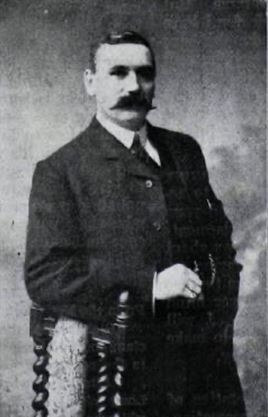
Charles Oswald Williams – Magician

Charles Oswald Williams initially grew up in Llanelly (it became Llanelli, after 1960),  born on 26th September 1864. When of age, Charles followed his father into the then successful tin industry in Llanelly.

Charles Oswald Williams magician portrait

However, around 1889 he moved to Cardiff and married Elizabeth Jane Bate. Living at 7, Stephenson Street and working as a Collector and Canvasser. In 1901 he lived at 10, Beauchamp Street and was a listed as a dealer in watches, musical instruments and homeware.

An enthusiastic, amateur conjurer, Williams corresponded regularly to all the burgeoning magic magazines with ideas, letters and magic effects.

From 1900 onwards he began a regular exchange of letters with Professor Louis Hoffmann, who was considered to be one of the greatest authorities, of his day, on the theory and practice of magic as entertainment.

Williams contributed to many seminal magic books; Hoffman’s ‘Later Magic’, Charles Lang Neil’s ‘The Modern Conjurer’ and many others.

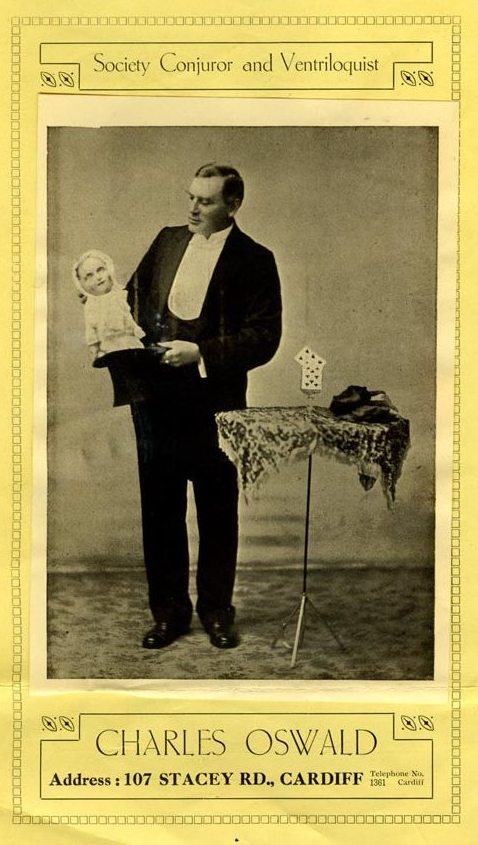
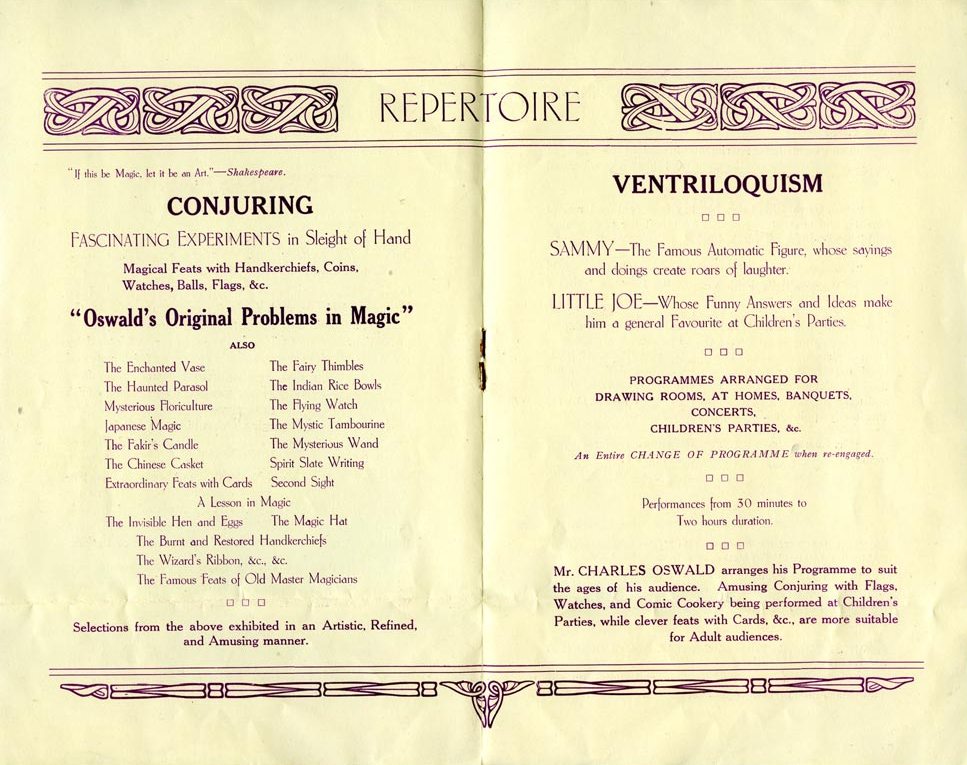
Charles Oswald - Conjuror and Ventiloquist programme - picture of CO- Glamorgan Archives

(Picture credit: Glamorgan Archives)

Now living at 107, Stacey Road, Williams was known internationally and nationally as an inventive and skilled magician. Encouraged by Hoffmann he became a professional magician in 1903, working under the name of Charles Oswald. In 1904 he was on the front cover of the American based ’The Sphinx’ magazine as magician of the month.

On Tuesday, April 10th 1906 at Maskelyne’s Theatre of Mystery in St George’s Hall, London, Williams appeared as one of the performers to appear in the newly formed Magic Circle’s first show, or as they called it, ‘The First Grand Seance’. He opened his act by speaking in Welsh! He was amongst one the first magicians to be a member of the Magic Circles ‘Inner’circle.

Charles Oswald - Conjuror and Ventiloquist programme inside - pic- Glamorgan Archives

Charles Oswald programme (Picture credit: Glamorgan Archives)

In 1913 he started as a magic dealer and was the UK representative for the renowned Thayer Magic Co. of the U.S.

Many famous magicians of the day, when in Cardiff visited Williams. Whenever Chung Ling Soo was appearing in Cardiff his first port of call was always the Williams house, on a number of occasions he tried to persuade C.O. to go into business with him and open a magic depot in London, but always the careful businessman, Williams was doubtful about the continued prosperity of the conjuring industry. Besides he already had a thriving and successful business and he looked upon magic as a hobby. Eventually, Soo convinced Williams to start selling tricks. In addition, any magician Soo met he used to tell them that if you are going anywhere near Cardiff then go and see Charlie Williams, where they would see more new effects than all the London depots put together. As a result of this, ‘Afton House’ 107, Stacey Road, Cardiff would soon become known to conjurers all over the world.

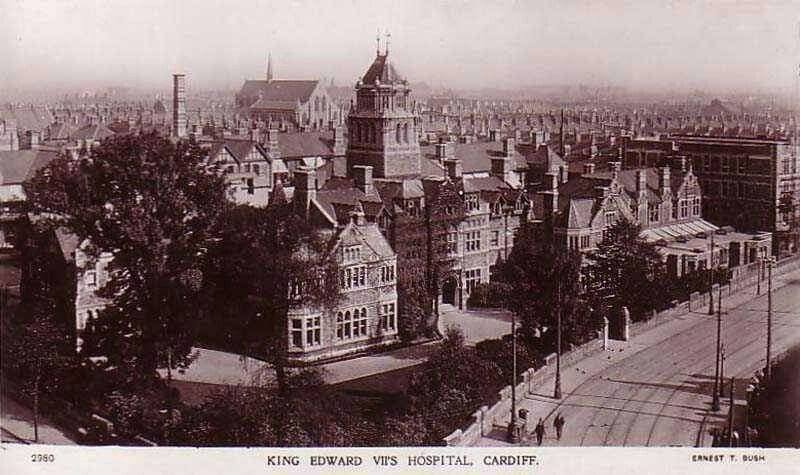
During WW1 he performed charity shows for wounded soldiers, arranging concert parties and on occasions persuading his famous visitors to accompany him to the King Edward VII Hospital (now Cardiff Royal Infirmary) to entertain the soldiers on the wards.

Charles Oswald Williams died on the 30th January 1924. He had eight children.

Steve Sanders

Charles Oswald Williams has been added to our ‘People of Roath’ page and given a red plaque.

Infirmary Plaque – Thomas Williams – a colourful story involving bigamy and a brothel

I was asked recently by a friend if I knew anything about Thomas Williams whose name appears on a plaque at the Cardiff Royal Infirmary.  I didn’t, but offered to take a look.

I first had a look to see if there was any information readily available regarding the plaque. There is reference to it in a 2010 Wales Online article describing the future refurbishment of the Infirmary and how the plaque will be saved, but that was all I found.

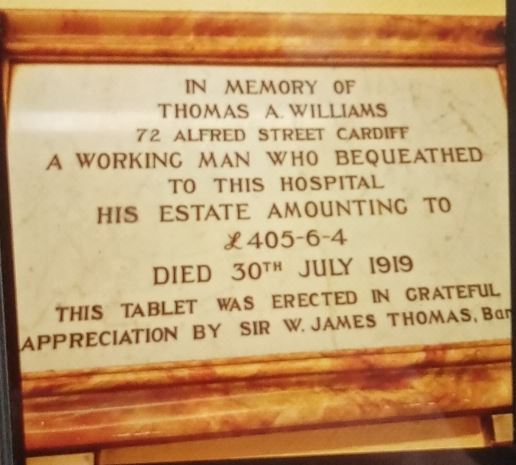
Thomas Williams - Cardiff Royal Infirmary Plaque

To understand the background of the plaque you have to realise that hospitals in those days were built and maintained with a lot of public donations.  The newspapers are littered with fundraising events and lists of people who donated sizable sums of money for its construction.  This was way before PFIs and long before the NHS.

This plaque is different from others in the Infirmary that name famous Cardiff dignitaries.  This plaque names Thomas A Williams, of 72 Alfred Street, who donated his estate of £404-6-4 to the hospital that was then called King Edward VII Hospital.  It seems Thomas wasn’t like the others. He wasn’t a wealthy Cardiff ship owner or industrialist. He was simply a generous working man.

To be honest at that stage I was expecting one of two things; either that I couldn’t find anything given that Thomas Williams is a fairly common name or to find that Thomas was simply what was evident on the plaque, a generous working man, with no family to pass his money onto.  I certainly wasn’t expecting to uncover the interesting story I did.

57504408_10217043775579114_3239808094682742784_n

I’ll take you through it in the order I discovered things just so I can share the surprises.  It’s also fair to state that although I am fairly confident of my discoveries I am by no means certain and am open to being disproved.

From a genealogical investigation point of view things initially looked like they should be easy.  I had a name, date of death and an address.  I used FreeBMD to see if I could find his age when he died.  Given he died on Jul 30th 1919 his death should have been registered in Quarter 3 of 1919.  Ahh, no Thomas A Williams death in Q3 in Cardiff or anywhere in the country nor in Q4 for that matter – strange.  There is just one Thomas Williams whose death was registered in Cardiff in Q3 and he was 78 years old.

Another approach needed.  He wasn’t living at 72 Alfred Street in the 1911 Census nor did he appear there in the 1914 Cardiff Directory.  My first breakthrough came when I found a probate record.  Thomas Williams (note the lack of middle initial) of 72 Alfred Street died on 30 Jul 1919 at King Edward VII Hospital leaving £545-7-11 in his estate with Robert Evan Salmon, Congregational Minister appointed as Executor of the Will.

Thomas Williams, 72 Alfred Street, 1919 probate record

Probate record for Thomas Williams

Robert Salmon lived on Morlais Street and was the minister at Roath Park Congregational Church (now Tabernacle) on Pen-y-wain Road.  We don’t know if Thomas left instructions with Rev Salmon on how his estate should be split or whether Rev Salmon made the decisions himself (a copy of the Will has now been ordered).

I took a punt at this stage and ordered the death certificate of Thomas Williams who died in Cardiff aged 78 in Q3 1919.  In the meantime I continued my research.

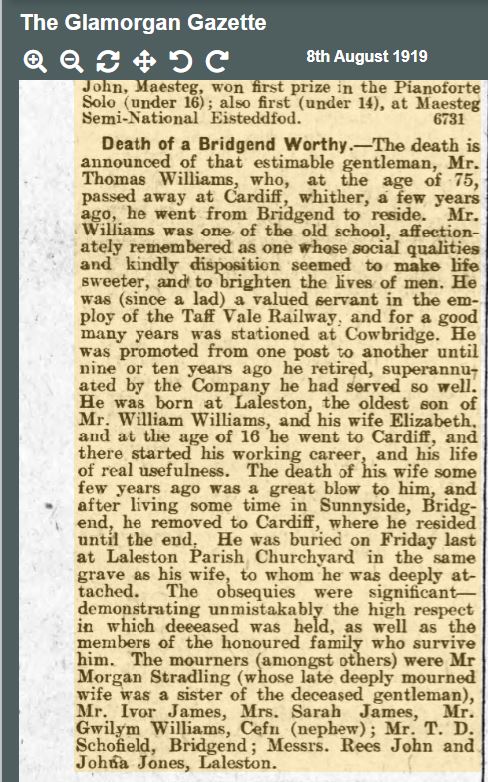
My next breakthrough came when I found a newspaper article from Aug 1919 detailing the death in Cardiff of Thomas Williams.  It was full of interesting facts for a family historian.  It stated his parent’s names, his place of birth (Laleston, near Bridgend), his occupation – he used to work for Taff Vale railway, his places of residence – Cowbridge, Sunnyside – Bridgend and then Cardiff, the fact he was a widower etc.  It describes a lovely man:-  “Mr Williams was one of the old school, affectionately remembered as one whose social qualities and kindly disposition seemed to make life sweeter, and to brighten the lives of men”.

Thomas Williams Laleston

Armed with the leads in the newspaper article I returned to searching the census records.

I quickly found him in the 1911 Census, living in Sunnyside, Bridgend with his niece Sarah James.  He is described as 70, a widower, a ‘retired engine driver loco’, and born in Laleston.

His entry in the 1901 Census was also easy to find.  He was living in East Village, Cowbridge, aged 59, a railway engine driver, born in Laleston, and spoke both English and Welsh.  He lived there with his wife Sarah, aged 40, born in Barnstaple, Devon.

In the 1891 Census he and Sarah were living in Taff Street, Cowbridge.  Thomas, aged 49, is described again as an engine driver and Sarah, aged 30, has her place of birth as Langtree, Devon.

The first surprise came when I went back another ten years and searched the 1881 Census.  Here I found Thomas Williams, aged 39, railway engine driver, born Laleston, living in Guilford Street, Cardiff. He is married not to Sarah but to Mary Williams, aged 42, born Guilford, Pembs.  Also living in the house is a daughter Mary A Williams, aged 18, born Aberdare.

So it seems our Thomas Williams had been married twice and had a daughter and possibly other decedents. Now I’m beginning to ask questions like why he didn’t leave his estate to the family.

Searching the 1871 Census for Thomas Williams, born in Laleston around 1841, yielded nothing.  I think I have found him on the 1861 Census, living in Alice Street, Canton, a 19 years old, working as a railway brakeman, born Laleston, boarding with some engine firemen. In 1851 I have found him at home, aged 9, in Laleston living with his parents, William Williams, a collier from Newton and Elizabeth Williams from Laleston.  I found his baptism record, on 27th Feb 1842 in Laleston with his father William then described as a labourer.

The missing 1871 census is still troubling me so I tried a few other angles.  I now know he is an engine driver and was married to Mary so I go back to searching the newspapers and found something I certainly wasn’t expecting.

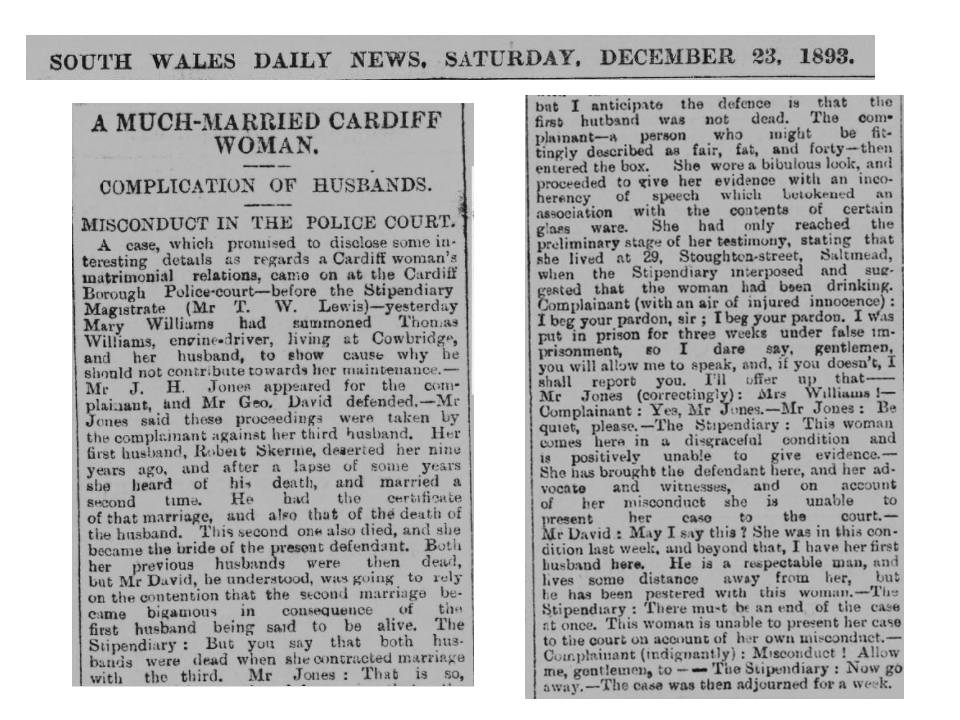
On 23 Dec 1893 Mary Williams had summoned Thomas Williams, an engine driver from Cowbridge, to court to make a case that he should pay her maintenance. The defence however seems to be preparing to make the case that her marriage to Thomas Williams we bigamous but we never quite get to hearing all the evidence as Mary Williams is the worse for wear.

Thomas Williams - Cardiff Infirmary plaque - bigamy case - Dec 23 1893

The newspaper description of Mary Williams:

…… The Complainant, a person who might fittingly be described as fair, fat and forty, then entered the box.  She wore a bibulous look, and proceeded to give her evidence with incoherency of speech which betokened an association with the contents of certain glass ware. She had only reached the preliminary stage of her testimony, stating that she lived at 29 Stoughton Street, Saltmead, when the Stipendiary interposed, and suggested that the woman had been drinking.

Complainant: (with an air of injured innocence), I beg your pardon Sir, I beg your pardon,  I was put in prison for three weeks under false imprisonment, so I dare say gentlemen you will allow me to speak, and if you don’t I shall report you. I’ll offer you up what ……..

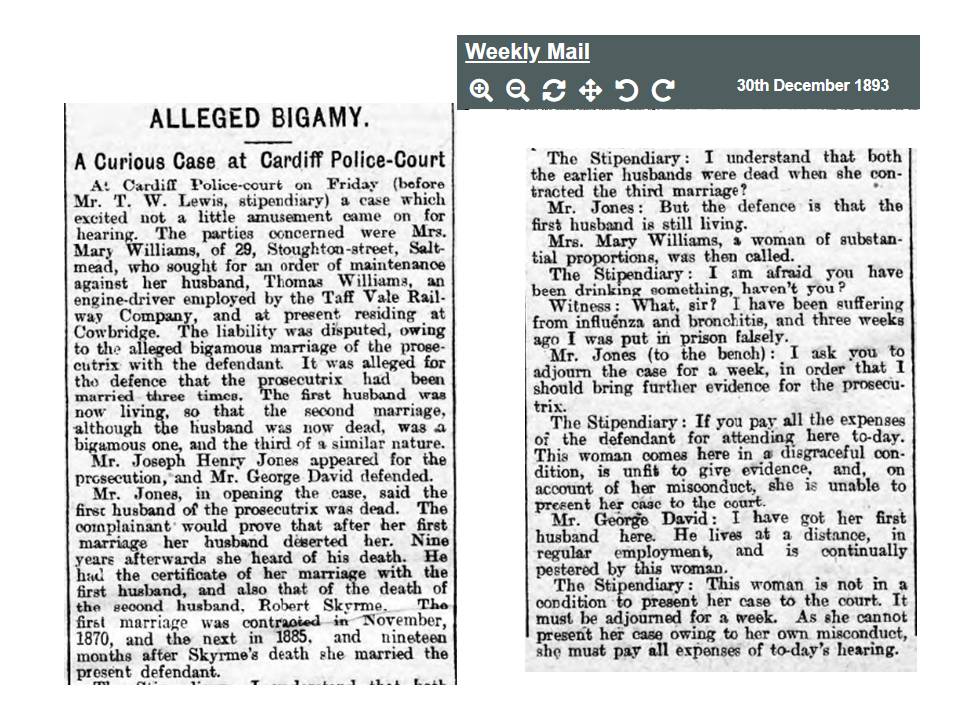
Given the state of Mary Williams the case was adjourned.  In another newspaper report she claimed to have been suffering from influenza.  The Western Mail also reported the case.

Cardiff Infirmary Plaque - Thomas Williams - story of bigamy and a brothel

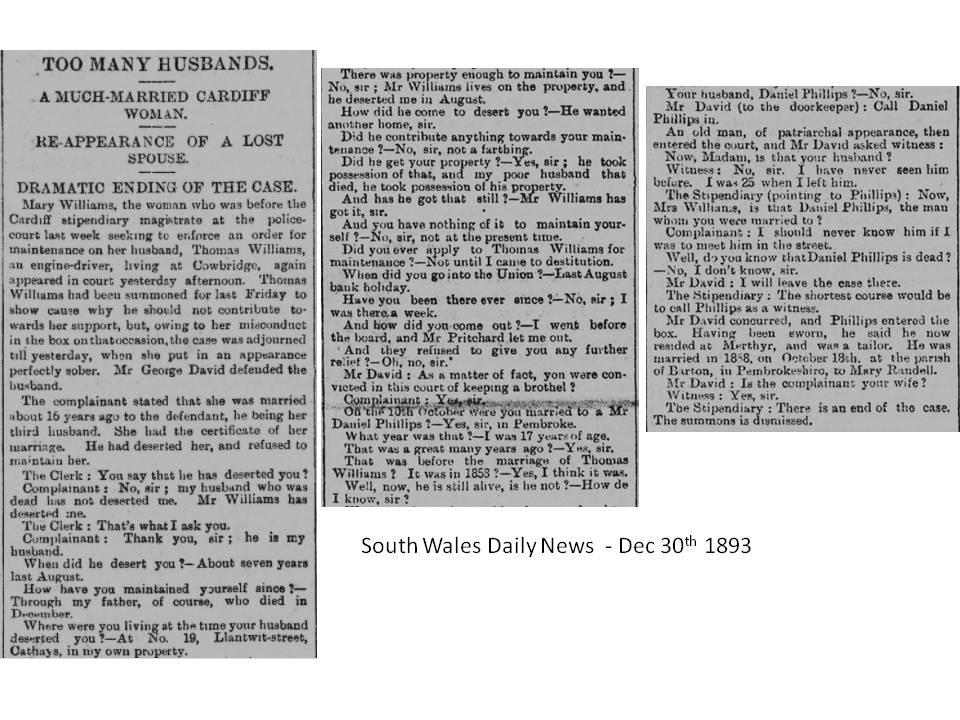
A week later, Mary Williams is back in court, this time perfectly sober.  In the course of the proceeding we hear how Mary Williams had earlier been convicted of owning a brothel.  The representatives of Thomas Williams argued that her third marriage to him is unlawful as her first husband Daniel Phillips is still alive.  She claims he is dead and even when Daniel Phillips is called she denies knowing him, “I should never know him if I was to meet him in the street”.  Daniel Phillips is sworn in and testifies that Mary Williams and he were indeed married.  Case dismissed.

Thomas Williams - Cardiff Infirmary - Bigamy case -South Wales Daily News 30 Dec

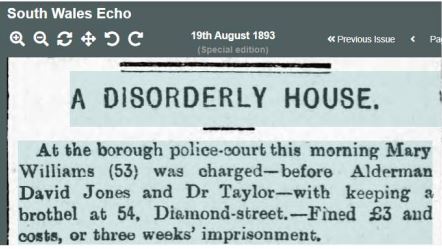
The newspaper reports of the case give some further clues as to the life of Thomas Williams as well as more questions.  There are a surprising number of cases involving a Mary Williams in Cardiff being convicted of keeping a brothel. The one referred to in the court case was quite possibly from Aug 1893 and involved 54 Diamond Street.

Mary Williams - 1893 - Brothel keeping

Given the case was in Dec 1893 and we found Thomas Williams married in Cowbridge in 1891 we are also left wondering whether his own marriage was bigamous.  Did his wife even know of the court cases in 1893 I wonder.

We know from the newspaper reports that Mary’s second husband was Robert Skyrme (at last – a less common surname to make searching easier!). He died in 1875 and his probate states he was living at 3 Guilford Street. This confirms that we seem to have the correct Thomas Williams from Laleston who was living there in 1881.  It also helps us find the marriage of Thomas Williams to Mary Skyrme in Cardiff in 1876.  So we know they were together for at least five years as evidenced by the 1881 Census.  We now also know that Mary A Williams, the daughter of Mary Williams is not the daughter of Thomas Williams but the daughter of her first husband Daniel Phillips.

There is another newspaper report of Thomas Williams, an engine driver for Taff Vale Railway, who lived in Cowbridge, helping break a strike in 1902.  Was this the same man I wonder?  The paper states that this Thomas Williams was commonly called ‘Robin’, could be Robbie, short for Anthony, that middle initial incorrectly included on the plaque – I wonder.

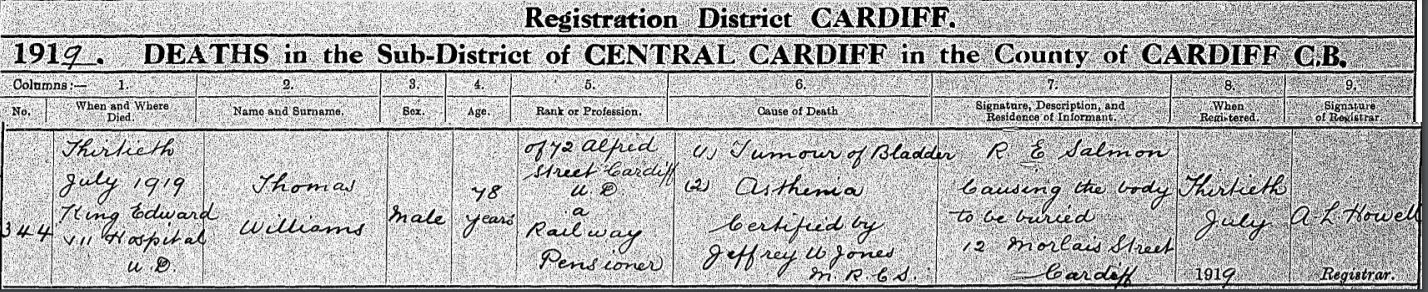
When the death certificate did arrive it substantiated the assumptions I had made.  Thomas Williams of 72 Alfred Street had died of bladder cancer aged 78 and was a retired railway worker.  I have now ordered his Will.  It will be interesting to see what that reveals.

Thomas Williams Death Certificate - Cardiff - 30 July 1919 - King Edward VII Hospital

Thomas Williams Death Certificate – Cardiff – 30 July 1919 – King Edward VII Hospital

It looks like we have found out quite a bit about the life of Thomas Williams, but by no means all I suspect.

January 2022 update: I have now received a copy of the Will of Thomas Williams.  It is interesting in that it seems he was renting a room at 72 Alfred Street whilst at the same time owning 19 Llantwit Street, Cathays.  That information nicely ties the story together for in the 1993 court case featuring the bigamous Mary Williams, she claimed to have been living at 19 Llantwit Street.

In the details of the Will it specified his Estate should be divided as follows:

  • £20 to his landlady Miss Gray
  • £20 to the Roath Park Congregational Church, Penywain Road
  • £20 to the Brecon Congregational Memorial College, Brecon
  • His Gold Chronometer Lever Watch to Reverend Robert Evan Salmon
  • All the rest to the Cardiff Infirmary

I have also now also visited Laleston and attempted to find his grave in the churchyard there but without any luck.

Penylan Club

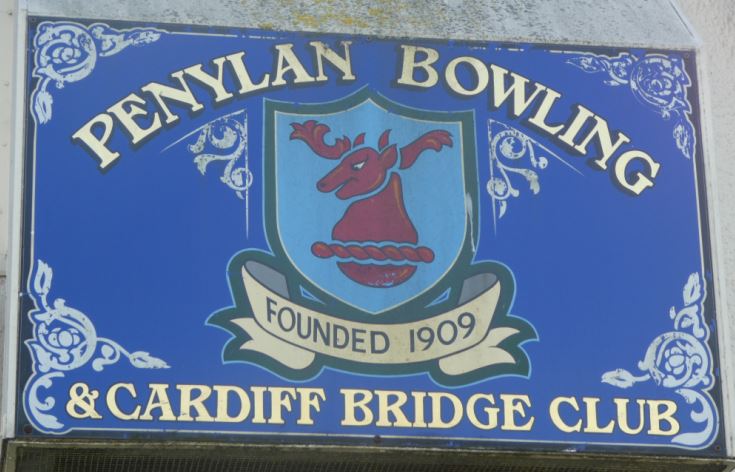
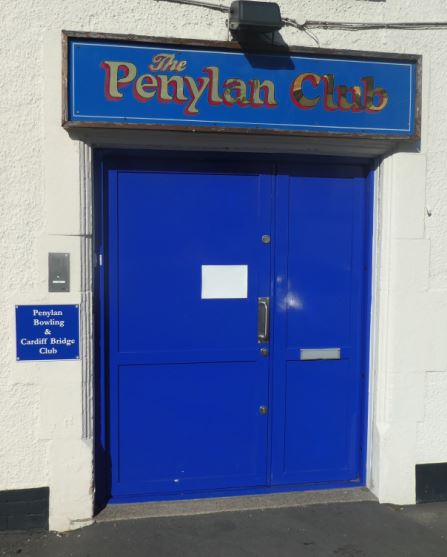
Hidden away in the back lanes off Marlborough Road is the Penylan Club, or to give it it’s official name ‘The Penylan Bowling and Cardiff Bridge Club’. 

We’ve kindly been given permission to reproduce the booklet ‘The Penylan Club Centenary Year 2009‘ which contains the fascinating history of the club itself and an interesting insight into the social history of the era.  The article below uses some extracts from that booklet, supplemented with press cuttings and photos:- 

The most important date in the history of our Club was Tuesday 3rd December 1907.  For it was on this date that an eminent local resident, Mr Thomas Mackenzie of 77, Connaught Road, circulated an invitation which read as follows:

“Proposed New Bowling Green For Roath”

Dear Sir, 

You are invited to attend a meeting in connection with the above in the Hall, Wesleyan Church, Albany Road on Thursday December 5th at 8.00pm.  As business of importance will be transacted you are particularly requested to attend. 

Yours Truly

T.Mackenzie

A further meeting was held at ‘The Creamery’, Wellfield Road on Dec 31st 1907.  A site for a bowling green had been offered by the Estate Agent acting on behalf of The Right Honourable The Lord Tredegar VC.  The original site offered was deemed to be too expensive to develop.  Further discussions with the Tredegar Estate were sought . The next meeting held at ‘The Creamery’ on Jan 8th 1908 considered an alternative site which had been offered and terms agreed.

At the first General Meeting of the Club in 1908 a vote on the naming of the club took place.  “The Marlborough Bowling Club” and “The Sandringham Bowling Club” were defeated.  The name “The Penylan Bowling and Lawn Tennis Club” was adopted.

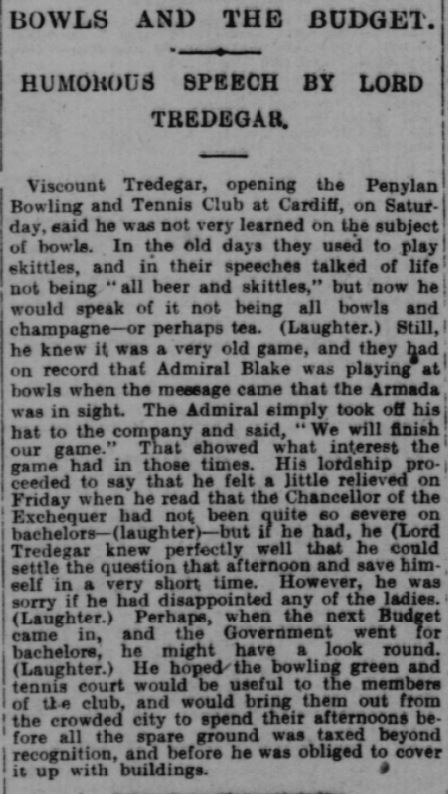
The Penylan Club was opened on May 1st 1909 by Lord Tredegar. His speech was hailed as humorous by the Western Mail:

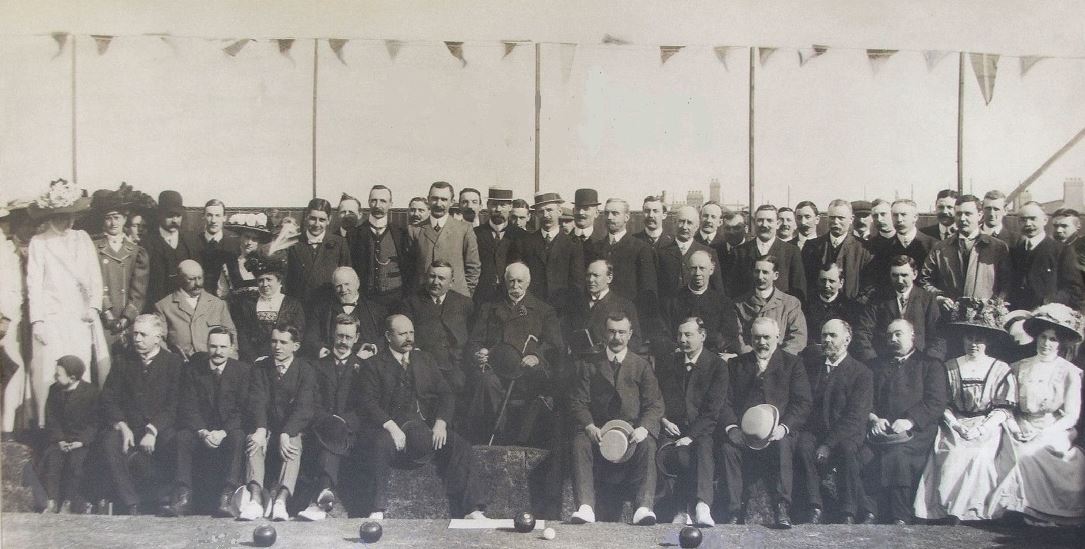
Their first President was Lord Tredegar, the man who owned most of the land in Pen-y-lan and had survived the ‘Charge of the Light Brigade’ at the Battle of Balaclava in 1854.

An early picture of the Penylan Bowling and Lawn Tennis Club with Lord Tredegar sat in the centre.

In 1912 the Western Mail reported a Penylan defeat by St Fagans, who were “helped” by the efforts of the Rt Hon The Earl of Plymouth and Lord Windsor (The St Fagans selectors were clearly not overawed by rank as both their Lordships played at third.)

These Penylan bowlers had the week before been hailed as heroes when the Western Mail of the 15th May 1912 reported:

“Some bowlers playing on the Penylan green on Tuesday evening observed flames in the neighbourhood of the Roath Laundry (on the other side of Blenheim Road to Marlborough Road school).  They stopped play immediately and ran to the fire.  Climbing a wall, they discovered that a big pile of clothes hampers were alight against the wall, and at once toppled them over. Police Constable Harold Breese arrived, and the flames were put out soon after the appearance of the tender from central station’.

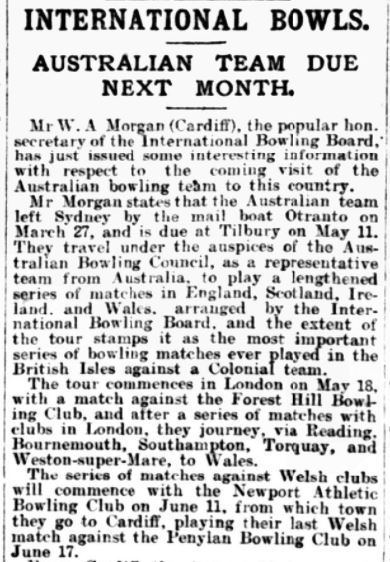
1912. Less than two years after the Penylan Club opened they were already hosting international fixtures.

In 1913 Club fees were increased to £1. 5s. 0d for Gents for Bowls and Tennis and £1.5s. 0d for Ladies for Tennis.

The War cast heavy shadow over the club and for the 1917 season all membership fees were waived  ‘in view of the endurance of the war’.  All revenues from Whist Drives etc, were donated to the local Military Hospitals.  The club purchased packets of cigarettes which were sent to members serving in the forces.  Bath chairs were purchased and distributed to all local Military Hospitals.  Proposals to relay the green and the painting of the premises were deferred.   On the brighter side bowling teas were to be introduced.  These could be provided under the food regulations at a charge of 6d per head.

In June 1918 the Penylan members took ownership of the club, albeit on a leasehold basis, the lease being held by the Tredegar Estate.  The Croquet lawn was voted out of existence but the bowls and tennis sections of the club had a waiting list.

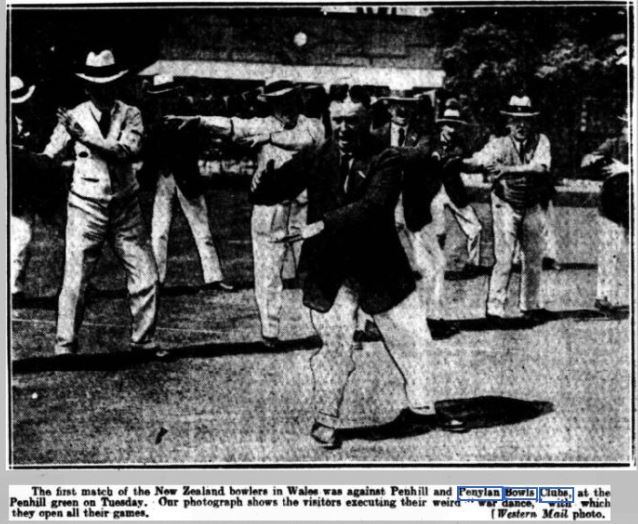
1921 – The Penylan Bowlers were reported a bit taken aback by the New Zealanders

In May 1926 the old clubhouse was broken into and, Mr H.Hayes, the son of a member, was badly mauled and had his personal effects damaged, in trying to arrest the intruder.  The Club compensated Mr Hayes in the sum of 5 Guineas and paid his medical bills.  The behaviour of the Police in not having Mr Hayes medically treated was reported to the Club President, Alderman A. J. Howell who would take the matter up with the Watch Committee (Police Authority).

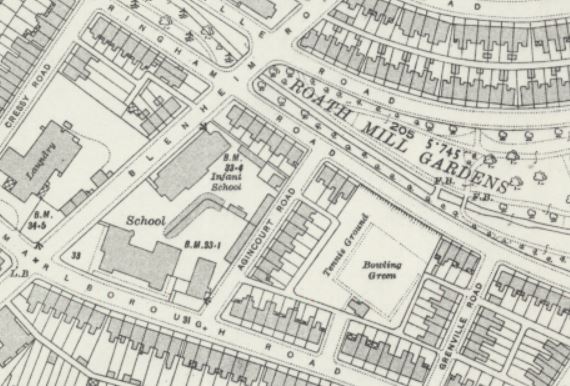
A map from the first half of the 20th Century (exact date unknown). Note the smaller size of the pavilion then. The Penylan Laundry is marked to the west.

The lease was purchased from the Tredegar Estate and this enabled plans to go ahead for the building of a new larger pavilion.  The Official Opening of the new Club House took place on 30th Jun 1936 and was carried out by the Lord Mayor of Cardiff, Alderman G. Fred Evans. 

In Oct 1936, 20 members of the Tennis Section forced the calling of a Special General Meeting on the proposal that “The courts be opened for Sunday play”.  The meeting accepted the proposal by 44 votes to 28.  At the following Management Meeting seven resignations, including that of the Lord Mayor, were received on account of the decision to allow Sunday tennis. [These resignations were subsequently withdrawn, but clearly what was seen as a breaking of the fourth commandment brought about a furious reaction.]

The years leading up to 1939 were uneventful and it is only then that the “National Crisis” which became the second World War enters the records of minutes.  The ladies tennis room was requisitioned by the Government for use as an Air Raid Wardens room and despite the new “black-out” regulations it was decided the Winter social activities should continue.

The heating of the Club would be affected by the introduction of coke rationing with the Club requesting extra rations because of the Air Raid Wardens use of the premises.

For the 1940 season all members serving in His Majesty’s forces would be granted free membership.

The Special General Meeting of 05 Oct  resulted in agreement that all members subscribe to a “War Levy” to replace loss of income from Whist Drives etc, which could no longer be held.  The levy, payable before Dec 1940 amounted to Bowlers £1.1s.0d; Social £1.1s.0d; Tennis (men) 10s 6d and Tennis (ladies) 5s.0d.

It was at this meeting that the gentlemen’s dress code on the green was emphasised – no member be allowed to play without blazer and waistcoat.

In 1942 the Lord Mayor, writing on behalf of the Anglo-Soviet Friendship Council asking for donations to raise £1500.0s.0d for an X-Ray machine for Russia. Those present at the Committee meeting immediately contributed £8.8s.0d and a fund was opened.  A month later the fund stood at £27.10s.7d.

During annual tournament week in 1950 an occasional License for the sale of alcohol was applied for.  The refreshments to be served from a marquee erected at one end of tennis court number 3.  Discussion began on the suitability of the Club obtaining a full License.  It was agreed that Wm Hancock & Co., Ltd., would operate the occasional License with the Club receiving 6% of the bar profits during tournament week.

On 8 Nov 1950 a Special General Meeting with 124 Members in attendance voted by 78 to 34 votes that the Club should obtain a full License for the sale of beer, wine and spirits.

Disaster struck in 1962 when the Groundsman treated the green with weed killer instead of fertiliser.  Most of the Private Clubs in South Wales offered the use of their greens during the recovery period.

September 1962

The sum of £105. 0s.0d. was dropped in the lane by the person doing the Club’s banking.  The money was found by three small boys from Tremorfa who returned it and received £15. 0s.0d. for their honesty.

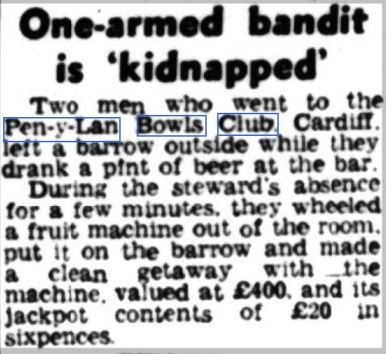
Gaming machines had been installed and were bringing in additional income. After the annual License fee of £75 had been paid a large surplus was being accumulated from the fruit machines.

The next major improvement occurred in 1973 when the Trustees authorised expenditure of up to £4,000 which would allow the Management Committee to pursue plans for a major extension of the Club lounge.  This would entail including the outside veranda area into the lounge area.  Initial plans were drawn up.

In Sep 1989 initial discussions were began with one of Wales’ premier Bridge Clubs with a view to amalgamation.  At a Special General Meeting held on 20 Dec 1989 it was decided that the long standing Badminton section would in future play at a venue away from the Club.   A motion that “Cardiff Bridge Club be incorporated into the Club and become a new section of the Club” was carried.

In 1995 a Ladies Bowling Section was formed and has since prospered.

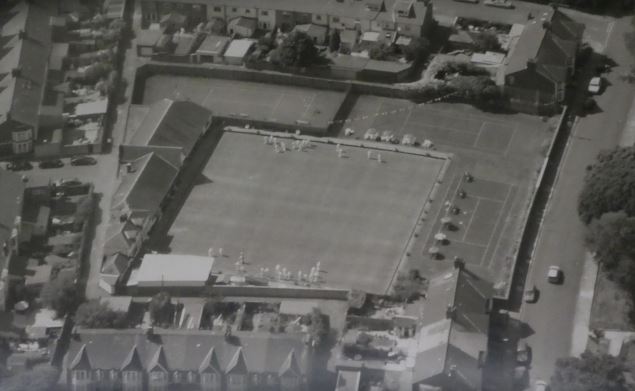
View from the air when the tennis courts were still in place.

The August 1998 Minutes record that at this mid Season point the Tennis Section Membership numbered 13 full Members and 13 Junior Members.  Grave concern was being expressed about the viable future of the Section.  By the following Season the Tennis Section which had played a large and important role in the life of Penylan had ceased to exist.

A new category of Membership was devised and there was a large response from local residents who joined as non-voting Associate Members.

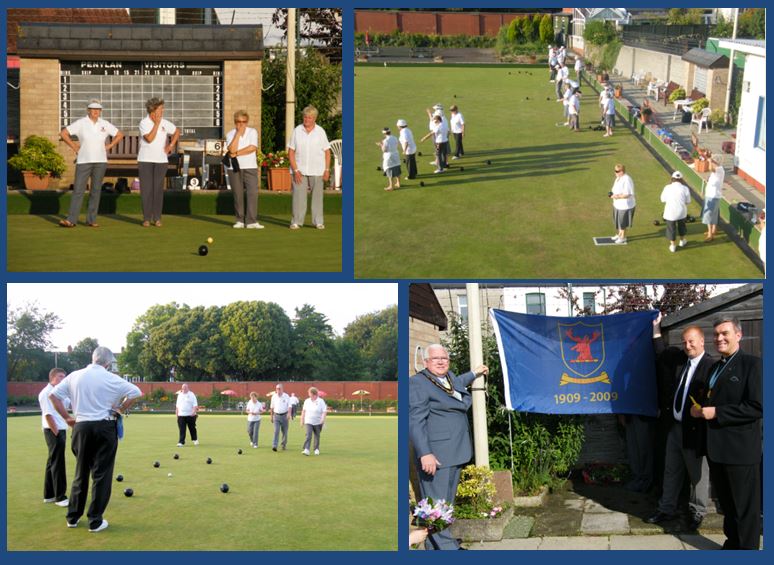
Scenes from the 2009 Centenary celebrations

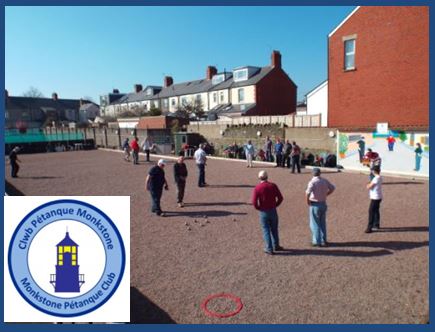
The Monkstone Pétanque Club joined the Penylan Club family about ten years ago and now lease and area of land within the premises.

Monkstone Petanque Club

The Penylan Club see themselves as a community asset and currently has a membership of 442.  New members are always welcome to apply for membership and the necessary forms are available from the club bar.

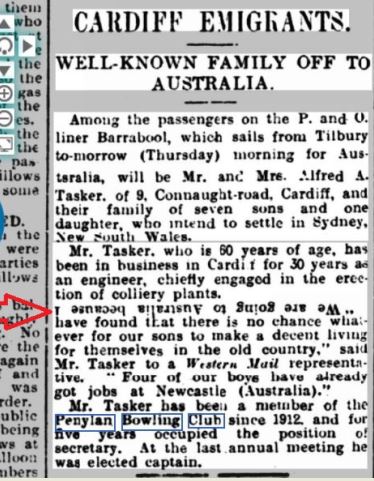
And to finish with here’s a story from the Western Mail in 1926 reporting the elected captain heading for Australia. It looks like the typesetter on the Western Mail nightshift was being a bit mischievous!


The Penylan Club has now been added to our webpage looking at the history of pubs and clubs in the area.

Owain Arwel Hughes

Renowned conductor and passionate about championing Welsh music

Owain Arwel Hughes CBE

The conductor Owain Arwel Hughes is the son of composer Arwel Hughes. He was brought up in 1 Colchester Avenue, Pen-y-lan, Cardiff and would have been born here in 1942 had it not been for the wartime air raids which meant he ended up been born in his Aunt’s house in Ton Pentre, Rhondda.  He is unusual for the time in being a Welsh-speaker from Cardiff but that is explained by his parents being Welsh speaking and him spending so much of his school holidays with his relatives in Rhosllanerchrugog, near Wrexham.

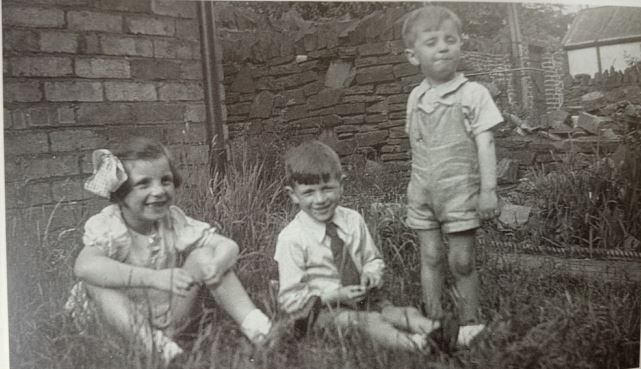
Owain Arwel Hughes with his sister and brother in the back garden of 1 Colchester Avenue

Owain Arwel Hughes with his sister and brother in the back garden of 1 Colchester Avenue in 1946

He had a strong chapel upbringing, attending Tabernacle Welsh-speaking chapel in the Hayes in Cardiff City Centre from an early age.  It had strong discipline with children being required to learn and recite biblical passages from a young age.  It also however gave youngsters attending the youth club responsibility from a young age.

Owain attended Marlborough Road Primary School and loved sport from an early age including playing baseball on the Rec.  He passed the eleven-plus but rather than attend Cardiff High School which taught lessons on a Saturday morning, he persuaded his parents to allow him to go to Hawardian High School which freed up his Saturday mornings for playing sport.

In 1985 Owain paid a return visit to Howardian with the broadcaster David Parry-Jones.  The footage itself is of historical interest as not only does it show scenes from the school that no longer exists but also of a conversation with Howardian stalwart Tom Foster, Latin and drama teacher and cricket fanatic.

Howardian High School and Owain Arwel Hughes

Owain doing an Assembly Reading in his school days, Mr Tom Foster, Owain and David Parry-Jones in 1985 at Howardian.

Owain was part of a cricket team nurtured by Tom Foster that got all the way to the cup-final and played at the Glamorgan Cricket ground, then at the Arms Park.

HOwardian Male Voice CHoir

Howardian High School league and cup-winning side of 1955 with Owain as captain.

It’s perhaps surprising that Owain succeeded in music at all given the fact that the Howardian music master left and was not replaced.  Owain recalls complaining to the Head about the lack of a choir to which the Head retorted that perhaps Owain should go off and form one himself – which he duly did. So Owain’s conducting career was catalysed by the lack of a music master at Howardian, but it wasn’t a musical career that Owain set off to attain.   He left school with every intention of entering the Christian Ministry by initially reading Philosophy at Cardiff University before intending to onto the South Wales Baptist College in Richmond Road.

He started his philosophy degree at Cardiff but didn’t by any means ignore his musical callings.  In his second year he got to lead the male voice choir in the inter-college Eisteddfod competition, a choir that included a fledgling politician Neil Kinnock with whom he has remained friends.  Owain redirected his degree studies towards music and from there his career as a conductor was formed. Whilst in college his met his future wife Jean and proposed to her on the steps of his parent’s home at 1 Colchester Avenue.

1 Colchester Avenue, Penylan, Cardiff, childhood home of Owain Arwel Hughes

1 Colchester Avenue, Penylan, Cardiff, childhood home of Owain Arwel Hughes and where he proposed to his future wife Jean.

After graduating in Cardiff Owain was offered a place at the Royal College of Music in London to study conducting where Sir Adrian Boult was his mentor.  But he wasn’t just a passive student.  Owain highlighted the lack of opportunities for those composing orchestral pieces to hear them played so duly formed an orchestra of his own at the college. As well as conducting Owain played the piano, trombone and percussion instruments.

Before Owain became a professional conductor the Welsh Arts Council gave him a bursary to experience the everyday business and functions of a conductor.  Owain chose to shadow the recently deceased Dutch conductor Bernard Haitink from whom he learnt a lot.

In London he immersed himself in Welsh life, attending a Welsh chapel, being a keen supporter of London Welsh Rugby Club and a member of the London Welsh Association for Welsh exiles living in London.

He married at the Welsh-speaking Tabernacle chapel in the centre of Cardiff though tells an interesting tale how it almost didn’t happen as he mislaid the paperwork.   Making ends meet was difficult for the young couple.  When his wife gave up teaching when pregnant Owain took a job as a taxi driver.

Soon however his career began to take off.  He gained appointments with the BBC Northern Ireland Orchestra, the BBC Studio Strings and the Halle Orchestra. This led to further appointments with the Royal Philharmonic Orchestra, the Philharmonia Orchestra and the BBC National Orchestra of Wales.  Over the years he has had international appointments too with orchestras in Cape Town, Newfoundland and Aalborg in Denmark.

In the 1980s he hosted a BBC series The Much Loved Music Show.

His father Arwel Hughes was particularly known for his choral music, and this facility was passed to Owain, whose stint as conductor of the world-famous Huddersfield Choral Society in the 1980s confirmed him as a major talent in the field of large-scale choral works. He has continued to excel in this area both in the concert hall and the recording studio.

He maintains strong links with Wales and in his time has was proud to be musical director of the National Youth Orchestra for Wales and  driving force behind the creation and success of The Welsh Proms.  His dedication to championing Welsh musical talent is typified by him establishing in 2005 Camerata Wales, a freelance orchestra of the highest international standard for Wales.

Rehearsing for the Welsh Proms 1987 Max Boyce, Nerys Hughes, Neil Kinnock, Owain Arwel Hughes and Cliff Morgan

Rehearsing for the Welsh Proms 1987 Max Boyce, Nerys Hughes, Neil Kinnock, Owain Arwel Hughes and Cliff Morgan

He and Jean went on to have two children together, Geraint and Lisa.  Tragedy struck in 2016 when Lisa, a head teacher in South London, died of an aggressive form of breast cancer. He dedicated the 2017 Welsh Proms to her.

Let’s not just talk about Owain Arwel Hughes in the past.  He is still very much a professional conductor including working with orchestras in Wales.

His contribution to musical life has been recognised by an OBE in 2004 and a CBE in the 2009 New Year honours list.

References and pic credits:

His autobiography,  Owain Arwel Hughes: My Life in Music, was published in 2012  by University of Wales Press.

The Owain Arwel Hughes website.

Red Plaque

A virtual red plaque for Owain Arwel Hughes has now been added to our People of Roath page. 

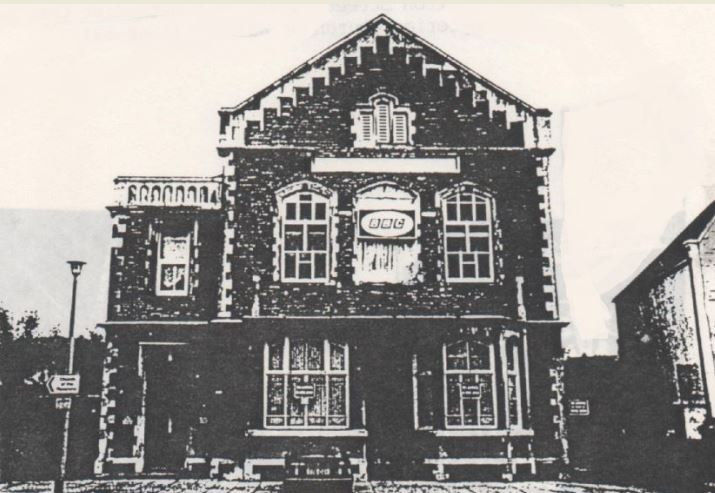
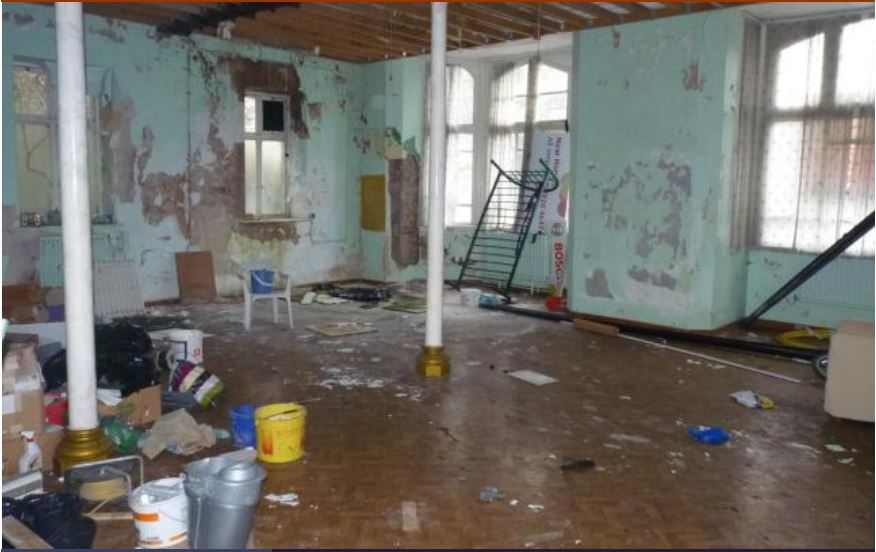
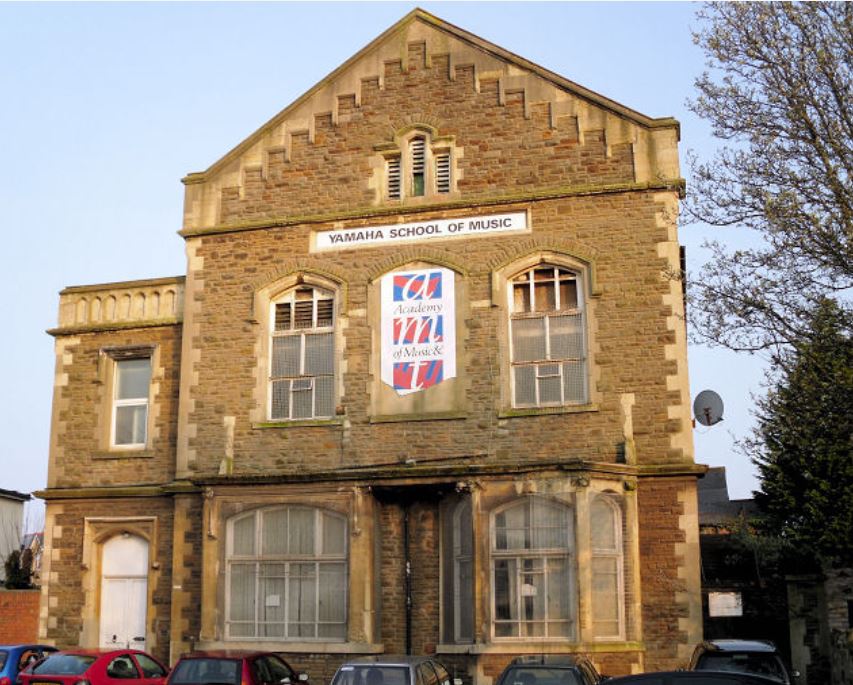
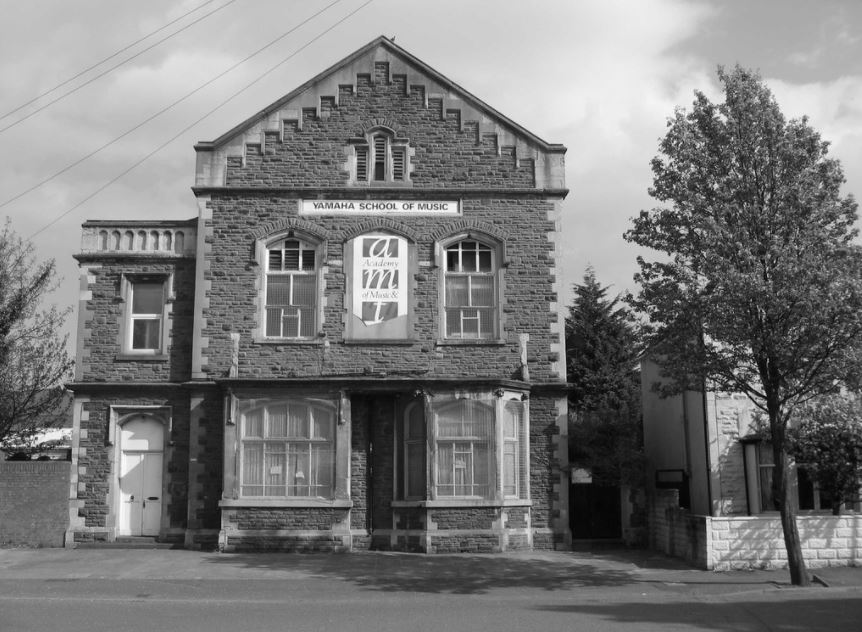
16a Stacey Road – but what was this building?

If you are ever stuck for a topic to start a discussion with a group of people from Roath just show them this picture and ask them what the building used to be used for.  You’ll get lots of different answers, and many will be right, but not all. Some will say it was a church.  Well, it almost was, but not quite.

Using newspaper archives and other mentions of the hall the following history has been pieced together:

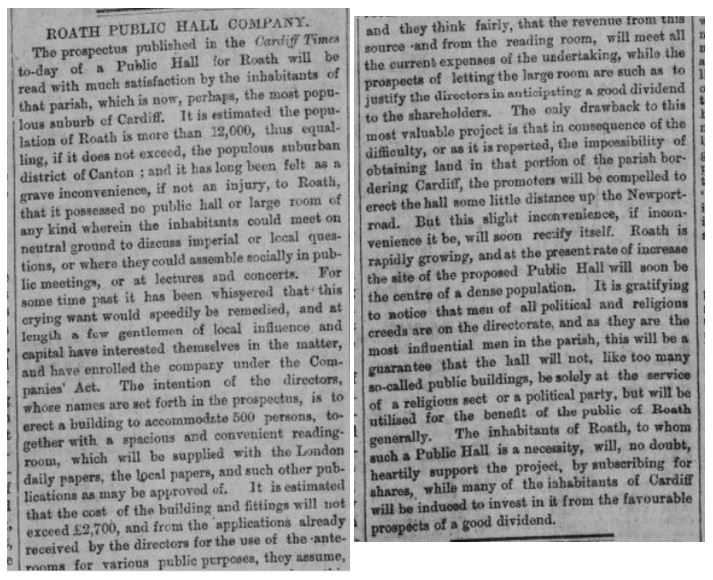
1873: A prospectus for Roath Public Hall issued.

~1881: Construction of Roath Public Hall

1883: First press records of events and concerts

1894: Purchased by Roath Congregational Church.

1898: Roath Public Library

1912-15: Roath Electric Theatre (silent movies)

1916 to ~1940: Stacey Hall

1940-45: Military barracks (Home Defence)  depot

1950: Star Ballroom & Stacey Labour Hall

1959 to ~1989: BBC Studios

~1990 to ~2000: Yamaha School of Music

~ 2000 to present day – vacant

Smashing image of the building from 2006 by Roath Park Mark on Flickr

The first mention of Roath Public Hall appears in the newspapers of January 1875 announcing the setting up of the Roath Public Hall Company. The prospectus states the intention to construct  hall in Stacey Road able to accommodate 600 plus a reading room. The justification being that Roath’s population has expanded to 12,000 and there was nowhere to hold concerts or lectures. Two thousand shares would be issued at £2 each. Top of the list of the Trustees was John Cory, the wealthy Cardiff ship-owner, coal exporter and philanthropist. Yes, that’s right, the man with a statue outside the museum that was unusually erected when he was still alive.  He was living in Roath Road (Newport Road) at the time but went on to purchase Duffryn House, St Nicholas.

In 1879 the papers report that Roath Public Hall has not materialised and the only evidence of it was a brass plaque outside the residence of the secretary to the company.  The article pointedly explains that the Catholics have meanwhile constructed a Guild Hall in Roath.

By 1883 however Roath Public Hall has evidently been constructed and opened and records of events begin to appear including:

April: A fundraising concert for a new Baptist chapel.

August: A German and Oriental concert, reported as being poorly attended.

October: A talk entitled ‘Escaped Nun’ delivered by a Edith O’Gorman Auffray recounting her days as a nun in USA before she ‘escaped’ and converted to Protestantism.

In September the same year a new music licence was granted to the hall, it having been demonstrated that 400 people could be evacuated in three and a half minutes.

From here on mentions of Roath Public Hall in the newspapers are frequent and they give an interesting insight into social history and history of the building over time.  Here’s a few examples, supplemented with information from other sources:  

1886: A fundraising concert for a new organ at St Margaret’s church.

1887: Cardiff Liberal Association hold a talk entitled ‘Ireland: Past, Present and Future’.

1888: Cardiff Jewish Literary and Musical Institute hold a series of soirees.

1888: Cardiff Liberal Association: ‘Coercion versus Conciliation’ or ‘England’s duty towards Ireland’.

1888: A meeting of the Cardiff Free Library and Museum Committee discussed an experiment of a branch reading room at Roath Public Hall. (this wasn’t to materialise for another ten years).  In the mentime a reading room was opened at Clifton Street Methodist church.

1894: Building sold to Roath Congregational chapel that had until now been meeting in a temporary building on Roath Road (Newport Road). The church met in the building behind Roath Public Hall and submitted plans to convert the hall into a church. It is believed at this change of use never took place.

1897: Dance classes being held at the hall.

1898:  Roath Branch Library opens in the hall.  Said to be a lot better lighted and ventilated than the previous location and able to accommodate a lot more readers.  The move however is only temporary as the corporation has purchased a site at Four Elms on Newport Road and the new library constructed and opened in Oct 1901.

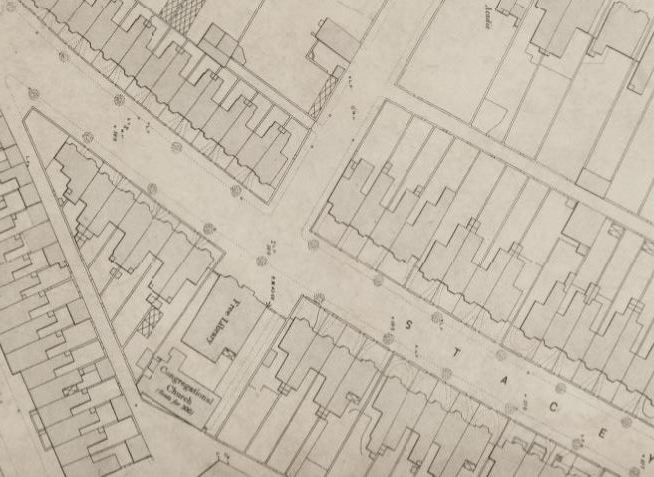
Map of around 1900 with the building labelled as the Free Library and the Congregational Church at the rear facing Broadway.

1899: An evening in which ‘a series of tableaux vivants of exceptionally high merit’ were part.

1909: Cookery lessons being delivered.

1909: Plans submitted for an outdoor washhouse

1911: Plans submitted for a ‘Cinema Box’

1912: listed as ‘Stacey Road Kinema’

1913: listed as ‘Roath Electric Cinema’

1915: For sale – ‘Roath Public Hall, together with the Chapel at the rear. The hall has two floors with excellent headroom, the upper floor recently having been used as a cinema …..’

1918: A series of entertainments held for soldiers at Stacey Hall headquarters of the R.D.C. at Cardiff.

1918: An interesting cutting reading: Outside Stacey Hall in Cardiff is to be seen what is probably the oldest trophy in Cardiff. It is composed of the Turkish, Sardinian, French and English flags in a row with the word Peace underneath. The trophy was made in Manchester and was first displayed at the end of the Crimean War. 

1920: Members of the Gwaelodygarth Welsh Dramatic Society gave a performance of  ‘Asgre Lan’.

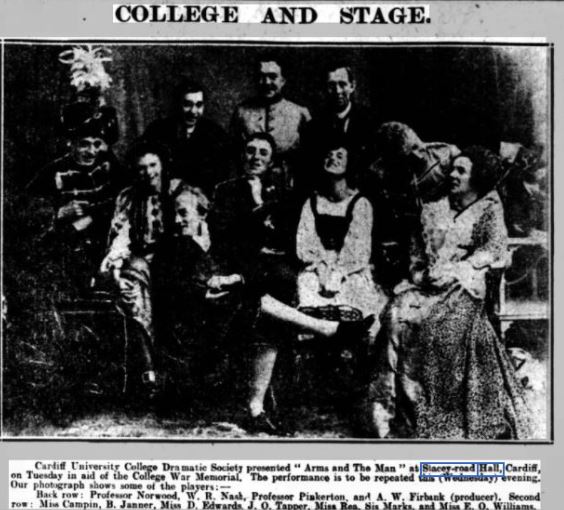
1921: Cardiff University College Dramatic Society gave a performance of ‘Arms and the Man’ in aid of the college war memorial.

1928: Mr E.Roy Calvert, Secretary of the National League for Abolition of the Death Penalty gave a talk ‘Why Capital Punishment Must Go’. (It was another 40 years before it was abolished)

1929: Four hundred people turn up for the payment of Christmas relief, a top-up to the standard weekly payments to the people of Roath and Plasnewydd wards in need of support. The extra 1s 6d came as a surprise to many recipients.

1940-45: Military barracks (Home Defence)  depot

1947: Well appointed Cardiff Ballroom tenancy advertised. ‘Perfect maple floor, 60ft x 30ft’. Applications to the Secretary, Stacey Hall.

In the late 1940s it was Star Ballroom, upstairs, large sprung dance floor with mirrors and seating around the perimeter. Rock ‘n’ Roll dances there from 1956 onwards.

1956: Beginners Ballroom dance class every Friday night.

1950s: Recollections from people of Whist Drives with 30 plus tables, four players per table.

1950s: Local Labour party offices and Labour League of Youth meetings.   

1959: James Callaghan MP, future Prime Minister, holds constituency meetings.

1959: BBC opens new Stacey Road studio.  The arrival of television prompted the BBC to purchase a ten acre site at Llandaff in 1952 to house all its operations in the city, but construction of the new headquarters was delayed due to the cost of the project, so in 1955 the Broadway Methodist Chapel in Roath – followed in 1959 by premises in nearby Stacey Road – were taken over to accommodate the fledgling television service.  Stacey Road studios were headquarters of the news broadcasting services.

BBC Stacey Road Studio

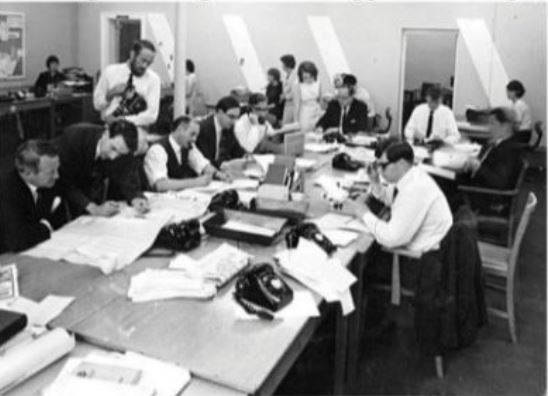
1966: Wales Today and the Welsh language news programme Heddiw were broadcast from Stacey Road at the time of the Aberfan Disaster.  

BBC News Studio at Stacey Road in 1966

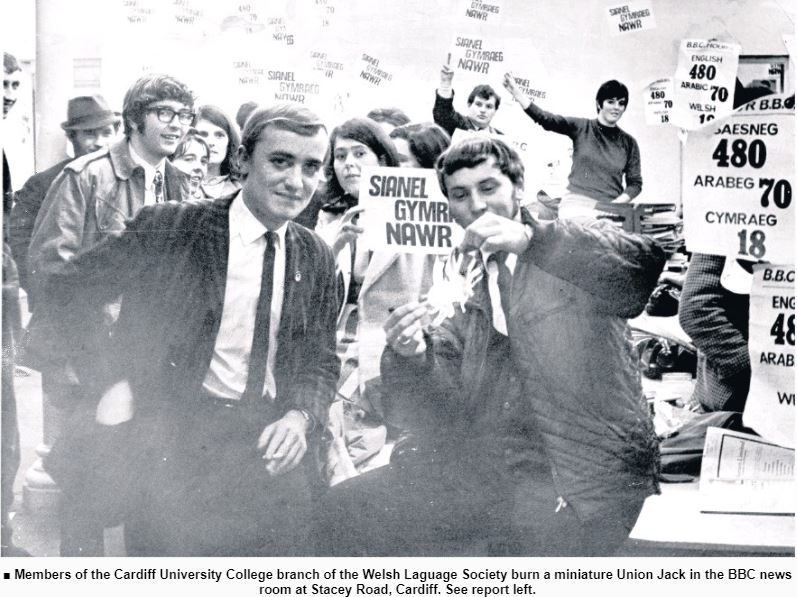
1968: Forty Welsh Language demonstrators occupy the Stacey Road news studios.

1974: BBC cease broadcasting  Wales Today from Stacey Road.

1990: BBC Film operations stayed at Stacey Road studios till 1990.

1990s: Yamaha School of Music – exact dates of occupancy uncertain.  Anyone remember going there?

~ 2000 to present day – vacant

Interior shot from one of the sales brochures. In need of renovation?

Please feel free to share your memories of the building, provide more accurate dates, additional information or highlight any errors. Photographs would be particularly welcome.

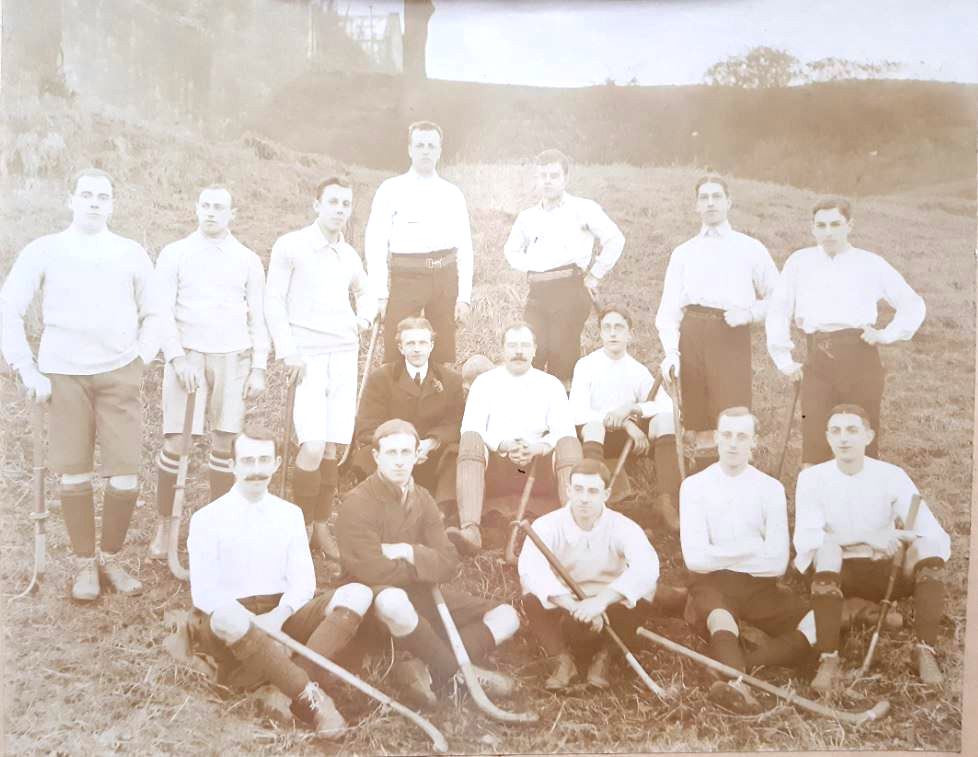
East Cardiff Hockey Club – the mystery photograph

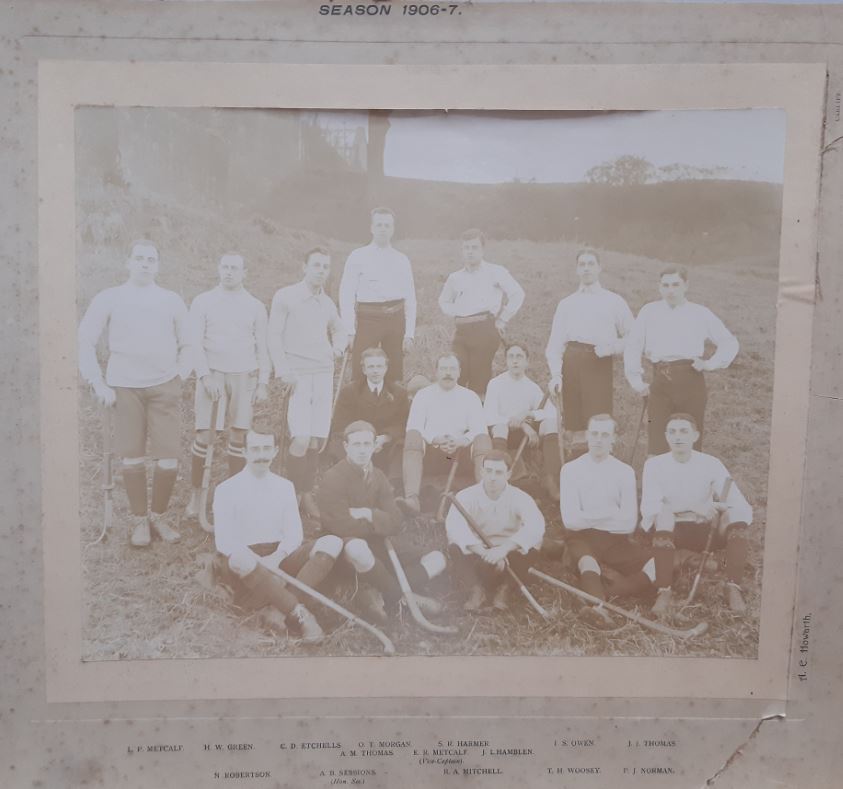
There’s nothing I like more than solving a mystery, so my luck was in when we were approached a couple of days ago asking for help in identifying a picture of a 1906-7 hockey team. 

We were approached by Mari from West Wales who had found the photo being used as a backing board for another photograph. In the process of adapting the old hockey photo for use as a backing board it had evidently been trimmed and the name of the club was missing.  Mari started some research and thought some of the names in the photo had a Cardiff connection.  That’s when she approached us wondering if we could shed any more light on the mystery hockey team.

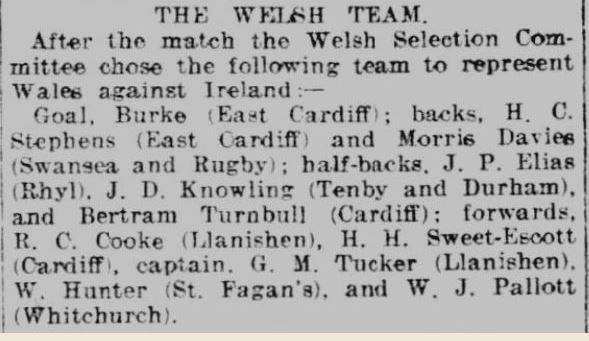
It has proved an interesting exercise and uncovered some interesting Cardiff history which I hadn’t anticipated.  My conclusion is that it is the East Cardiff Hockey team based on press cuttings naming the team and the individuals.  But this is where I need your help.  Are there any hockey historians out there? Who were the East Cardiff Hockey Team and what happened to them?  I haven’t even been able to find out where they played.  It’s all still a bit of a mystery.  

There is one newspaper cutting from 1914 describing a court case involving the landlord of the Maltsters Arms Hotel in  Whitchurch and the East Cardiff Hockey Club. It says that accommodation was provided for 2 guineas a year.  Does this imply their home ground was nearby I wonder?  I can find nothing about the club after this.  I’m wondering if they went out of business or merged with another club.  I wondered if they went on to become Whitchurch Hockey Club, still going strong today.   

Western Mail – 14 August 1914

The confusing thing is that the players were based in West Cardiff rather than East Cardiff.  Did the club start life in East Cardiff and then migrate to another area? Roath had a strong hockey team at the end of the 1800s and the Cardiff Hockey club website states that their history can be traced back to the Roath club.  Could it be that the Roath became East Cardiff became the Cardiff Hockey club.   Enough of this postulating and onto the individuals in the photo.

1914 Welsh Hockey Team selection – appears to indicate East Cardiff was a different team to Whitchuch and to Cardiff

The mystery photo had one important thing going for it – the people pictured were named.  Not only that but quite a lot of the surnames were relatively unusual making tracing the individuals so much easier.  Add to that the fact that hockey at that time tended to be a middle class sport which meant that the players were somewhat more likely to appear in press cuttings. 

The names that appeared at the foot of the mystery hockey photo.

And so the task began.  How many of the fifteen individuals would reveal their identities I wondered. I made use of the popular genealogy resources such as Find My Past and Ancestry together with Welsh Newspapers Online

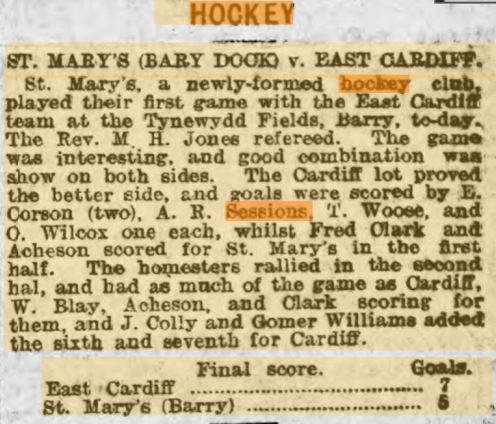
1903 newspaper article names Sessions as a goal scorer
1908 – East Cardiff Hockey Club annual meeting, named T H Woosey and Norman Robertson who are in the photograph

As my research progressed some trends began to appear.  The identified players tended to live in the Pontcanna, Canton, Llandaff and Whitchurch areas of Cardiff.  Quite a number worked in banks.  It wasn’t surprising to find that many were not born in Cardiff but came here to work, or at least their parents did.  Many had West Country origins as did a large proportion of the Cardiff workforce at the turn of the nineteenth century.  Many of them left Cardiff in later life to pursue their careers elsewhere.

Perhaps the person whose story most surprised me is that of Norman Robertson, the man with the spectacles in the front row on the left. He ended up having a prominent role in Cardiff sport, not in hockey as such but in football. He played an integral part in the history of Cardiff City FC.  He was born in Roath, went to Albany Road school and later Howard Gardens and Cardiff High and then went on to become a solicitor.  He was the man who drew up the lease for Ninian Park, Cardiff City’s football ground named after Lord Ninian.

The notes on my research are below, and yes they are only notes.  Twelve of the players have been identified, some with more certainty than others.  Of the twelve identified I’m pleased to say I only found one that fell in WWI, Richard Arnold Mitchell. 

L P Matcalf

Lawrence Piper Metcalf b. 1877 in South Norwood, Surrey.  Married in 1903 in Bromley, Kent and seemingly moved to the Cardiff area shortly afterwards. In 1911 he was living at St Hilda’s, Mill Road, Peterston-super-Ely with wife and three children.  He worked as a Distiller’s commercial traveller and died in 1933 at a hotel in Hereford.  An international hockey player. Buried at Llandaff Cathedral.

H W Green

Possibly:  Howard Walter Green, b. 1882, Poole, Dorset.  Lived in Conway Road, Pontcanna in 1911 with his wife.  Worked as a bank cashier at Lloyds Bank, St Mary’s Street. Died 1933 in Whitchurch, Cardiff.

C D Etchells

Charles Dunbar Etchells, b.1883 in Tenby, son of a Wesleyan minister. In the 1901 census he was at 13 Claude Road as a visitor and worked as a bank clerk. By 1911 he had moved to Islington, London and was working as a bank cashier. He served as a Captain in the Welsh Regiment in WWI. In 1939 he was a bank manager in St Albans. He died 1974 in Tunbridge Wells, Kent.
O T Morgan

Possibility: Owen Thomas Morgan, born 6 Feb 1873 in Newport.  In 1901 he was living in Pontcanna Street and working as a hide and skin buyer. Married Florence Jane Lloyd in 1896.   Captain in 10th Battalion of the Welsh Regiment in WWI.  Died in 1940 in Radyr.  His son Owen Kenrick Morgan was killed in 1941 in WWII.

S R Harmer

Scotford Russell Harmer was born in Cirencester 1885. He started work in the Midland Bank in Cardiff Docks in 1899. In 1901 he was boarding in Neville Street and working as a bank clerk. He married Elsie Margaret Scott in Canton Parish Church in 1913 when living in Teilo Street, Pontcanna and served in the Royal Artillery in WWI. In 1939 he was working as a bank manager and living in Croydon. He went on to manage the Midland Bank central office in Threadneedle Street, London.  Scotford Russell Harmer died 1967 in Kennsington, London.

I S Owen

Unknown

J J Thomas

Unknown

A M Thomas

Unknown

E R Metcalf (Vice-captain)

Edward Robinson Metcalf, born 1872 in Croydon. 1901, married Ethel Mary Hodgson in Croydon.  Played cricket for Cardiff Rambles (1907). Director of Harding & Co, aerated and mineral waters. Had a licence for a wine and spirit merchants at 6 Wyndham Crescent (1910). Living in Caerau (1910). In 1911 he was landlord of the Butcher’s Arms in Crickhowell where he lived with his wife and four children.  Played cricket for Whitchurch, Cardiff (1913).  In the 1939 Register he lived in Herne Bay, and was described as a retired bank official, married to Ethel M Metcalf. Died in Herne Bay, Kent in 1952.

J L Hamblen

Possibly: Lionel James Hamblen born 1886 in Yeovil, who was living in Neville Street in 1911 and working as a shop assistant. Died 1947 in Loughborough.

N Robertson

Norman Robertson.  Born 18 Jan 1882 in Weston Super Mare, son of James Robertson, a master tailor.  Moved to Cardiff shortly afterwards and lived at 2 Glenroy Street.  Attended Albany Road School before going on to Howard Gardens school in 1894 and then Cardiff Higher Grade School (Cardiff High on Newport Road).  By 1901 the family had moved to Column Road and Norman was an solicitor’s articled clerk. In 1904 the newspaper reports that he obtained a first class  honours degree and Law Society prize, third in the country and the highest place among any Welsh candidates.  In 1910 he acted for ‘a local association football club’ in taking up a lease on a land in Sloper Road to become a football ground.  The club became Cardiff City and the ground Ninian Park.  In the 1911 census he was a qualified solicitor. His offices were at 9 Park Place.

A B Sessions (Hon Sec)

Arthur Bertram Sessions b.14 May 1884 in Cardiff, son of Arthur Session, a prominent Cardiff businessman and deputy-chairman of the Parks Committee and a Quaker. His mother was Eliza Cory, daughter of the prominent Cardiff ship owner John Cory.  Arthur Bertram Sessions married Ethel Jane Morgan in 1908 in Cardiff. By 1916 had moved to Newport and later he became a director of The British Dredging Company.  His brother Herford Sessions fell in WWI. In 1939 the Arthur Bertram Sessions and family lived in Plymouth Road, Penarth.

R A Mitchell

Richard Arnold Mitchell, b.1882 in Cardiff.  In 1901 the Mitchell family lived at Wyndham Crescent, Canton.  He worked as a bonded store warehouse keeper, the same as his father Charles Mitchell. In 1910 he was Captain of the Taff Rowing club.  In 1911, aged 29, he lived in Romilly Road West, Victoria Park, Cardiff still with his parents. He married Dora Mayman in Birkenhead in 1912. In WWI he served as a Private with the 15th Battalion, London Regiment. He was killed in action in France on 1 Sep 1918 aged 36. He is buried at the Rancourt  Military Cemetery in France.

R A Mitchell headstone at Rancourt Cemetery

T H Woosey

Thomas Holmes Woosey was born in Cardiff in 1881, son of John Woosey, superintendent of the Cardiff Health Department.  In 1901 he was an articled clerk and living with his family in Penhill Road, Canton. He passed his final exams with the Law Society in 1904.  In 1908 he became Vice-captain of East Cardiff Hockey Club.  He also rowed in the Cardiff Rowing Club. In 1911 he was a qualified solicitor and living on The Avenue, Whitchurch, Cardiff. In June 1912 he married Mabel Shearman at Llandaff Cathedral and lived in Heol Don, Whitchurch.  He worked in the solicitors department of Cardiff Corporation and in WWI was a Second-Lieutenant with the South Wales Borderers.  Later moved to London where he died in 1946.

P J Norman

Percy John Norman, b. 1884 in Shepton Mallet, Somerset. He was son of Rowland H Norman, a farmer, and in 1901 the family were living in Eldenfield, Worcester and Percy working as a bank clerk. In 1911 he was working as a bank clerk and living in Grove Place, Penarth. He later moved to Paignton, Devon and became a bank manager and married Constance Ella Tilley from Monmouth.

If you could help shed any more light on this picture then we and I’m sure Mari would love to hear from you.  Please leave a comment or drop us an email roathhistorywebsite@gmail.com

The mystery hockey photograph

Archibald Dickson – An Unsung Roath Hero

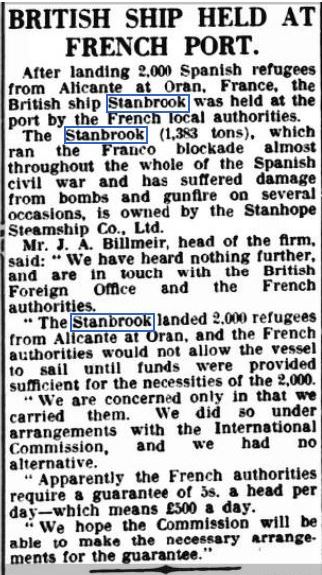
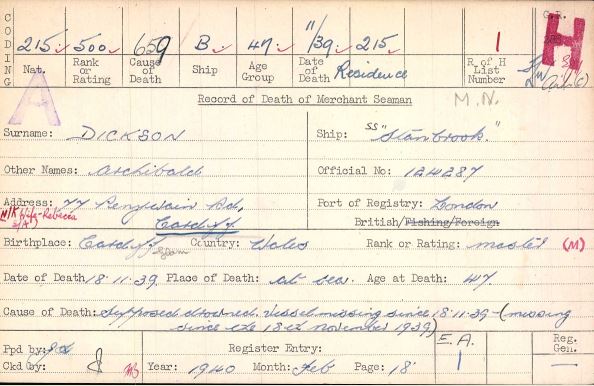
In March 1939, in scenes reminiscent of today’s Kabul, Archibald Dickson sailed the SS.Stanbrook into the blockaded Alicante harbour.  Rather than load up with the cargo he was there to collect he loaded 2600 refugees trapped there by Franco’s approaching army and took them to Oran, Algeria.  Archibald Dickson and his family lived in Pen-y-Wain Road, Roath Park and was tragically killed later that year, aged 47, when the SS.Stanbrook was torpedoed at the start of WWII.

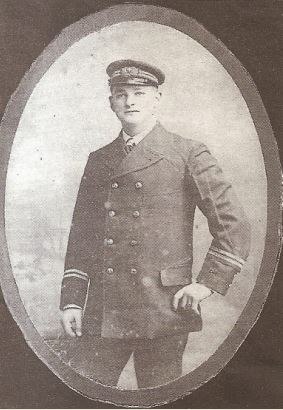
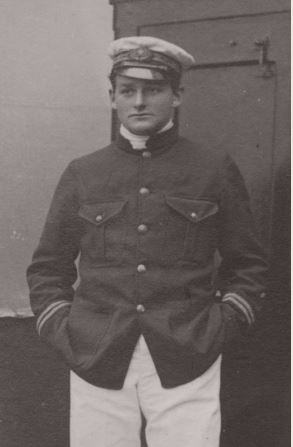
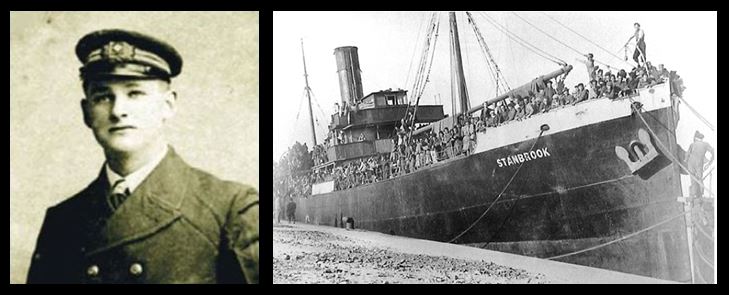
Archibald Dickson

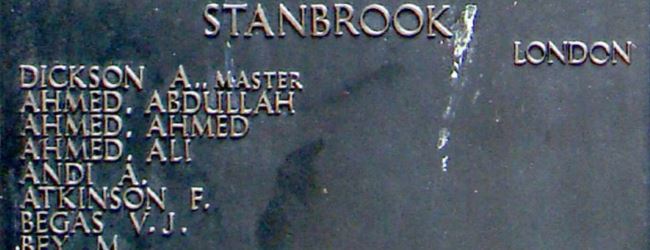
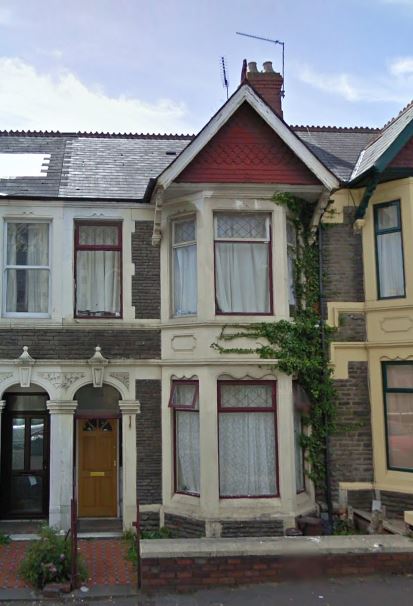
Archibald Dickson was born in Cardiff on 22 Jan 1892, one of thirteen children born to Robert Dickson, a stone mason, originally from Beer, Devon and Thirza Dickson née Hodges originally from Weston-super-Mare. He grew up in the Canton area.  He joined the Merchant Navy at the age of 15 and gained his First Mate certificate in 1913, aged 21.  He served as a temporary Lieutenant in the Navy in WWI before being discharged in 1919. In 1925 we pick him up sailing to New York on board the Majestic. His profession at the time is Ship’s Officer and his address 9 Princes Street, Roath. He married Rebecca Phillips and they had three children together, one of whom died in infancy. Archibald and Rebecca Dickson and his children lived at 77 Pen-y-Wain Road, opposite the church. He was tragically killed on 18 Nov 1939, aged 47, when the SS.Stanbrook was torpedoed in the North Sea.  Archibald Dickson and 19 crew members were lost.  He is remembered on the Tower Hill Memorial for Merchant Seamen in London. Commonwealth War Graves Commission record. We have also remembered him on the Roath Virtual War Memorial.

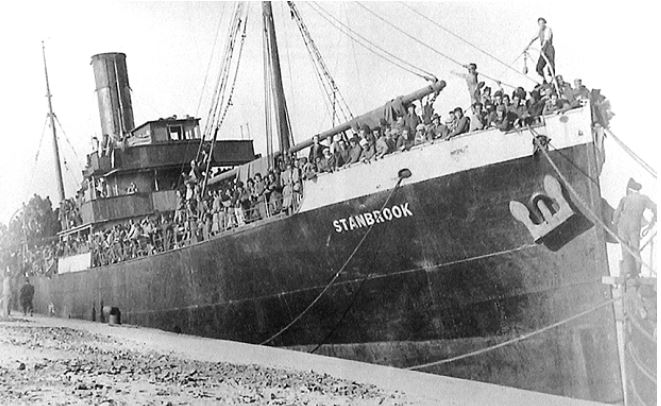
The Stanbrook loaded with refugees

My attention was initially drawn to the story of Archibald Dickson when reading the following piece by Ray Palmer who has kindly allowed me to reproduce it here:

Cardiff has many heroes, though some are better known than others.

For instance, have you heard of Archibald Dickson from Pen-y-Wain Road in Roath?  Chances are if you live in Alicante in Spain you’re more likely to know the name than if you live in Roath.

His command was an old tramp steamer called The Stanbrook, which had seen better days. In March 1939 he sailed out of Cardiff to Alicante to pick up a cargo of fruit. But this was the time of the Spanish Civil War, and General Franco’s fascist army was on the brink of victory. His Italian ally Mussolini was blockading the port, making it virtually impossible for vessels to get through. But Dickson was a hardened sailor used to coping with difficulties in his 33-year service, and – anxious to fulfil his contract – he decided to run the blockade anyway, and was able to dock in Alicante.

But what he found there were nearly 30,000 refugees fleeing from Franco’s forces, expecting the town to be bombed, and hoping to catch a ship to safety. Dickson crammed almost 3000 of them onto his ship, and sailed out of the port. Just ten minutes later the expected bombardment of Alicante began in earnest. Dickson made a 20-hour run across the Mediterranean to French-controlled Oran.

But in Oran the authorities kept 1000 men on the ship for weeks, only permitting them to disembark when the ship became a health hazard. Most of the refugees were sent to internment camps and spent years in exile. But those left behind in Alicante suffered far worse at the hands of Franco’s vengeful Nationalists, and thousands were marched off to concentration camps on the outskirts of Alicante.

There was no happy ending for Dickson or his crew either. Just a few months later, World War II broke out. In the early hours of 19 November 1939, The Stanbrook was sailing back to England from Antwerp when a German torpedo hit her port side. She broke in two and sank quickly. Dickson and the 20 crew members died.

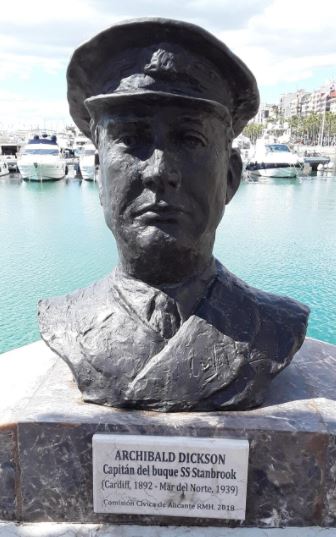
The sailor from Pen-y-Wain Road is still regarded as a hero in Spain today, and in April 2018 a bust of Captain Dickson was unveiled in the port. I believe there is also a commemorative plaque in Cardiff Bay.

Archibald Dickson of Cardiff

Archibald Dickson

Another interesting report of the Stanbrook at Alicante was written by Jack Troughton in the Costa Levante News:

SHIP’S Captain Archibald Dickson, his crew and the SS Stanbrook sailed into history when they snatched a cargo of desperate men, women and children from the stricken city of Alicante in the last days of the Spanish Civil War.

The 230ft-long ship left harbour with 2,643 refugees crammed on board; some of the 30,000 desperate supporters of the doomed Republic hoping to flee the country and escape the advancing forces of Nationalist leader General Franco and his fascist allies from Germany and Italy.

In April, a bronze bust of the Cardiff-born seaman was unveiled alongside the existing plaque on the docks, remembering the bravery of the skipper, his 24-strong crew and the ship in March 1939 – the war officially ended on April 1.

And yet the story of the Stanbrook remains largely unknown or forgotten in the United Kingdom; possibly, because the British government with Neville Chamberlain at the helm as prime minister was intent on a policy of appeasement with Nazi Germany at the time.

In Alicante and across Spain the name of Capt. Dickson, his ship, and tale of the maritime great escape are revered. 

The Stanbrook sailed into Alicante on March 19, 1939, after a two day voyage from Marseille; using the cover of darkness to evade a naval blockade of the city.  The ship remained tied up as the captain waited for instructions and was informed by the ship’s owners to proceed to sea “forthwith” unless he was likely to load a cargo.

SS Stanbrook loaded with refugees

A day later a lucrative cargo of tobacco, oranges and saffron arrived at the port – but so did a host of people looking to escape the fascist forces; many were soldiers and militiamen of the Republican army, along with trade unionists, international brigade members and foreign advisors.

Ignoring orders, Capt. Dickson crammed people onto the Stanbrook and, again at night, set sail for Algeria, bombs being dropped in an air raid as she headed out to sea.

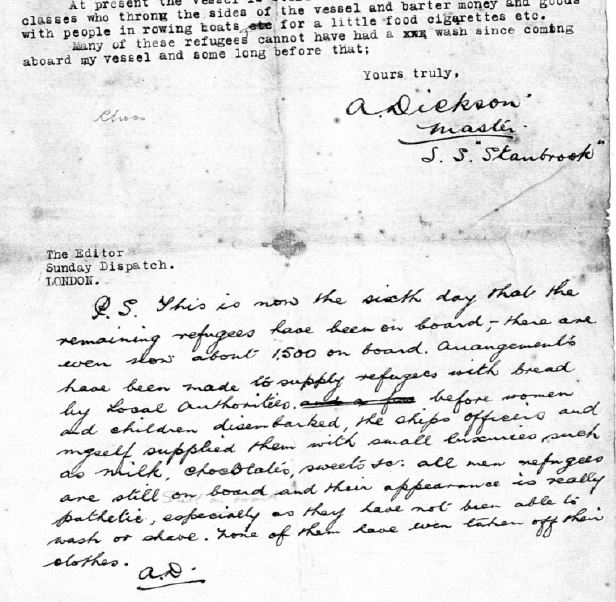
Sadly, six months later in November 1939 and the start of the Second World War, the Stanbrook was lost, torpedoed by a German submarine as she headed to Tyneside from Antwerp.  The 47-year-old captain and 22 officers and men perished after the ship broke in two.  However, Capt. Dickson was able to tell the story before his death in an interview with the Sunday Dispatch newspaper in London; he said, “Amongst the refugees were a large number of women and young girls and children of all ages, even including some in arms.

End of Archie Dickson letter to the Sunday Dispatch

“Owing to the large number of refugees, I was in a quandary as to my own position, as my instructions were not to take on refugees unless they were in real need.”

“However, from seeing the condition of the refugees, I decided from a humanitarian point of view to take them aboard as I anticipated they would soon be landed at Oran in Algeria.”

He said the crowds at the port were made up of people of all classes; some very poor and “looking half-starved an ill clad, attired in a variety of clothing  ranging from boiler suits to old and ragged pieces of uniform”.

The captain noted how some people seemed to be carrying their worldly possessions in suitcases, bags or “tied up in handkerchiefs”.

The Stanbrook’s gangplank soon became choked with people and the captain contemplated leaving the quay – but remained tied up because he was fearful people would be thrown into the water and drowned.

Numbers on board made it impossible for anyone to move, people refused to go down below deck into the hold and if any space was made, it was immediately filled with people.

“In all my experience at sea covering some 33 years, I have never seen anything like it and I hope I never will again,” said Capt. Dickson.

With rumours being spread of an impending air raid — two bombs later fell in the ship’s wake as she left – there was a last-minute rush to get on board before the Stanbrook was able to leave; steering a zigzag course to try and avoid warships mounting the blockade. Capt. Dickson said: “We had only just got clear of the port when the air raid rumour proved to be true and within 10 minutes or so of leaving port, a most terrific bombardment of the town and port was made and the flash of explosions could be seen quite clearly from on board my vessel  and the shock of exploding shells could almost be felt.

“The refugees appeared to think that every vessel which moved in sight was a Franco vessel coming to intercept them; and as a large number of refugees were armed, I was rather alarmed at what might have occurred had we sighted a Franco ship.

“Many of the refugees stated that if a Franco vessel did intercept them, they were prepared to sell their lives dearly.”

It was a 22-hour journey to North Africa and conditions were atrocious; there were just two toilets on board and a shortage of both food and water.

When the Stanbrook steamed into Oran, the French colonial authorities first refused to allow her to dock – an angry Capt. Dickson first negotiating the landing of women, children and the elderly; men remained on board for days and were only allowed onto dry land when the seaman underlined the threat of a typhus outbreak.

1939 April

Captain Dickson’s son Arnold and his daughter Dorothy visited Alicante in 2009 as guests of the Alicante Civic Commission for the Recovery of Historical Memory to attend a ceremony to remember the story of the Stanbrook.

Arnold said they were “lionised”; he said: “I felt very humbled. There must have been 3,000 people there – they wanted to thank my father but he wasn’t there; we were the only way they could express their gratitude.  I met two sisters who told me ‘we wouldn’t be here if it wasn’t for your father’.”

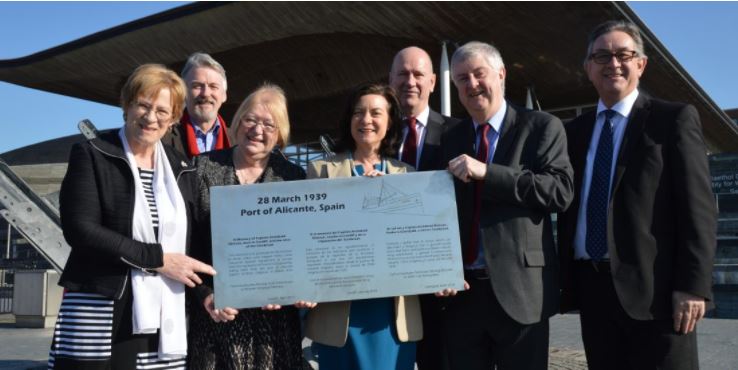
And in 2015, Labour International Costa Blanca Branch arranged for a delegation from the Alicante civic commission to visit Capt. Dickson’s home city of Cardiff where they presented a stainless steel plaque to the then Lord Mayor Margaret Jones, depicting an image of the Stanbrook in Alicante harbour and bearing an inscription in English, Welsh and Spanish.

Also present were Capt. Dickson’s two children, two great-grand-children of the ship’s engineer Henry Lillystone, and members of the Welsh section of the International brigades Memorial Trust.

Archibald Dickson of Roath, Cardiff
Archibald Dickson

Stanbrook History

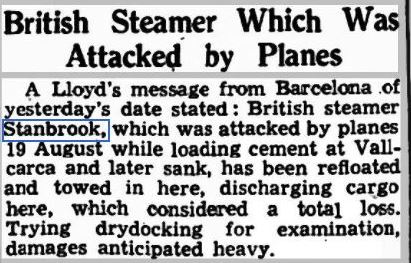
The 1383 ton cargo steamer Stanbrook was built on the Tyne in 1909. It was originally called Lancer but in 1937 renamed Stanbrook, but the same year also carried the name Polyfloisvos for a short time when used by the Republicans during the Spanish Civil War.  The Stanbrook was a blockade-runner in the Spanish Civil War regularly breaking through Franco’s blockades to deliver food and essential materials.  In August 1938 it was hit by bombs dropped by Italian warplanes and sunk at Vallcarca, 25 miles southwest of Barcelona.  She was later refloated and repaired before once again suffering serious damage after being bombed in Feb 1939.  It is not known if Archibald Dickson was Captain on these occasions.  In March 1939 it was involved in the rescue of refugees from Valencia (described above).

1938 Aug

The sinking of the Stanbrook in WWII is described on uboat.net and wrecksite .   At 02.13 hours on 19 November 1939 the unescorted Stanbrook (Master Archibald Dickson) was hit on the port side in the stern by one G7a torpedo from u-boat U-57, broke in two and sank quickly west-northwest of the North Hinder Lightship. The master and 19 crew members were lost. The torpedo had been a tube runner and hit despite of being launched manually due to the short distance to the target.

Archibald Dickson remembered at Tower Hill memorial

The Memorial Plaque

A memorial plaque dedicated to Archibald Dickson and the Stanbrook was gifted to Cardiff by the people of Alicante.  The Cardiff plaque was at one time unveiled at the Mansion House in 2015 but then there were reports that it would be mounted in a more central location.  The idea now is to have it on display in the Pierhead building but plans have this far been delayed by Covid.

Mark Drakeford with the plaque in 2019
First Minister Mark Drakeford with the plaque in 2019


Additional References

The story of the Archibald Dickson and the Stanbrook have been told on many occasions.  Here are just a few more.  Some are in Spanish but browsers are clever these days and often ask you if you want an English translation. 

View from La Vila – Blogs from the balcony

As a tribute to Archibald Dickson and the sailors of the Stanbrook and all the ships that assisted in the evacuations.

International Brigade Memorial Trust

A Few Extra Pictures

Archiald Dickson and SS Stanbrook

77 Pen-y-wain Road
77 Pen-y-wain Road, Roath Park, former home of Archibald Dickson and family.
Archibald Dickson of Merchant Navy card

Ted Richards

Chair, Roath Local History Society


————————————

Arthur Cole from Pencoed has penned this poem about Archibald Dickson and kindly allowed us to reproduce it here:-

‘Captain Archibald Dickson’

One of thirteen children, such a humble upbringing,

at aged fifteen, the Merchant Navy came calling.

Sea became Archie’s master, many Oceans sailed,

Archie became a Captain, rank deservedly attained.

It was at Alicante, where Archie made his name,

a port of desperation, Archie a hero proclaimed.

Franco’s fascists aim, was to overrun the port,

to escape internment, the quay a last resort.

With chaos ensuing, Archie had to make a choice,

forego his cargo or see innocent lives destroyed.

Observing fearful families, with everything to lose,

a lifesaving decision, Archie ultimately chose.

The S.S. Stanbrook, Archie’s trusty tramp steamer,

would become a safe haven, a high seas redeemer.

Possessing great resolve, many lives Archie saved,

a timely intervention, Franco would have enslaved.

After ten minutes at sea, Alicante was bombarded,

horrific scenes, a town overrun, humanity discarded.

Archie’s passengers survived, such hell they endured,

their courage undeniable, with safe passage secured.

A Spanish Oscar Schindler, is how Archie’s described,

such a brave humanitarian, this cannot be denied.

Archie’s Alicante exploits are forever revered,

a true Welsh hero, who’s now infinitely endeared.

Arthur Cole..2021..All Copyright Reserved

William Curtis Brangwyn, architect and father of artist Sir Frank Brangwyn

I was looking for something on the Friends of Cathays Cemetery website the other day when my eye was caught by the fact the William Curtis Brangwyn is buried in Plot R2486.  True, I’d never heard of him, but the name of his son, Frank Brangwyn, rang a bell. The Brangwyn Hall in Swansea is named after him, somewhere I walked past on a daily basis many years ago to and fro from college and even went into a few times; to see Sutherland Brothers and Quiver, Chris Bonington deliver and excellent lecture, and to receive a degree certificate wearing a funny hat.  Anyway, I digress, a common ploy for someone trying to write something that know nothing about – not my fault – I was told to do it as an exam technique.

I paid a visit Plot R2486 at Cathays Cemetery.  The headstone was covered in ivy and in the shadow of an holly tree.  Gently removing some of the ivy revealed an unusual headstone design on which William’s middle name Curtis is split between two lines without even a hyphen.  That’s architects for you!  My interest was now piqued and I was asking myself why has this grave been seemingly forgotten.  I began to research him and another interesting life story slowly revealed itself.  

The Genealogy Bit

Many articles written about Frank Brangwyn state his parents were Welsh.  Well, his mother Eleanor was for certain but try as I might I haven’t found any Welsh connections with William Curtis Brangwyn – other than he is buried in our beautiful city and his surname sounds like it should be of Welsh origin.  True, his family history isn’t straightforward, particularly as the spelling of Brangwyn has changed over time from Brangwin to Brangwyn.  If there are any family historians out there keen to take a look then I’d be glad of a helping hand.

Census returns consistently give William Curtis Brangwyn’s  birthplace as Crendon, Buckinghamshire.  It seems he was born on 10 Aug 1837 to William Brangwin, a cattle dealer and Mary Curtis and baptised on 21 Nov 1837 in Long Crendon.  In 1851 he was a scholar living with his uncle Thomas Brangwin in Long Crendon.  In 1861, he is 23 and living in Scarborough, Yorkshire working as a trainee architect and by now his surname has morphed to Brangwyn. The same year he publishes a booklet entitled ‘Gothic Memorials: Being Sundry Sketches for Headstones, Monuments and Crosses’ (available for free download on Google Play).

It appears his career was about to take off – he became an ecclesiastical architect and designing not only the churches themselves but everything inside them, especially the tapestries.  Perhaps we shouldn’t be surprised by this, after all he came from Long Crendon, which used to be the centre for the England steel needle-making industry in the mid 16th-century.

Eleanor Brangwyn nee Griffiths

His wife Eleanor was born in Llanstephan, Radnorshire and grew up in the village of Glasbury, daughter of James Griffiths, a house servant and Ann Griffiths.  In 1861 at the age of 19 she was working as a housemaid for Rev Walter Powell Jones, the rector Llyswen.

Eleanor married William Curtis Brangwyn on 24 Jun 1865 at the Sardinian Roman Catholic chapel in St Giles, London.  It puzzled me for a while how Eleanor, a country girl from deepest Radnorshire, ended up marrying William Curtis Brangwyn in London.  I have a theory about that.  I discovered that her employer Rev Walter Powell Jones had moved from LLyswen to London and in the 1871 census we find him working as a clergyman in Marylebone.  I think therefore that Eleanor probably went with the family to be their housemaid in London.  Perhaps, one day, a budding young ecclesiastical architect William Brangwyn knocked on the door hoping to entice Rev Walter Powell Jones into buying some of his latest tapestry designs.  Eleanor answers the door. “Hello Mr Brangwyn, unfortunately Rev Jones is busy at the moment but perhaps you’d like to come in for a glass of communion wine?” “That would be nice” says young Mr Brangwyn “Perhaps you’d like to see my etchings?”.  And the rest as they say is history. 

Their first child, Edith, was born in Jun 1864, prior to them getting married.  After their marriage they moved to Bruges, Belgium so that William can further his career as an ecclesiastical architect.  Eleanor has three more children whilst they are in Bruges including Frank Brangwyn in 1867 who was actually baptised Guilliaume Francois Brangwyn.

Life in Bruges

William’s time in Bruges appears to have been pretty successful.  He won a prize in 1865 for the best designed parish church awarded by the Belgium Guild of St Thomas and St Luke. Whilst in Bruges he was appointed to help carry out the decoration of the Holy Blood Chapel (Bruges) in neo-Gothic style.  He also decorated the now disappeared chapel of the Saint Juliaangesticht (1870) in the Boeveriestraat.  In 1868 he also designed the neo-gothic extension of the Saint Vedastus church in Zerkegem.

Saint Vedastus church in Zerkegem

 A religious banner designed by William Brangwyn was exhibited in Paris at the Universal Exhibition of 1867, where it received the prize offered for embroidery by the Roman Catholic Congress of Malines.  The embroidery is now at the Victoria and Albert museum in London – though not necessarily on display.

The work of William Curtis Brangwyn at the V&A Museum

He was certainly up there with the top embroiderers.  The book ‘English Church Embroidery 1833 to 1953 – The Watts Book of Embroidery’ describes his work alongside other renowned artists of the time such as Pugin and Bodley.  

When you are working in the field of ecclesiastical embroidery I guess the top endorsement you can get is from an Archbishop and this is what William got in 1868.  The newspaper carried an advertisement quoting a letter from Henry Manning, Archbishop of Westminster. ‘I have much pleasure in testifying to the beauty and excellence of your Ecclesiastical Embroidery of which this Diocese processes several rich specimens.  I feel it only needs to be seen to be appreciated. ……’

Return to England

The family returned to London in the 1870s with offices at 6 John Street, Adelphi.  It is written that after returning to England, Brangwyn went to work in the studio of architect Sir Horace Jones (the man credited with designing Tower Bridge).

Whilst in Bruges it seems William Brangwyn had an emphasis on embroidery but may be that fell away when he returned to England. In 1872 William Curtis Brangwyn of Baker Street, ecclesiastical embroiderer, went into liquidation.  Having said that, as late as 1892 he designed the alter hangings used at the Royal Wedding of Princess Marie of Edinburgh and Prince Ferdinand of Romania.    

Although it is possible to find building designs by William Brangwyn, finding actual completed structures is more difficult.  He did design a school and church in Langsett, South Yorkshire but I’m afraid you are out of luck if you wanted to visit nice though the village looks.  It was demolished in 1988.

Langsett School, Yorkshire

There are pictures of his competition entries for building designs including the Middle Class Schools for the Grocer’s Company in Hackney (1874) and the Board of Works Offices In Greenwich (1875). The Cardiff Times of 1874 describes a competition submission for a school design by W C Brangwyn and L A Withall (London) which included twin turrets.  It is not known if they won the tender.

Relocating to Wales

William moved to Cardiff where he became a draughtsman employed by the renowned architect Col. Bruce Vaughan.  There seems to be little documented information on William Brangwyn’s time in Cardiff.  He isn’t accredited with any of Bruce Vaughan’s pieces directly but may well have leant a hand on one of his best pieces, St James the Great church on Newport Road.  It has been written that  ‘The appealing artistry here, for example in the depiction of two angels swinging censors over the porch entrance, would have owed something to his collaboration in these years with the Welsh designer William Brangwyn’.   The church is currently being converted into flats but the angels above the door can still be seen from the road.

The angels above the doorway on St James the Great church, Newport Road, Cardiff

In  the 1901 census we find William Brangwyn, architect, aged 61, living as a boarder at 121 Crwys Road.  He died at 36 Salisbury Road on 19 Nov 1907 of intestinal obstruction and cardiac failure.  The informant was Catherine Williams, present at death. The age on his death certificate is given as 72 though he was probably more accurately 70.   The newspaper was advertising rooms for rent at 36 Salisbury Road earlier that year.  I am wondering if William Brangwyn was boarding in the house, Catherine Williams was the landlady and whether he was somehow estranged from his family.  His death was only reported in the newspaper in Feb 1908 where he was described as an authority in Gothic architecture.  Eleanor was still alive in 1901 but I haven’t found her anywhere on a census. She was living with her son Frank in the 1911 census and she passed away in 1918 in Hertfordshire.

The man behind the ecclesiastical architecture

An interesting insight into the life of William Curtis Brangwyn comes from the book Frank Brangwyn and his works – by Walter Shaw-Sparrow.  It was written in 1911, not long after the death of William Curtis Brangwyn and reads as it had good access to family information.  In fact it refers to William Curtis Branwyn being known as Curtis Brangwyn and newspapers after this date also called him Curtis Brangwyn.  It describes his life as one of ups and downs and of a man who preferred undertaking art in various forms rather than the business of trying to sell it.  Here are some extracts:

…. But (Frank) Brangwyn is not drawn to Wales by any strong feeling of affection, although his art owes so much to his mother’s race and country, and although his father, Mr. Curtis Brangwyn, spoke always of Wales with great enthusiasm, and himself claimed some descent from that country.

Mr. Curtis Brangwyn was a very remarkable man, and his name has been coupled with that of Pugin, for he greatly loved Gothic and helped to reawaken the public taste for mediaeval arts and crafts. His temperament was Anglo-Welsh ; and when he chose architecture as his profession, he did not know that building methods had lost their old-time freedom, and that they needed long office hours and stern business habits. Painting would have suited him much better; and although he gained the confidence and admiration of distinguished architects like G. E. Street and Sir Horace Jones, Mr. Curtis Brangwyn was thwarted all his life by his inability to be at the same moment an artist and a man of business. Many writers on architecture have deplored the effects of a mercantile routine on men of imagination. Fergusson went so far as to say that modern architects in practice “could never afford to give many hours to the artistic elaboration of their designs,” and that they generally succeeded ‘more from their business-like habits than their artistic powers.” Fergusson was right, and the career of Mr. Curtis Brangwyn was a case in point.

The racehorse could not be broken to the plough; that is to say, the artist could not adapt himself to relentless methods of routine in a city office, so he worked in the employ of other men rather than bear the many responsibilities that Fergusson hated and condemned.

Mr. Curtis Brangwyn married early, and his education in architecture having brought him in touch with the energetic school of thought known as the Gothic Revival, he kept his home for some time by doing for church uses such work as many could afford to buy. Then, believing that life on the Continent would be less expensive than it was in London, he decided to make his home in Belgium, at Bruges; here he set up his quarters at No. 24 in the Rue du Vieux Bourg, and then opened workrooms for the reproduction of old embroideries for altar-cloths and vestments. At Bruges his son Frank was born, May the 12th, 1867. Mrs. Brangwyn was then twenty-three, and her husband twenty-seven. Frank Brangwyn was their third child. He had two sisters for playmates, and Bruges -she has been called the Dead City – was a quiet nursery.

One thinks of Bruges as a fitting birthplace for a Fernand Khnopff or a Maeterlinck; but Brangwyn and Bruges?

And I find, too, that Brangwyn has very little to tell about his birthplace, though he remained there for eight years. Some recollections are clear-cut, but they have nothing to do with boyish mischief in the town. They are all connected with art. He remembers many a visit to his father’s workrooms, where exquisite needlework lay on tables, shimmering with bright colours ; and one day in his father’s garden he found by chance a bundle of photographic negatives, half broken, and looking up from them he saw, against a background of houses and blue sky, a tree covered with red blossoms, such as the Japanese love in their lightly touched prints.  Colour was to him what music was to the boy Mozart. He has related that the home garden in old Bruges was an enchanted place to him, where great beasts lurked in the shadows, where trees were giants and ogres, and flowers little lords and ladies.

More important still, I think, is another recollection. There was a portfolio of prints at home, and the boy was allowed to play with it. A good many artists were represented, but only one really delighted him ; it was Charles Degroux, a painter of the Belgian poor, who died in 1870. ………..

 Yet Brangwyn at the age of eight not only enjoyed Degroux, but struggled to copy from engravings after Degroux’s pictures. The boy was father to the man. His present work (to a great extent) was foretold by his native tastes in childhood. ………

At the beginning of 1875 Mr. Curtis Brangwyn left Bruges for England. “I remember dimly our embarkation, though it might have resulted in the days of my youth being ended once for all, for – at least, so I am told I was discovered crawling along one of the sponsons of the steamer. From this highly perilous position I was rescued in the nick of time, and – here recollection becomes more vivid – soundly spanked and put to bed. In England I went first of all to a dame’s school, and then to a big middle-class school, the name of which has totally escaped me. For reasons into which I need not enter, but which have nothing to do with myself, my schooldays came to an abrupt end, and I made myself useful in my father’s office.”

When Mr. Curtis Brangwyn arrived in London he took an office at No. 6 John Street, Adelphi, and sent two architectural designs to the Royal Academy, “ Hastings Town Hall,” and “Schools of the Grocers’ Company, Hackney.” Next year, 1876, he exhibited again, ‘‘ Design for Offices of the Board of Works at Greenwich,” and also, in 1879, “ Yarmouth Town Hall,” and a fine sketch in water-colour of a pulpit at Canford Church. The R.A. catalogues give me no other information, but Mr. Curtis Brangwyn is permanently represented at the Victoria and Albert Museum by a beautiful piece of embroidery – a banner carried out from his designs in his own establishment. After a life of hard work, chequered with ups and downs, he died in December 1907.

Offspring

William Curtis and Eleanor Brangwyn had six children.  Edith (b.1864) born in England, Eleanor (b.1866), Frank (b.1867) and Philip (b.1870) born in Bruges and then Cuthbert (b. 1876) and Lawrence (b. 1879) born back in England. 

Frank Brangwyn was an artistic jack-of-all-trades and difficult to categorise. As well as paintings and drawings, he produced designs for stained glass, furniture, ceramics, table glassware, buildings and interiors, was a lithographer and woodcutter and was a book illustrator.  The life of Sir Frank Brangwyn has been well recorded.  There is a synopsis on Dictionary of Welsh Biography and a nice piece by Phil Carradice.   If you prefer to view a biography on him rather than read something then I would recommend this Goldmark video.  He was initially taught by his father, then spotted by Mackmurdo and also no doubt benefited from his short time working for William Morris. The history of the British Empire Panels at Brangwyn Hall is nicely covered by Andrew Green.

One of the British Empire Panels at Brangwyn Hall, Swansea

Frank Brangwyn is reputed to have produced over 10,000 works of art. You would have thought among  those there would have been some of his Mum and Dad, but unfortunately I haven’t come across any as yet.  

Two of the other sons also benefited from being taught by their father William Curtis Brangwyn.  Cuthbert Patrick Joseph Brangwyn (1875-1911) went to America and became an designer and interior decorator for McCreery & Company’s Pittsburgh branch.  Philip Brangwyn also became an interior decorator in Canada but I haven’t been able to find any further information about him or for that matter the other siblings.

The work of Cuthbert Brangwyn

As part of my research into this article I did an internet search on “Brangwyn” and “Architecture” and came across Caitlin Brangwyn who is studied architecture at Liverpool School of Architecture, following in the family footsteps and uses embroidery in her work.  Here’s wishing Caitlin all the best in her future career.

So next time you are taking a walk around the peaceful Cathays Cemetery, take a careful look under the ivy.  You’d be surprised what story you may unearth.

The grave of William Curtis Brangwyn at Cathays Cemetery, Cardiff

Postscript

Sketch of lectern in oak by W.C.Brangwyn. This sketch was found in the archives of W.Clarke of Llandaff, a building, sculpting and church furnishings company. Whether the lectern ever got carved and placed in a church is not known. (photo credit: Cardiff Libraries and Michael Stratham)